

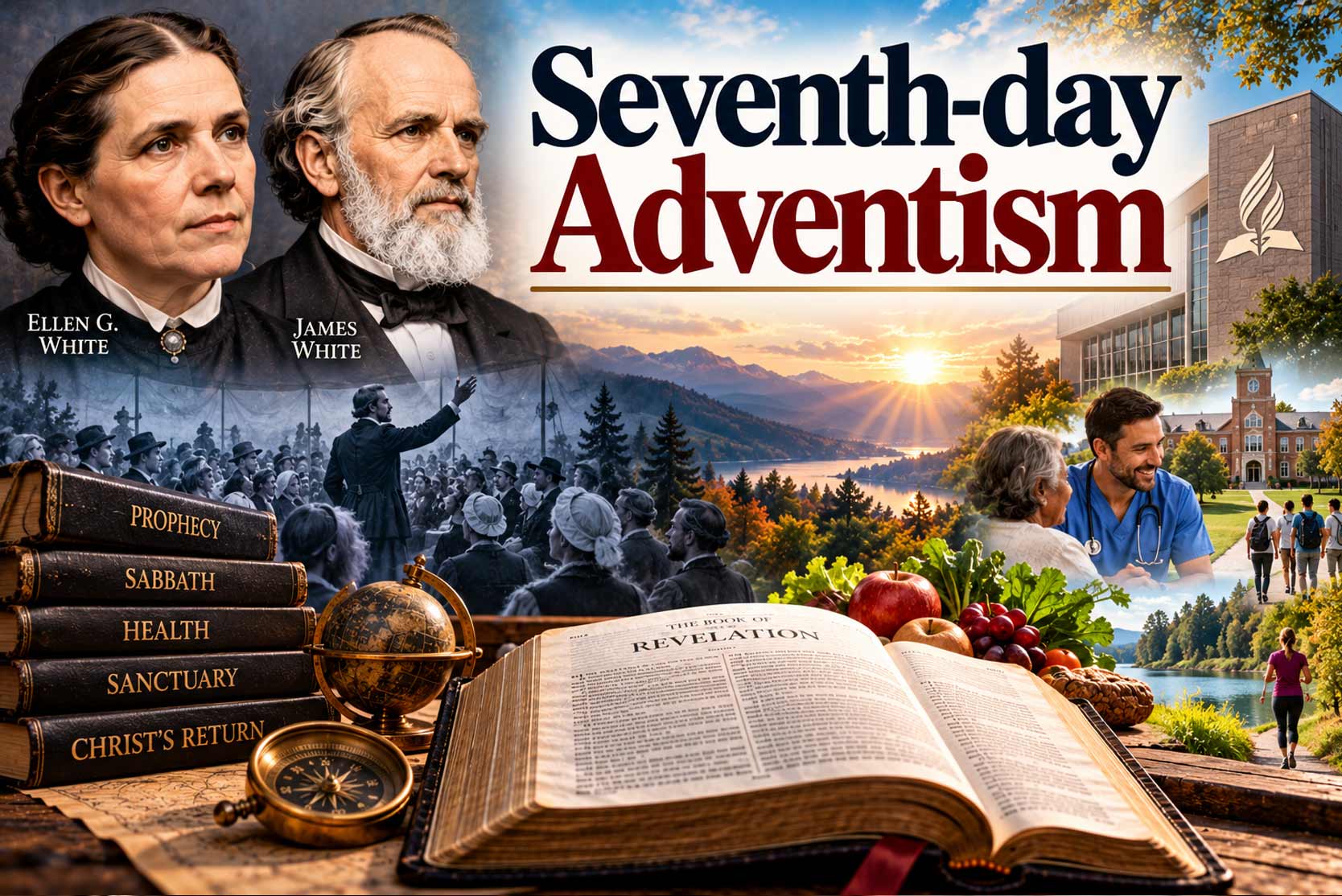
If you know only one thing about Seventh-day Adventists, it’s probably that they go to church on Saturday. If you know two things, the second may be that they don’t eat much bacon. Both are true enough, but neither gets very close to explaining Seventh-day Adventism.
The Seventh-day Adventist Church emerged from the wreckage of the Millerite movement after the Great Disappointment of 1844. As we saw in our article on Adventism, William Miller had become convinced that biblical prophecy pointed to the return of Christ around 1843 or 1844. Eventually October 22, 1844, became the expected date, but it came and went with no Return.
Most failed prophetic movements don’t have much of a future after something like that. Millerism did, largely because some of Miller’s followers concluded that the date had been right but they had misunderstood what was supposed to happen. From that reinterpretation, combined with seventh-day Sabbath observance and the influence of Ellen G. White, came one of the world’s largest and most unusual Protestant denominations.
The Seventh-day Adventist Church was formally organized in 1863.
Ellen G. White
You really can’t understand Seventh-day Adventism without understanding Ellen White. Ellen Harmon was a teenager when she and her family became involved with the Millerite movement. Following the Great Disappointment, she began reporting visions that she believed came from God. She later married James White, another important early Adventist leader, and over the course of her life she became the most influential figure in the development of Seventh-day Adventist theology and practice.
Adventists don’t officially place Ellen White’s writings above the Bible. Their fundamental beliefs describe Scripture as the supreme and authoritative revelation of God’s will, and Adventist sources themselves emphasize that White regarded the Bible as the final authority.
At the same time, the church officially recognizes a continuing gift of prophecy and identifies White’s ministry with that gift. That creates one of the obvious questions outsiders have about Adventism.
If the Bible is the final authority, exactly how much authority does Ellen White have? Adventists have answered that question in different ways over the years, and individual Adventists certainly don’t all relate to White’s writings in exactly the same way. But historically, her influence on Adventist theology, lifestyle, education, health practices and understanding of prophecy is impossible to miss. White one of the reasons it became the movement it did.
Why Saturday?
The seventh-day Sabbath is probably the easiest Adventist belief to understand. Adventists look at the Ten Commandments and notice something fairly obvious: the fourth commandment says to remember the Sabbath day and identifies the seventh day as the Sabbath. Saturday is the seventh day.
So why are Christians worshiping on Sunday? Most Christians answer that the resurrection of Jesus on the first day of the week and the practice of the early church explain the development of Sunday worship. Adventists aren’t convinced that any of that amounts to biblical authorization for transferring the Sabbath from the seventh day to the first.
They therefore observe the Sabbath from Friday sunset to Saturday sunset as a period of worship, rest, fellowship and ministry. The church regards the Sabbath not merely as a Jewish ceremonial regulation but as something established at creation and incorporated into God’s moral law.
Whatever you think of that conclusion, the argument isn’t difficult to follow. The word Seventh-day in the denomination’s name means exactly what it says. And Adventist points to the other great emphasis of the movement: the Second Advent, or return, of Jesus Christ.
What Happened in 1844?
This is where things become considerably more complicated. After Christ failed to return in 1844, some Millerites concluded that Miller had correctly identified the end of the prophetic 2,300-day period in Daniel 8:14 but had misunderstood the event. Instead of Christ coming from heaven to earth, they came to believe that Christ had entered a new phase of His ministry in the heavenly sanctuary.
This eventually developed into the Seventh-day Adventist doctrine of the investigative judgment. According to the church’s current fundamental beliefs, Christ entered the second and final phase of His heavenly ministry in 1844. This involves a work of judgment preceding the Second Coming, revealing who among the dead and living belongs to Christ. When this heavenly ministry is completed, human probation ends and the Second Advent follows.
If you’ve never heard that doctrine before, you’re not alone. Most Christians haven’t. And this is probably the most controversial distinctively Adventist doctrine.
Other Protestants generally agree that Christ is our heavenly High Priest and that there will be a final judgment. The controversy is over the claim that Daniel’s 2,300 evenings and mornings lead to 1844 and that Christ then entered a distinct final phase of His heavenly ministry. Critics see the doctrine as a theological explanation developed to rescue a failed prophecy. Adventists see it as a biblical doctrine that became clearer when believers went back to Scripture after misunderstanding what Miller’s chronology actually predicted.
Those are two very different ways of telling the same story.
Salvation
This is also where it’s important not to freeze Seventh-day Adventism in the nineteenth century or describe every Adventist according to its harshest critics. The church today explicitly teaches salvation through Jesus Christ and describes Christ’s life, death and resurrection as central to salvation. Its official beliefs affirm the Trinity, the full deity of Christ, His incarnation, His atoning death, bodily resurrection and return. Those are historic Christian doctrines.
Adventists also place a strong emphasis on obedience to God’s commandments, particularly the Sabbath commandment. That’s where some evangelical Christians become uncomfortable. If Sabbath keeping becomes a test of whether someone belongs to God’s faithful remnant, critics argue that the movement comes dangerously close to adding obedience to the law to the gospel.
Adventists respond that obedience is the result of salvation rather than the means by which salvation is earned. That’s an important distinction. It also explains why blanket descriptions of Adventists as people who believe they’re saved by keeping Saturday aren’t particularly helpful. That isn’t how the denomination officially describes salvation.
The more interesting question is how grace, obedience, the Sabbath, the remnant church and the investigative judgment fit together in actual Adventist theology.
The Remnant Church
Adventists have historically understood themselves through the imagery of Revelation, especially the people who “keep the commandments of God and the faith of Jesus.” Their official beliefs speak of a universal church composed of all who truly believe in Christ, while also describing a “remnant” in the last days called to proclaim a particular end-time message.
That means the official Adventist theology doesn’t simply say that everyone outside the Seventh-day Adventist Church is lost. At the same time, Adventism sees its own message (particularly the Sabbath, judgment and end-time proclamation) as having a special role in preparing the world for Christ’s return.
Once again, you can hear the Millerite heritage. The date passed, but the end-time message didn’t.
What Happens When You Die?
Adventists don’t believe that an immortal soul leaves the body at death and immediately begins conscious existence in heaven or hell. Instead, they teach what is commonly called conditional immortality. Human beings aren’t inherently immortal. The dead remain unconscious until the resurrection. This is often called “soul sleep,” although Adventists may prefer other terminology.
At Christ’s return, the righteous dead are raised and the living righteous are transformed. Adventists also reject the doctrine of eternal conscious torment. The wicked are ultimately destroyed rather than kept alive forever in hell for the purpose of experiencing endless punishment.
That places Adventists outside the traditional majority position of Christianity on the intermediate state and hell, but they argue that their position takes seriously the biblical language describing death as sleep and eternal life as God’s gift rather than something human beings naturally possess. Their current beliefs explicitly describe the dead as unconscious until resurrection and teach the eventual destruction of the wicked.
Health, Food and Lifestyle
Then there’s the food. Ellen White placed enormous emphasis on health, and that emphasis became deeply embedded in Adventist culture. Adventists have historically discouraged tobacco and alcohol and encouraged exercise, healthy living and a largely plant-based diet.
Not every Adventist is a vegetarian, but vegetarianism is common and strongly associated with the movement. Adventists who eat meat generally avoid foods considered unclean under Old Testament dietary laws, including pork. The health emphasis eventually became much bigger than dietary advice.
Seventh-day Adventists developed hospitals, medical schools, clinics and other healthcare institutions around the world. Loma Linda University and its medical center are probably the best-known American examples. So the Adventist health message produced something much more substantial than telling people not to eat sausage. It helped create an international medical ministry.
Creation
Adventists also maintain a strong commitment to a recent six-day creation. This is connected directly with Sabbath theology. If the seventh-day Sabbath commemorates God’s completed creation week, then the nature of that creation week matters. The denomination’s official statement describes creation as occurring during six literal days forming the same kind of week we experience today. That makes Seventh-day Adventism one of the major institutional defenders of young-earth creationism within Christianity.
Again, the doctrines connect. Creation leads to the Sabbath. The Sabbath leads into the commandments. The commandments connect with Revelation’s faithful remnant. The remnant connects with the last days. And the last days take us right back to the Second Coming.
Are Seventh-day Adventists a Cult?
This question has followed the movement for a long time. Part of the difficulty is that the word cult can mean almost anything depending on who’s using it.
If by cult we mean a group that denies foundational Christian doctrines such as the Trinity and the deity and resurrection of Christ, modern Seventh-day Adventism doesn’t fit comfortably into that category. Its official doctrinal statements affirm those beliefs explicitly. That distinguishes Adventism sharply from groups such as Jehovah’s Witnesses, despite their historical connections to the wider nineteenth-century Adventist environment.
But that doesn’t make the theological controversies disappear. The authority attributed to Ellen White, the investigative judgment, the interpretation of 1844, the remnant concept and some historical Adventist teachings have led many evangelical Christians to regard the movement with considerable suspicion. Other evangelicals regard Seventh-day Adventists as Christians with several serious doctrinal errors rather than as a non-Christian religion.
There have also been differences within Adventism itself over how certain doctrines should be understood and emphasized. So simply writing “cult” across the page doesn’t teach us very much. It’s more useful to identify the doctrines, compare them with Scripture and historic Christianity, and let the reader see exactly where the disagreements are.
A Much Bigger Movement Than Most People Realize
If your only encounter with Seventh-day Adventism is a small Saturday congregation somewhere in your town, it’s easy to underestimate the movement. Adventism developed an extensive worldwide system of churches, schools, universities, publishing ministries, hospitals and humanitarian organizations. It also became intensely missionary from relatively early in its denominational history. The church’s own historical encyclopedia traces organized overseas missionary expansion beginning in the nineteenth century.
That’s a remarkable outcome for a movement born from one of the most embarrassing failed predictions in American religious history. And maybe that’s what makes Seventh-day Adventism so interesting. If the story had ended on October 23, 1844, William Miller would probably occupy a few paragraphs in books about American religious enthusiasm.
Instead, a group of disappointed believers went back to their Bibles, concluded that something had happened after all, and constructed a theological system around what they believed they had discovered. Whether you find that system convincing or not, you can’t really understand Seventh-day Adventism until you understand 1844.