
The story of the National Baptist Convention, USA, Inc. begins with something easy to overlook when telling American Baptist history: after emancipation, Black Christians didn’t simply need access to white Baptist institutions. They wanted the freedom to build and govern institutions of their own.
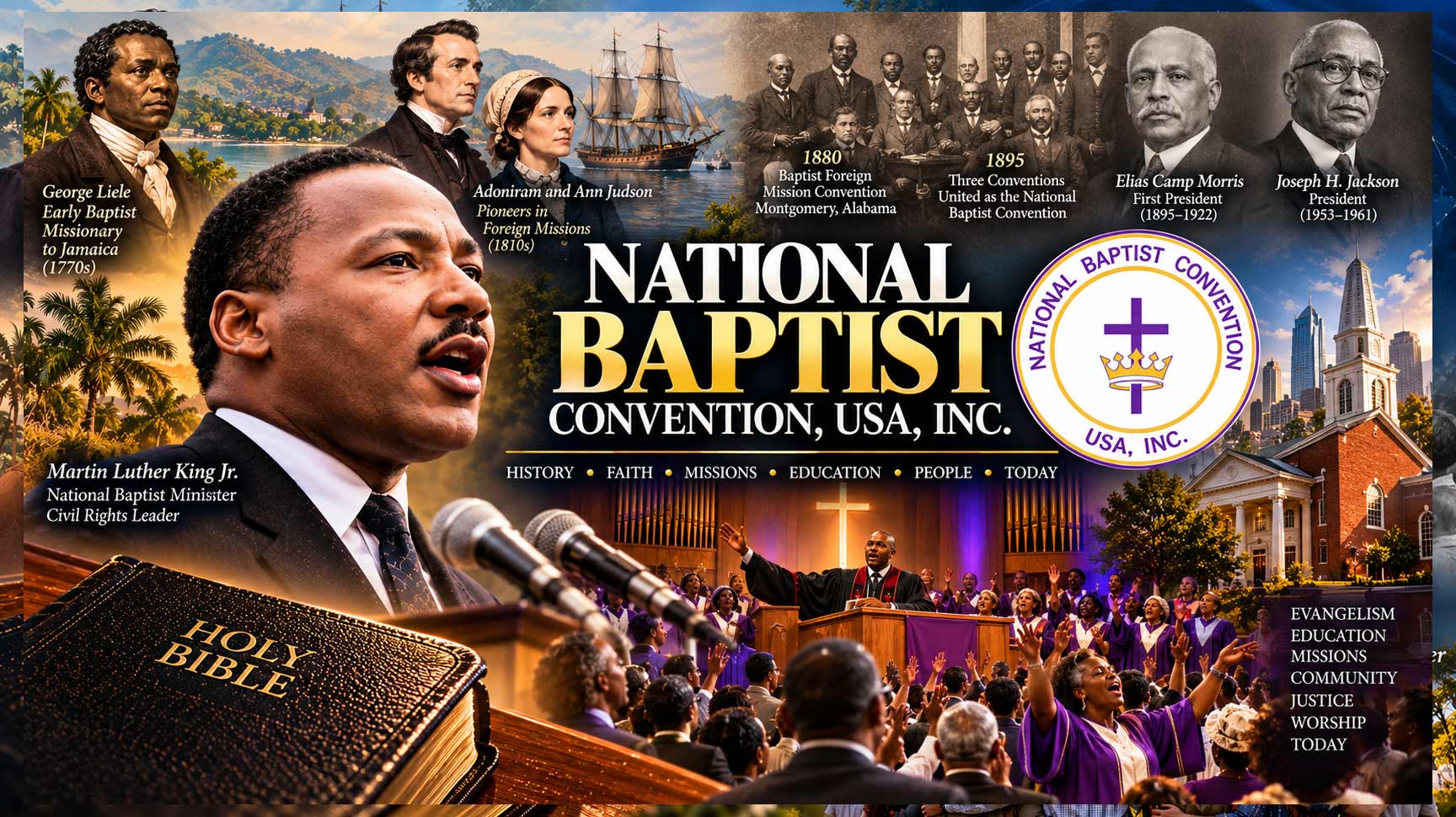
That distinction matters. Black Baptist churches had existed long before the Civil War, and African American preachers such as George Liele and Andrew Bryan belonged to the Baptist story before the United States had even reached the nineteenth century. But emancipation created new possibilities. Millions of formerly enslaved people could establish churches, educate ministers, organize missionary work, publish their own literature, and create institutions under Black leadership. Out of that remarkable period eventually emerged the National Baptist Convention, USA, one of the most important institutions in the history of the Black church in America. The convention today traces its organizational beginnings to 1880 and the merger that created the unified National Baptist Convention to 1895.
And if you know the name Martin Luther King Jr., you already know something about National Baptist history—even though King’s relationship with the convention eventually became part of one of its greatest controversies.
The Black Baptist Church Before the Convention
The National Baptist Convention didn’t create the Black Baptist church. Black Baptists had been preaching, organizing congregations, and carrying the gospel long before a national convention existed. George Liele, whom we encountered in our American Baptist article, became a missionary to Jamaica in the eighteenth century, while Andrew Bryan, who had been associated with Liele, became an important Baptist pastor in Savannah, Georgia.
Slavery made independent Black religious organization extraordinarily difficult, but it didn’t eliminate it. Black Christians developed congregations and networks in which the church became far more than a place for Sunday worship. It was a center of spiritual life, community leadership, education, mutual assistance, and eventually political and social organization.
After the Civil War, that institutional role expanded dramatically. Formerly enslaved Christians left many white-controlled congregations and established churches in which they could choose their own pastors and govern themselves. For Baptists, who already believed strongly in congregational autonomy, that independence had a particularly natural theological home.
Missions to Africa
The immediate organizational ancestor of the National Baptist Convention grew out of missions. In 1880, 151 representatives from eleven states met in Montgomery, Alabama, to organize the Baptist Foreign Mission Convention. Their ambition was striking: African American Baptists wanted to participate directly in taking Christianity to Africa rather than merely contributing to missionary programs controlled by white denominations. W. H. McAlpine of Alabama became the organization’s first president.
There’s something particularly significant about formerly enslaved people and their children organizing themselves to send missionaries across the Atlantic. Within fifteen years of the end of the Civil War, Black Baptists were already thinking internationally. They weren’t merely asking what white Christians would do for them. They were asking what they could do for the world.
Three Conventions Become One
The Foreign Mission Convention wasn’t the only national Black Baptist organization to emerge. In 1886, representatives from seventeen states formed another body, generally known as the American National Baptist Convention. Then in 1893, the National Baptist Education Convention was established with a particular concern for Christian education.
The existence of several organizations created a familiar Baptist problem. Everybody believed in cooperation, but Baptists have an impressive ability to create multiple organizations through which to accomplish it. Eventually they decided that combining their efforts made more sense.
In 1895, representatives gathered at Friendship Baptist Church in Atlanta, Georgia, and united the three organizations into the National Baptist Convention. Their previous concerns didn’t disappear. Foreign missions, home missions, and education became major components of the united convention’s work. The new convention elected Elias Camp Morris as its president. He would lead it for the next twenty-seven years.
Elias Camp Morris
Morris is one of those figures who deserves to be much better known. Elias Camp Morris was born into slavery in Georgia in 1855. He became a minister, educator, businessman, and one of the leading Black Baptist figures of his generation. He helped establish what became Arkansas Baptist College and pastored Centennial Baptist Church in Helena, Arkansas, while becoming increasingly prominent in national Baptist life.
When the three Baptist organizations united in 1895, Morris became president of the new National Baptist Convention. Under his leadership, the organization grew into an enormous religious institution. By the time of his death in 1922, the convention represented millions of Black Baptists and had become one of the most important African American organizations in the country.
Think about the arc of that life for a moment. Morris was born enslaved. Forty years later, he was elected to lead a national organization created and governed by African Americans. That’s quite a piece of American church history.
Publishing Our Own Books
One of the convention’s most important early achievements involved something that may not sound particularly dramatic: Sunday school literature. But it was dramatic. Black Baptist churches needed hymnals, Sunday school lessons, theological materials, church literature, and books. If all of those materials came from white publishers, African American Christians remained dependent upon white institutions to decide whose voices would be published and how Christian teaching would be presented.
In the 1890s, the convention established a publishing operation in Nashville under the leadership of Richard Henry Boyd, another former slave who became an important Black Baptist entrepreneur and religious leader. The enterprise produced materials specifically for African American Baptist churches.
This was about more than printing paper. It was about intellectual and institutional independence. Black ministers could write for Black churches. Black Christians could own the presses. Black Baptist organizations could control their own educational materials. Ironically, that tremendous achievement eventually produced one of the convention’s biggest fights. Apparently Baptist publishing can be almost as controversial as Baptist theology.
The Publishing Controversy
A dispute developed over who actually controlled the publishing operation. Was the publishing board an independent institution, or was it accountable to the National Baptist Convention? That may sound like an argument best left to accountants and lawyers, but questions of ownership, authority, and institutional independence became serious enough to divide the convention. In 1915, the dispute resulted in a major split. The incorporated body became known as the National Baptist Convention, USA, Inc., while the opposing group developed into what became the National Baptist Convention of America.
That distinction is important because the names are confusingly similar. When we’re talking about the denomination in this article, we’re talking about National Baptist Convention, USA, Inc.—NBCUSA. And, yes, we’ll eventually need a scorecard for all these Baptist conventions.
What National Baptists Believe
Theologically, the National Baptist Convention stands squarely within the historic Baptist tradition. National Baptists affirm the authority of Scripture, the Trinity, the deity of Jesus Christ, His atoning death and bodily resurrection, salvation through faith in Christ, believer’s baptism, the Lord’s Supper, the local church, evangelism, missions, and the future return and judgment of Christ.
Like other Baptists, National Baptists practice believer’s baptism by immersion. Baptism follows personal faith rather than being administered to infants as the means by which they enter the church. Congregational autonomy is also fundamental. The National Baptist Convention doesn’t function like a Catholic diocese or an episcopal denomination. Individual churches govern themselves, call their own pastors, and voluntarily cooperate through associations, state conventions, and the national convention.
That means National Baptists share quite a lot theologically with Southern Baptists and American Baptists. The differences emerge more clearly when we look at their history and church culture.
The Black Preaching Tradition
One of the great contributions of the Black Baptist church to Christianity has been its preaching tradition. National Baptist preaching developed within a community where the sermon had to do more than communicate theological information. Preaching proclaimed salvation in Christ, interpreted Scripture, encouraged people enduring hardship, confronted injustice, called sinners to repentance, strengthened community identity, and reminded congregations that their circumstances didn’t have the final word.
That tradition developed its own rhythms and forms. The interaction between preacher and congregation became part of the sermon itself. Responses from the congregation weren’t necessarily interruptions. They were participation. The preacher might begin with careful biblical exposition and gradually build toward a highly rhythmic conclusion in which voice, repetition, cadence, and congregational response became part of the proclamation. Anyone accustomed to a quiet Baptist congregation can experience a bit of culture shock. But both congregations may still be thoroughly Baptist.
Music and Worship
The same is true of music. Black Baptist worship helped shape gospel music, and gospel music eventually influenced enormous portions of American popular culture. Spirituals, hymns, gospel songs, choirs, soloists, organists, and congregational singing all became important parts of National Baptist worship.
The Black church didn’t invent every musical element associated with gospel, of course, and Black Baptist worship itself is extremely diverse. But Baptist churches provided one of the primary environments in which the gospel tradition developed and flourished. That influence escaped the church walls. Blues, soul, R&B, rock, and eventually numerous forms of contemporary Christian music all carry traces of musical traditions nurtured in Black churches. American music would sound very different without them.
Education
Education was one of the reasons the National Baptist Convention existed in the first place. For people who had only recently emerged from a system in which teaching enslaved people to read could be prohibited or punished, establishing schools had enormous significance. Black Baptists supported colleges, seminaries, academies, and ministerial training because education represented both Christian formation and freedom.
One institution especially associated with National Baptist life is American Baptist College in Nashville, which has trained generations of Black ministers and civil-rights leaders. Churches also built educational ministries through Sunday schools, Baptist Training Unions, women’s organizations, youth programs, and denominational congresses. Reading the Bible for yourself has always been an important Baptist idea. For former slaves and their descendants, the ability to read anything for yourself carried an additional meaning.
Women Built the Convention Too
As in most Baptist traditions, the official history can become overly dominated by the names of male pastors and convention presidents. That doesn’t tell the whole story.
Women were indispensable to Black Baptist missions, education, fundraising, children’s ministries, charitable work, and local congregational life. Women’s missionary organizations mobilized enormous numbers of church members and raised money for home and foreign missions.
One particularly important figure was Nannie Helen Burroughs, a Baptist educator, activist, and organizational leader. She became a major figure in the Woman’s Convention, an auxiliary connected with the National Baptist movement, and founded a school for Black women and girls in Washington, D.C. Her story illustrates something we’ve seen repeatedly in church history: sometimes the official organizational chart doesn’t tell you where much of the actual work is being done.
The Great Migration
During the twentieth century, millions of African Americans moved from the rural South to cities in the North and West during the Great Migration. They took their churches with them.National Baptist congregations became major institutions in cities such as Chicago, Detroit, Philadelphia, New York, Cleveland, and Los Angeles. Churches helped newcomers find housing, employment, social connections, and community while providing continuity with the religious culture they had known in the South.
Some congregations became enormous. Pastors of major Black Baptist churches could become some of the most influential figures in their cities, exercising leadership that extended far beyond Sunday worship. That influence inevitably brought the church into contact with politics and the growing struggle for civil rights. And eventually it produced another Baptist fight.
Joseph H. Jackson
In 1953, Joseph H. Jackson became president of the National Baptist Convention. Jackson was pastor of the enormous Olivet Baptist Church in Chicago and became the longest-serving president in the convention’s history. He was a powerful preacher, administrator, and denominational leader who emphasized economic development, education, individual advancement, and what he described as achieving civil rights through established legal processes.
The Civil Rights Movement, however, was accelerating. The Montgomery Bus Boycott had demonstrated the effectiveness of organized nonviolent protest. Sit-ins, marches, boycotts, and other forms of direct action increasingly challenged segregation. A younger generation of Black ministers believed churches needed to become more directly involved. Among them was a young Baptist pastor named Martin Luther King Jr.
Martin Luther King Jr. and the National Baptist Convention
King came directly from the National Baptist world. His father, Martin Luther King Sr., was a prominent Baptist pastor, and the younger King emerged from the same Black Baptist preaching and church tradition that had produced generations of National Baptist ministers.
But King and President Jackson increasingly disagreed about the strategy of the Civil Rights Movement. Jackson favored a more cautious approach centered upon legal action, economic advancement, voting, and established political processes. King and his allies supported nonviolent direct action, including marches, demonstrations, boycotts, and civil disobedience against unjust laws.
The disagreement wasn’t simply between people who cared about civil rights and people who didn’t. It concerned how civil rights should be pursued, how directly the convention should involve itself in protest, and how much risk churches should accept in confronting segregation. The conflict was compounded by a separate dispute over Jackson’s lengthy tenure as convention president and the rules governing presidential terms. Eventually the disagreement became irreconcilable.
Gardner C. Taylor
Another important figure in this controversy was Gardner C. Taylor, one of the most celebrated Black Baptist preachers of the twentieth century. Taylor and other ministers challenged Jackson’s leadership. Their side included figures associated with the emerging Civil Rights Movement, among them King and Ralph Abernathy. The struggle became bitter and eventually spilled into litigation and convention-floor confrontation.
So if anyone thinks Southern Baptists have a monopoly on memorable convention fights, National Baptist history would like a word. The dispute ultimately produced another Baptist denomination.
The Progressive National Baptist Convention
In 1961, ministers dissatisfied with Jackson’s leadership and the convention’s direction organized the Progressive National Baptist Convention, or PNBC. Martin Luther King Jr., Gardner Taylor, Ralph Abernathy, and other civil-rights leaders became closely associated with the new body. The PNBC consequently developed a particularly strong identification with the Civil Rights Movement.
We’ll examine the Progressive National Baptists separately because their story deserves more than a paragraph. But understanding where they came from is essential. They weren’t outsiders criticizing the National Baptist Convention. They were National Baptists who left after an internal struggle over leadership, governance, and civil-rights strategy. Once again, Baptist history proves that church polity matters.
National Baptists and the Civil Rights Movement
The 1961 split shouldn’t lead us to conclude that National Baptists who remained with NBCUSA were indifferent to racial justice. The picture was considerably more complicated. National Baptist pastors and congregations participated in civil-rights efforts in different ways and at different levels. Churches provided meeting places, leadership, financial assistance, voter education, community organization, and moral support. Individual ministers took positions ranging from Jackson’s more cautious strategy to direct participation in demonstrations.
Black churches were operating under circumstances white churches often didn’t experience. Pastors had to consider not only theological principles but threats against church buildings, economic retaliation against members, violence, arrests, and the possibility that challenging local power structures could place entire congregations at risk.
People could agree that segregation was wrong while disagreeing sharply about the wisest strategy for defeating it. That doesn’t make every strategy equally effective. But it helps us understand why the debate became so intense.
A Church Within a Community
One of the most important things to understand about the National Baptist tradition is that the local Black church historically performed functions that many white churches never had to perform. The church could be a worship center, school, meeting hall, political organizing space, charitable institution, employment network, cultural center, and refuge from a society structured by racial discrimination.
The pastor therefore often occupied a distinctive leadership position. He wasn’t merely the person who preached Sunday morning. He might be one of the most educated people in the community, an intermediary with political leaders, a spokesperson during crises, an organizer, counselor, educator, and advocate.
That history helps explain why Black Baptist pastors became such prominent leaders during the Civil Rights Movement. The infrastructure was already there.
National Baptists and Southern Baptists
The comparison with the Southern Baptist Convention is particularly interesting because both traditions are Baptist and both developed most strongly in the American South. Their churches could stand only a few blocks apart while their members lived in radically different social worlds.
Both traditions emphasized conversion, believer’s baptism, biblical preaching, missions, congregational autonomy, Sunday school, revival meetings, and evangelism. A visitor could recognize both as Baptist without much difficulty. But race separated them institutionally for generations.
Southern Baptists created an enormous predominantly white convention in 1845. Black Baptists built their own conventions after emancipation and developed parallel missionary agencies, publishing operations, educational institutions, state conventions, and national leadership. In other words, American segregation didn’t merely separate church pews. It helped produce parallel Baptist institutional worlds.
A Distinct Black Baptist Identity
That history is one reason we shouldn’t describe National Baptists simply as “Black Southern Baptists.” They aren’t.
The National Baptist tradition developed its own institutions, leaders, worship traditions, theological emphases, educational networks, missionary organizations, publishing history, and relationship with the broader African American experience. Black Baptist Christianity also developed a particularly strong biblical vocabulary of deliverance.
The Exodus story naturally resonated with people whose ancestors had been enslaved. The prophets’ denunciations of injustice carried obvious relevance. Jesus’ proclamation of good news to the poor spoke directly into Black experience, while the cross and resurrection offered a theological framework in which suffering wasn’t allowed the final word. None of those texts belongs exclusively to Black Christianity. But history affects what people notice when they read the Bible.
Evangelism and Social Ministry
Like other historic Baptist bodies, the National Baptist Convention has maintained a strong emphasis upon evangelism and missions. The convention’s very first national predecessor was created to send missionaries.
That fact is worth remembering because Black church history can sometimes be told almost entirely through the lens of American racial politics. Civil rights are indispensable to the story, but they aren’t the entire story. National Baptists preached conversion. They planted churches. They sent missionaries. They trained ministers. They educated children. They supported colleges. They cared for struggling families. They buried the dead and baptized new believers. They held revivals. They preached Jesus. Political and social engagement grew out of that larger religious world rather than replacing it.
The Convention Today
NBCUSA remains a major Black Baptist organization headquartered at the Baptist World Center in Nashville, Tennessee. Measuring its exact size is difficult because autonomous Baptist congregations and conventions don’t always maintain membership statistics in the same manner. The convention reported more than 21,000 congregations and approximately 8.4 million members worldwide in 2023, while independent demographic counts produce substantially lower figures, so membership numbers should be treated as denominational estimates rather than precise headcounts.
In September 2024, Dr. Boise Kimber was elected the convention’s nineteenth president. As of 2026, he continues to lead NBCUSA, with an emphasis summarized by the convention in the phrase “Changing the Course, Not Our Conviction—The Gospel Still Works!” Its stated 2026–2027 emphasis is “Unmovable: Standing on God’s Word.”
That current language is worth noticing. For an institution born from Black Christians organizing missions in the nineteenth century, the emphasis remains unmistakably evangelical: the gospel still works.
Why the National Baptist Convention Matters
The National Baptist Convention tells a part of American Christian history that can disappear when Baptist history is narrated primarily through white denominations.
Its roots reach into the churches created by enslaved and formerly enslaved Christians. Its national organization grew from a desire to send missionaries to Africa. Its leaders created publishing houses because Black Christians wanted to produce their own literature. Its churches established schools because education was inseparable from freedom. Its congregations became centers of community life during segregation and the Great Migration.
Then the convention found itself at the center of one of the most important moral struggles in American history. Joseph H. Jackson argued for one approach to civil rights. Martin Luther King Jr., Gardner Taylor, Ralph Abernathy, and others argued for another. Their disagreement became so severe that another denomination emerged from it.
That’s not a side story to American Christianity. It is American Christianity.
More Than a Response to Racism
But there’s a danger in ending there. If we define the National Baptist Convention entirely by slavery, segregation, and civil rights, we unintentionally make white racism the central character in Black Christian history. It wasn’t.
Generations of National Baptists weren’t merely reacting to what white America did to them. They were building churches, preaching sermons, writing books, educating children, composing music, sending missionaries, creating businesses, establishing schools, developing leaders, and worshiping God.
They built institutions because they believed they had something worth building. And perhaps the most remarkable detail comes near the beginning of the story. Only fifteen years after the Civil War ended, 151 Black Baptists gathered in Montgomery because they wanted to send the gospel to Africa. They had plenty of needs of their own. They went on mission anyway. That tells us something important about the National Baptist Convention—and something important about Christianity itself.