
My great-grandfather was a Primitive Baptist. He died in the mid-1960s, before I was old enough to know anything about Primitive Baptists, and certainly before I knew that there were Baptist churches where people washed each other’s feet. By the time I became interested in theology and church history, Primitive Baptists seemed like a small and rather obscure corner of the Baptist world.
They weren’t always so obscure. Primitive Baptists were once a substantial presence in parts of the American South, Appalachia, and the rural Midwest. Mid-twentieth-century religious statistics show a much larger Primitive Baptist presence than most Americans encounter today, although the decentralized nature of the movement makes precise comparisons difficult. My great-grandfather therefore belonged to a Baptist tradition that would have been considerably more visible during his lifetime than it is now.
The name itself is enough to raise questions. Were they called Primitive Baptists because they were especially backward? Did they reject missions? Why didn’t they have Sunday schools? Why did some of them worship without musical instruments? And what’s this business about foot washing? As it turns out, the answers take us directly into one of the great Baptist controversies of the nineteenth century.
What Does “Primitive” Mean?
The word primitive wasn’t originally intended as an insult. Primitive Baptists used it in the older sense of something belonging to the earliest or original form. They believed they were preserving the faith and church practices of the earliest Baptists and, more importantly, the New Testament church.
They have also been called Old School Baptists, Old Baptists, and historically anti-mission Baptists, although that last term requires some explanation. Their disagreement with other Baptists wasn’t simply over whether Christians should preach the gospel outside their own communities. It concerned the new organizations Christians were creating to accomplish that work.
Primitive Baptists looked at the New Testament and saw local churches, elders, deacons, preaching, baptism, the Lord’s Supper, prayer, congregational singing, and Christians helping one another. What they didn’t see were mission boards, denominational seminaries, Sunday-school societies, Bible societies, tract societies, or elaborate fundraising organizations.
That raised a question which became the defining question of their movement: If Jesus and the apostles didn’t establish these institutions, what authority does the church have to create them?
The Missionary Revolution
American Christianity changed dramatically during the early nineteenth century. Christians established voluntary societies for foreign missions, home missions, Bible distribution, theological education, Sunday schools, temperance, and other causes. Many evangelicals regarded these organizations as wonderful tools for fulfilling the Great Commission and transforming society.
Not everybody was impressed. Some Baptists worried that these new organizations were creating an institutional Christianity they couldn’t find in the New Testament. They objected particularly when churches were pressured to finance societies governed by boards outside the local congregation. They feared that professional missionary organizations and theological schools would eventually create a religious establishment separating ordinary Christians from a professional religious class.
The controversy became increasingly bitter during the 1820s and 1830s. Baptists who supported the new organizations were generally called Missionary Baptists, while their opponents increasingly identified themselves as Old School or Primitive Baptists.
The division wasn’t really between people who cared about the gospel and people who didn’t. It concerned how Christians believed the gospel should be spread and what kinds of institutions the church had biblical authority to create.
The Kehukee Declaration
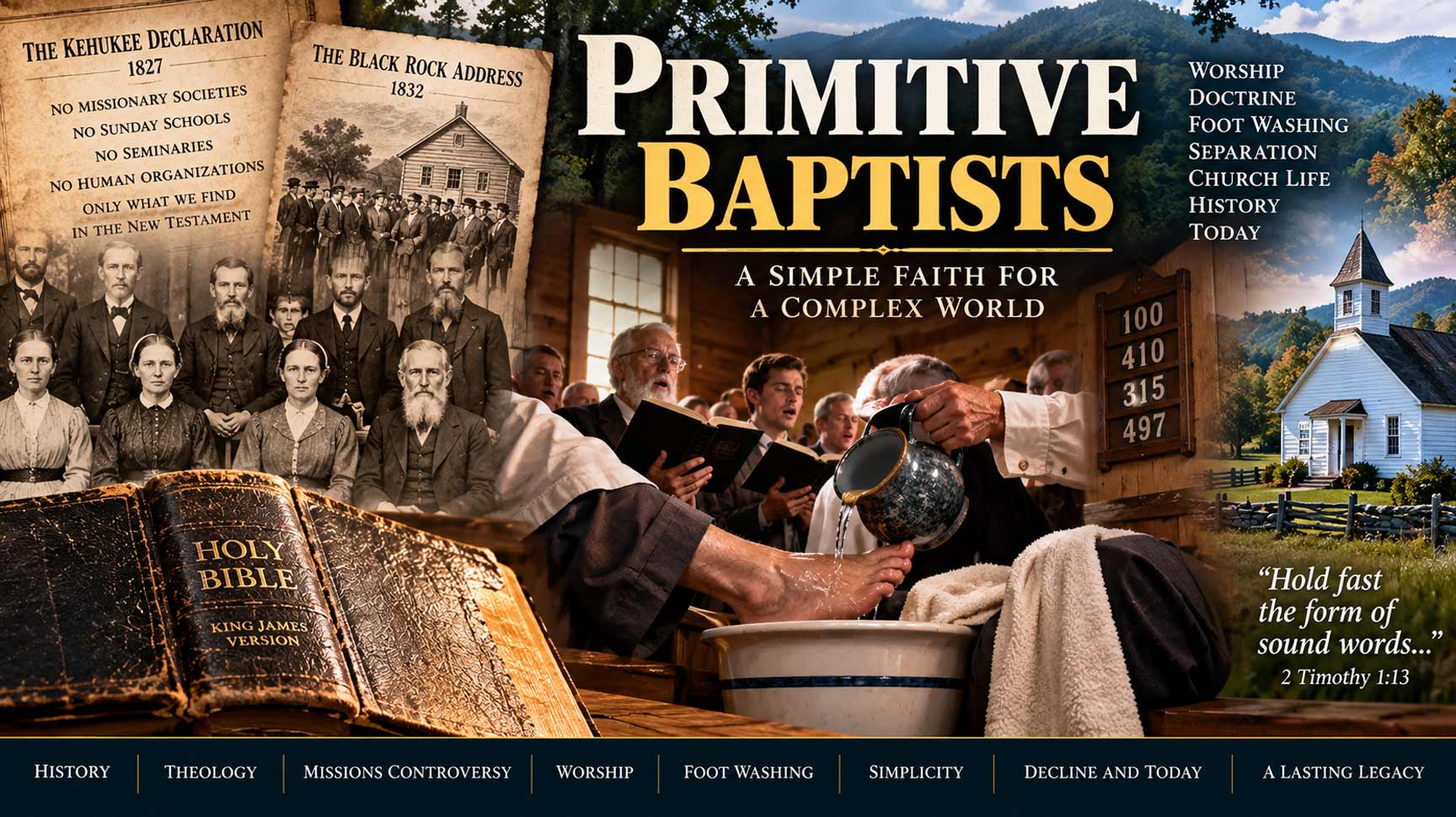
One of the decisive moments occurred in North Carolina. The Kehukee Baptist Association, one of the oldest Baptist associations in America, had been debating missionary methods for years. In 1827 it finally took a firm position, rejecting missionary societies, Bible societies, theological seminaries, and the fundraising methods used to support them because the association regarded such institutions as human inventions without warrant in Scripture. That’s stronger than simply saying, “We prefer doing missions another way.” They believed the new system was changing the nature of the church.
The Kehukee Declaration became one of the important landmarks in the development of Primitive Baptist identity, and similar arguments soon appeared elsewhere. The dispute was moving toward a permanent separation between two kinds of Baptists who had previously worshiped together.
The Black Rock Address
The most famous statement came in 1832, when conservative Baptists met at Black Rock Church in Maryland and issued what became known as the Black Rock Address. The address opposed the growing network of religious societies and institutions that its authors believed had no foundation in New Testament Christianity. Similar actions were occurring among Baptist associations across the country, and the Black Rock meeting became symbolic of the division between Old School and Missionary Baptists.
Primitive Baptists believed Christianity had become unnecessarily complicated. Instead of simply preaching the gospel and allowing local churches to carry out Christ’s commands, Christians were building organizations to coordinate, finance, and professionalize religious work. Missionary Baptists looked at exactly the same situation and reached almost the opposite conclusion. They saw mission societies and seminaries as useful tools for accomplishing things individual congregations couldn’t accomplish effectively by themselves. Both sides thought they were protecting New Testament Christianity. They just couldn’t agree about what that required.
Were Primitive Baptists Against Missions?
Calling Primitive Baptists “anti-mission” is somewhat misleading. Traditional Primitive Baptists objected particularly to the missionary society system. They believed gospel ministers should preach wherever God opened opportunities and churches could support ministers directly, but they rejected the idea that mission boards and fundraising societies were necessary instruments for fulfilling Christ’s commands.
Their argument was essentially that the New Testament gives the responsibility for Christian ministry to the church rather than to organizations Christians create alongside it. Whether we agree with that conclusion or not, it’s considerably more sophisticated than saying Primitive Baptists didn’t want anyone evangelized. Their disagreement was ecclesiological. Who has been authorized to do the work of the church?
Salvation Is God’s Work
The controversy over missions was also connected with Primitive Baptist theology. Primitive Baptists historically held a strongly Calvinistic understanding of salvation. Human beings are spiritually unable to save themselves, election originates entirely in God’s grace, Christ actually accomplished redemption for His people, and regeneration is the sovereign work of the Holy Spirit.
They therefore became suspicious of evangelistic methods that seemed to imply that salvation depended upon the preacher’s ability to persuade someone to make a decision. That gives us an extraordinary contrast with the Independent Fundamental Baptists we just studied. IFB culture became famous for door-to-door soul winning, revival campaigns, altar calls, bus ministries, and urging people to make an immediate decision for Christ.
Traditional Primitive Baptists could look at that entire system and wonder whether people were trying to do the Holy Spirit’s job. Both groups could be extremely conservative Baptists. But their understanding of evangelistic methodology could hardly be more different.
Election and Predestination
Primitive Baptists have consequently been associated with the doctrines of election and predestination. God doesn’t look ahead to discover who will choose Him and then elect those people. Election originates in God’s sovereign purpose. Salvation is ultimately grounded in what God does rather than what human beings accomplish. That conviction could provide tremendous assurance. If salvation begins with God, rests upon Christ’s finished work, and is applied by the Holy Spirit, the believer’s hope doesn’t depend upon maintaining a particular emotional experience or remembering whether he said exactly the right words during an altar call.
But strong Calvinism has always raised another question: If God sovereignly saves His people, what role does preaching play? Primitive Baptists have answered that question in different ways, and some streams have gone farther than others. The movement has never been quite as theologically uniform as outsiders sometimes assume.
The Gospel and Regeneration
One of the more unusual positions associated with some Primitive Baptists is the distinction between eternal salvation and the temporal blessings of hearing and believing the gospel. In its stronger forms, this theology argues that regeneration itself isn’t produced by hearing a preacher present the gospel. God gives spiritual life sovereignly through the Holy Spirit. Gospel preaching instructs, comforts, and nourishes people whom God has made alive rather than functioning as the human mechanism that causes regeneration.
That differs substantially from the way most evangelical Christians speak about conversion. Many evangelicals naturally connect Romans 10—“faith comes by hearing”—with the necessity of gospel proclamation for conversion. Primitive Baptist interpretations have sometimes placed greater emphasis upon God’s immediate sovereign action in regeneration. This also helps explain why aggressive evangelistic campaigns never became central to traditional Primitive Baptist identity. Their theology didn’t naturally produce them.
A Very Simple Church
Walk into a traditional Primitive Baptist church and one of the first things you might notice is what isn’t there. Historically, Primitive Baptists resisted much of the organizational machinery that became normal in American Protestantism. Traditional congregations might have no denominational program, elaborate committee structure, Sunday school, youth department, missionary society, or seminary-trained professional ministry.
The simplicity was deliberate. If the New Testament didn’t require something for the church to function, Primitive Baptists were reluctant to treat it as necessary. That same principle influenced worship.
Where’s the Piano?
Many traditional Primitive Baptist churches worship a cappella – no piano, no organ, or worship band. Just people singing. The reasoning is similar to their objections to other innovations. The New Testament repeatedly instructs Christians to sing, but Primitive Baptists traditionally haven’t found a New Testament command or example authorizing instrumental music in Christian worship. They therefore concluded that congregational singing was sufficient.
The result developed into a distinctive musical tradition, particularly in Southern and Appalachian congregations. Primitive Baptists became associated with unaccompanied hymn singing and, in some areas, shape-note traditions. To someone accustomed to modern worship with keyboards, guitars, drums, sound systems, projection screens, and fog machines, a Primitive Baptist service might feel as though somebody forgot to finish setting up. But to the Primitive Baptist, that might be exactly the point.
And Then They Wash Feet
This is the part I wish I could have asked my great-grandfather about. Traditional Primitive Baptists commonly practice foot washing, usually in connection with Communion. They take seriously the account in John 13, where Jesus washes His disciples’ feet and tells them that He has given them an example to follow. Many Christians interpret Jesus’ action primarily as an illustration of humble service. Primitive Baptists traditionally ask a straightforward question: If Jesus actually did this and told His disciples to follow His example, why did Christians stop doing it?
So they didn’t. Practices aren’t completely uniform, and Primitive Baptist sources themselves acknowledge that some co ngregations don’t observe foot washing. Where it is practiced, however, it is understood as a tangible expression of humility, equality, service, and fellowship among believers. I grew up Baptist and eventually spent a great deal of time studying theology, but my great-grandfather died before I knew enough to ask him about any of this. I would love to know what those services were like from someone who actually lived inside that world.
Communion
Primitive Baptists practice the Lord’s Supper, often in a particularly solemn setting. Communion and foot washing together can create a striking picture of Christian fellowship. Believers remember Christ’s death while performing the humble action He performed for His disciples on the night before the crucifixion.
There is something difficult to dismiss about the symbolism. Christians can debate whether John 13 establishes a continuing church practice, but kneeling down and washing another person’s feet makes humility considerably harder to leave as an abstract theological concept. You actually have to pick up the towel.
No Sunday School?
Another historic Primitive Baptist distinctive was opposition to Sunday schools. That sounds particularly strange today because Sunday school became so thoroughly embedded in Baptist culture that many Christians assume it has always existed. It hasn’t.
The modern Sunday-school movement arose during the late eighteenth and nineteenth centuries. Primitive Baptists therefore saw it as another innovation. The New Testament assigned Christian instruction to parents and churches, they argued, but never created a separate Sunday-school organization with age-graded classes and specialized educational programs. Missionary Baptists regarded Sunday schools as useful methods for teaching Scripture. Primitive Baptists asked where the apostles established one.
Again, the argument wasn’t usually against learning the Bible. It was about whether Christians should invent institutions to accomplish things the church had already been commanded to do.
What About Seminaries?
The same logic applied to theological seminaries. Primitive Baptists were suspicious of creating a professional ministerial class whose qualification for preaching depended upon academic credentials. They emphasized the calling of God and training within the church rather than formal theological education.
That didn’t mean they believed ministers should be ignorant. Primitive Baptist preachers could be serious students of Scripture and theology. The question was whether a seminary degree should become the normal gateway into Christian ministry. Their concern is worth hearing even if we believe formal theological education can be extremely valuable. Christianity existed for centuries before accredited seminaries did, and possessing a degree has never guaranteed that somebody can pastor a church.
On the other hand, rejecting formal education can create problems of its own. There’s no particular virtue in ignorance either.
Ministers and Money
Primitive Baptists also traditionally resisted the professionalization of the ministry. Many ministers worked ordinary jobs rather than functioning as salaried professional clergy. Churches could support ministers and assist with their needs, but Primitive Baptists were suspicious of systems that appeared to turn preaching into a career.
Once again, the concern was theological. The minister should preach because God called him, not because a denominational system provided employment. That approach could protect churches from careerism. It could also make ministry difficult for pastors carrying substantial responsibilities while supporting their families through other work. Primitive Baptist simplicity had costs as well as strengths.
Foot Washing, No Piano, No Sunday School—and Still Baptist
For all their unusual practices, Primitive Baptists remained thoroughly Baptist in several important respects. They practiced believer’s baptism by immersion. They emphasized the autonomy of the local church. They rejected centralized ecclesiastical government. Congregations associated voluntarily with other churches rather than submitting to bishops or denominational authorities.
Scripture occupied the central position in church life, and preaching remained essential. Their differences with other Baptists arose largely because they believed other Baptists had moved away from older Baptist simplicity. That’s why Primitive made sense to them. They weren’t trying to invent something new. They believed everyone else had.
Not All Primitive Baptists Are the Same
We need an important qualification here because the name Primitive Baptist covers more than one historical stream. White Primitive Baptist associations and African American Primitive Baptist organizations developed along somewhat different institutional paths, particularly after the Civil War. The National Primitive Baptist Convention, USA became an important Black Primitive Baptist body and today maintains congregations and associations in several states. Its organizational structure and worship traditions shouldn’t simply be assumed to duplicate every Old School Primitive Baptist association.
Even among predominantly white Primitive Baptists, congregations and associations haven’t agreed about every doctrine or practice. That’s predictable. These are Baptists whose name begins with a tradition emphasizing local-church independence. Uniformity was never likely.
My Great-Grandfather’s Primitive Baptist World
This is where the history becomes personal for me. My great-grandfather died in the mid-1960s. I never had the opportunity to sit down with him and ask what being a Primitive Baptist meant to him. I don’t know what he would have said about predestination, mission societies, Sunday schools, musical instruments, or foot washing. But I can place him within a historical world much better now.
Primitive Baptists were still a visible part of American religious life during his lifetime, particularly in the regions where the movement had historically been strongest. Mid-century religious statistics recorded substantial Primitive Baptist constituencies, although historical reports vary widely because different Primitive Baptist bodies counted members, churches, and adherents differently.
So he didn’t belong to some tiny historical curiosity that had already disappeared. He belonged to a living tradition whose roots reached directly into the great Baptist controversies of the nineteenth century. I just arrived too late to ask him about it.
Where Did They Go?
Primitive Baptists haven’t disappeared. Congregations still exist, and church directories and religious surveys continue to record Primitive Baptist churches and associations. But their visibility and influence have diminished considerably from earlier periods. Even historical treatments of the movement note that Missionary Baptists eventually became the dominant Baptist tradition while Primitive Baptist influence waned. There probably isn’t one explanation.
Primitive Baptists were particularly strong in rural communities, and twentieth-century America became increasingly urban and suburban. Younger generations moved away from isolated communities. Small rural churches aged and closed. A tradition that intentionally avoided many of the institutions other denominations used for education, evangelism, youth ministry, clergy training, and expansion naturally had fewer mechanisms for reproducing itself on a large scale.
Their strengths could therefore become demographic weaknesses. A church that doesn’t believe it needs programs, denominational machinery, seminaries, professional evangelists, or sophisticated recruitment campaigns is unlikely to become a megachurch movement. Primitive Baptists probably wouldn’t regard that as a particularly devastating criticism.
Were They Right About Anything?
This is where Primitive Baptists become more than an interesting historical curiosity. Their solution may have gone farther than many Christians would accept, but some of their questions remain remarkably relevant.
How much institutional machinery does Christianity actually require? Can churches become so dependent upon programs that the programs begin driving the church? Can seminaries produce credentials without producing pastors? Can mission organizations become bureaucracies? Can fundraising manipulate Christians? Can church growth become more concerned with numbers than discipleship? Can professional ministry become a career rather than a calling?
Those are not ridiculous questions. A Primitive Baptist from 1832 might walk into some modern churches, look at the organizational chart, marketing department, production team, fundraising strategy, branded merchandise, leadership conferences, satellite campuses, and fog machines and quietly ask: “Where exactly is all this in Acts?”
I doubt that I would agree with every conclusion he reached, but I’d probably chew on it a bit.
The Other Side of the Argument
The New Testament doesn’t mention church websites, microphones, printed Bibles, air-conditioning, or automobiles either. Christians routinely use methods and technologies that aren’t specifically described in Scripture as long as they help accomplish something Scripture actually commands. Jesus commanded His followers to make disciples of all nations. If churches can cooperate through a mission organization to do that effectively, many Christians see no biblical reason they shouldn’t.
The same argument can be made for seminaries and Sunday schools. Scripture commands Christians to teach. A seminary is one possible way to train teachers, and Sunday school is one possible way to teach children and adults. So the real disagreement isn’t whether everything absent from the New Testament is forbidden. It’s about how much freedom the church has to develop new methods for accomplishing biblical purposes. That’s a much more interesting theological question.
Two Very Different Kinds of Fundamentalism
Putting Primitive Baptists next to the Independent Fundamental Baptists also reveals how inadequate our modern religious labels can be. Both movements can be extremely conservative. Both emphasize biblical authority. Both value local-church autonomy. Both can distrust denominational bureaucracy. But their church cultures developed in almost opposite directions.
Independent Fundamental Baptists became known for aggressive evangelism, organized soul winning, bus ministries, Sunday schools, Christian schools, Bible colleges, missionary agencies, revival campaigns, and elaborate church programs. Primitive Baptists historically looked at many of those things and said, “Where did the apostles do that?” One conservative Baptist tradition produced tremendous religious activity. The other intentionally stripped much of it away. Both believed they were being faithful to Scripture.
Why Primitive Baptists Matter
Primitive Baptists preserve a Baptist argument that largely lost the historical contest. Mission boards became normal. Sunday schools became normal. Seminaries became normal. Denominational agencies became normal. Church programs became normal.
The Missionary Baptists won that argument so thoroughly that many Christians today don’t even realize there was an argument. That’s exactly why Primitive Baptists are worth remembering. They force us to distinguish between what the New Testament actually commands and the methods Christians have developed to carry out those commands. They remind us that institutions we regard as ancient may actually be relatively recent. And their continuing practices—simple worship, a cappella singing, congregational independence, and foot washing—preserve a form of Baptist Christianity that once occupied a much larger place in American religious life.
For me, there’s one additional reason they’re worth remembering. One of those Primitive Baptists was my great-grandfather. I never got to ask him why he belonged to that church. I never heard him explain predestination or tell me what he thought about mission boards. I never asked whether he washed another man’s feet at Communion or had another man wash his.
By the time I knew enough to ask those questions, he was gone. But studying Primitive Baptists gives me at least a small window into the Christian world he knew. And after learning what these peculiar old Baptists actually believed, I find myself wishing I could sit down with him for an afternoon. I’d have quite a few questions.