
The Wisconsin Evangelical Lutheran Synod, almost universally called WELS, is the third-largest Lutheran church body in the United States. If our last two articles established a spectrum within American Lutheranism, WELS gives us the third major piece of the picture. The ELCA is the largest and permits considerable theological and ethical diversity. The Lutheran Church—Missouri Synod is substantially more confessional and conservative. Then we arrive at WELS, which shares much of Missouri’s theology but applies its understanding of biblical authority and Christian fellowship even more strictly.
That doesn’t mean WELS members spend their time trying to determine whether Missouri Synod Lutherans are conservative enough. The differences involve some surprisingly specific questions about prayer, church fellowship, ministry, and the roles of men and women. WELS and Missouri were once close partners and remain remarkably similar on justification, Baptism, Communion, biblical inerrancy, creation, marriage, and the Lutheran Confessions. Understanding why they nevertheless separated tells us quite a bit about what confessional Lutheranism actually means.
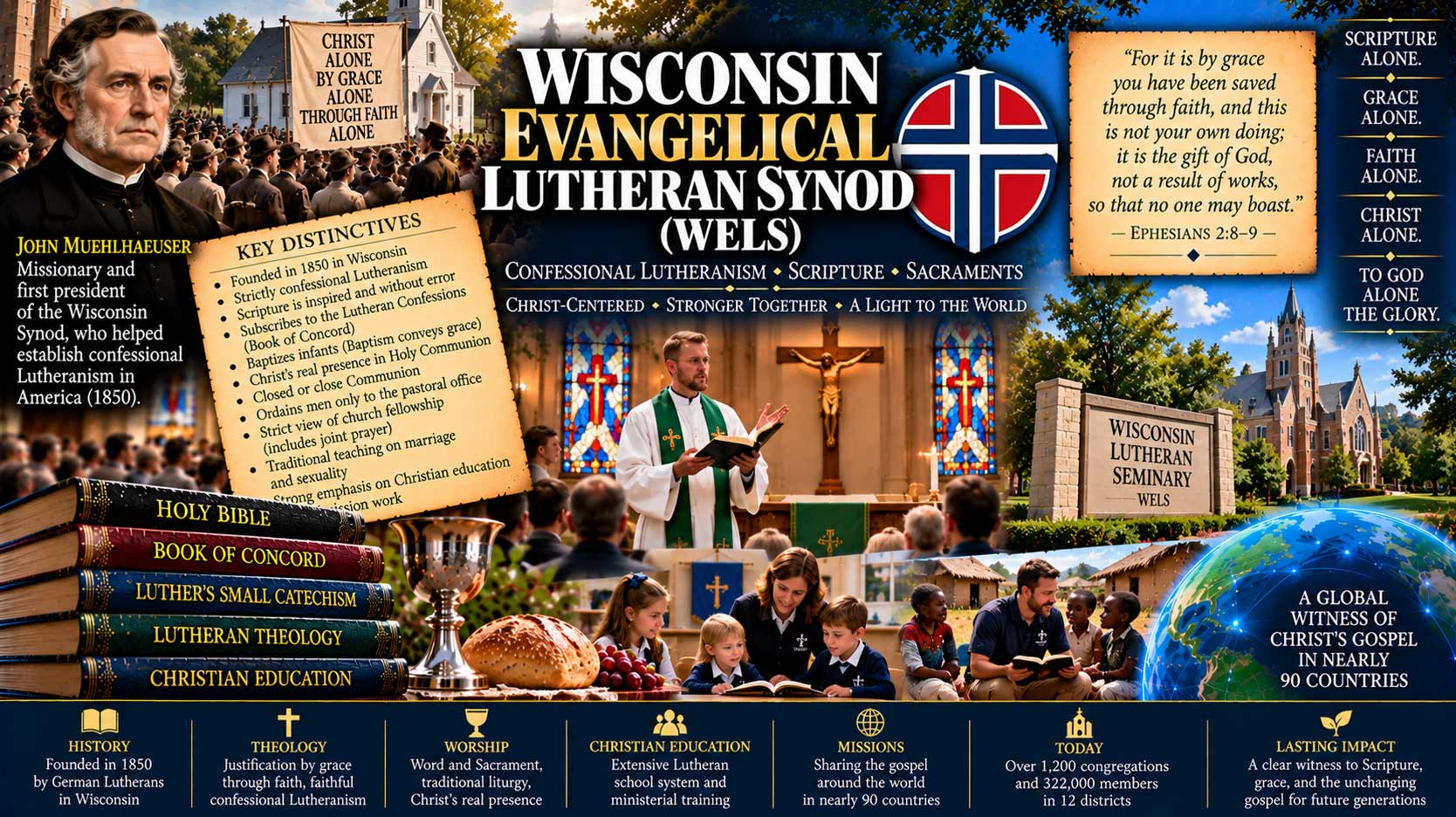
WELS currently reports roughly 322,000 baptized members in more than 1,200 congregations, organized into twelve districts. It’s considerably smaller than either the ELCA or LCMS, but its influence extends beyond those numbers through its schools, ministerial training system, publishing work, missions, and international Lutheran partnerships.
Another German Lutheran Story
Like the Missouri Synod, the Wisconsin Synod grew largely from German Lutheran immigration during the nineteenth century. Its story begins with German mission societies attempting to provide pastors for the rapidly growing German-speaking population of North America.
One of those missionaries was John Muehlhaeuser, who arrived in the United States in the 1830s and eventually moved to Wisconsin. In 1850, representatives met at Granville, Wisconsin, and organized the body that would develop into the Wisconsin Synod, with Muehlhaeuser serving as its first president.
The early Wisconsin Synod wasn’t initially as rigidly confessional as the denomination would later become. It maintained connections with German mission societies containing varying theological influences, and its Lutheran identity developed and sharpened over time.
That makes WELS history particularly interesting. The denomination didn’t begin as the finished theological product we see today. It became more confessionally Lutheran as it went along.
Becoming More Lutheran
A major figure in that development was John Bading, who became synod president in 1860. Under Bading and other leaders, the Wisconsin Synod increasingly embraced the Lutheran Confessions and distanced itself from the less confessional influences that had accompanied some of its European missionary connections.
In 1868, the Wisconsin Synod severed its remaining institutional ties with its German mission society. The decision reflected the conviction that the synod needed to stand clearly upon Scripture and the Lutheran Confessions rather than depend upon European organizations whose theology it increasingly questioned.
That movement brought Wisconsin closer to other confessionally conservative Lutheran bodies in America, particularly the Missouri Synod. For a long time, Missouri and Wisconsin weren’t rivals, but allies – very close allies. Which makes what happened later considerably more interesting.
The Synodical Conference
In 1872, the Wisconsin and Missouri synods joined several other conservative Lutheran bodies to establish the Evangelical Lutheran Synodical Conference of North America. The original federation included Missouri, Wisconsin, Ohio, Illinois, Minnesota, and the Norwegian Synod.
The Synodical Conference was built upon substantial doctrinal agreement. Its members shared a strong commitment to biblical inspiration, justification by grace through faith, Lutheran sacramental theology, and the Lutheran Confessions. For decades, Missouri and Wisconsin worked together closely. Meanwhile, the Wisconsin Synod itself continued consolidating. In 1892, the Wisconsin, Minnesota, and Michigan synods formed a federation, and in 1917 the Wisconsin, Minnesota, Michigan, and Nebraska synods merged, with the former bodies becoming districts within the enlarged Wisconsin Synod.
By the early twentieth century, WELS had become a firmly confessional Lutheran church body with schools, seminaries, missions, publications, and a growing network of congregations. Then its relationship with Missouri began to unravel.
Scripture Means Scripture
The place to begin understanding WELS theology is its doctrine of the Bible. WELS teaches that the entire Bible is verbally inspired by God and without error. Scripture isn’t merely a human record of religious experiences through which God’s Word may sometimes be encountered. Its statements are true because the biblical writers spoke as they were moved by the Holy Spirit.
The Bible is therefore the final authority for Christian faith and life. Creeds, theologians, church traditions, scientific theories, cultural expectations, and personal experiences must ultimately be judged by Scripture rather than Scripture being judged by them. That sounds almost identical to the Missouri Synod because, on this subject, the two denominations remain very close.
The difference between WELS and ELCA is considerably greater. WELS rejects approaches to biblical interpretation that permit Christians to conclude that Scripture itself contains theological or factual errors. For WELS, the question isn’t whether the Bible contains God’s Word. The Bible is God’s Word, and everything else begins there.
The Lutheran Confessions
WELS also subscribes wholeheartedly to the Lutheran Confessions contained in the Book of Concord of 1580. That includes the Augsburg Confession, its Apology, Luther’s Small and Large Catechisms, the Smalcald Articles, and the Formula of Concord. Like the Missouri Synod, WELS doesn’t regard these documents as another inspired Bible. Scripture alone possesses divine authority. The denomination accepts the Lutheran Confessions because it believes they correctly explain what Scripture teaches.
That distinction is fundamental to confessional Lutheranism. WELS doesn’t say, “Martin Luther said it, therefore it’s true.” It says, in effect, “Luther and the Lutheran Confessions correctly explain Scripture, therefore we confess what they teach.”
If the distinction seems rather precise, you’re beginning to understand WELS. Precision is something these people take seriously.
Grace Alone
At the center of WELS theology is the Lutheran doctrine of justification by grace through faith. Human beings are born sinful and spiritually incapable of reconciling themselves to God. Salvation isn’t achieved through moral improvement, religious observance, good works, church membership, or a sufficiently sincere decision to follow Jesus. God saves. Christ lived the righteous life sinners haven’t lived, died for the sins of humanity, and rose from the dead. God declares sinners righteous because of Christ, and the Holy Spirit creates faith through the gospel.
Even faith isn’t treated as the one good work we contribute to complete the transaction. Faith receives what God has already provided. That’s classical Lutheran Christianity, and on this point the ELCA, LCMS, and WELS still share a recognizable theological center. Whatever else American Lutherans argue about, Martin Luther would at least recognize the conversation.
Law and Gospel
WELS also places tremendous importance upon properly distinguishing Law and Gospel. God’s Law tells us what he requires. It reveals God’s will, exposes our sin, restrains wickedness, and guides Christians in holy living. But the Law can’t save sinners because nobody obeys it perfectly.
The Gospel is fundamentally different. It announces what God has already accomplished through Jesus Christ. The Law says, Do this. The Gospel says, Christ has done this for you. Confusing those two messages distorts Christianity. Turn the Gospel into another set of requirements and salvation becomes another human achievement. Remove the Law and people no longer understand either the seriousness of sin or why Christ’s saving work was necessary.
This is one reason Lutheran preaching can sound different from revivalist evangelical preaching. The sermon isn’t supposed to culminate primarily in “Here’s what you need to do this week.” Eventually it needs to get to what Christ has done.
Baptism Saves
Like the Missouri Synod and ELCA, WELS practices infant baptism and teaches that Baptism is a genuine means of grace. That phrase is important. Baptism isn’t simply an outward symbol by which Christians tell the congregation they’ve decided to follow Jesus. God is doing something through Baptism.
WELS teaches that through Baptism God offers and gives forgiveness, creates or strengthens faith, and joins the baptized person to Christ. Infants are baptized because they too are born sinful and need God’s saving grace. This can sound startling to Christians from Baptist, Pentecostal, or many nondenominational backgrounds. WELS doesn’t hesitate to use biblical language connecting Baptism with salvation.
But that doesn’t mean water possesses magical power. The power is in God’s promise attached to the water through his Word. Once again, the emphasis falls upon God acting first. An infant certainly isn’t showing off his theological accomplishments. He’s being given something.
The Lord’s Supper
WELS teaches the real presence of Christ’s body and blood in the Lord’s Supper. The bread remains bread and the wine remains wine, but Christ’s body and blood are truly present and received by those who eat and drink. WELS rejects both the Roman Catholic doctrine of transubstantiation and the purely symbolic interpretation commonly found among Baptists and many evangelicals. This isn’t merely a theological detail. Communion delivers Christ’s promise of forgiveness and strengthens faith. It is another means of grace.
WELS has devoted considerable theological attention even to questions concerning the consecration and the moment of Christ’s sacramental presence. Its formal doctrinal work on the Lord’s Supper developed partly through discussions with the Evangelical Lutheran Synod beginning in the late 1970s. If you want to see how seriously confessional Lutherans take Communion, read their debates about precisely when Christ’s body and blood are sacramentally present.
Closed Communion
WELS practices closed Communion, and its understanding of fellowship makes the practice particularly strict. Receiving Communion together is a public confession that the communicants are united in Christian doctrine. Consequently, WELS normally invites to Communion those who have been instructed in its teachings and are in doctrinal fellowship with the congregation.
This doesn’t mean WELS teaches that Christians outside its fellowship aren’t Christians. That’s an important distinction. A Baptist may genuinely trust Christ while being wrong, from the WELS perspective, about Baptism. A Catholic may genuinely trust Christ while belonging to a church teaching doctrines WELS rejects. An LCMS Lutheran may genuinely be a Christian despite the fact that WELS and Missouri no longer share formal church fellowship.
The issue isn’t simply “Are you a Christian?” It’s “Are we publicly confessing the same Christian doctrine?” For WELS, Communion says yes. So it wants the answer actually to be yes.
Church Fellowship
Here we reach the doctrine that probably distinguishes WELS most clearly from the Missouri Synod. WELS teaches that expressions of Christian fellowship require doctrinal unity. This applies not merely to Communion or exchanging pastors but more broadly to joint expressions of Christian faith, including worship and prayer.
WELS calls this the unit concept of fellowship. Christians shouldn’t divide fellowship into separate categories and say doctrinal agreement is necessary for Communion but unnecessary for other explicitly religious activities. If people are jointly expressing their Christian faith, WELS believes they’re practicing Christian fellowship. This can produce practices that seem remarkably restrictive to Christians from other traditions. A WELS pastor may decline participation in an ecumenical worship service or public interfaith prayer event even when the cause itself is commendable.
The reasoning isn’t that everyone outside WELS is condemned, but that praying together says something about religious unity. And WELS doesn’t want to say publicly that doctrinal unity exists when it doesn’t.
Wisconsin and Missouri Separate
That doctrine became the central issue in the breakdown of fellowship between WELS and the Missouri Synod. Beginning particularly in the 1930s and 1940s, Wisconsin became concerned that Missouri was participating in discussions and joint religious activities with Lutheran bodies that weren’t in full doctrinal agreement with the Synodical Conference. Prayer became one of the disputed questions.
Missouri increasingly distinguished among different levels or expressions of fellowship. Wisconsin insisted that joint prayer itself is an expression of religious fellowship and therefore requires doctrinal agreement. Years of discussions failed to resolve the disagreement. In 1961, WELS formally suspended fellowship with the Missouri Synod.
Think about that for a moment. These churches agreed about the Trinity, justification, biblical inerrancy, infant baptism, Christ’s real presence in Communion, the Lutheran Confessions, traditional sexual morality, and a huge portion of Christian theology. And they still concluded that their disagreement over fellowship was serious enough to prevent church fellowship. When WELS says doctrinal agreement matters, it isn’t speaking rhetorically.
Prayer Can Be Fellowship
This is probably the WELS position most likely to surprise many evangelicals. Suppose several Christian pastors from different denominations gather for a community event and someone suggests they all pray together.
A lot of Christians would think, Well, surely we can at least pray together. WELS asks a different question. What does praying together communicate? Prayer isn’t merely standing beside another person while both happen to think religious thoughts. It’s an expression of faith directed toward God. Joint prayer therefore expresses some degree of shared faith.
If the participants publicly confess contradictory doctrines, WELS believes joint prayer can communicate a spiritual unity that doesn’t actually exist. That doesn’t mean WELS members can’t pray for other Christians. They certainly can. The issue is praying with them as an expression of shared religious fellowship. It’s a distinction most Christians probably never knew anybody was making.
Men and Women
WELS also differs from both the ELCA and, at some points, the Missouri Synod in its teaching concerning the roles of men and women. WELS teaches that men and women possess equal spiritual worth before God and share equally in salvation. It also teaches that God has established different roles for men and women and has assigned spiritual headship to men in the home and Church. Women therefore aren’t ordained as pastors.
But WELS goes further than merely reserving the pastoral office for men. Its application of passages such as 1 Timothy 2 and 1 Corinthians 11–14 has historically restricted women from positions within the congregation that it understands as exercising authority over men. At the same time, women have long served in many forms of Christian ministry and education where WELS doesn’t believe that principle is violated. Its formal statement addressing these questions was adopted in 1993 after years of synodical study.
That makes WELS more complementarian in its institutional practice than the ELCA and generally more restrictive than Missouri. The disagreement isn’t over whether women possess spiritual gifts. It’s over how Scripture says those gifts should be exercised within the order of the Church.
The Public Ministry
WELS also has a distinctive understanding of the public ministry. Missouri Synod theology has historically placed particular emphasis upon the pastoral office as the divinely instituted office of public ministry, with other church offices understood in relation to it.
WELS developed a somewhat different approach. It teaches that the public ministry of the gospel can take various forms, provided Christians are properly called to exercise aspects of that ministry on behalf of the Church. That means pastors aren’t the only people who can possess a divine call into public ministry. Teachers and other called workers can exercise genuine forms of public ministry appropriate to the responsibilities entrusted to them.
This may sound like an obscure disagreement. It wasn’t obscure to the Lutherans debating it. The issue generated theological discussion between Wisconsin and Missouri for decades and eventually contributed to formal WELS statements on church and ministry.
We have now reached the point in our denominational project where we’re distinguishing Lutherans partly by what they believe about the divine call of a Lutheran schoolteacher. We’re definitely below the surface now.
Christian Education
That discussion makes more sense when we understand how important Christian education has been within WELS. Like the Missouri Synod, Wisconsin developed an extensive network of Lutheran elementary schools, high schools, early-childhood programs, and ministerial training institutions. Education isn’t regarded merely as an optional service for parents who prefer private schools.
It’s part of the Church’s work of teaching the Word of God to the next generation. That tradition goes back almost to the denomination’s beginning. By 1858, when the Wisconsin Synod had only seventeen pastors, it already reported sixteen parish schools. That’s remarkable. They were barely large enough to hold a respectable convention and were already building a school system.
Training Pastors
WELS maintains a particularly integrated system for training its pastors. Men preparing for pastoral ministry commonly move through schools within the WELS educational system before eventually attending Wisconsin Lutheran Seminary in Mequon, Wisconsin. The seminary traces its history to the nineteenth century and exists specifically to prepare pastors for the synod.
That creates a highly cohesive ministerial culture. Pastors aren’t simply graduates of dozens of unrelated seminaries who later decide to join WELS. They’re generally formed within a common theological and educational system. The advantage is obvious: the denomination can preserve a remarkably consistent confessional identity.
The possible downside is equally obvious: a tightly connected system can become intellectually insulated if it stops listening seriously to Christians outside itself. WELS would answer that confessional consistency isn’t a defect when the confession is biblical. And that takes us right back to the fundamental question.
Creation
WELS teaches a straightforward form of six-day creation. Its doctrinal summary states that God created the heavens, earth, and all creatures at the beginning of time in six days, bringing creation into existence through his almighty Word. Adam and Eve are understood as specially and directly created human beings rather than merely symbolic representatives of an early human population.
WELS therefore rejects evolutionary explanations that it believes contradict the biblical creation account. This position is connected to more than Genesis alone. Adam’s historical fall into sin provides the background for Paul’s presentation of Christ as the second Adam. Sin and death enter human experience through the Fall, while righteousness and life come through Christ.
Once again, WELS is extremely reluctant to reinterpret biblical historical claims because another intellectual authority tells the Church that Scripture couldn’t have meant what it appears to say. That doesn’t settle every scientific question. It tells us which authority WELS believes gets the final word.
Marriage and Sexuality
WELS maintains the historic Christian teaching that marriage is the lifelong union of one man and one woman and that sexual intimacy belongs within that covenant. It therefore doesn’t perform same-sex marriages or ordain pastors living in same-sex sexual relationships. That puts WELS alongside the Missouri Synod and in direct disagreement with the ELCA on contemporary sexuality.
But the difference isn’t an isolated disagreement over one moral question. WELS sees sexual ethics as another consequence of biblical authority. If Scripture’s teaching concerning creation, marriage, male and female, and sexual behavior is authoritative, the Church doesn’t possess the authority to revise it when the surrounding culture changes.
That doesn’t justify cruelty toward people who disagree or toward people experiencing sexual temptations that the Church regards as sinful. The Christian obligation to love one’s neighbor doesn’t disappear when the neighbor disagrees. Neither, according to WELS, does biblical teaching.
The Papacy and the Antichrist
Here’s one you probably weren’t expecting. WELS retains the historic Lutheran confessional identification of the papacy with the Antichrist. Before anybody imagines WELS teaching that an individual pope is secretly the horned fellow from a prophecy chart, that’s not quite the doctrine. Historic confessional Lutheranism identifies the papal office and its claims with the biblical Antichrist because it believes the papacy places human authority over God’s Word and historically obscured justification by grace through faith.
WELS has formally reaffirmed that interpretation rather than treating it as an embarrassing sixteenth-century relic. Its doctrinal materials explain that Luther came to identify the papacy with the Antichrist because he believed papal claims placed themselves in opposition to the gospel of Christ.
This is one of those moments when we discover that old confessional Protestantism can be considerably less ecumenical than modern evangelicalism. A WELS Christian may treat an individual Roman Catholic with complete kindness and recognize genuine Christians within Catholicism while simultaneously maintaining a remarkably severe theological judgment about the papal office.
Worship
WELS worship generally remains recognizably Lutheran and liturgical. Congregations commonly follow historic orders of worship involving confession and absolution, Scripture readings, hymns, the creeds, preaching, prayer, and the Lord’s Supper. The church calendar follows Advent, Christmas, Epiphany, Lent, Easter, Pentecost, and the other traditional seasons.
Styles vary among congregations, and contemporary music isn’t unknown. But the theological center remains Word and Sacrament. The service isn’t primarily conceived as Christians gathering to generate a spiritual experience for God.
God is serving his people through his Word, forgiveness, Baptism, and Communion. That’s why even very conservative Lutherans can look surprisingly Catholic to evangelical visitors. Then they start talking about the pope, and the confusion usually clears up.
Missions
WELS has maintained missionary work from relatively early in its history. In 1893, the Wisconsin federation adopted mission work among the Apache people as a world mission project, establishing a relationship that would become one of the most enduring missions in WELS history. The denomination subsequently developed mission relationships in Africa, Asia, Latin America, Europe, and other parts of the world. Its international partnerships often involve theological education as well as evangelism and church planting.
This is especially important for a confessional denomination. WELS doesn’t simply want to produce congregations that use the Lutheran name. It wants churches that share its doctrine. Consequently, training pastors and establishing theological education can become just as important as starting individual congregations. The goal isn’t merely more churches, but churches teaching the same gospel.
WELS Today
WELS today describes itself as a fellowship of more than 320,000 people in more than 1,200 congregations across the United States and Canada. It is divided into twelve districts and maintains congregations, schools, ministerial-training institutions, publishing ministries, domestic missions, and international partnerships.
Its relatively modest size can obscure how developed the denomination actually is. WELS possesses an entire ecclesiastical ecosystem capable of educating children, training teachers, preparing pastors, publishing theological material, planting congregations, and maintaining international church relationships. And it has done all of that while preserving a remarkably specific theological identity.
You may disagree with Wisconsin Lutherans, but you’ll rarely wonder what they believe.
ELCA, LCMS and WELS
Now that we’ve examined all three, the American Lutheran landscape becomes much clearer. All three churches claim the heritage of Martin Luther, confess justification by grace through faith, practice infant baptism, celebrate Holy Communion, and retain important elements of historic Lutheran worship. But their paths have diverged dramatically.
The ELCA permits women’s ordination, same-sex marriage and LGBTQ clergy, participates extensively in ecumenical relationships, and allows broader historical-critical approaches to Scripture.
The LCMS confesses biblical inerrancy, restricts the pastoral office to men, maintains traditional Christian sexual ethics, practices closed Communion, and requires substantial doctrinal agreement for church fellowship.
WELS shares most of those conservative LCMS positions but applies fellowship principles more comprehensively, including to joint prayer, has somewhat different teachings concerning the forms of public ministry, and applies its understanding of male spiritual headship beyond the question of pastoral ordination.
So if we wanted the oversimplified version, it might look like this:
ELCA: Lutheranism with broad theological and ecumenical latitude.
LCMS: conservative confessional Lutheranism.
WELS: conservative confessional Lutheranism with even tighter boundaries concerning fellowship and church practice.
That’s an oversimplification, but at least now we know what’s underneath it.
Why the Wisconsin Synod Matters
The Wisconsin Evangelical Lutheran Synod matters because it forces us to think about something modern Christians frequently avoid: How much doctrinal agreement is actually necessary for Christian fellowship?
At one extreme, Christians can behave as though doctrinal differences don’t matter as long as everyone loves Jesus. At the other extreme, believers can draw boundaries so tightly that Christian unity becomes almost invisible.
WELS believes the answer lies in taking both truth and fellowship seriously. Christian fellowship means something precisely because Christian doctrine means something. Sharing Communion, worship, and prayer publicly expresses a unity of faith that shouldn’t be manufactured merely because Christians would prefer not to discuss their disagreements.
Other Christians – including many who share WELS’s high view of Scripture – will conclude that Wisconsin draws those boundaries too tightly. The Missouri Synod itself eventually did. But WELS poses a legitimate question that doesn’t disappear merely because its answer makes us uncomfortable. When Christians say we’re united in faith, how much do we actually have to be united about?
That question explains both the strength and the difficulty of the Wisconsin Synod. It also gives us a much better understanding of American Lutheranism than simply dividing Lutherans into “liberal” and “conservative.”
The ELCA, Missouri Synod, and Wisconsin Synod all inherited the same Reformation. What they disagree about is how faithfully that inheritance is being carried forward.