
The Global Methodist Church is the newest denomination in our Methodist series, but its founders would probably object if we described its theology as new. The church officially launched on May 1, 2022, in the middle of the long United Methodist conflict over Scripture, sexuality, church discipline, and theological authority. Its stated purpose was not to invent a twenty-first-century version of Methodism but to recover what its founders believed Methodism had historically been: evangelical, Wesleyan, sacramental, mission-minded, committed to scriptural holiness, and dependent upon the Holy Spirit.
That distinction is essential to understanding the GMC. It is tempting to summarize the story as, “The conservative Methodists left the United Methodist Church and started another denomination.” There’s truth in that sentence, but not nearly enough. The people who created the GMC believed the disagreement that finally divided United Methodism exposed much deeper questions about what the Bible is, how doctrine should function, whether church discipline actually means anything, and how far a denomination can change before traditionalists conclude that remaining together is no longer possible.
A Church Born from a Methodist Crisis
For decades, the United Methodist Church officially maintained traditional Christian teaching concerning marriage and homosexual practice. Its Book of Discipline described homosexual practice as incompatible with Christian teaching, prohibited the ordination of practicing gay clergy, and prohibited clergy from conducting same-sex weddings.
The problem was that a growing portion of the denomination no longer agreed with those rules. Some clergy openly violated them, some conferences resisted enforcing them, and repeated General Conferences became battlegrounds over whether the language should remain. Traditionalists increasingly complained that the denomination possessed standards on paper that portions of the church had no intention of observing.
The conflict came to a head at the specially called 2019 General Conference. Many people expected the UMC to liberalize its policies. Instead, delegates narrowly adopted the Traditional Plan, retaining traditional teaching and strengthening enforcement provisions. That didn’t resolve the conflict. If anything, it demonstrated how thoroughly divided the denomination had become.
Traditionalists began preparing for a future outside the UMC.
The Wesleyan Covenant Association
An important organization behind the eventual formation of the GMC was the Wesleyan Covenant Association, organized several years before the denomination itself. It brought together United Methodist clergy and laity who wanted to preserve traditional Wesleyan theology and historic Christian teaching on marriage and sexuality.
The WCA wasn’t initially a denomination. It functioned as a network within the United Methodist world, advocating renewal while preparing for the possibility that institutional separation might eventually become necessary.
By the early 2020s, that possibility had become reality. Plans for an orderly denominational separation became tangled in delays surrounding the UMC General Conference, including postponements during the COVID era. Rather than wait indefinitely, organizers announced that the Global Methodist Church would begin operating on May 1, 2022.
A new branch had appeared on the Methodist family tree.
Why “Global”?
The name was chosen deliberately. The founders didn’t envision merely an American conservative Methodist denomination. United Methodism had become a worldwide church, and many of its most theologically traditional regions were outside the United States, particularly in Africa.
The GMC therefore wanted a denomination capable of growing across national and cultural boundaries from the beginning. That aspiration has become increasingly visible. By 2026, the church reported more than 7,000 congregations worldwide, with annual conferences spread across multiple continents and a majority of its annual conferences outside the United States.
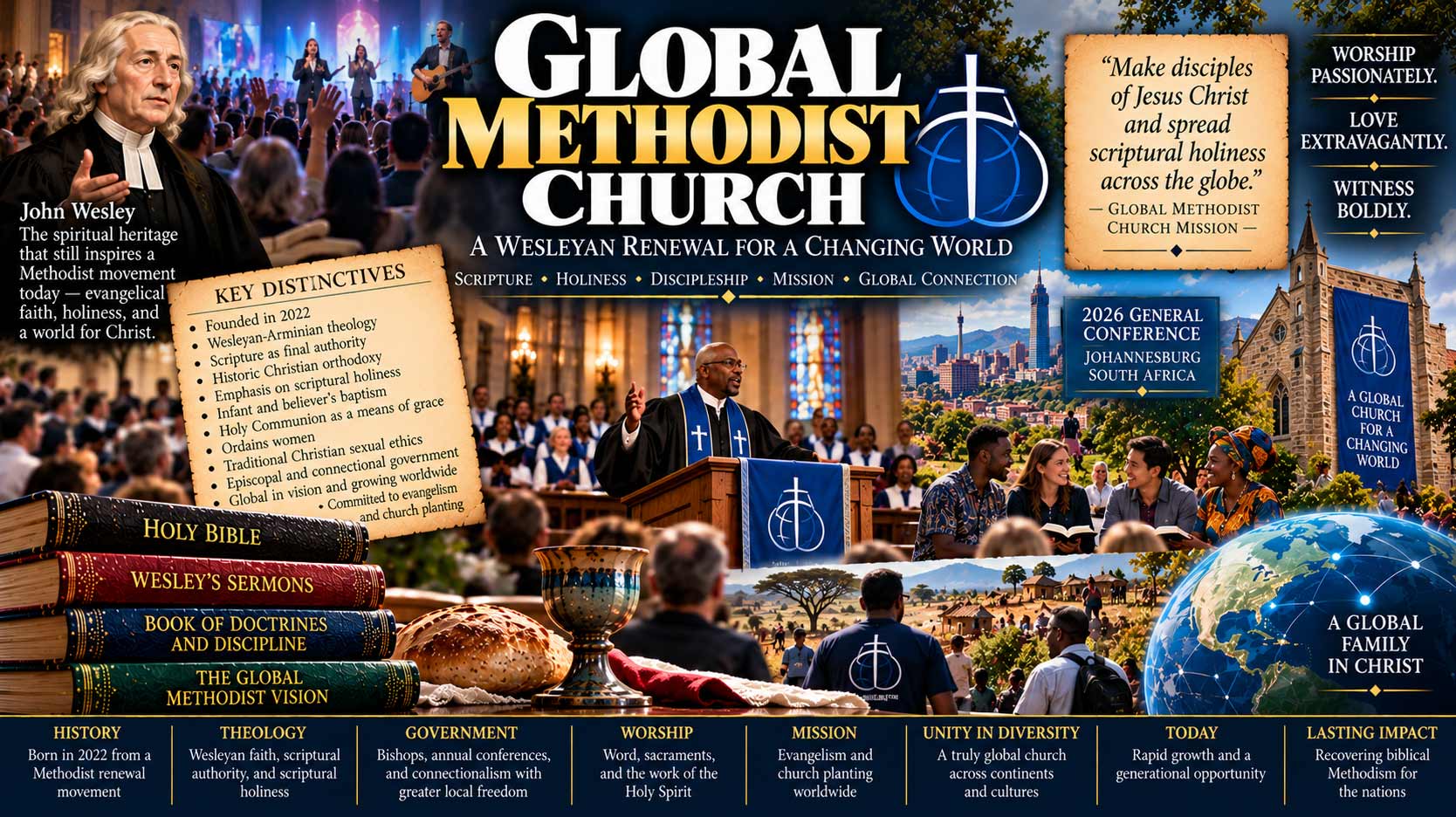
Its 2026 General Conference was held in Johannesburg, South Africa, which says something important about where the denomination sees itself heading. The GMC doesn’t want Africa and other regions treated as distant mission fields attached to an American church. It wants to function as a genuinely international Methodist connection.
That’s considerably easier to put on a denominational logo than to accomplish, but they’re certainly trying.
Scripture Comes First
One of the strongest emphases in Global Methodist identity is the authority of Scripture. The denomination describes the Bible as the primary rule and authority for Christian faith, morals, and service, against which other authorities must be measured.
That language reflects one of the deepest disputes behind the UMC separation. Traditionalists didn’t believe the argument concerned only a handful of biblical passages about sexuality. They believed the disagreement revealed fundamentally different approaches to biblical authority and interpretation.
Global Methodists still value Christian tradition, reason, and experience, as Methodists historically have. But they don’t understand those sources as independent authorities capable of overruling Scripture when contemporary experience points in another direction.
The distinction may sound subtle until a denomination encounters a controversial issue. Then it becomes enormous.
Historic Christian Orthodoxy
The GMC deliberately anchors itself in Christianity older than Methodism. Its doctrinal foundations incorporate the historic creedal tradition represented by the Apostles’ Creed, Nicene Creed, and Definition of Chalcedon. It affirms the Trinity, the full deity and humanity of Christ, his atoning death, bodily resurrection, the work of the Holy Spirit, the Church, resurrection, judgment, and Christ’s return.
That matters because the denomination doesn’t understand Wesleyan Christianity as a replacement for historic Christianity. John Wesley belongs inside the larger Christian tradition.
The church also retains the historic Methodist Articles of Religion and the theological inheritance of the Evangelical United Brethren tradition that entered United Methodism in the 1968 merger. Wesley’s sermons and the General Rules of the Methodist societies also remain important standards.
So although the GMC is only a few years old, much of its doctrinal furniture is centuries old.
New Articles of Faith
The denomination is still young enough that some of its foundational documents are developing in real time. At the 2026 General Conference in Johannesburg, delegates adopted a new combined set of Articles of Faith intended to articulate the normative doctrinal standards of the Global Methodist Church. The final official publication is still being incorporated into the denomination’s revised Book of Doctrines and Discipline as of this writing.
The preliminary articles reaffirm classical Christian orthodoxy while expressing specifically Protestant and Wesleyan convictions. One interesting feature reflects the genuinely global character the denomination is trying to build: Global Methodists may use the Nicene Creed either with or without the Western filioque phrase concerning the Holy Spirit proceeding from the Father “and the Son.”
That’s a fairly sophisticated ecumenical accommodation for a denomination younger than some people’s refrigerators. More importantly, the new standards demonstrate that the GMC doesn’t intend to define itself forever as simply “the Methodists who left the UMC.” A sustainable denomination eventually needs to explain what it believes rather than merely what it opposed.
Wesleyan-Arminian Theology
The GMC remains thoroughly Wesleyan-Arminian. Like Wesley, Global Methodists emphasize God’s grace operating throughout the entire process of salvation. Prevenient grace reaches fallen people before conversion, enabling them to respond to God. Justifying grace brings forgiveness and reconciliation through faith in Christ, while sanctifying grace transforms believers throughout the Christian life.
Christ’s saving work is offered genuinely to all people rather than being restricted to an eternally predetermined elect. Human beings don’t initiate salvation independently of grace, but God’s grace enables a meaningful response.
That puts Global Methodists in the same broad theological family as the UMC, Free Methodists, Nazarenes, Wesleyans, and many Pentecostals. Their disagreement with the modern UMC isn’t primarily over Calvinism versus Arminianism. Both churches inherited Wesley.
The fight has been over what faithfulness to that inheritance requires.
Scriptural Holiness
If one phrase summarizes the GMC’s theological ambition, it may be scriptural holiness. The denomination’s mission is to “make disciples of Jesus Christ and spread scriptural holiness across the globe.”
That’s vintage Wesley. John Wesley believed salvation should produce transformed lives. Christianity wasn’t merely about having one’s sins legally forgiven or holding correct theological opinions. God’s grace should actually change people, producing love for God, love for neighbor, victory over sin, spiritual maturity, and holy character.
The GMC wants that doctrine moved back toward the center of Methodist identity. Holiness isn’t supposed to mean legalistic rule keeping, nor is it supposed to mean adjusting Christian morality to whatever a culture currently considers acceptable. It means becoming increasingly like Christ through the grace and power of God.
That also explains why the Holy Spirit receives unusually prominent attention in Global Methodist language.
The Holy Spirit
The GMC speaks frequently about dependence upon the Holy Spirit, sometimes in language that sounds more charismatic than many people expect from Methodists. Its official materials describe believers as dependent upon the Spirit for transformation, worship, witness, ministry, and holy living.
That isn’t actually foreign to Wesleyanism. Early Methodism was a revival movement filled with dramatic conversions, testimonies, fervent prayer, healing accounts, powerful preaching, and expectations that God was actively working among his people.
Global Methodists aren’t a Pentecostal denomination, and speaking in tongues isn’t treated as the defining evidence of Spirit baptism. But neither does the denomination present Christianity as though the Holy Spirit retired after inspiring the New Testament. For someone coming from a Pentecostal background, parts of Global Methodist spirituality may therefore sound surprisingly familiar even when the theological framework isn’t identical.
Baptism
Like historic Methodism, Global Methodists practice infant baptism and believer’s baptism. Baptism is a sacrament and means of grace rather than merely a public testimony of something that has already happened privately.
Infants of Christian families may be baptized because Methodists understand God’s grace as preceding conscious human response and view children as belonging within the covenant community. Unbaptized adults who come to faith may also receive baptism upon profession of faith.
Global Methodists don’t ordinarily rebaptize someone who has already received valid Christian baptism. Baptism rests fundamentally upon God’s covenant faithfulness rather than the intensity of the recipient’s experience at a particular moment.
Baptists will immediately recognize that they have entered different theological territory.
Holy Communion
The GMC also retains the Wesleyan understanding of the Lord’s Supper as a means of grace. Communion remembers Christ’s saving death, but it isn’t merely an intellectual exercise in remembering a historical event. God meets and strengthens believers through the sacrament.
Global Methodists reject the Roman Catholic doctrine of transubstantiation while also resisting a purely symbolic understanding of Communion. Wesley himself encouraged frequent participation in the Lord’s Supper and regarded it as one of the ordinary ways through which God’s grace operates in Christian life.
This sacramental theology is one reason Methodism can sometimes surprise evangelicals. A Global Methodist church may sound thoroughly evangelical during the sermon and surprisingly liturgical when everyone approaches the Communion table.
Both sides belong to the same tradition.
Women in Ministry
Here’s another feature that may surprise people who assume the GMC is simply the “conservative UMC.”
Global Methodists ordain women. Women may serve as deacons, elders, pastors, and at the highest levels of denominational leadership. The denomination explicitly states that women and men may serve throughout the church.
This wasn’t an accidental inheritance that the GMC simply forgot to remove from United Methodism. The denomination intentionally retained women’s ordination because its leaders believe Scripture permits women to exercise ordained ministry. That means the GMC is conservative on biblical authority and sexuality while remaining egalitarian concerning ordained ministry. As we saw with the Free Methodists, those positions aren’t historically incompatible within Wesleyan Christianity.
Someone trying to classify denominations using only the American categories “conservative” and “progressive” is going to need a bigger filing cabinet.
Marriage and Sexuality
On marriage and sexuality, however, the GMC stands firmly within historic Christian teaching. Marriage is understood as the covenantal union of one man and one woman, and clergy aren’t permitted to conduct same-sex weddings.
Sexual intimacy belongs within that marriage covenant. These convictions were central to the disputes from which the denomination emerged, but Global Methodists generally insist that their position isn’t based primarily upon political conservatism. They understand it as a matter of biblical authority and Christian discipleship.
At the same time, the denomination teaches that people should be treated with dignity and welcomed into worship. Maintaining traditional sexual ethics doesn’t, in its official understanding, justify hostility toward people who don’t live according to those ethics.
The GMC therefore wants to distinguish between welcoming people and redefining Christian moral teaching. Whether contemporary culture will accept that distinction is another matter.
Not Merely the Anti-UMC
The danger facing any denomination created during a church conflict is allowing the conflict to become its identity. If the GMC spends the next fifty years explaining why it isn’t the United Methodist Church, it will eventually become a monument to a denominational divorce.
Its leaders seem well aware of that problem.
The church increasingly describes itself through positive themes: discipleship, scriptural holiness, evangelism, missions, church planting, worship, the Holy Spirit, Wesleyan theology, and global connection. Its frequently used language calls Global Methodists to “worship passionately, love extravagantly, and witness boldly.”
Those aspirations matter because eventually a new generation of Global Methodists will enter the denomination who weren’t present for the UMC conflict and don’t particularly care who said what at the 2019 General Conference. They’ll need a better reason to stay than an argument their grandparents had.
Bishops, but Not Quite the UMC System
The GMC retains bishops, but its episcopal system was deliberately designed with greater accountability and less institutional permanence than many traditional Methodist systems. Bishops are elected from among elders and serve as general superintendents charged with guarding doctrine, discipline, mission, and the order of the church.
The denomination also retains annual conferences and other elements of Methodist connectional government. Local congregations aren’t completely independent organizations. They belong to a larger connection that shares doctrine, clergy, mission, and accountability.
At the same time, GMC architects wanted more authority and resources retained closer to the local church. The Book of Doctrines and Discipline repeatedly emphasizes that disciple-making actually occurs primarily through local congregations.
In other words, they wanted to remain connectional without rebuilding every layer of the bureaucracy they had just left. Give them a few generations. Methodists are very good at committees.
Church Property
One of the most significant structural differences involves church property. Traditional United Methodist polity operates with a trust clause under which local church property is held in trust for the denomination. That arrangement became extremely important during the recent disaffiliation battles because congregations wishing to leave had to navigate denominational procedures in order to retain their property.
The GMC moved away from that model. Local churches generally hold their own property rather than holding it under a denominational trust clause.
That isn’t merely an administrative footnote. It reflects one of the lessons GMC founders drew from the United Methodist conflict: denominational connection should rest upon shared faith and mission rather than making departure financially impossible.
A connection is healthier when people remain because they want to be connected.
Clergy Accountability
Another major GMC concern is accountability. The denomination’s founders believed one of the UMC’s central failures was not simply that its Discipline contained disputed standards but that enforcement had become inconsistent.
The GMC therefore places considerable emphasis upon bishops, clergy, congregations, and conferences actually living under the Book of Doctrines and Discipline they have agreed to follow. Bishops are expected to guard doctrine rather than function merely as administrators.
Of course, writing strong accountability procedures is easier than maintaining them for fifty or a hundred years. Institutions have a remarkable ability to discover creative interpretations of their own rules. The GMC is young enough that the real test is still ahead.
Worship
Global Methodist worship can range from traditional Methodist liturgy to contemporary evangelical worship. One congregation may feature robes, organ music, Wesley hymns, creeds, and frequent Communion, while another may use a worship band and look superficially like a nondenominational evangelical church.
The denomination nevertheless wants Word and sacrament to remain central. Preaching, Scripture, prayer, baptism, Communion, congregational worship, and discipleship aren’t supposed to become competing alternatives.
Charles Wesley’s hymns remain part of the Methodist inheritance, while contemporary worship and charismatic influences can also appear in local churches. The result is a denomination that may look considerably different from congregation to congregation while sharing the same Wesleyan theological framework.
Evangelism and Missions
Evangelism sits near the center of the GMC’s stated identity. Its mission doesn’t merely call the church to preserve correct doctrine but to make disciples and spread scriptural holiness around the world.
Church planting has consequently become a major priority. The denomination isn’t limiting its growth to congregations that transferred from United Methodism. It wants to establish new congregations, train clergy, develop lay leaders, engage younger Christians, and expand into areas where Methodism has little existing presence. That distinction will ultimately determine whether the GMC becomes a durable denomination or merely a temporary landing place for churches leaving the UMC.
A movement survives a separation only when it eventually starts producing something besides former members of the organization it left.
Rapid Growth
The early numerical growth of the Global Methodist Church has been remarkable, although the numbers require some context. Much of the initial expansion came from existing congregations leaving the United Methodist Church rather than from newly converted people or newly planted churches.
Still, the geographic growth is significant. Within four years of its 2022 launch, the GMC reported more than 7,000 congregations worldwide. Its annual conferences now span the United States, Africa, Europe, Asia, and other regions. That growth also creates challenges. It’s one thing to gather thousands of congregations united by dissatisfaction with their previous denomination. It’s another to develop a coherent culture among churches separated by continents, languages, economic conditions, worship styles, and political environments.
The word Global is becoming less aspirational. Now comes the difficult part of actually being global.
The 2024 General Conference
The GMC held its first Convening General Conference in San José, Costa Rica, in September 2024. Delegates established major portions of the denomination’s permanent governance, refined its Book of Doctrines and Discipline, and moved the church beyond the transitional structures used during its first two years.
Holding the conference outside the United States was symbolically important. From its first General Conference, the denomination was signaling that Global Methodism wasn’t intended to become merely another American Methodist body with overseas affiliates. The decisions adopted there took effect in 2025 and provided the institutional framework within which the young church could continue developing.
But because the denomination is moving unusually quickly, another major gathering wasn’t far behind.
Johannesburg 2026
The 2026 General Conference in Johannesburg marked another stage in the denomination’s development. Delegates from across the connection considered hundreds of petitions, elected leaders, strengthened the church’s global structures, and worked extensively on the denomination’s doctrinal standards.
The conference’s theme, “The Beauty of Holiness,” was almost perfectly Wesleyan. It emphasized the idea that holiness isn’t supposed to be grim religious rule keeping but a life transformed into the character of Christ. The gathering also demonstrated how quickly the GMC’s international identity is developing. A Methodist denomination born largely from an American denominational crisis held its second General Conference on the African continent.
That’s quite a journey in four years.
GMC and UMC
The relationship between the Global Methodist Church and United Methodist Church will inevitably attract attention for years. They share Wesley, Methodist history, episcopal government, infant baptism, Communion as a means of grace, women’s ordination, connectionalism, and much of the same historical doctrinal inheritance.
But their contemporary trajectories are substantially different. The UMC now permits same-sex marriage and gay clergy and contains broad theological diversity. The GMC retains traditional Christian teaching on marriage and sexuality, places stronger institutional emphasis upon biblical authority and historic doctrinal standards, and intends its disciplinary requirements to be enforceable.
The distinction isn’t that one church is Methodist and the other isn’t. Both claim Methodist identity. The argument is over what Methodism should become.
GMC and Free Methodists
Comparing the GMC with the Free Methodist Church is almost more interesting. Both are evangelical Wesleyan denominations committed to biblical authority, holiness, missions, traditional marriage, women in ministry, and the active work of the Holy Spirit.
The biggest difference is historical. Free Methodism emerged in 1860 from disputes involving slavery, class privilege, pew rentals, holiness, and Methodist institutional life. Global Methodism emerged in 2022 from disputes involving biblical authority, sexuality, church discipline, and the direction of United Methodism.
Separated by more than 160 years, the two movements nevertheless demonstrate a recurring Methodist instinct: when Methodists believe Methodism has wandered away from Wesleyan Christianity, somebody eventually starts another Methodist church.
John Wesley didn’t intend to create a denomination in the first place. Ironically his spiritual descendants have more than made up for it.
The Global Methodist Church Today
The GMC is still too young for anyone to know exactly what kind of denomination it will become. That’s part of what makes it interesting. We’re not studying a church whose identity was settled generations ago. We’re watching one construct that identity in real time.
Its foundations are now fairly clear: historic Christian orthodoxy, biblical authority, Wesleyan-Arminian theology, scriptural holiness, sacramental worship, women’s ordination, traditional Christian sexual ethics, connectional government, accountable episcopal leadership, evangelism, missions, and reliance upon the Holy Spirit. Its future will depend upon whether those commitments become the lived culture of the denomination rather than simply the ideals written into documents during its founding generation.
Every reform movement eventually faces that test.
Why the Global Methodist Church Matters
The Global Methodist Church matters because it provides a rare opportunity to watch a major denomination being built almost from scratch. Most of the denominations we’ve studied developed through generations of revivals, mergers, divisions, controversies, and institutional growth. With the GMC, we’re close enough to the beginning to watch those decisions being made.
Its founders looked at the United Methodist conflict and concluded that theological boundaries needed to be clearer, biblical authority needed to be stronger, accountability needed to mean something, local congregations needed greater freedom, and the global church needed a larger voice.
Whether the structures they’ve created will accomplish those goals won’t be answered by the first or second General Conference. That answer will take decades. But the denomination has already moved beyond simply leaving something behind. It’s trying to determine what it wants to build.
For a church founded in 2022, that’s probably the most important transition of all.