
Nondenominational Christianity refers to Protestant churches and ministries that are not formally governed by, or institutionally affiliated with, a traditional Christian denomination. Rather than identifying primarily as Baptist, Methodist, Presbyterian, Lutheran, Pentecostal, or another denominational tradition, these churches usually present themselves simply as Christian, Bible, community, fellowship, or evangelical churches. They often emphasize a direct commitment to Scripture, personal faith in Jesus Christ, evangelism, local church ministry, and cooperation with Christians across denominational boundaries.
Nondenominational Christianity is not itself a denomination and does not represent a single theological system. Two nondenominational churches may have nearly identical beliefs, while others may differ significantly concerning baptism, predestination, spiritual gifts, church government, women in ministry, eschatology, and other issues. Many nondenominational churches are broadly Evangelical, while others are charismatic or Pentecostal in theology and practice. Some closely resemble Baptist churches without using the Baptist name, and still others combine influences from several Protestant traditions.
The dramatic expansion of nondenominational churches during the twentieth and twenty-first centuries represents an important development in modern Protestantism. It reflects both the influence of Evangelical Christianity and a broader tendency among many Christians to place less emphasis on denominational identity. At the same time, the term “nondenominational” can obscure important theological differences, making it necessary to examine the beliefs and practices of individual churches rather than assuming that the label itself defines their theology.
Historical Background
The desire for Christianity that transcends denominational divisions is much older than the modern nondenominational church movement. Protestantism fragmented into numerous traditions following the Reformation, and subsequent centuries produced additional denominations through theological disagreements, revival movements, ethnic and national differences, disputes over church government, and changing social circumstances. Christians repeatedly responded by attempting to recover what they regarded as a simpler form of Christianity centered on the New Testament rather than denominational institutions.
Revival movements contributed significantly to this development. Evangelists frequently preached to audiences drawn from multiple denominations and emphasized conversion to Christ rather than membership in a particular church tradition. The eighteenth-century Great Awakening and the revival movements of the nineteenth century created networks of Christians whose shared Evangelical convictions sometimes became more important than their denominational differences. Bible societies, missionary organizations, evangelistic associations, student movements, and other voluntary organizations further encouraged Christians from different Protestant backgrounds to work together around common beliefs and objectives.
The Restorationist Impulse
Some nineteenth-century movements attempted to move beyond denominationalism by restoring what they believed to be the simple Christianity of the New Testament. The Stone-Campbell Movement, associated particularly with Barton W. Stone and Alexander Campbell, famously sought Christian unity without requiring allegiance to historic denominational structures or creeds. Its churches eventually developed identifiable traditions of their own, including Churches of Christ and Christian Churches, so they should not simply be classified as modern nondenominational churches. Nevertheless, their desire to be “Christians only” rather than members of a denominational party illustrates an important impulse that would appear repeatedly in American Protestantism.
Similar attitudes appeared elsewhere. Independent Bible churches, Christian assemblies, revival networks, and missionary organizations sometimes deliberately avoided denominational structures because they believed such institutions could divide Christians unnecessarily or interfere with the authority of the local congregation. These movements did not all share the same theology, but they helped establish an environment in which independent Protestant churches could flourish.
Fundamentalism and the Bible Church Tradition
The Fundamentalist-Modernist controversies of the late nineteenth and early twentieth centuries also contributed to the development of independent churches. As theological liberalism gained influence within some established Protestant denominations and seminaries, conservative Christians debated whether they should remain within those institutions or separate from them. Some formed new denominations, while others established independent Bible churches and fellowships.
These churches typically emphasized biblical authority, the deity and resurrection of Christ, salvation through his atoning work, personal conversion, evangelism, missions, and conservative Protestant theology. Many placed relatively little emphasis on formal liturgy and instead centered worship on preaching, congregational singing, prayer, and Bible teaching. This Bible church tradition became one important ancestor of modern nondenominational Evangelicalism.
Evangelicalism and Cooperation Across Denominations
The emergence of modern Evangelicalism during the twentieth century further weakened denominational boundaries for many Protestants. Evangelical leaders sought cooperation among Christians who shared core beliefs even when they belonged to different denominations. Evangelistic campaigns, colleges, seminaries, publishers, missionary organizations, radio ministries, youth ministries, and parachurch organizations created a Protestant culture that operated across traditional institutional lines.
Billy Graham became one of the most visible representatives of this cooperative Evangelical approach. Although Graham was a Baptist minister, his evangelistic campaigns involved Christians from numerous Protestant traditions and emphasized the basic Christian message of repentance and faith in Christ rather than the distinctives of any particular denomination. Organizations such as InterVarsity Christian Fellowship, Youth for Christ, Campus Crusade for Christ, and numerous mission agencies similarly created settings in which denominational identity became secondary to a shared Evangelical faith.
This broader Evangelical culture helped create conditions in which Christians could attend churches without feeling a strong need for a denominational label.
The Jesus Movement
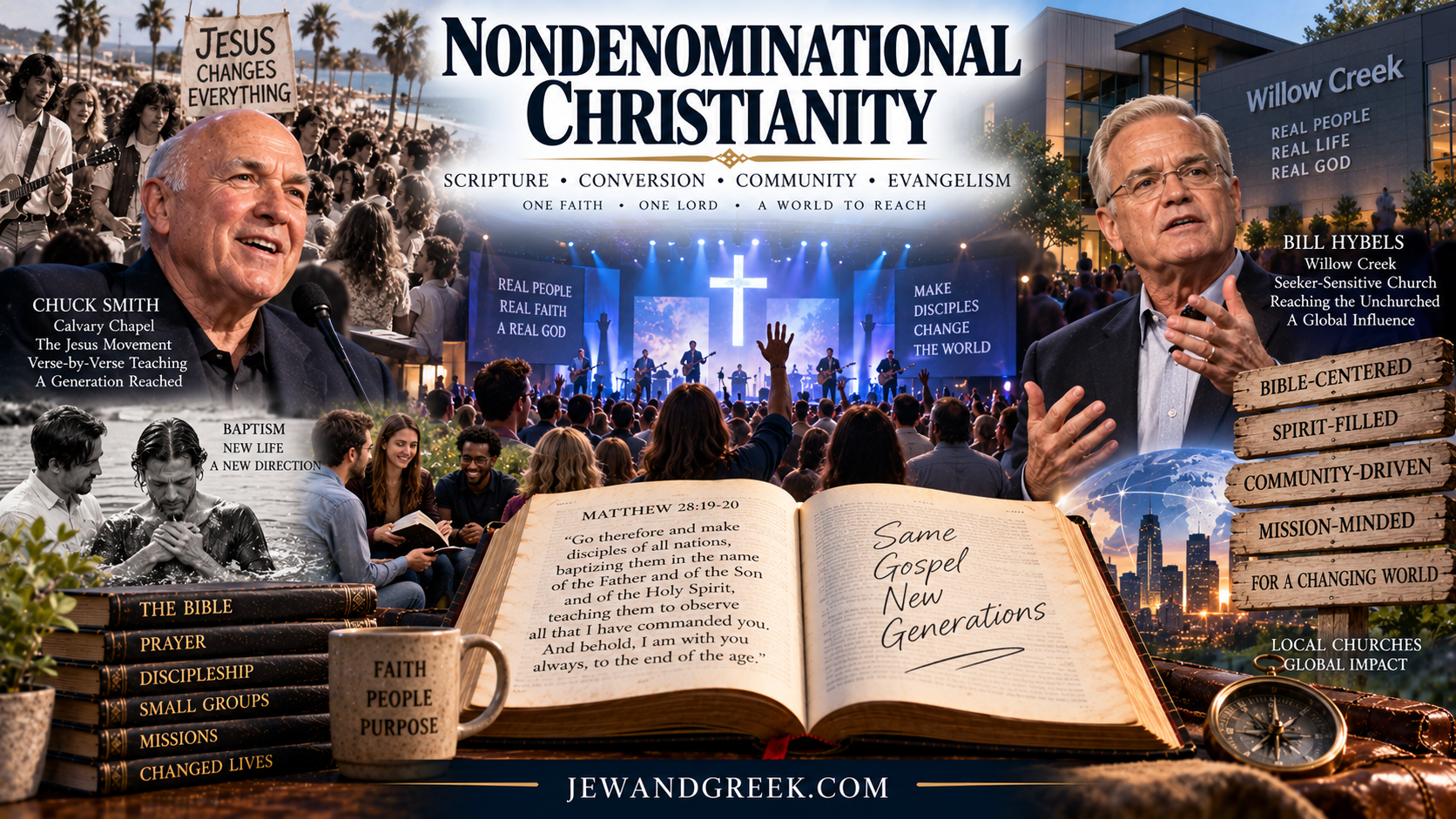
The Jesus Movement of the late 1960s and 1970s became particularly important in the development of contemporary nondenominational Christianity. Emerging partly from the counterculture, the movement attracted many young people who were suspicious of established institutions but interested in Jesus and the Bible. Informal worship, contemporary Christian music, evangelism, Bible teaching, and an emphasis on personal relationship with Christ became characteristic features.
Traditional denominational identities often seemed less important within this environment. Churches associated with the movement frequently adopted informal names and structures, and pastors sometimes avoided traditional clerical clothing, liturgy, and ecclesiastical terminology. Calvary Chapel, which became strongly associated with the Jesus Movement, developed into a large network of churches combining verse-by-verse Bible teaching with informal worship and an openness to the contemporary work of the Holy Spirit.
The Jesus Movement helped establish patterns that became familiar in later nondenominational churches: casual dress, contemporary music, practical sermons, simple church names, strong youth ministry, and an intentional effort to make church accessible to people without traditional religious backgrounds.
The Rise of the Megachurch
The growth of large congregations during the late twentieth century further increased the visibility of nondenominational Christianity. Although megachurches exist within denominations, many of the best-known large congregations developed independent identities or minimized their denominational affiliations in public presentation.
These churches often organized extensive ministries for children, youth, families, small groups, counseling, missions, and community outreach. Contemporary worship music, large auditoriums, sophisticated media, multiple services, and later multisite campuses became common features in some large churches. Sermons frequently emphasized biblical teaching presented in language intended to be understandable to people unfamiliar with traditional church culture.
The megachurch model also changed the institutional character of some nondenominational churches. A congregation might technically be independent while operating an organization considerably larger and more complex than many traditional denominational churches. This development demonstrated that being nondenominational did not necessarily mean being small, informal, or institutionally simple.
The Authority of Scripture
Most Evangelical nondenominational churches emphasize the Bible as the supreme authority for Christian belief and practice. Statements of faith commonly affirm the inspiration and authority of Scripture and present the church’s theology as an attempt to follow biblical teaching rather than a denominational confession.
This emphasis is one reason many churches prefer the nondenominational label. They may argue that Christians should identify primarily with biblical Christianity rather than theological systems developed by particular denominations. Expressions such as “Bible-believing church” often reflect this conviction.
In practice, however, every church interprets Scripture within some theological framework, whether or not that framework carries a denominational name. A nondenominational church may hold views that are historically Baptist, Reformed, Wesleyan, Pentecostal, dispensational, or drawn from several traditions simultaneously. Rejecting a denominational label does not eliminate theological tradition; it often makes that tradition less explicit.
Conversion and Personal Faith
Personal conversion is central to most nondenominational Evangelical churches. Christianity is understood as requiring an individual’s response to the gospel rather than merely participation in a religious institution or inheritance of a family tradition. Preaching therefore commonly emphasizes repentance, faith in Jesus Christ, forgiveness of sins, the new birth, and a personal relationship with God.
This emphasis reflects the wider Evangelical heritage of revivalism and conversion. Invitations to respond to the gospel may occur during worship services, evangelistic events, small groups, or personal conversations. Some churches use altar calls or prayers of commitment, while others avoid formal invitations and emphasize ongoing discipleship and personal confession of faith.
Because conversion occupies such a central place, nondenominational churches generally distinguish between merely attending church and personally becoming a follower of Christ.
Baptism
Most nondenominational Evangelical churches practice believer’s baptism rather than infant baptism, reflecting strong Baptist influence on the movement. Baptism commonly follows a personal profession of faith and is often administered by immersion. It is usually understood as an act of obedience and public identification with the death, burial, and resurrection of Christ rather than as the means by which a person receives salvation.
This practice is widespread but not universal. Because nondenominational Christianity has no central doctrinal authority, individual congregations establish their own positions. Some independent churches recognize infant baptism performed in other Christian traditions, while others require believer’s baptism for membership. Charismatic and independent churches may also attach somewhat different theological significance to baptism.
The absence of a denominational label therefore does not remove the traditional Protestant disagreements concerning baptism.
Communion
Nondenominational churches commonly observe the Lord’s Supper as a memorial of Christ’s death and an expression of fellowship among believers. Bread and the cup are usually understood symbolically, although individual churches may describe Christ’s spiritual presence in stronger terms.
Communion practices vary considerably. Some churches celebrate it weekly, others monthly, and some less frequently. Many practice open Communion, inviting professing Christians to participate regardless of church membership. Others place additional requirements on participation.
As with baptism, these differences demonstrate that nondenominationalism describes an institutional relationship more than a complete theological identity.
Church Government
There is no standard nondenominational form of church government. Some churches operate congregationally, with members voting on major decisions and selecting leaders. Others are governed by a board of elders, while still others give substantial authority to a senior pastor or leadership team.
Many contemporary nondenominational churches use a pastor-and-elders model in which the senior pastor provides primary leadership while a group of elders exercises spiritual oversight and accountability. Deacons or ministry leaders may supervise practical areas of church life. Large churches may employ extensive professional staffs and organizational structures resembling those of large nonprofit institutions.
Independence can provide flexibility, but it also raises questions concerning accountability. Without a denomination capable of investigating misconduct or removing leaders, responsibility must be built into the local church’s governing structure. The effectiveness of those safeguards varies substantially among independent churches.
Worship
Contemporary worship is one of the most recognizable characteristics of many nondenominational churches. Worship bands using guitars, keyboards, drums, and modern Christian songs often replace traditional choirs, organs, hymnals, and formal liturgies. Services may be held in auditoriums designed more like contemporary performance spaces than historic sanctuaries.
This style should not be mistaken for the essence of nondenominational Christianity. Independent churches existed long before contemporary worship music, and some continue to use hymns or more traditional forms. Nevertheless, the expansion of contemporary Christian music has been closely connected with the growth of nondenominational and charismatic churches.
The relative absence of fixed liturgy also gives individual congregations considerable freedom to structure worship according to local preferences and theological convictions.
Spiritual Gifts and the Charismatic Influence
Nondenominational churches vary widely concerning the gifts of the Holy Spirit. Some are cessationist or cautious continuationist, while others openly practice prophecy, speaking in tongues, healing, words of knowledge, and other charismatic gifts. Still others affirm that such gifts continue but rarely incorporate them into public worship.
The Charismatic movement significantly influenced the development of nondenominational Christianity. Beginning in the mid-twentieth century, Pentecostal experiences spread beyond classical Pentecostal denominations and became increasingly common among Christians who did not identify as Pentecostal. Independent charismatic churches subsequently multiplied, particularly during the late twentieth century.
As a result, the boundary between nondenominational and charismatic Christianity can sometimes be difficult to define. A congregation may have worship and ministry practices strongly resembling Pentecostalism while rejecting the Pentecostal denominational label or the doctrine that tongues are the necessary initial evidence of Spirit baptism.
The Church Growth Movement
The Church Growth movement also influenced modern nondenominational Christianity. Leaders and researchers studied why some congregations expanded while others declined and encouraged churches to consider cultural, organizational, and communication factors that could create unnecessary barriers to participation.
This approach contributed to what became known as the seeker-sensitive model. Churches sought to communicate Christianity in ways understandable to people with little church background, sometimes replacing traditional terminology, architecture, music, and service formats with more contemporary alternatives.
Supporters regarded these changes as adaptations of method rather than compromises of the gospel. Critics sometimes argued that excessive attention to accessibility, numerical growth, or consumer preferences could weaken theological depth and Christian discipleship. The resulting debate has continued within Evangelical Christianity.
Independent Charismatic Churches
A major portion of contemporary nondenominational Christianity developed through independent charismatic churches. These congregations often emphasize contemporary worship, spiritual gifts, healing, prayer, personal experience of the Holy Spirit, and strong pastoral leadership without formally belonging to classical Pentecostal denominations.
Some developed networks in which independent churches voluntarily relate to influential pastors, apostolic leaders, ministry organizations, or conferences. Such networks can function somewhat like denominations while retaining more flexible organizational structures.
This illustrates an important paradox of nondenominational Christianity. Churches may reject traditional denominational structures while eventually creating new networks that perform many of the same functions, including ministerial relationships, theological training, missions, conferences, church planting, and leadership accountability.
Networks and Informal Denominations
The term “nondenominational” can therefore be somewhat misleading. Many churches described as nondenominational belong to associations, church-planting networks, pastoral fellowships, or ministry movements that provide resources and relationships without exercising the formal authority of traditional denominations.
These networks may share theological statements, worship styles, ministry philosophies, conferences, educational resources, and leadership structures. In practice, some become recognizable Protestant traditions even though they continue to reject the word “denomination.”
The difference often concerns the degree of institutional authority. A traditional denomination may own property, credential ministers, assign pastors, establish binding doctrinal standards, or exercise disciplinary authority. A church network may provide many similar benefits while leaving substantially greater authority with the local congregation.
Theology Without the Label
One of the most important things to understand about nondenominational Christianity is that being nondenominational does not mean being theologically neutral. Every congregation makes theological decisions even if it does not identify those decisions with historical traditions.
A church practicing believer’s baptism by immersion, symbolic Communion, congregational government, and eternal security may function theologically much like a Baptist church. A congregation emphasizing spiritual gifts, healing, prophecy, and Spirit baptism may resemble Pentecostal or charismatic Christianity. Another church emphasizing divine sovereignty and Reformed soteriology may effectively represent a form of Reformed Evangelicalism without using a Presbyterian or Reformed denominational name.
For this reason, understanding a nondenominational church requires examining its statement of faith, leadership structure, teaching, and practices rather than relying solely on the absence of a denominational affiliation.
Advantages and Criticisms
Supporters of nondenominational churches often value their flexibility, local decision-making, ability to cooperate across traditional boundaries, and emphasis on what they regard as essential Christian beliefs rather than denominational distinctives. Independent churches can sometimes adapt quickly to local ministry needs without navigating large ecclesiastical bureaucracies.
Critics raise different concerns. Independence can reduce external accountability, particularly when authority becomes concentrated in a prominent pastor or small leadership group. Churches that minimize historical theology may unknowingly reproduce older theological ideas without understanding their origins or the debates surrounding them. The desire to avoid controversial doctrines can also result in theological ambiguity.
These strengths and weaknesses are not universal. Some nondenominational churches possess strong systems of accountability and extensive theological education, while some denominational churches experience serious institutional failures. The relevant differences must therefore be evaluated at the level of individual churches and networks rather than assumed from the label alone.
Nondenominational Christianity Around the World
Although modern nondenominational Christianity has been particularly visible in the United States, independent Evangelical and charismatic churches have become increasingly important throughout the world. Rapid church growth in Latin America, Africa, and parts of Asia has often occurred through congregations and networks that do not fit neatly into traditional Western denominational categories.
Some of these churches developed from missionary activity, while others arose through indigenous revival and church-planting movements. Large independent congregations and networks now exercise substantial influence in countries such as Brazil, Nigeria, South Korea, and numerous other nations.
This global development makes nondenominational Christianity difficult to define solely through American megachurch culture. Independent Protestant and charismatic Christianity now encompasses an enormous variety of cultural expressions and organizational forms.
Nondenominational Christianity in Perspective
Nondenominational Christianity represents both continuity and change within Protestant history. Its central convictions frequently come from older traditions: biblical authority from the Reformation, personal conversion from Evangelical revivalism, believer’s baptism from Baptist Christianity, spiritual gifts from Pentecostalism and the Charismatic movement, and local church autonomy from congregational traditions. What is relatively new is the extent to which these elements can be combined without requiring identification with one inherited denominational structure.
The movement reflects a widespread desire among modern Christians to emphasize common faith in Christ rather than denominational identity. At the same time, the disappearance of a denominational name does not make theological differences disappear. Questions concerning baptism, salvation, spiritual gifts, church leadership, Communion, sanctification, and biblical interpretation remain even when a congregation calls itself simply a Christian church, community church, fellowship, or church.
Nondenominational Christianity is therefore best understood not as another denomination but as a broad organizational approach within contemporary Protestantism. Its churches share independence from traditional denominational government while drawing their beliefs and practices from many of the Protestant traditions that preceded them.