

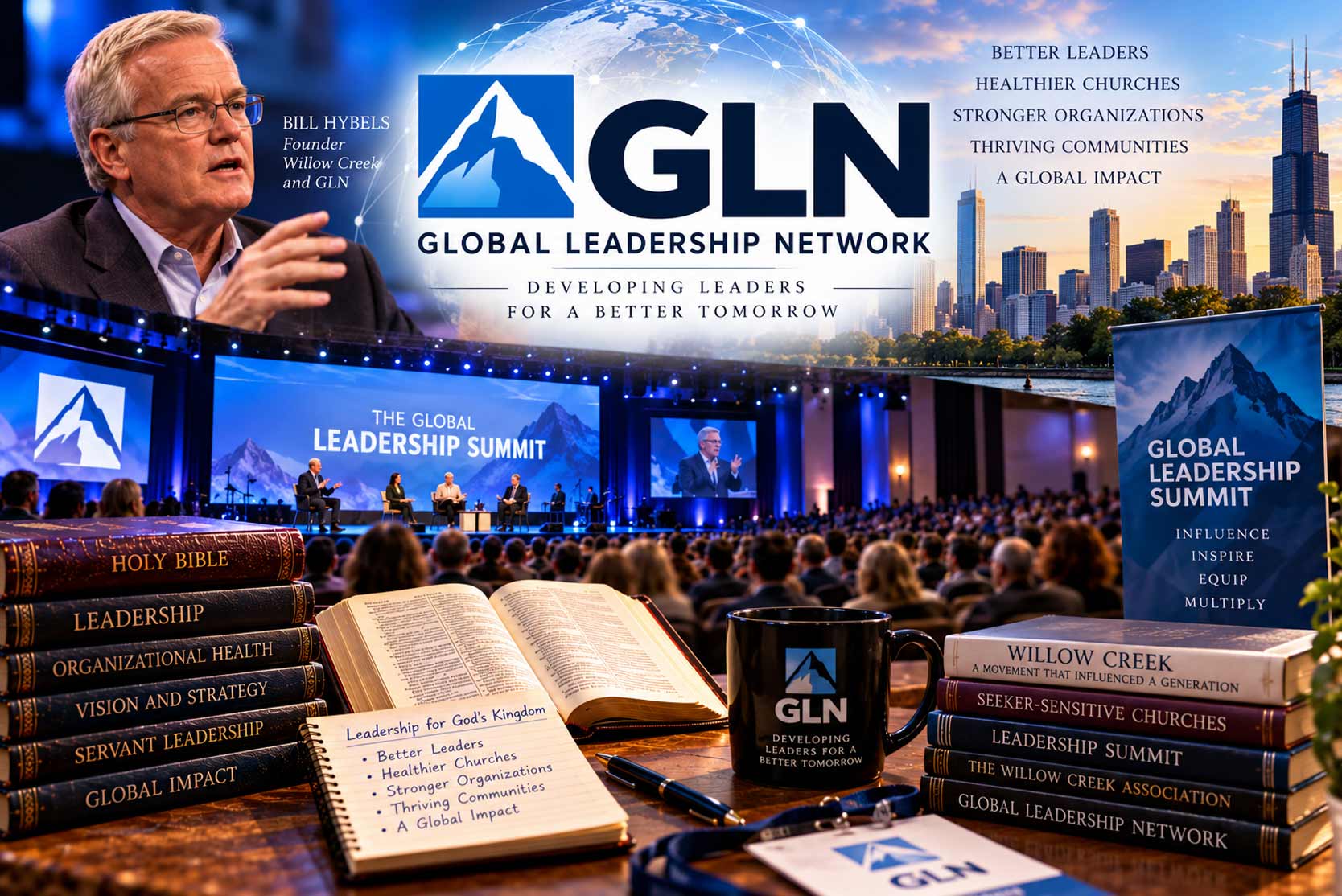
The Global Leadership Network, usually called GLN, is a little unusual for a Christian organization because it isn’t a denomination, a church-planting network or even primarily a ministry organization in the traditional sense. It grew out of one of the most influential megachurches in American evangelicalism, but its principal subject isn’t theology, evangelism or missions. It’s leadership. The basic conviction behind the organization is that churches, businesses, nonprofits and communities become healthier when the people leading them become better leaders. GLN still describes its purpose in explicitly Kingdom-oriented terms, but today it serves leaders well beyond the walls of the local church.
That may sound like a strange subject for a page about Christianity, but GLN has had an enormous influence on the way evangelical churches think about leadership. Pastors now routinely talk about vision, organizational culture, succession, staff development, strategic planning and leadership pipelines using language that would have sounded much more at home in a business school a few generations ago. GLN didn’t create all of that, but it became one of the largest pipelines carrying those ideas into the evangelical world.
And the story begins with Willow Creek Community Church.
Willow Creek
Willow Creek Community Church was founded in the Chicago area in 1975 under the leadership of Bill Hybels. The church became famous for what came to be known as the seeker-sensitive approach to ministry. Rather than designing every church service primarily around the expectations of established Christians, Willow Creek deliberately tried to create an environment in which people who had little experience with Christianity could feel comfortable investigating the faith.
The approach was enormously influential. Willow Creek used contemporary music, drama, multimedia presentations and practical sermons while avoiding much of the traditional church language that outsiders might not understand. Hybels also placed enormous emphasis on organizational leadership, arguing that churches couldn’t accomplish their mission effectively if they were poorly led.
That emphasis distinguished Willow Creek from many other megachurches. Hybels wasn’t simply interested in preaching to larger crowds. He became fascinated with the question of how organizations work, how leaders develop, how teams function and how churches can translate vision into action.
Eventually Willow Creek began sharing what it was learning with other churches.
The Willow Creek Association
In 1992, the Willow Creek Association was created to help develop leaders beyond Willow Creek itself. The organization wasn’t a denomination, and churches that participated didn’t become branches of Willow Creek Community Church. They remained independent congregations and could belong to completely different denominations while using Willow Creek’s conferences, training and ministry resources. GLN’s own historical account identifies 1992 as the organization’s beginning under its former Willow Creek Association name.
This distinction matters because the word network can be misleading. Willow Creek Association didn’t operate like the Assemblies of God, Southern Baptist Convention or even Calvary Chapel. It didn’t ordain the pastors of participating churches, control their property or determine their theology. It provided something different: a network through which church leaders could learn from one another and gain access to leadership training.
That model proved extremely attractive. Pastors didn’t have to leave their denominations or surrender local control to participate. A Baptist, Methodist, Presbyterian or independent pastor could attend the same conference and return home with ideas about staffing, leadership and organizational development.
Churches had discovered something they could argue about considerably less than baptism – Management.
The Leadership Summit
The event that eventually came to define the organization was the Leadership Summit, first held in 1995 near Chicago. It brought pastors and Christian leaders together to hear speakers address leadership, organizational health, personal development and the challenges of leading institutions. As the event grew, technology allowed it to be transmitted to satellite locations rather than requiring everyone to travel to Willow Creek. GLN’s history records the first satellite expansion in 1998, expansion into Canada in 1999 and significant international expansion beginning in the following years.
The event eventually became known as the Global Leadership Summit, or GLS, and its audience expanded far beyond pastors. Business executives, nonprofit leaders, educators and people working in government and community organizations began participating alongside church leaders. The organization deliberately brought speakers from both ministry and the marketplace because it believed Christians could learn leadership principles from people who had demonstrated unusual effectiveness outside the church as well.
That decision became one of the Summit’s greatest strengths and one of its recurring controversies.
Learning From the Marketplace
Traditional Christian conferences usually put pastors, missionaries and theologians on the platform. The Global Leadership Summit was willing to put a pastor onstage and follow him with a corporate executive, psychologist, author, entrepreneur or leadership consultant.
The reasoning was fairly straightforward. A person doesn’t have to share Christian theology to understand organizational culture, negotiation, communication, management or innovation. If somebody has spent decades successfully leading a complicated organization, there may be something a pastor can learn from that experience.
That sounds perfectly reasonable, but it also raises an important question: How much should the church learn from the business world?
The New Testament certainly discusses leadership, but it doesn’t describe pastors as corporate executives. Jesus speaks repeatedly about servant leadership, and the qualifications for elders in the pastoral epistles emphasize character much more than organizational genius. A person can therefore become extraordinarily effective at building an organization without necessarily becoming a better Christian leader.
GLN’s influence has forced evangelical churches to wrestle with that tension.
Leadership Is Influence
One of the ideas repeatedly associated with the Summit is that leadership isn’t just a title. Leadership is influence. Leadership isn’t restricted to the person whose name appears at the top of an organizational chart. Parents lead families, teachers lead classrooms, pastors lead congregations, executives lead companies and ordinary people exercise influence in countless relationships.
That broad definition helped make GLN useful outside traditional ministry settings. Leadership development could become relevant to almost anyone rather than merely senior pastors and CEOs.
There is something genuinely valuable in that idea. Christians sometimes imagine leadership almost entirely in terms of formal church offices, while Scripture contains numerous examples of people exercising influence without possessing the highest institutional position.
But defining leadership as influence also makes leadership an extremely broad category. Almost everyone influences somebody.
The Global Leadership Summit
The Global Leadership Summit became the organization’s signature event and remains central to GLN today. Rather than functioning simply as an annual conference, GLN now presents the Summit as the centerpiece of a year-round approach to leadership development. Its current Network provides churches and organizations with continuing resources intended to turn leadership development into an ongoing practice rather than a two-day burst of inspiration.
The scale eventually became remarkable. GLN currently describes its work as reaching hundreds of thousands of leaders annually through the Summit in more than 123 countries and 60-plus languages. Those figures naturally change as the network develops, but they illustrate how far the organization moved beyond its beginnings at one suburban Chicago megachurch.
What began as Willow Creek sharing ideas with other American churches became an international leadership organization.
That’s quite a journey for something that started in a church parking lot in Illinois.
Is GLN Christian?
This is where GLN becomes particularly interesting for a site like Jew & Greek. The organization remains historically and institutionally connected to Christianity, and its current Network describes participating churches and organizations as developing leadership so they can thrive in their mission to expand God’s Kingdom. International GLN material also publishes a Christian statement of faith affirming biblical authority, the Trinity and historic Christian beliefs.
At the same time, GLN’s leadership material is intentionally useful outside explicitly Christian ministry. Its audience includes people from business, nonprofit organizations and other sectors of society, and its speakers aren’t limited to Christian pastors or theologians. GLN describes its mission in terms of developing leaders capable of producing positive transformation wherever they live and work.
So GLN isn’t a church, and attending the Summit isn’t the equivalent of attending a Christian discipleship conference. It is better understood as a Christian-rooted leadership organization with a deliberately broad leadership audience.
The Church and Business Culture
One criticism of the leadership movement represented by Willow Creek and GLN is that it can encourage pastors to think too much like corporate executives. Churches begin talking about branding, organizational alignment, measurable outcomes, strategic objectives and leadership effectiveness while giving comparatively less attention to prayer, holiness, pastoral care and theological depth.
The criticism shouldn’t simply be dismissed. Churches aren’t corporations, congregations aren’t customers and pastors aren’t CEOs. A church can be extremely well organized while becoming spiritually shallow, and nothing in the New Testament suggests that Jesus will evaluate pastors according to whether they successfully increased market share.
But the opposite mistake is equally possible. Spiritual language can become an excuse for incompetent leadership. Churches handle money, employ people, manage facilities, resolve conflicts and make decisions that affect hundreds or thousands of lives. A pastor who refuses to learn anything about leadership because “this isn’t a business” can hurt a lot of people.
The question isn’t whether churches need leadership. They obviously do. The question is what Christian leadership should look like.
When Leadership Becomes the Message
GLN also illustrates a broader development within modern evangelicalism: leadership itself became a ministry category.
Previous generations certainly produced books about pastoral ministry and church administration, but the modern evangelical leadership industry became something much larger. Conferences, podcasts, consultants, leadership books and coaching organizations developed around the conviction that improving leaders could transform entire organizations.
There is considerable truth in that. Poor leadership can destroy a healthy church remarkably quickly, while good leadership can create an environment in which other people flourish.
But Christians also have reason to be cautious whenever leadership becomes fascinated with itself. Jesus didn’t spend his ministry teaching his disciples how to become impressive leaders. He repeatedly had to correct them because they were interested in status, position and greatness.
His model of leadership involved a towel and a basin. Any Christian leadership philosophy eventually has to come back to that.
Bill Hybels and the Crisis of 2018
GLN’s history can’t be told honestly without discussing the crisis involving Bill Hybels.
In 2018, allegations of sexual misconduct and abuse of power involving Hybels became public. Hybels stepped down from Willow Creek Community Church and also resigned as chair of the Willow Creek Association board and withdrew from participation in that year’s Global Leadership Summit. The organization later participated with Willow Creek Community Church in commissioning an independent advisory process to investigate what had happened and recommend changes. In its 2019 response to that investigation, the Willow Creek Association acknowledged the seriousness of the allegations and the damage surrounding the organization’s culture and response.
The scandal was particularly painful because Hybels had spent decades teaching other people about leadership. That irony shouldn’t be used merely as an opportunity for an easy shot. It raises a much more serious question about Christian leadership culture. Organizations can become so dependent upon gifted founders that charisma, organizational success and institutional loyalty make it difficult to challenge the person at the center.
A leader can teach good principles and still fail to live by them. That’s precisely why Christian leadership can never be measured solely by organizational results.
Becoming the Global Leadership Network
The transition away from the Willow Creek name was already being discussed before the Hybels crisis. GLN’s historical material says its board began conversations about a name change in 2017, and work on a broader Global Leadership Network platform was underway that year. The organization formally changed its name from Willow Creek Association to Global Leadership Network on February 19, 2019.
That’s an important detail because it would be easy to assume that the organization simply changed its name to escape the scandal. The timing makes the reality more complicated. The move toward a global identity predated the public crisis, although the scandal obviously changed the environment in which the transition occurred.
The new name also made sense organizationally. By then the ministry had long since expanded beyond Willow Creek Community Church, and the Global Leadership Summit had developed an identity of its own.
Beyond Willow Creek
The separation in identity became increasingly important after 2018. GLN continued its leadership mission while Willow Creek Community Church faced its own pastoral and institutional rebuilding. The Global Leadership Summit also continued to use Willow Creek’s South Barrington campus as its principal gathering location; GLN’s Summit materials have identified that campus as the event’s main site since the first Summit in 1995.
This creates an unusual relationship. GLN came out of Willow Creek, its signature event was born there, and the organizations share a substantial history. But GLN isn’t simply another name for Willow Creek Community Church.
Understanding that distinction prevents a lot of confusion. Willow Creek is the church. GLN is the leadership organization that grew out of the Willow Creek world. The Global Leadership Summit is GLN’s signature event. Those three things are related, but they aren’t interchangeable.
Leadership After Hybels
The Hybels scandal also exposed the difference between teaching leadership and practicing accountability. An organization can produce sophisticated material about organizational health while still developing blind spots around its most powerful personalities.
That’s hardly a problem unique to Willow Creek. Church history contains plenty of leaders whose gifts allowed them to accumulate more authority than their character could safely support. Modern megachurches simply have the ability to do it on a much larger scale.
One lesson from the Willow Creek crisis is therefore broader than Willow Creek itself. Healthy Christian organizations need structures capable of confronting leaders before a crisis becomes catastrophic. Loyalty to a ministry can’t become loyalty to a personality, and organizational success can’t be allowed to function as evidence of spiritual maturity.
A full auditorium proves that somebody can fill an auditorium. It doesn’t really prove much else.
The Global Network
Today GLN presents itself as a global community devoted to developing leaders across churches, businesses, nonprofits and communities. Its signature Summit remains central, but the organization also provides leadership resources throughout the year and encourages participating organizations to develop ongoing cultures of leadership growth.
That makes the modern GLN broader than the Willow Creek Association from which it emerged. The original organization largely helped churches learn from Willow Creek’s experience. The current organization describes itself as a network in which leaders from numerous sectors learn from one another.
In that sense, the name change represents more than rebranding. It describes what the organization became.
What GLN Got Right
Whatever criticisms can be made of the evangelical leadership movement, GLN recognized something churches sometimes learn the hard way: leadership matters.
A pastor may preach excellent sermons and still create a dysfunctional staff. A church may possess sound theology while managing conflict terribly. A ministry can have a worthy mission and still collapse because nobody understood finances, accountability, succession or organizational culture.
Spiritual maturity and leadership competence aren’t identical. The church needs character more than charisma, but character doesn’t magically teach someone how to manage a staff of fifty people.
There is nothing unspiritual about learning how to communicate clearly, resolve conflict, delegate responsibility or build healthy organizations. Those are practical skills, and Christians don’t dishonor God by learning them from people who happen to know what they’re doing.
What GLN Forces Christians to Ask
The more difficult question is where leadership technique ends and Christian leadership begins. A successful CEO may teach a pastor something valuable about organizational culture. A psychologist may explain human behavior that helps church leaders understand conflict. An entrepreneur may have excellent insights into innovation and decision-making.
But none of those things tells Christians what the church is for. For that, leadership theory isn’t enough. The church gets its mission from Christ.
That’s ultimately the line GLN and every Christian leadership movement has to navigate. The church can learn from the marketplace without becoming the marketplace. Pastors can learn organizational leadership without becoming executives. Christians can value influence without confusing influence with spiritual authority.
Leadership Changes Things
The Global Leadership Network began as the Willow Creek Association in 1992, launched the Leadership Summit in 1995, expanded across national and cultural boundaries and formally adopted its present name in 2019. Today it operates far beyond the congregation that gave birth to it while retaining its Christian roots and its conviction that better leadership can produce healthier organizations and communities.
Its history also provides an unusually good case study in the possibilities and dangers of modern Christian leadership culture. Willow Creek demonstrated how much a gifted leader and well-organized church could accomplish. The Hybels scandal demonstrated why leadership ability can never substitute for character and accountability.
Both lessons are worth remembering. Christians should want competent leaders. We should want pastors who can communicate, organize, develop people and make wise decisions. There is nothing particularly spiritual about incompetence.
But Jesus’ greatest leaders weren’t the people who learned how to get everyone else to follow them. They were the people who learned how to serve. Any Christian leadership network worth keeping eventually has to lead us back there.