

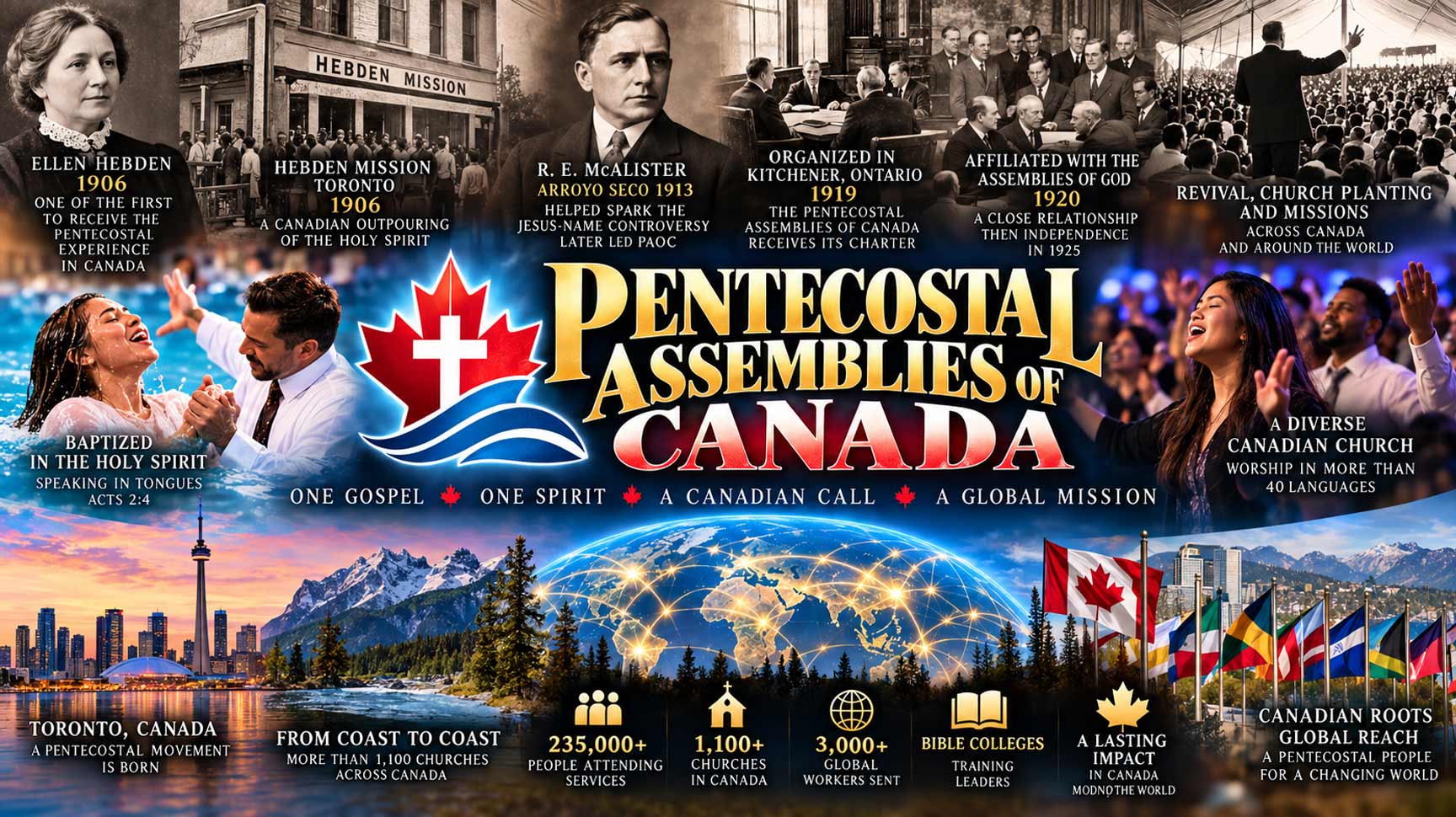
The Pentecostal Assemblies of Canada, usually abbreviated PAOC, can look at first glance like the Canadian version of the Assemblies of God. That’s understandable. The two movements share the same basic classical Pentecostal theology, have cooperated closely for more than a century, and for several years were formally connected. But calling PAOC simply “the Canadian AG” misses a much more interesting story. Canadian Pentecostalism developed its own pioneers, revivals, controversies, institutions, missionary movement, and eventually its own national identity.
And there’s a surprise buried near the beginning of the story that I certainly didn’t expect when I started looking into it. The denomination that today explicitly affirms the historic doctrine of the Trinity emerged from a Canadian Pentecostal movement that briefly wrestled seriously with the Oneness controversy. In other words, the PAOC story unexpectedly connects several of the Pentecostal branches we’ve already studied: Azusa Street, the Assemblies of God, PAW, the New Issue, and classical Trinitarian Pentecostalism all appear somewhere in the family history.
Pentecost Comes to Canada
Modern Pentecostalism arrived in Canada almost immediately after the movement began spreading from the United States. Reports of unusual spiritual experiences were already traveling through Holiness networks, religious newspapers, personal correspondence, and itinerant ministries when the Azusa Street Revival erupted in Los Angeles in 1906.
One of the earliest important centers of Canadian Pentecostalism developed in Toronto through the ministry of James and Ellen Hebden. Ellen Hebden experienced what Pentecostals understood as baptism in the Holy Spirit in November 1906, and the Hebdens’ mission became a gathering place for people interested in the new Pentecostal message. Within only a few years, a number of Canadian congregations had developed connections with the Toronto work.
The significance of Ellen Hebden is easy to overlook, especially if we tell early Pentecostal history almost entirely through male ministers. Yet PAOC’s own historical material identifies her experience in 1906 as one of the important beginnings of Canadian Pentecostalism. Women were preaching, praying, evangelizing, and exercising spiritual gifts during the movement’s formative years, just as they had at Azusa Street.
Canada wasn’t merely receiving an American denomination. A Canadian Pentecostal movement was already being born.
The Hebden Mission
The Hebden Mission became one of the most important early Pentecostal centers in Canada. People came to the Toronto meetings seeking the same experience of Spirit baptism that was being reported elsewhere, and the mission helped spread Pentecostalism into surrounding communities. By 1910, fourteen new Canadian congregations had emerged, many associated in some way with the Hebden Mission.
The Hebdens themselves, however, were suspicious of formal denominational organization. That’s another recurring feature of early Pentecostal history. People who believed they were experiencing a fresh movement of the Holy Spirit weren’t particularly excited about immediately creating committees, constitutions, headquarters, and denominational bureaucracies.
You can probably see the problem. Revival movements eventually acquire buildings. Buildings require money. Missionaries require support. Ministers need credentials. Churches need some way of recognizing one another. Somebody has to publish literature, resolve disputes, train ministers, and decide who is authorized to represent the movement. Sooner or later, somebody calls a meeting.
R. E. McAlister
Another major figure in early Canadian Pentecostalism was Robert Edward McAlister. McAlister encountered the emerging Pentecostal movement in the United States and became an important evangelist, organizer, writer, and eventually denominational leader in Canada. He would serve as the first general secretary of the PAOC and later became closely associated with its principal periodical, the Canadian Pentecostal Testimony.
McAlister also connects Canadian Pentecostal history with one of the biggest controversies we’ve encountered so far. Remember the Arroyo Seco camp meeting of 1913? McAlister was there.
During a baptismal service, he observed that the apostles in Acts baptized converts in the name of Jesus Christ rather than repeating the wording of Matthew 28:19. His remarks helped stimulate the discussion that developed into the New Issue controversy over Jesus-name baptism and ultimately the Oneness understanding of God.
That’s quite a historical connection. One of the men who would become instrumental in building Canada’s largest classical Pentecostal fellowship also helped ignite the controversy that divided early Pentecostalism over the Trinity.
The New Issue Reaches Canada
As the Jesus-name controversy developed, McAlister himself became associated for a time with the emerging Oneness position. Other Canadian Pentecostals were wrestling with the same questions, and when the Pentecostal Assemblies of Canada first organized, its relationship to Trinitarian and Oneness Pentecostalism hadn’t yet settled into the form we know today.
This was the period when Pentecostals were trying to determine whether baptism should be administered using the Trinitarian formula of Matthew 28:19 or specifically in the name of Jesus Christ, as described repeatedly in Acts. What began as a discussion about baptism quickly became a much larger discussion about the nature of God.
We’ve already seen the American result. The Assemblies of God adopted an explicitly Trinitarian Statement of Fundamental Truths in 1916, and ministers who embraced Oneness theology departed. Canada’s road was a little more complicated.
Organizing the PAOC
Early attempts to organize Canadian Pentecostals had already been made, including an effort in 1909 that failed partly because some Pentecostals feared formal organization would interfere with the freedom of the Holy Spirit. By the end of the next decade, however, the practical need for cooperation had become difficult to ignore.
On May 17, 1919, the Pentecostal Assemblies of Canada received its federal charter. Seven Pentecostal pioneers were named in the application, including R. E. McAlister and George A. Chambers, who became the fellowship’s first general chairman. The purposes written into the new organization’s charter were remarkably straightforward: provide places of worship, conduct religious instruction, and carry out home and foreign missionary work.
The first General Assembly met later that year in Kitchener, Ontario. PAOC was officially underway. But the theology wasn’t completely settled.
PAW Almost Enters the Story
Here’s one of the more interesting intersections in our Pentecostal family tree. Some of the Canadian leaders involved in organizing PAOC had connections with the Pentecostal Assemblies of the World, the Oneness organization we just studied. George Chambers and R. E. McAlister were navigating the same theological controversies that were reshaping Pentecostal organizations south of the border, and early PAOC discussions reflected uncertainty over exactly how narrowly the new fellowship should define the doctrine of God and the baptismal formula.
By its first General Assembly, however, the Canadian fellowship was already moving toward recognition of the Father, Son, and Holy Spirit in a way that pointed back toward Trinitarian Pentecostalism. McAlister and other leaders ultimately rejected the Oneness position.
The Canadian movement then made a decision that settled the direction much more clearly. It joined the Assemblies of God.
The Canadian Assemblies of God—For a While
In 1920, PAOC affiliated with the Assemblies of God in the United States. Meanwhile, Pentecostals in western Canada had already organized in relationship with the American AG as the Western Canada District.
This is why describing PAOC as the Canadian counterpart of the Assemblies of God isn’t entirely wrong. For several years the relationship was organizational, not merely theological. PAOC adopted the classical Trinitarian Pentecostal position associated with the Assemblies of God, while Canadian Pentecostals increasingly consolidated into a national fellowship.
The arrangement didn’t last permanently. By 1925, the formal union with the American Assemblies of God had ended, and the western Canadian churches joined the PAOC. The result was a genuinely national Canadian Pentecostal organization.
The relationship with the Assemblies of God remained friendly, but PAOC would chart its own course. That distinction remains important today. The PAOC isn’t a Canadian district of the American Assemblies of God. It is an independent Canadian Pentecostal fellowship.
Frank Small and the Pentecostals Who Didn’t Follow
Not every Canadian Pentecostal accepted the movement toward Trinitarianism.
Frank Small, one of PAOC’s original founders, remained committed to the Oneness position. In 1921 he and other ministers separated from PAOC and organized what became the Apostolic Church of Pentecost of Canada.
So Canada experienced its own version of the division we’ve already encountered in the United States. The New Issue wasn’t merely an American argument that Canadian Pentecostals watched from a distance. It helped divide Canadian Pentecostalism too.
That means the family tree we’ve been building now has another branch. PAOC eventually became firmly Trinitarian and remained within classical Pentecostalism, while other Canadian Apostolic Pentecostals continued along the Oneness path. Apparently no history of early Pentecostalism can remain uncomplicated for more than about three paragraphs.
What PAOC Believes
Theologically, PAOC belongs squarely within classical Trinitarian Pentecostalism. Its contemporary Statement of Essential Truths explicitly confesses one God eternally existing as Father, Son, and Holy Spirit. It affirms the full deity and humanity of Jesus Christ, His virgin birth, sinless life, atoning death, bodily resurrection, present reign, and future return.
The Bible is regarded as God’s written revelation and the final authority for Christian belief and conduct. Salvation comes through Jesus Christ, and believers are called to lives of discipleship, holiness, worship, service, and participation in the mission of the church.
So if you’re already familiar with the Assemblies of God, much of PAOC theology will sound familiar. That’s because they’re theological cousins—and very close ones.
The Full Gospel
PAOC summarizes its Pentecostal identity through the traditional Full Gospel understanding of Jesus as Saviour, Healer, Spirit-Baptizer, and Soon Coming King. That little formula contains a remarkable amount of Pentecostal theology. Jesus saves from sin. Jesus continues to heal. Jesus baptizes believers in the Holy Spirit and empowers them for Christian witness. And Jesus will return.
Those convictions shaped the early Pentecostal movement long before Pentecostals developed extensive systematic theologies. They could fit their theology onto banners, revival advertisements, church signs, and missionary literature.
That’s not necessarily a bad thing. Sometimes four phrases tell you more about what a movement actually emphasizes than four hundred pages of denominational minutes.
Baptism in the Holy Spirit
PAOC teaches a baptism in the Holy Spirit that empowers believers for Christian life and witness. Like the Assemblies of God, it distinguishes this Pentecostal experience from conversion and teaches that speaking in tongues is the initial evidence of Spirit baptism.
The denomination also affirms the continuing operation of the spiritual gifts described in the New Testament. Prophecy, tongues, interpretation, healing, and other manifestations of the Spirit aren’t treated as phenomena restricted to the apostolic age.
That places PAOC comfortably within the Pentecostal theology we’ve already been discussing. The Holy Spirit doesn’t merely occupy a paragraph in the doctrinal statement. His activity is expected in the life of the church.
PAOC and the Assemblies of God
The similarities between PAOC and the American Assemblies of God are substantial enough that someone moving from one denomination to the other would probably experience relatively little theological culture shock.
Both are Trinitarian. Both are evangelical. Both teach Spirit baptism with tongues as initial evidence. Both affirm divine healing and contemporary spiritual gifts. Both emerged from the same early twentieth-century Pentecostal world and developed strong commitments to missions, church planting, ministerial training, and evangelism.
But they aren’t the same denomination. PAOC developed within Canada’s particular geography, culture, immigration patterns, bilingual environment, and religious history. It created its own districts, institutions, leadership structures, missions programs, publications, and theological statements. The relationship is probably best understood as close relatives rather than parent and child.
Women and Pentecostal Ministry
Women were present near the beginning of Canadian Pentecostalism, and Ellen Hebden makes that impossible to miss. PAOC today explicitly affirms the equality of women and men in ministry leadership and recognizes women serving under ministerial credentials.
That position has deep Pentecostal roots. Early Pentecostals frequently appealed to Joel’s prophecy, repeated by Peter at Pentecost, that God’s Spirit would be poured out upon sons and daughters and that both would prophesy. They interpreted the outpouring of the Spirit as creating responsibility for Spirit-empowered ministry wherever God bestowed the gift.
PAOC’s contemporary affirmation therefore isn’t simply a concession to twenty-first-century Canadian culture. The denomination understands women in ministry as something embedded in the Pentecostal movement from its earliest Canadian beginnings. Ellen Hebden was already making the point in 1906.
A Missionary Movement
Missions weren’t something PAOC added after the denomination became established. They were one of the reasons it organized.
The original 1919 charter specifically included home and foreign missions among the purposes of the fellowship, and the first generation of Canadian Pentecostals displayed the same extraordinary missionary enthusiasm we’ve encountered elsewhere. Some went overseas with limited money, minimal institutional support, little cultural preparation, and an enormous conviction that Jesus was coming soon and therefore the gospel needed to reach the world immediately.
Whatever we might say about their methods from a century’s distance, nobody can accuse them of lacking commitment. PAOC reports that during its first century it sent more than 3,000 full-time global workers, participated in planting tens of thousands of churches, helped train tens of thousands of leaders, and established Bible colleges and social ministries in numerous countries.
That international legacy is one of the strongest reasons PAOC matters beyond Canada.
Missions Come Home
Canada itself has also changed dramatically since PAOC was founded.
The Canada of 1919 was overwhelmingly shaped by European immigration and historic Protestant and Catholic institutions. Modern Canada is religiously and ethnically far more diverse. Immigration has brought Christians from Africa, Asia, Latin America, the Caribbean, and elsewhere, while the country has simultaneously become substantially more secular.
PAOC now reports worship and ministry occurring in more than forty languages. Its domestic mission priorities include cultural-language communities, Quebec and Francophone Canada, Indigenous communities, younger generations, and major urban centers.
That’s an interesting reversal in missionary history. Pentecostal missionaries once left Canada to establish churches around the world. Now Christians from many of those same parts of the world are helping shape Pentecostal Christianity inside Canada.
Quebec and French-Speaking Canada
The Canadian context also presents PAOC with a challenge that doesn’t have an exact American equivalent: French-speaking Canada, particularly Quebec.The Quiet Revolution dramatically altered Quebec’s relationship with institutional Christianity during the twentieth century, weakening the enormous cultural influence once exercised by Roman Catholicism and contributing to one of the most secular environments in North America.
For an evangelical Pentecostal denomination, that creates both difficulty and opportunity. PAOC has therefore treated Quebec and Francophone ministry as an important missionary concern rather than assuming that a national church can simply operate everywhere in English.
Even the denomination’s name reflects that Canadian reality: The Pentecostal Assemblies of Canada / Les Assemblées de la Pentecôte du Canada. Sometimes bilingual letterhead tells you something about ecclesiology.
Education
As PAOC matured, ministerial education became increasingly important. The movement that began through missions, revival meetings, prayer gatherings, and storefront congregations eventually developed Bible colleges and theological training institutions across Canada.
One important example is Summit Pacific College in British Columbia. Its roots reach to the British Columbia Bible Institute established in 1941, which later became Western Pentecostal Bible College and eventually Summit Pacific College. The school now provides undergraduate and graduate theological education and remains closely connected with PAOC ministry preparation.
The evolution is familiar by now. Early Pentecostals sometimes worried that too much formal education might extinguish spiritual fire. Later Pentecostals discovered that ignorance wasn’t actually a spiritual gift. The healthier approach is to keep both—the expectation of the Holy Spirit’s activity and serious preparation for ministry.
A Fellowship Rather Than a Machine
Like the Assemblies of God, PAOC describes itself as a fellowship. Local churches possess substantial responsibility for their own ministries while cooperating through districts and national structures for credentialing, missions, education, church planting, and other work that individual congregations couldn’t accomplish as effectively alone.
That cooperative instinct goes all the way back to 1919. The earliest Pentecostals didn’t organize because they suddenly became enthusiastic about denominational bureaucracy. They organized because independent churches discovered that cooperation made missions, ministerial recognition, education, publishing, and church planting possible on a larger scale.
There is a tension there that Pentecostals have never entirely escaped. Too little organization produces chaos. Too much organization can produce bureaucracy. Apparently the spiritual gift of finding the perfect denominational structure hasn’t appeared yet.
More Than 1,100 Churches
Today PAOC describes itself as a fellowship of more than 1,100 churches across Canada, with more than 235,000 people attending services and more than 3,500 credentialed pastors and ministry leaders. Its churches minister in more than forty languages, making contemporary PAOC considerably more diverse than the predominantly Anglo-European movement that first organized in 1919.
Those numbers don’t make PAOC one of the enormous Pentecostal organizations we’ve encountered globally, but Canada has a much smaller population than the United States. Within the Canadian context, PAOC represents one of the country’s principal evangelical and Pentecostal church networks.
And its international influence has always been larger than its domestic numbers suggest. That has been true almost from the beginning.
Canadian Pentecostalism Finds Its Identity
Perhaps the most interesting thing about PAOC is watching a movement gradually figure out what it was.
The Hebdens initially resisted organization because they feared organization might restrain the Holy Spirit. McAlister helped spark the baptismal discussion that contributed to the Oneness controversy. Some early Canadian Pentecostals moved toward Oneness theology. PAOC organized in 1919 without immediately resolving every theological question. It then moved decisively toward Trinitarian Pentecostalism, affiliated with the Assemblies of God, lost Oneness ministers such as Frank Small, incorporated western Canadian Pentecostals, and eventually separated organizationally from the American AG while retaining close theological ties.
That’s not a neat origin story. It’s a real one. Denominations frequently write their histories backward, as though their founders already possessed the theological statements, institutional structures, and identities that later generations developed.
PAOC’s actual history is more interesting than that. They were figuring it out as they went.
The Canadian Pentecostal Story
We’ve spent considerable time looking at American Pentecostalism, and understandably so. Topeka, Azusa Street, Hot Springs, Memphis, Cleveland, Indianapolis, and Los Angeles keep appearing because so much early Pentecostal history happened there.
PAOC reminds us that Pentecostalism crossed the Canadian border almost immediately.
Toronto had the Hebden Mission. R. E. McAlister became one of early Pentecostalism’s important theological and organizational figures. Canadian Pentecostals participated directly in the New Issue controversy. Western Canadian churches organized with the Assemblies of God. Canadian missionaries carried Pentecostal Christianity around the world. And eventually those different streams came together in a national fellowship that developed its own identity.
So PAOC isn’t simply an appendix to the Assemblies of God story. It’s the story of Canadian Pentecostalism becoming Canadian.
PAOC’s Place in Pentecostalism
The Pentecostal Assemblies of Canada belongs firmly within classical Trinitarian Pentecostalism. Theologically, its closest comparison among the denominations we’ve studied is the Assemblies of God. Historically, however, its journey intersects with far more of the Pentecostal family than I expected.
The Hebden Mission takes us back to 1906. R. E. McAlister takes us to Arroyo Seco and the New Issue. Early PAOC history brushes against PAW and Oneness Pentecostalism. The 1920 affiliation takes us directly into the Assemblies of God. The 1925 reorganization gives us an independent national Canadian fellowship. Missions take the story around the world, while immigration eventually brings global Pentecostalism back into Canadian churches.
That makes PAOC a fitting place to stop our Pentecostal denominational tour—for now. We began with people trying to understand what happened at Azusa Street.
More than a century later, we’re looking at a global Pentecostal movement containing Trinitarians and Oneness believers, Wesleyan-Holiness and Finished Work traditions, predominantly Black denominations and interracial fellowships, episcopal systems and congregational structures, megachurches and storefront missions. And somewhere in the middle of all that, the Canadians quietly built their own version. .