
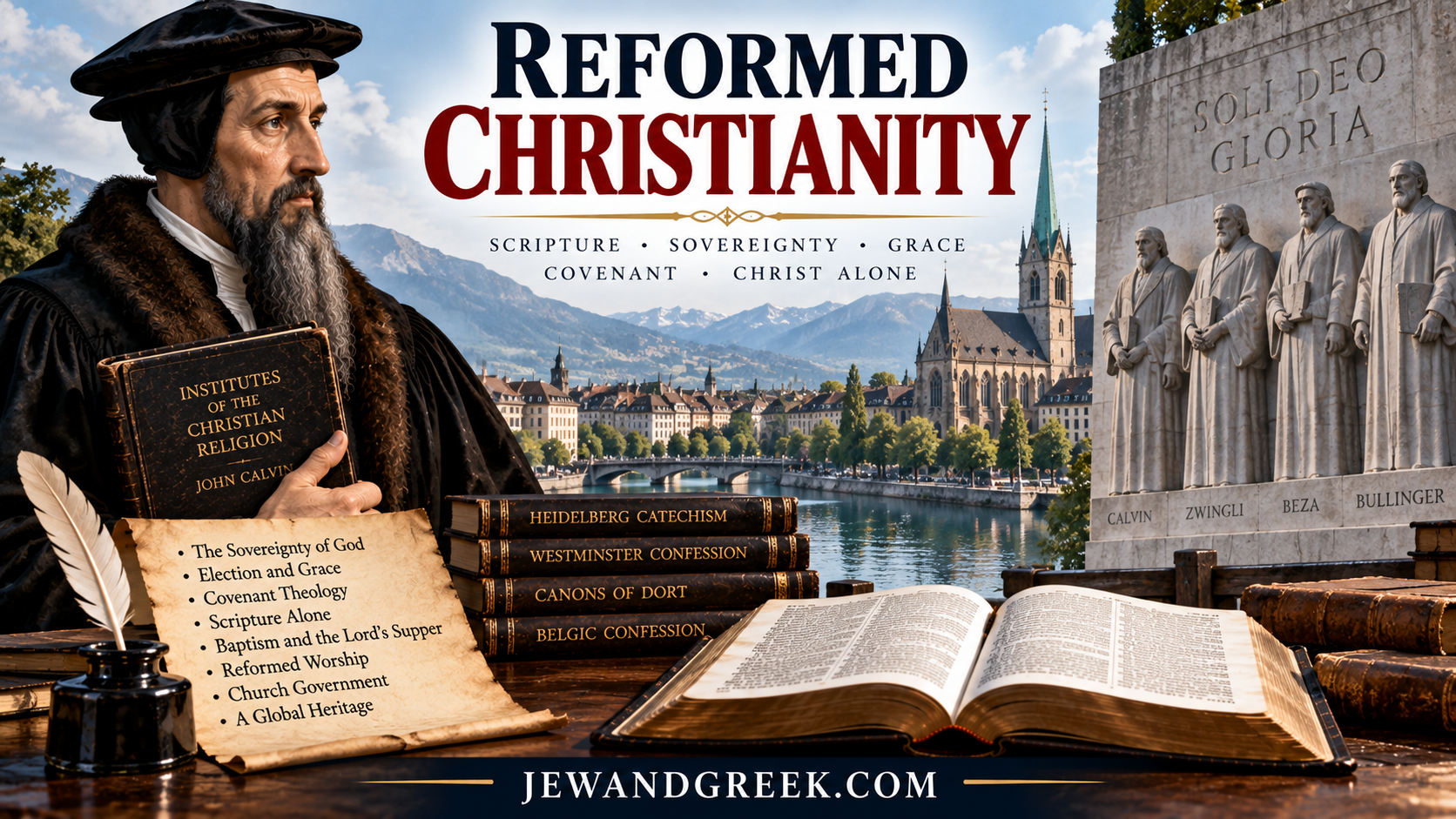
Reformed Christianity is one of the major theological traditions that emerged from the Protestant Reformation. Developing primarily in Switzerland during the sixteenth century, it became associated especially with reformers such as Huldrych Zwingli, John Calvin, Heinrich Bullinger, and Theodore Beza.
From Switzerland, Reformed theology spread throughout Europe and eventually around the world. Presbyterian churches developed from the Reformed tradition, as did the Dutch Reformed churches, Congregationalists, and numerous later Evangelical movements.
Reformed Christianity shares the central convictions of the Protestant Reformation while placing particular emphasis on the sovereignty of God, the authority of Scripture, covenant theology, and salvation by divine grace.
The Swiss Reformation
The Reformed tradition developed alongside, but independently from, Martin Luther’s reforms in Germany.
In Zürich, Huldrych Zwingli began preaching systematically through the Bible and challenging practices he believed lacked biblical support.
Beginning in the early 1520s, Zürich introduced extensive reforms to worship and church life. Images were removed from churches, the Mass was replaced by a simpler service, clerical celibacy was rejected, and preaching from Scripture became central.
Zwingli agreed with Luther on many Reformation doctrines, but the two men differed significantly concerning the Lord’s Supper.
Their disagreement became particularly clear at the Marburg Colloquy of 1529. Although they agreed on most issues discussed, they could not reach agreement concerning Christ’s presence in Communion.
This disagreement contributed to the development of Lutheran and Reformed Christianity as distinct Protestant traditions.
John Calvin and Geneva
The theologian most closely associated with Reformed Christianity is John Calvin.
Born in France in 1509, Calvin embraced the Protestant cause as a young man and eventually became a leading reformer in Geneva.
His most famous work, the Institutes of the Christian Religion, first published in 1536 and expanded repeatedly throughout his life, became one of the most influential works of Protestant theology.
Calvin sought to provide a systematic explanation of Christian belief centered on the glory and sovereignty of God.
His influence extended far beyond Geneva.
Students, pastors, and refugees who encountered Reformed theology carried its teachings into France, Scotland, England, the Netherlands, Germany, Hungary, and elsewhere.
Geneva consequently became an important center for the international Reformation.
The Authority of Scripture
Like other Protestant traditions, Reformed Christianity affirms sola Scriptura.
Scripture is regarded as the supreme written authority for Christian doctrine and practice.
Historic Reformed theology nevertheless places considerable value on creeds, confessions, catechisms, and theological scholarship.
These documents do not possess authority equal to Scripture. Rather, they serve as summaries of what Reformed churches believe Scripture teaches.
This combination of strong biblical authority and systematic theological reflection became one of the characteristic features of the Reformed tradition.
The Sovereignty of God
Perhaps no theme is more strongly associated with Reformed theology than the sovereignty of God.
God is understood as the sovereign Creator and ruler of everything that exists.
Nothing ultimately lies outside God’s providential rule.
This conviction affects Reformed understandings of creation, history, salvation, worship, and Christian life.
The emphasis on sovereignty is not intended merely as an abstract philosophical doctrine. Reformed Christians have traditionally viewed it as a source of confidence that history and salvation ultimately depend upon God’s purposes rather than human power or chance.
Human Sin and Divine Grace
Historic Reformed theology emphasizes the seriousness of humanity’s fallen condition.
Sin affects every aspect of human existence. Human beings therefore cannot restore themselves to fellowship with God through moral improvement, religious effort, or unaided free choice.
Salvation must originate with divine grace.
Like Lutherans, Reformed Christians affirm justification by faith alone. Sinners are accepted by God because of Christ rather than because of their own righteousness.
Reformed theology, however, developed a particularly detailed understanding of God’s sovereign initiative in salvation.
Election and Predestination
The doctrine of predestination is closely associated with Calvinism, although Calvin did not invent it. Earlier Christian theologians—most notably Augustine—and other Protestant Reformers also taught strong doctrines of divine election.
Historic Reformed theology teaches that God’s decision to save is ultimately grounded in God’s gracious purpose rather than foreseen human merit.
Calvin understood election as a consequence of salvation by grace: if fallen humanity cannot save itself, salvation must ultimately originate with God.
Later Reformed theologians developed these ideas further.
Predestination became one of the major points of disagreement between Reformed Christians and theological traditions that emphasized a stronger role for human freedom in responding to grace.
Calvinism and the Five Points
Reformed theology is frequently summarized through the Five Points of Calvinism, commonly remembered by the acronym TULIP:
Total Depravity — Sin affects the whole person, leaving humanity unable to achieve salvation apart from God’s grace.
Unconditional Election — God’s election is based upon his gracious purpose rather than foreseen human merit.
Limited Atonement — Often called particular redemption, this teaches that Christ’s saving work was intended effectively to secure the salvation of the elect.
Irresistible Grace — God’s saving grace effectively brings those whom God calls to faith.
Perseverance of the Saints — Those genuinely brought to saving faith by God will ultimately persevere in faith.
Despite their popular association with Calvin himself, these five points were formulated later in response to theological disputes involving followers of Jacobus Arminius.
They therefore should not be treated as a complete summary of either Calvin’s theology or the broader Reformed tradition.
The Synod of Dort
A major controversy developed within the Dutch Reformed churches after the death of Jacobus Arminius.
His followers, known as the Remonstrants, challenged aspects of prevailing Reformed teaching concerning election, grace, and perseverance.
The Synod of Dort, meeting from 1618 to 1619, rejected the Remonstrant position and articulated doctrines that later became summarized as the Five Points of Calvinism.
The controversy helped establish one of the most enduring theological divisions within Protestantism: Calvinism and Arminianism.
That debate continues in various forms among Protestants today.
Covenant Theology
Another major characteristic of Reformed Christianity is covenant theology.
Reformed theologians understand the biblical story through God’s covenant relationships with humanity.
Although particular systems vary, classical covenant theology commonly speaks of a covenant of works associated with Adam and a covenant of grace through which God brings salvation after humanity’s fall.
The biblical covenants with Noah, Abraham, Israel, David, and the new covenant in Christ are interpreted within this broader theological framework.
Covenant theology strongly influences Reformed understandings of salvation, the church, baptism, and the relationship between the Old and New Testaments.
Baptism
Reformed churches traditionally practice infant baptism as well as the baptism of converts.
Unlike Baptists, Reformed Christians generally understand the children of believers as belonging to the visible covenant community and therefore as appropriate recipients of the covenant sign of baptism.
Reformed theology does not ordinarily teach that baptism automatically guarantees salvation.
Rather, baptism is understood as a sign and seal of God’s covenant promises.
This understanding reflects the close connection between Reformed sacramental theology and covenant theology.
Later Christians who embraced Reformed views of salvation while rejecting infant baptism became an important stream within Reformed Baptist Christianity.
The Lord’s Supper
Calvin’s understanding of the Lord’s Supper differed both from Roman Catholicism and from the strongly memorial interpretation associated with Zwingli.
Calvin rejected transubstantiation and did not believe Christ’s physical body was locally present in the bread and wine.
Nevertheless, he rejected the idea that Communion was merely an act of remembrance.
Calvin taught that believers genuinely participate in Christ through the Holy Spirit in the Lord’s Supper.
This understanding is often described as the spiritual presence of Christ.
The Reformed tradition therefore historically occupied a position distinct from both Lutheran sacramental theology and purely memorial views of Communion.
Worship
Reformed worship developed around the conviction that God should be worshiped according to his revealed will.
Some Reformed theologians developed what became known as the regulative principle of worship: the church should include in worship only those elements warranted by Scripture.
Historically, this produced relatively simple worship services centered on preaching, prayer, Scripture reading, congregational singing, and the sacraments.
Some early Reformed churches removed religious images and elaborate ceremonial practices they believed lacked biblical authorization.
Modern Reformed churches vary considerably in worship style, ranging from traditional liturgical services to contemporary Evangelical worship.
Church Government
The Reformed tradition produced several forms of church government, but presbyterian government became particularly influential.
The term comes from the Greek word presbyteros, meaning elder.
In Presbyterian churches, congregations are governed by elders rather than by a single bishop or independent congregation.
Local churches participate in broader representative bodies such as presbyteries and general assemblies.
Other churches influenced by Reformed theology developed congregational forms of government in which individual congregations possess greater independence.
Consequently, Reformed theology is not limited to a single denominational structure.
The Reformation in Scotland
Reformed Christianity became particularly influential in Scotland through John Knox.
Knox spent time in Geneva and strongly admired Calvin’s reforms.
After returning to Scotland, he became a leading figure in the Scottish Reformation.
The resulting Church of Scotland developed along Reformed and Presbyterian lines.
Scottish Presbyterianism subsequently became a major influence in Ireland, North America, and other parts of the English-speaking world.
Reformed Confessions
Reformed churches produced numerous confessions and catechisms explaining their theology.
Among the most influential are the Belgic Confession, the Heidelberg Catechism, and the Canons of Dort, often known collectively as the Three Forms of Unity.
In the English-speaking Presbyterian tradition, the Westminster Confession of Faith and the Westminster catechisms became particularly important.
These documents address far more than predestination. They contain extensive treatments of Scripture, God, creation, providence, Christ, salvation, the church, sacraments, Christian ethics, and the last things.
Puritanism and the Reformed Tradition
Reformed theology strongly influenced the English Puritan movement.
Puritans sought further reform of the Church of England according to principles they believed were derived from Scripture.
Some remained within Anglicanism, while others developed Presbyterian, Congregationalist, or Separatist churches.
Puritan theology became particularly influential in colonial New England and produced a large body of devotional and theological literature.
Later Evangelical movements inherited important elements of this Reformed and Puritan tradition.
Reformed Christianity Today
Today, Reformed Christianity includes Presbyterian churches, Dutch and continental Reformed denominations, Congregational traditions, Reformed Baptists, and numerous Evangelical churches influenced by Calvinist theology.
Considerable diversity exists within this family.
Some denominations maintain strict adherence to historic confessional standards. Others identify with the Reformed tradition while adopting more modern theological approaches.
Still others, particularly within contemporary Evangelicalism, describe themselves as Reformed primarily because they affirm Calvinistic doctrines of salvation.
Consequently, Reformed and Calvinist are related terms but are not always interchangeable.
Historic Reformed Christianity encompasses a broader theological tradition involving covenant theology, sacraments, worship, ecclesiology, and confessional identity in addition to doctrines of election.
Reformed Christianity in Perspective
Reformed Christianity represents one of the most influential streams of Protestant thought.
Its theological heritage extends from Zwingli and Calvin through the Presbyterian, Dutch Reformed, Puritan, Congregationalist, and later Evangelical traditions.
Its characteristic emphases include the sovereignty of God, the authority of Scripture, salvation by grace, covenant theology, divine election, disciplined worship, and the glory of God.
Although Reformed Christians continue to disagree among themselves on important questions, the tradition remains united by a theological vision in which every dimension of Christian faith and life ultimately exists under the sovereign rule of God.