
The Independent Christian Churches and Churches of Christ are probably the least understood of the three major branches of the Restoration Movement, partly because their name creates almost as much confusion as it clears up. They aren’t the same as the Churches of Christ we just discussed, even though some of their congregations are called Churches of Christ. They aren’t part of the Christian Church (Disciples of Christ), even though many of their congregations are called Christian Churches.
Confused yet?
The easiest way to understand them is to think of them as the conservative, evangelical branch of the Restoration Movement that uses instrumental music. That’s an oversimplification, but it’s a pretty good place to start.
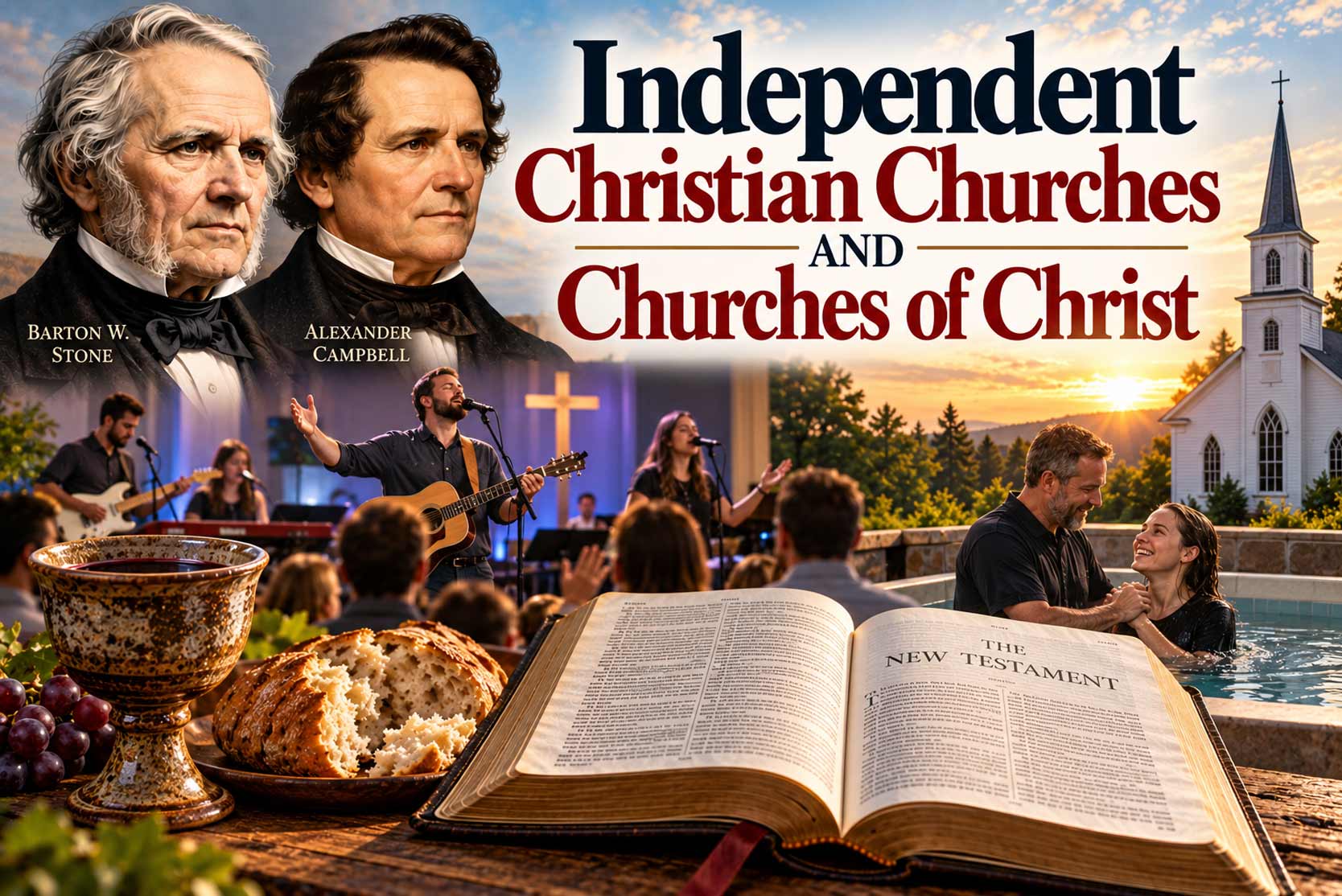
Like the other Restoration churches, they trace their history primarily through Barton W. Stone and Alexander Campbell and the nineteenth-century attempt to restore New Testament Christianity. They practice baptism by immersion, normally observe the Lord’s Supper every Sunday, reject denominational creeds and emphasize the independence of the local congregation. But unlike traditional Churches of Christ, they generally use musical instruments in worship.
And unlike the Disciples of Christ, they never developed into a centralized mainline Protestant denomination.
So Where Did They Come From?
Originally, there weren’t three clearly defined branches of the Restoration Movement. There were congregations calling themselves Churches of Christ, Christian Churches or Disciples of Christ, often without the names carrying the precise meanings they have today.
The first major division produced the separation between the instrumental Christian Churches and the a cappella Churches of Christ. That division developed during the nineteenth century over instrumental music, missionary societies and the larger question of what the New Testament authorizes the church to do.
The churches that accepted instruments and cooperative missionary organizations remained associated with what eventually became known broadly as the Christian Church or Disciples of Christ. But that didn’t end the divisions.
During the late nineteenth and especially the twentieth century, significant theological differences developed within the Disciples. Some ministers and congregations became more receptive to liberal Protestant theology, biblical criticism and the increasingly denominational structure of the movement. Conservatives resisted those developments. They didn’t want a denominational headquarters telling autonomous congregations what to believe or do. They also believed the authority of Scripture and the original Restoration principles were being weakened. So another separation gradually developed.
Unlike a church split where everybody meets on Tuesday night, votes and goes home belonging to two different denominations, this one took decades. Congregations, colleges, missionary organizations and publications gradually aligned with one side or the other. By the twentieth century, a recognizable network of independent Christian Churches and Churches of Christ had emerged.
Independent Means Independent
The word “Independent” is important. There is no denomination called the Independent Christian Church with a national headquarters controlling its congregations. Local churches are autonomous. One congregation doesn’t answer to another congregation, and there is no bishop or denominational executive who can appoint or remove its minister. That makes them similar to Churches of Christ.
Independent Christian Churches do cooperate extensively, however. They support missionaries, colleges, church-planting organizations, conferences, camps and other ministries. The distinction they make is between voluntary cooperation and denominational control.
A congregation can financially support a missionary organization without surrendering its authority to that organization. It can participate in a convention without the convention becoming a governing body. That’s a very Restoration Movement way of doing things: cooperate when useful, but don’t build an ecclesiastical hierarchy over the local church.
What Do They Believe?
Theologically, most Independent Christian Churches are conservative and evangelical. They believe in the inspiration and authority of Scripture, the Trinity, the deity of Christ, His virgin birth, His death for sin, His bodily resurrection and His eventual return. Salvation comes through Jesus Christ rather than through church membership or human merit.
Like other Restoration churches, they have historically been reluctant to adopt formal denominational creeds. You’ll sometimes encounter the old slogan “No creed but Christ, no book but the Bible.”
That doesn’t mean they have no doctrinal standards. Individual churches, colleges and ministry organizations frequently publish statements of faith. The difference is that there isn’t a denominational confession imposed on every congregation. That can produce some variation from church to church, but the movement as a whole has remained considerably more conservative than the Disciples of Christ.
Baptism
Baptism is one place where their Restoration heritage becomes especially obvious. Independent Christian Churches practice believer’s baptism by immersion and generally connect baptism more closely with conversion than many Baptists and other evangelicals do.
Acts 2:38 is important here. When Peter tells the crowd to “repent, and be baptized” for the forgiveness of sins, Restoration churches have traditionally taken that language seriously. As with Churches of Christ, this sometimes produces arguments over baptismal regeneration. Independent Christian Churches generally don’t teach that water itself saves anyone or that baptism earns salvation. Salvation is through Christ and depends entirely upon what He accomplished. But neither do they normally treat baptism as an optional ceremony that can be separated indefinitely from conversion.
The New Testament pattern is belief, repentance, confession and baptism. Rather than spending a lot of time trying to determine the precise fraction of a second in which regeneration occurs, many Christian Churches simply tell believers to do what converts in the New Testament did.
Believe in Christ and be baptized. That approach is thoroughly Restorationist.
Communion Every Sunday
Independent Christian Churches also normally celebrate the Lord’s Supper every Sunday. This is one of the practices shared across all three major branches of the Restoration Movement. Acts 20:7 describes Christians gathering on the first day of the week to break bread, and Restoration churches generally concluded that Communion belonged in the regular weekly worship of the church.
For Christians accustomed to taking Communion quarterly or a few times a year, that may seem unusual. In a Christian Church, it would be unusual not to have it. The service itself is generally simple. Bread and grape juice are distributed following prayer and perhaps a short meditation on the death of Christ. There is no priestly consecration of the elements and no doctrine of transubstantiation. It’s simply part of what Christians do when they gather on Sunday.
Yes, They Have Instruments
This is the easiest way to distinguish an Independent Christian Church from a traditional Church of Christ. They use instruments. Historically that might have meant a piano or organ. Today it could mean guitars, drums, keyboards and a full contemporary worship band.
Independent Christian Churches don’t accept the argument that the absence of instrumental music from New Testament descriptions of Christian worship constitutes a prohibition against it. If Scripture doesn’t forbid instruments, they generally see no reason Christians can’t use them. That puts them on the other side of one of the oldest controversies in Restoration history.
The disagreement can look rather strange from outside the movement. Two churches may agree about the authority of Scripture, baptism, Communion, congregational government, salvation and most major Christian doctrines, yet have historically belonged to different branches because one has a piano.
But again, the real argument was never just about the piano. It was about how biblical authority works.
What Would One Look Like Today?
Here’s where things become interesting. Walk into a large Independent Christian Church today without knowing its history and you might never guess that it came from the Restoration Movement. It may look like a contemporary evangelical megachurch. There may be a worship band, large video screens, children’s ministries, small groups, coffee in the lobby and a pastor preaching in jeans.
The church might even have a name that doesn’t tell you anything about its heritage. Something like Journey Christian Church, Community Christian Church or simply The Crossing isn’t going to immediately make you think about Alexander Campbell. But look more closely and the Restoration DNA begins to appear.
They baptize believers by immersion. They celebrate Communion every Sunday. The congregation is independent. There is no denominational headquarters. The church is normally led by elders. And somewhere in its explanation of what it believes, you’re likely to find a strong emphasis on the Bible rather than a historic denominational confession.
The packaging has changed considerably. The underlying structure hasn’t changed nearly as much.
Christian Churches or Churches of Christ?
Unfortunately, the names don’t make this any easier. A congregation in this tradition may be called First Christian Church, Central Christian Church, Southeast Christian Church or something entirely different. Some use the name Church of Christ even though they aren’t part of the a cappella Churches of Christ.
You can’t always identify the affiliation from the sign out front. One clue is instrumental music. If a congregation calls itself a Church of Christ and has a worship band, there’s a good chance it belongs to the independent Christian Church tradition rather than the traditional Churches of Christ.
But even that isn’t an absolute rule anymore because some Churches of Christ have begun using instruments. Welcome to church history.
Somewhere Between the Other Two
If you’re trying to place Independent Christian Churches on the Restoration family tree, they occupy an interesting position. They share the conservative theology, congregational autonomy, baptism by immersion and strong concern for New Testament Christianity found in Churches of Christ. But they don’t share the traditional Church of Christ prohibition against instrumental music and have generally been more willing to use contemporary methods of ministry.
At the same time, they share historical roots with the Disciples of Christ but rejected the denominational structure and theological direction the Disciples increasingly adopted during the twentieth century. That leaves them occupying territory that will look remarkably familiar to many American evangelicals. In fact, someone could attend an Independent Christian Church for years without realizing that he’s participating in a movement whose roots reach back to Barton Stone, Alexander Campbell and the frontier revivals of the early nineteenth century.
But every Sunday, when believers gather around the Communion table, baptize new converts by immersion and open the New Testament to ask what the church ought to be, the old Restoration Movement is still there. You just may have to look past the guitars to see it.