

Georgia is a relatively small country tucked into the Caucasus between Europe and Asia, but its Christian history is anything but small. Christianity became the official religion of the ancient Georgian kingdom of Iberia in the fourth century, making Georgia one of the earliest Christian nations in the world. For centuries afterward, Georgian Orthodox Christianity survived invasions by Persians, Arabs, Mongols, Turks, and Russians, followed by decades of Communist persecution under the Soviet Union. Through all of it, the church became so closely intertwined with Georgian identity that it’s difficult to tell the history of one without telling the history of the other.
The Georgian Orthodox Church is an autocephalous member of Eastern Orthodoxy, sharing the theology, mysteries, liturgy, icons, monasticism, and understanding of salvation we’ve discussed in our Eastern Orthodoxy overview. But Georgia brings something distinctive to the story. It isn’t Greek, Slavic, or Romanian. It has its own ancient language, alphabet, Christian literature, saints, architecture, and liturgical traditions. In a region repeatedly conquered by much larger powers, Orthodoxy became one of the principal ways Georgians remembered who they were.
Did the Apostle Andrew Go to Georgia?
Like several ancient Orthodox churches, the Georgian Church traces its beginnings all the way back to the apostles. Georgian tradition maintains that the Apostle Andrew preached in the region during the first century. Other traditions associate additional apostles with the evangelization of the Caucasus.
Those apostolic traditions are important to Georgian Christianity, but the historically clearer story begins several centuries later with a woman named Nino. And she is one of the most remarkable women in early Christian history.
Saint Nino
Saint Nino—or Nina—was a Christian woman traditionally said to have come from Cappadocia in Asia Minor. She arrived in the Georgian kingdom of Iberia during the early fourth century and began preaching Christianity. According to Georgian tradition, she carried a cross made from grapevines bound together with strands of her own hair. The grapevine cross remains one of the most recognizable symbols of Georgian Christianity.
Nino eventually came into contact with Queen Nana and King Mirian III. The traditional account says that Mirian was hunting when darkness suddenly descended upon him. After prayers to his pagan gods accomplished nothing, he prayed to Nino’s God and promised to worship Him if the darkness disappeared. Light returned, and Mirian subsequently embraced Christianity.
Whatever details we can reconstruct historically, the larger event is well established: Christianity became the official religion of the kingdom during the fourth century, traditionally dated to the 330s. The ancient capital of Mtskheta became the spiritual center of Georgian Christianity, and Saint Nino became known as the Enlightener of Georgia.
Most Americans have probably never heard of her. In Georgia, she’s one of the most important people in the country’s history.
The Church with Christ’s Robe
Mtskheta contains another fascinating Georgian Christian tradition. Svetitskhoveli Cathedral, one of the country’s holiest churches, stands on a site associated with the conversion of Georgia and with a much older story concerning the crucifixion of Jesus.
According to Georgian tradition, a Jewish man from Mtskheta named Elias was in Jerusalem at the time of the crucifixion and obtained Christ’s robe. He brought it home to Georgia, where his sister Sidonia took the garment, clutched it to herself, and died overcome with emotion. Because the robe couldn’t be removed from her hands, she was supposedly buried with it.
A cedar eventually grew over her grave. Centuries later, when King Mirian ordered a church constructed there following his conversion, the cedar was cut down and made into pillars. One pillar supposedly couldn’t be moved until Saint Nino prayed, after which it miraculously returned to earth and produced healing myrrh. The name Svetitskhoveli means something like “Life-Giving Pillar.”
Whether Christ’s robe actually lies beneath the cathedral is a matter of tradition rather than something historians can establish. But the story has shaped Georgian Christianity for centuries, and the site itself is unquestionably ancient. The present Svetitskhoveli Cathedral dates primarily from the eleventh century, while earlier churches occupied the location. Together with Jvari Monastery and Samtavro Monastery, it forms part of the UNESCO-listed historical monuments of Mtskheta.
That’s a lot of Christian history packed into one little Georgian town.
A Church of Its Own
As Georgian Christianity developed, its church gradually achieved independence from outside ecclesiastical authorities. Exactly when full Georgian autocephaly developed is historically complicated, and different sources assign different dates to stages in the process. What matters for our purposes is that the Georgian Church became an ancient self-governing church rather than simply a distant branch administered by Constantinople or another patriarchate.
Its head came to bear the unusual title Catholicos-Patriarch of All Georgia. Catholicos is an ancient ecclesiastical title used in several Eastern Christian traditions and shouldn’t be confused with “Catholic” in the modern Roman Catholic sense.
The Georgian Church’s own constitutional relationship with the modern Georgian state describes it as autocephalous since the fifth century. Its ancient ecclesiastical center remains Mtskheta, even though Tbilisi became the political capital and an important patriarchal center. By the medieval period, an independent Georgian church had become one of the foundations of a distinctly Georgian Christian civilization.
Georgia’s Golden Age
Georgia reached the height of its medieval power during the eleventh through thirteenth centuries. One of the most famous rulers of this period was David IV, usually called David the Builder, who reigned from 1089 to 1125. David strengthened the Georgian state, defeated invading forces, promoted education, and became an important patron of the church.
Then came one of Georgia’s most famous rulers: Tamar. She’s usually called Queen Tamar, but the Georgian royal tradition treated her authority so seriously that she’s sometimes described as “King Tamar.” She ruled from 1184 until 1213 during what became the great golden age of medieval Georgia.
Under Tamar, Georgia became a major regional power. Georgian art, architecture, literature, and monasticism flourished, and the kingdom extended its influence throughout the Caucasus. Tamar was eventually canonized by the Georgian Orthodox Church.
So one of medieval Orthodox Christianity’s most celebrated rulers was a woman commanding a powerful Christian kingdom in the Caucasus. There’s another “I didn’t know that” for the pile.
Georgian Monks Went Everywhere
Georgian Christianity wasn’t confined to Georgia. Georgian monks established or inhabited monasteries throughout the Christian East, including communities in Jerusalem, Sinai, Antioch, and Mount Athos. The Georgian Iviron Monastery on Mount Athos became one of the Holy Mountain’s great monastic houses and remains there today.
These monasteries became centers for translating Christian literature into Georgian. Scripture, theology, sermons, saints’ lives, and liturgical works circulated through Georgian monastic networks, helping create a rich Christian literary culture. This matters because Georgia wasn’t simply receiving Christianity from the Byzantine world. Georgians became active participants in the intellectual and spiritual life of Eastern Christianity. They developed their own Christian literature, architecture, hymnody, manuscript traditions, and monastic culture while remaining part of the larger Orthodox world.
A Language All Its Own
Walk into a Georgian Orthodox church and you may notice something immediately: the writing doesn’t look Greek, Cyrillic, Latin, Hebrew, or Arabic. Georgia has its own alphabet. The Georgian script is one of the world’s distinctive writing systems, and Christian literature played an enormous role in its historical development and preservation. Some of the earliest surviving Georgian texts are Christian, and Scripture and liturgical literature helped establish Georgian as a literary language.
That made the church more than a religious institution. Through centuries of foreign domination, churches and monasteries became guardians of the Georgian language and written culture. It’s a recurring pattern in the Orthodox countries we’ve been studying. When the state disappeared, the church often remained. And Georgia’s state disappeared more than once.
Between Christian and Muslim Empires
Georgia’s geography placed it in a dangerous neighborhood. The Caucasus stood between powerful empires, and Georgia repeatedly found itself caught between them. Persian armies invaded. Arab forces conquered Tbilisi. Seljuk Turks entered the region. Mongols arrived in the thirteenth century. Later, Ottoman Turks and Persian dynasties competed for control and influence.
Christian Georgia sometimes survived as an independent kingdom and sometimes fractured into smaller kingdoms and principalities. Churches were destroyed and rebuilt. Monasteries suffered and recovered. Georgian rulers sometimes had to maneuver between larger Muslim empires simply to survive. Yet Georgia remained overwhelmingly identified with Christianity.
That fact became increasingly important because religion distinguished Georgians from many of the powers surrounding them. Orthodoxy became not only a faith but one of the markers separating Georgian identity from Persian and Ottoman political domination. Eventually Georgian rulers looked north for help from another Orthodox power – Russia. That didn’t turn out quite the way they expected.
Russia Comes to “Protect” Georgia
By the eighteenth century, the Georgian kingdom of Kartli-Kakheti faced continuing pressure from Persia and the Ottoman Empire. King Erekle II sought Russian protection, and in 1783 Georgia and the Russian Empire signed the Treaty of Georgievsk.
Russia was Orthodox. Georgia was Orthodox. An alliance with a powerful Christian empire must have seemed preferable to continued vulnerability before Persia and the Ottomans. But Russia eventually did more than protect Georgia.
In 1801 the Russian Empire annexed the eastern Georgian kingdom. Then, in 1811, the Russian authorities abolished the Georgian Church’s autocephaly and placed it under the administration of the Russian Orthodox Church. The office of Catholicos-Patriarch disappeared, and Russian ecclesiastical control replaced Georgia’s ancient self-government.
Think about that for a moment. The Georgian Church had survived centuries of pressure from Muslim empires only to lose its independence to another Orthodox Christian country. History has a sense of irony.
Getting the Church Back
During the nineteenth century, Georgian clergy and intellectuals increasingly campaigned for the restoration of their church’s independence. The issue became closely connected with the broader revival of Georgian national identity. The opportunity finally arrived during the upheaval of the Russian Revolution.
In March 1917, Georgian clergy meeting at Svetitskhoveli Cathedral restored the autocephaly of the Georgian Orthodox Church after 106 years of Russian control. Kirion II was elected Catholicos-Patriarch.
Georgia itself briefly became an independent republic in 1918. Neither freedom lasted peacefully for long. The Bolsheviks were coming.
Soviet Persecution
The Red Army invaded Georgia in 1921, and Georgia was eventually incorporated into the Soviet Union. The Georgian Orthodox Church now faced something much worse than Russian ecclesiastical control: an aggressively atheistic Communist government.
Churches were closed or destroyed, monasteries were suppressed, property was confiscated, clergy were arrested, and religious education was attacked. The scale of the destruction was enormous. Orthodox Church in America historical material records that Georgia had thousands of churches in 1921 but only a tiny fraction remained open by the late Soviet period.
One of the great Georgian church leaders of this era was Catholicos-Patriarch Ambrosi. He publicly protested Soviet policies and appealed internationally on Georgia’s behalf. Soviet authorities arrested him, and he was eventually imprisoned. The Georgian Church survived, but Soviet rule severely weakened an institution that had been part of Georgian life for more than fifteen centuries. Then, in 1977, a new patriarch was elected. His name was Ilia II.
Ilia II and the Revival of Georgian Christianity
Ilia II became Catholicos-Patriarch of All Georgia in 1977, when the Soviet Union still seemed firmly established. He would lead the Georgian Church for nearly half a century and became one of the most important religious figures in modern Georgian history.
Under his leadership, the church began a remarkable revival. The process accelerated dramatically as Soviet restrictions weakened during the 1980s and Georgia regained independence in 1991. Churches reopened, monasteries revived, theological education expanded, and Orthodox Christianity returned visibly to public life.
There was also unfinished business concerning autocephaly. Georgia regarded its independence as ancient and restored in 1917, but questions surrounding its recognition had lingered within the Orthodox world. In 1990 the Ecumenical Patriarchate formally recognized the autocephaly and patriarchal status of the Georgian Church.
Ilia II remained patriarch until his death in March 2026. That means something rather remarkable happened this year.
A New Patriarch in 2026
For almost fifty years, Ilia II was the face of Georgian Orthodoxy. Many Georgians had never known another patriarch.
Following his death on March 17, 2026, the Holy Synod elected Metropolitan Shio of Senaki and Chkhorotsku as the new Catholicos-Patriarch on May 11. He took the name Shio III and was enthroned at Svetitskhoveli Cathedral in Mtskheta—the same ancient spiritual center associated with Saint Nino, King Mirian, and the Christianization of Georgia. Vatican News
There’s something wonderfully fitting about that continuity. A twenty-first-century patriarch assumes leadership in a cathedral standing on a Christian site whose story reaches back to the fourth century. Georgia has changed governments, borders, kingdoms, empires, and political systems. Mtskheta is still there.
Church and State in Modern Georgia
The Georgian Orthodox Church occupies an unusually prominent position in modern Georgian society. Georgia isn’t legally an Orthodox theocracy, and its constitutional framework recognizes the independence of church and state. At the same time, the Georgian state formally recognizes the church’s exceptional historical role in shaping Georgian culture and national identity.
That relationship was formalized in a 2002 constitutional agreement between the Georgian government and the Orthodox Church. The agreement recognizes the church as a historic public-law institution while affirming mutual independence between church and state.
As we’ve seen in Russia, Serbia, Romania, and Bulgaria, cultural Orthodoxy and active Christian practice aren’t necessarily identical. Someone may strongly identify Orthodoxy with Georgian identity without participating regularly in the sacramental life of the church. But in Georgia the historical connection is exceptionally deep. Christianity has been part of Georgian civilization for roughly seventeen centuries.
Crosses in the Mountains
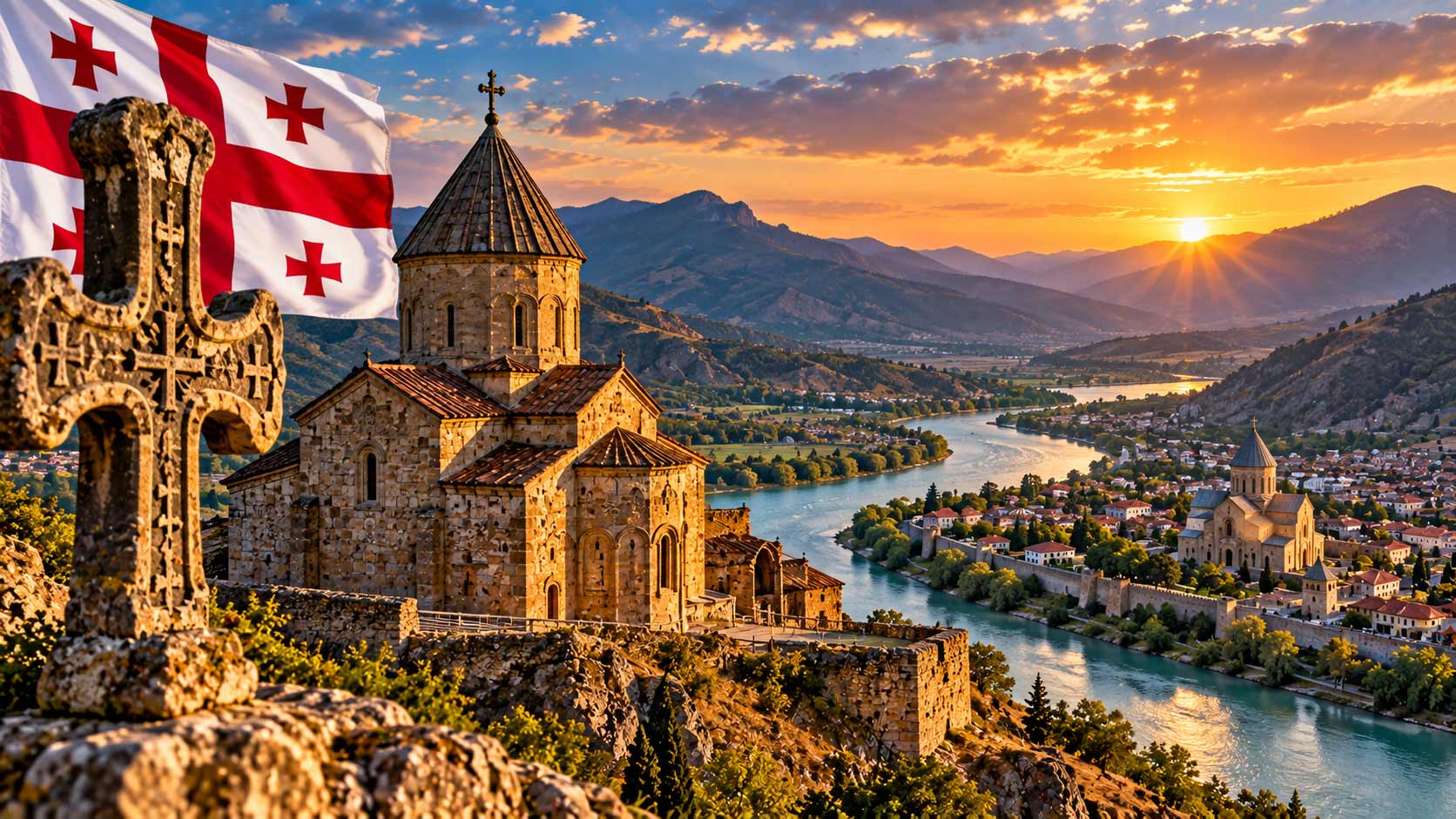
Perhaps the best symbol of Georgian Orthodoxy isn’t a patriarch or even a cathedral. It’s the sight of an ancient stone church sitting on a mountain ridge. Georgia is filled with them.
Some stand in towns that have been inhabited for centuries. Others sit above valleys, beside monasteries, or seemingly in the middle of nowhere. Their distinctive architecture—with stone walls, tall drums, conical domes, carved crosses, and relatively restrained exteriors—looks as though it grew naturally out of the Caucasus landscape.
Jvari Monastery overlooks the ancient capital of Mtskheta from a hill above the confluence of two rivers. Its present church dates from the sixth century and stands at a place associated with Saint Nino and the earliest period of Georgian Christianity. UNESCO regards Jvari, Svetitskhoveli, and Samtavro as outstanding examples of medieval Georgian religious architecture.
It’s difficult to imagine a better picture of Georgian Christianity: an ancient cross on a mountain overlooking a civilization that has repeatedly been invaded, conquered, divided, annexed, and liberated. And the cross is still there.
A Small Country with a Very Old Church
Georgia doesn’t have Russia’s population or Greece’s visibility in Western accounts of Christian history. Most American Christians could probably locate neither Mtskheta nor Svetitskhoveli on a map, and Saint Nino is considerably less familiar than Augustine, Luther, Calvin, or Wesley. But Georgian Christianity deserves to be known.
Georgia became Christian while the Roman Empire itself was still undergoing its Christian transformation. Saint Nino became one of history’s most successful female missionaries. Georgian monks participated in the wider Christian world from Jerusalem to Mount Athos. Kings and queens built monasteries and cultivated a distinctive Christian civilization. The church preserved Georgian language and identity through centuries of invasion and foreign domination.
Then an Orthodox empire abolished its independence. A Communist empire tried to suppress its faith. Both eventually disappeared from Georgia. The Georgian Orthodox Church didn’t. That’s why Georgian Orthodoxy belongs in our story of Eastern Christianity. Its theology is Eastern Orthodox, but its history is unmistakably Georgian—a story of an ancient Christian people living between empires and discovering, again and again, that political kingdoms don’t last nearly as long as faith can.