
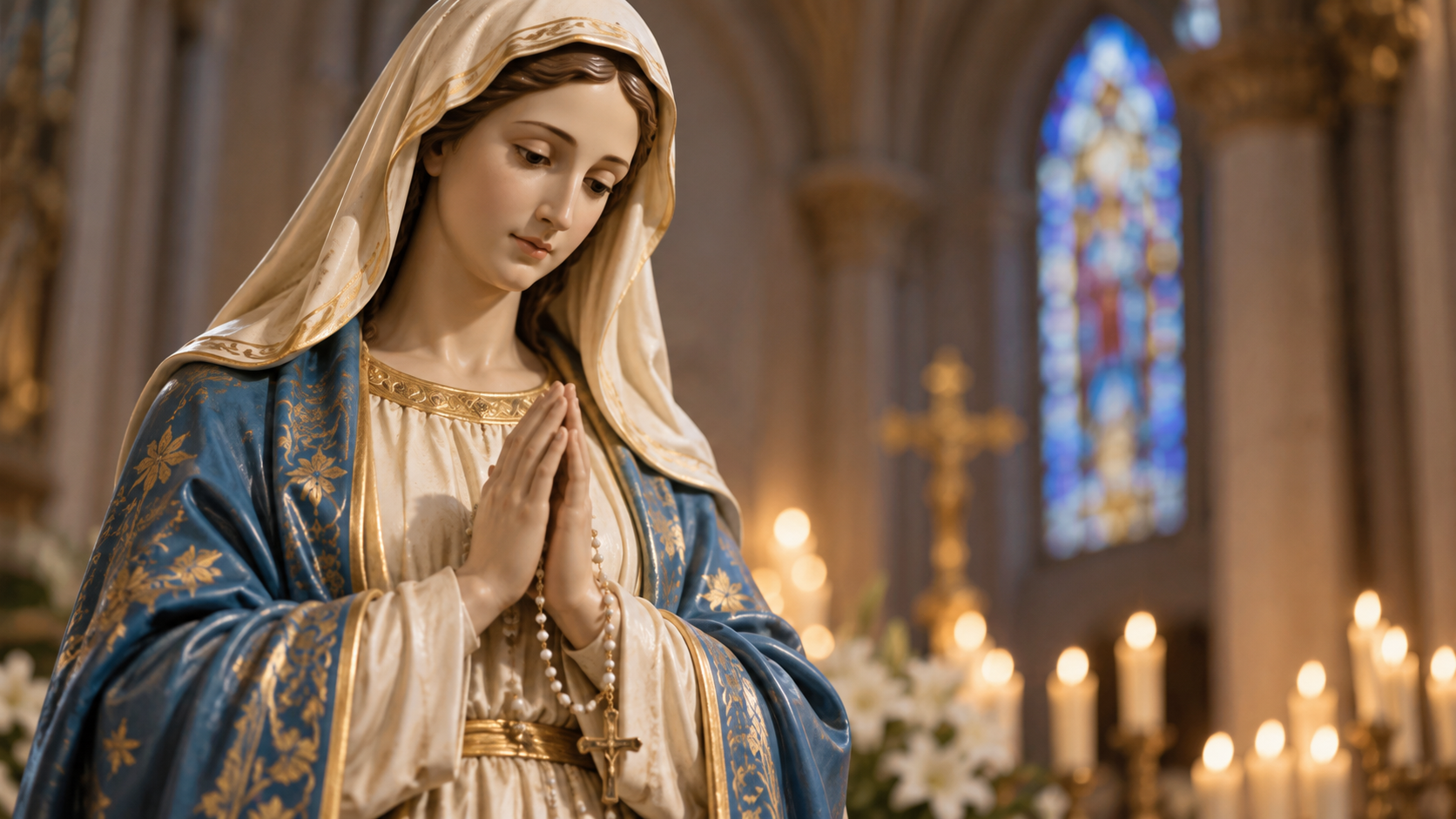
Mary occupies a unique place of honor within Roman Catholic devotion and theology.Few aspects of Roman Catholicism are more unfamiliar—or more controversial—to many Protestants than Catholic devotion to Mary and the saints. A Protestant entering a Catholic church may encounter statues of Mary, candles burning before images of saints, prayers asking saints for intercession, and titles for Mary that sound surprisingly exalted. Without understanding the theology behind these practices, it is easy to conclude that Catholics are simply worshiping people other than God.
Catholics reject that description. Catholic theology distinguishes between the worship owed to God alone and the honor given to the saints. Mary receives a unique degree of honor because of her relationship to Christ, but Catholic teaching does not regard her as divine. Whether the biblical and historical arguments justify these practices is a separate question. Before considering that question, it is important to understand what Catholics actually believe.
Mary, the Mother of Jesus
Catholics share with other Christians the belief that Mary was the virgin mother of Jesus and that she responded faithfully to God’s extraordinary calling upon her life. Where Catholicism differs from most Protestant traditions is in the extent to which later Christian theology developed doctrines and devotional practices concerning her.
Catholics commonly refer to Mary as the Mother of God, a title that can sound startling if its original purpose is misunderstood. The Greek term Theotokos, usually translated “God-bearer” or “Mother of God,” became particularly important during the Christological controversies of the fifth century. The title was intended primarily to say something about Jesus rather than to suggest that Mary existed before God or was the source of His divine nature. The child she bore was one person who was truly human and truly divine.
The Perpetual Virginity of Mary
Catholicism teaches that Mary remained a virgin throughout her life. This belief is known as the perpetual virginity of Mary and has a long history in Christian tradition. It was also accepted by a number of important Protestant Reformers, even though most Protestants today do not consider it a necessary Christian doctrine.
The principal biblical difficulty involves passages referring to the brothers and sisters of Jesus. Catholics have understood these references in several ways, including as relatives or as children of Joseph from a previous marriage. Protestants commonly understand the language more naturally as referring to children subsequently born to Mary and Joseph. The disagreement therefore involves both the interpretation of Scripture and the authority given to early Christian tradition.
The Immaculate Conception
The Immaculate Conception is frequently confused with the virgin birth of Jesus, but they are two different doctrines. The virgin birth concerns the conception of Jesus. The Immaculate Conception concerns the conception of Mary.
Defined as Catholic dogma in 1854, the doctrine teaches that Mary, from the first moment of her conception, was preserved from original sin by the grace of God in view of the saving work of Christ. Catholic theology therefore does not teach that Mary had no need of a Savior. Rather, it teaches that the grace of Christ was applied to her in a unique, preventative manner.
Most Protestants reject the doctrine because they do not believe Scripture teaches that Mary was conceived without original sin. The disagreement again illustrates the larger difference between Catholic and Protestant understandings of the relationship between Scripture and Tradition.
The Assumption of Mary
Catholicism also teaches the Assumption of Mary, formally defined as dogma by Pope Pius XII in 1950. According to this teaching, at the completion of her earthly life, Mary was taken body and soul into heavenly glory.
The Catholic definition does not settle the question of whether Mary died before her assumption. Eastern Christian traditions have historically spoken instead of the Dormition, or “falling asleep,” of Mary. Protestants generally reject the Assumption as a doctrine lacking sufficient biblical support.
The relatively late dates at which the Immaculate Conception and Assumption were formally defined sometimes create the impression that Catholics believe the doctrines were invented in the nineteenth and twentieth centuries. Catholics instead understand the definitions as formal declarations of beliefs that developed within the church over a much longer period. That raises an important question about doctrinal development, but it is not quite the same thing as claiming that a pope simply created a new belief one afternoon.
The Saints
In Catholic usage, a saint is a person who is with God in heaven. The church formally recognizes certain individuals as saints through a process called canonization, but Catholic theology does not teach that only canonized saints are in heaven.
Catholics honor saints because they regard them as examples of faithful Christian lives and members of the church who remain alive in Christ. Churches may be named for saints, feast days may commemorate them, and religious artwork frequently depicts them. Catholics also preserve relics associated with certain saints, a practice that has ancient roots but has often been controversial among Protestants.
Praying to the Saints
When Catholics speak of “praying to” a saint, they generally mean asking that saint to pray for them. The Catholic argument is that Christians routinely ask other believers on earth to pray for them, and death does not sever believers in heaven from the body of Christ. Asking a saint for intercession is therefore understood as an extension of the communion that exists among Christians.
Most Protestants object that the New Testament instructs believers to pray to God and presents Christ as the mediator between God and humanity. They question both whether departed believers can hear such requests and whether Scripture gives Christians any reason to address them. Catholics respond by distinguishing Christ’s unique mediatorial work of salvation from the intercessory prayers Christians offer for one another.
The disagreement therefore involves more than terminology. It raises questions about prayer, the state of believers after death, the communion of saints, and the biblical basis for Christian practices.
Worship and Veneration
Catholic theology makes a formal distinction between the worship given to God and the honor given to the saints. The traditional term latria refers to the worship due to God alone, while dulia refers to the veneration given to saints. Mary receives a distinctive form of honor traditionally called hyperdulia, reflecting her unique place as the mother of Jesus.
Those distinctions matter when describing Catholic belief fairly. Saying that Catholic doctrine officially teaches Christians to worship Mary would be inaccurate. At the same time, Protestants may still question whether particular forms of Marian devotion or veneration of saints maintain those distinctions clearly enough in actual practice. Understanding what Catholics intend by a practice and evaluating whether that practice is biblically warranted are related questions, but they are not identical questions.
Why Mary and the Saints Matter
The disagreement over Mary and the saints reaches into several much larger theological questions. How much authority should Christian tradition possess? Can doctrines legitimately develop beyond what is explicitly stated in Scripture? What relationship exists between Christians on earth and believers who have died? What forms of honor are appropriate for faithful Christians of the past?
Those questions cannot be settled simply by pointing to a statue of Mary or observing that Catholics and Protestants behave differently. The practices grow out of different understandings of Scripture, Tradition, the church, and the communion of saints. Later articles can examine the biblical and historical arguments individually. For now, understanding those differences gives us another important piece of the larger Roman Catholic framework.