


 ; the ancient added
the feminine

 . What is that? But some of
the ancient texts give the equivalent words

 , and
Horhotep does without them altogether. These words were evidently
additions not merely to the text but to the scholia.
I am he who closeth and he who openeth, and I am but One.(1)
I am Râ at his first appearance.
I am the great god, self-produced;
His Names together compose the cycle of the gods;
Resistless is he among the gods.(2)
I, who am Osiris, am Yesterday and the kinsman of the Morrow.(3)
A scene of strife arose among the gods when I gave the command.(4)
Amenta is the scene of strife among the gods.
I know the name of the great god who is here.
Herald[20] of Râ is his name.
I am the great Heron who is in Heliopolis, who presideth over the account of whatsoever is and of that which cometh into being.(5)
Who is that? It is Osiris who presideth over the account of all that is and all that cometh into being, that is Endless Time and Eternity. Endless Time is Day and Eternity is Night.
I am Amsu in his manifestations; there have been given to me the Two Feathers upon my head.(6)
Who is that, and what are his Feathers? It is Horus, the avenger of his father, and the Two Feathers are the Uræi upon the forehead of his father Tmu.(7)
I have alighted upon my Land, and I come from my own Place.
36What is that? It is the Horizon of my father Tmu.
All defects are done away, all deficiencies are removed, and all that was wrong in me is cast forth.
I am purified at the two great and mighty Lakes at Sutenhunen, which purify the offerings which living men present to the great god who is there(8).
Who is that? It is Râ himself.
Which are the two great and mighty Lakes? The Lake of Natron and the Lake of Māāt(9).
I advance over the roads, which I know, and my face is on the Land of Māāt.
What is that? The road upon which father Tmu advanceth, when he goeth to the Field of Aarru, approaching to the land of Spirits in Heaven.
I come forth through the T’eser gate.
What is that? This gate of the gods is Haukar. It is the gate and the two doors and openings, through which father Tmu issueth to the Eastern Horizon of Heaven.(10)
O ye who have gone before! Let me grasp your hands, me who become one of you.
Who are they? Those who have gone before are Hu and Sau. May I be with their father Tmu, throughout the course of each day.(11)
I make full the Eye when it waxeth dim on the day of battle between the two Opponents.(12)
What is that? The battle of the two Opponents is the day upon which Horus fighteth with Sut, when he flingeth his filth upon the face of Horus, and when Horus seizeth upon the genitals of Sut, for it is Horus who doeth this with his own fingers.
I lift up the hairy net from the Eye at the period of its distress.(13)
What is that? The right Eye of Râ in the period of its distress when he giveth it free course, and it is Thoth who lifteth up the net from it.
I see Râ, when he is born from Yesterday, at the dugs of the Mehurit cows?(14) His course is my course, and conversely mine is his.
What is that? Râ and his births from Yesterday at the dugs of the Mehurit cows? It is the figure of the Eye of Râ, at his daily birth. And Mehurit is the Eye.
I am one of those who are in the train of Horus.
37What is that—‘one of those in the train of Horus’? Said with reference to whom his Lord loveth.
Hail, ye possessors of Māāt, divine Powers attached to Osiris, who deal destruction to falsehood, ye who are in the train of Hotepeschaus, grant me that I may come to you. Do ye away the wrong which is me, as ye have done to the Seven Glorious ones, who follow after the Coffined one, and whose places Anubis hath fixed on that day of ‘Come thou hither’!
Hotepeschaus is the divine Flame which is assigned to Osiris for burning the souls of his adversaries. I know the names of the Seven Glorious ones who follow the Coffined one, and whose places Anubis hath fixed on the day of ‘Come thou hither.’ The leader of this divine company,
‘An-ar-ef, the Great’ is his name; 2, Kat-kat; 3, the Burning Bull, who liveth in his fire; 4, the Red-eyed one in the House of Gauze; 5, Fieryface which turneth backwards; 6, Dark Face in its hour; 7, Seer in the Night.(15)
I am he whose Soul resideth in a pair of gods.
It is Osiris, as he cometh to Tattu, and there findeth the soul of Râ; each embraceth the other, and becometh Two Souls.
The pair of gods are Horus, the Avenger of his Father, and Horus, the Prince of the City of Blindness.
I am the great Cat, who frequenteth the Persea tree in Heliopolis, on that night of battle wherein is effected the defeat of the Sebau, and that day upon which the adversaries of the Inviolate god(16) are exterminated.
Who is that great Cat? It is Râ himself. For Sau said, He is the likeness (Maȧu) of that which he hath created, and his name became that of Cat (Maȧu).(17)
The night of conflict is the defeat of the children of Failure at Elephantine. There was conflict in the entire universe, in heaven and upon the earth.
He who frequenteth the Persea tree is he who regulateth the children of Failure, and that which they do.
O Râ, in thine Egg, who risest up in thine orb, and shinest from thine Horizon, and swimmest over the firmament without a peer, and sailest over the sky; whose mouth sendeth forth breezes of flame, lightening up the Two Earths with thy glories, do thou deliver N from that god whose attributes are hidden, whose eyebrows are as the arms of the Balance upon that day when outrage is brought to account, and each wrong is tied up to its separate block of settlement.
38The god whose eyebrows are as the arms of the Balance is “he who lifteth up his arm.”[21]
Deliver me from those Wardens of the Passages with hurtful fingers, attendant upon Osiris.
The Wardens of Osiris are the Powers who keep off the forces of the adversaries of Râ.
May your knives not get hold of me; may I not fall into your shambles, for I know your names; my course upon earth is with Râ and my fair goal is with Osiris. Let not your offerings be in my disfavour, oh ye gods upon your altars! I am one of those who follow the Master, a keeper of the writ of Chepera.
I fly like a Hawk, I cackle like the Smen-Goose, I move eternally like Nehebkau.(18)
Oh Tmu who art in the Great Dwelling, Sovereign of all the gods, deliver me from that god who liveth upon the damned; whose face is that of a hound, but whose skin is that of a man; at that angle of the pool of fire; devouring shades, digesting human hearts and voiding ordure. One seeth him not.
This god whose face is that of a hound and whose skin[22] is that of a man: Eternal Devourer is his name.(19)
Oh Fearful one, who art over the Two Earths, Red god who orderest the block of execution; to whom is given the Double Crown and Enjoyment as Prince of Sutenhunen.
It is Osiris to whom was ordained the Leadership among the gods, upon that day when the Two Earths were united before the Inviolate god.
The junction of the Two Earths is the head of the coffin of Osiris whose father is Râ[23] the beneficent Soul in Sutenhunen, the giver of food and the destroyer of wrong, who hath determined the paths of eternity.
It is Râ himself.
Deliver me from that god who seizeth upon souls, who consumeth all filth and corruption in the darkness or in the light: all those who fear him are in powerless condition.
39This god is Sut.
Oh Chepera, who are in the midst of thy bark and whose body is the cycle of the gods for ever; deliver me from those inquisitorial Wardens to whom the Inviolate god, of Glorious Attributes, hath given guard over his adversaries, and the infliction of slaughter in the place of annihilation, from whose guard there is no escape. May I not fall under your knives, may I not sit within your dungeons, may I not come to your places of extermination, may I not fall into your pits; may there be done to me none of those things which the gods abominate; for I have passed through the place of purification in the middle of the Meskat, for which are given the Mesit and the Tehenit cakes in Tanenit.
The Meskat is the place of scourging in Sutenhunen, the Tehenit is the Eye of Horus.... Tanenit is the resting place of Osiris.(20)
Tmu buildeth thy dwelling, the Lion-faced god layeth the foundation of thy house, as he goeth his round. Horus offereth purification and Sut giveth might, and conversely.
I have come upon this earth and with my two feet taken possession. I am Tmu and I come from my own Place.
Back, oh Lion with dazzling mouth, and with head bent forwards, retreating before me and my might.
I am Isis and thou findest me as I drop upon my face the hair which falleth loosely on my brow.
I was conceived by Isis and begotten by Nephthys. Isis destroyeth what in me is wrong, and Nephthys loppeth off that which is rebellious.
Dread cometh in my train and Might is in my hands. Numberless are the hands who cling fast to me. The dead ones and the living come to me. I defeat the clients of mine adversaries, and spoil those whose hands are darkened.
I have made an agreeable alliance. I have created the inhabitants of Cher-âbat and those of Heliopolis.(21) And every god is in fear before the Terrible, the Almighty one.
I avenge every god against his oppressor, at whom I shoot my arrows when he appeareth.
I live according to my will.
40I am Uat’it, the Fiery one.(22)
And woe to them who mount up against me!
What is this? “Of unknown attributes, which Hemen(23) hath given” is the name of the Funereal Chest. “The Witness of that which is lifted” is the name of the Shrine.
The Lion with dazzling mouth and with head bent forwards is the Phallus of Osiris [otherwise of Râ].
And I who drop the hair which hath loosely fallen upon my brow—I am Isis, when she concealeth herself; she hath let fall her hair over herself.
Uat’it the Fiery is the Eye of Râ.
They who mount up against me, woe to them, they are the associates of Sut as they approach.(24)
The seventeenth chapter is one of the most remarkable in the
whole collection, and it has been preserved from times previous to
the XIIth dynasty. The very earliest monuments which have
preserved it have handed it down accompanied with scholia and
other commentaries interpolated into the text. Some of the monuments
enable us to some extent to divide the original text from the
additions, in consequence of the latter being written in red. But
there is really only one text where the additions are suppressed,
and which therefore offers the most ancient form, as far as we know
it, of the chapter. This is the copy on the wall of the tomb of
Horhotep. The sarcophagus itself of Horhotep contains a copy of
the text along with the additions. The chapter must already at the
time have been of the most venerable antiquity. Besides these two
copies of the chapter we have those from the sarcophagi of Hora and
Sit-Bastit (published, like those of Horhotep, by M. Maspero[24]), two
from the sarcophagi of Mentuhotep, and one from that of Sebek-āa
(the three latter published by Lepsius in his Aelteste Texte). The
British Museum has Sir Gardner Wilkinson’s copy of the texts
inscribed on the coffin of Queen Mentuhotep of the XIth dynasty,
and also a fragment (6636 a) of the coffin of a prince named Hornefru.
Here then we have an abundance of witnesses of the best period.
They unfortunately do not agree. The progress of corruption had no
41doubt begun long before, and the variants are not simply differences
of orthography but positively different readings. The differences
however are chiefly in the scholia. Even when the explanations of
the text are identical, the form differs. The latest recensions
have retained the form ; the ancient added
the feminine . What is that? But some of
the ancient texts give the equivalent words , and
Horhotep does without them altogether. These words were evidently
additions not merely to the text but to the scholia.
The text of the chapter grew more and more obscure to readers, and the explanations hitherto given were so unsatisfactory as to call for others. The texts of the manuscripts of the new empire furnish a good deal of fresh matter, much of which is extremely ancient, though the proof of this is unfortunately lost through the disastrous condition of literature in the period preceding the XVIIIth dynasty. The XVIIIth dynasty and its immediate successors inherited but did not invent the new form of the Book of the Dead, with its succession of vignettes, which however differing in detail bear the stamp of a common traditional teaching. The manuscripts of a later period bear witness, with reference to this as well as to other chapters, to a recension of an authoritative kind. The text becomes more certain though perhaps not either more true or more intelligible, and the notes and explanations have here reached their fullest extent.
It would take an entire volume to give the translations of all the forms the chapter has assumed. It must be sufficient here to give the earliest forms known to us of the text and of the first commentaries. These are printed in characters which show the difference between text and later additions; all of which, it must be remembered, are of extreme antiquity—some two thousand years before any probable date of Moses.
Explanations or other interesting matter occurring in the manuscripts of the later Empire will be referred to in the notes.
The title in the early copies is the simple one here heading the chapter. In those which begin at the XVIIIth dynasty the title is very like that given for the first chapter. The chief additions are that the deceased person “takes every form that he pleases, plays draughts, and sits in a bower, comes forth as a soul living after death, and that what is done upon earth is glorified.”
421.
It would be difficult for us to imagine that the very remarkable
opening of the chapter is an addition. Yet it is unknown to the
primitive recension on the walls of Horhotep’s tomb, though found
everywhere else. The texts however which contain it do not agree.
“I am He who closeth, and He who openeth, and I am but One.”
‘He who closeth’ is 
 Tmu, ‘He who openeth’
 Unen.
As the god who closes and who opens is one and the same, ‘I am
but One,’ is a very natural ending of the sentence, and for its sense
the whole may appeal to classical, and higher than classical, authority.
“I am Alpha and O, the beginning and the ending, saith the Lord.”[26]
The meaning of the Egyptian is quite plain, but the readings
most probably through the absence of determinatives in the
oldest style are somewhat different. Horhotep and other texts have

 , apparently as one word (compounded of tmu
and unen), which may signify the ‘closer and opener,’ but Sebek-āa and
later texts have

 . The papyrus of Nebseni
has
 , in the third person, which does not alter the meaning,
but this is quite an isolated reading. The later recension, as represented
by the Turin Todtenbuch and the Cadet papyrus, has , which
only prominently brings forward, what is implied in all the other
texts, that the Opener is a god.[27] The absence of the determinative
 after is no objection to the sense ‘opener,’ especially after
. It is absolutely necessary when dealing with mythology
to look to physical rather than to metaphysical meanings. I have
sufficiently discussed the meanings of the word
 in my essay on
the Myth of Osiris Unnefer.
43The later recensions add an interpolation (not without very different
readings) to the effect that the Sun made his first appearance
when Shu raised the Sky from the height of Chemennu, where he
destroyed the ‘Children of Failure’ 


 .
The raising of the Sky by Shu is very frequently represented in pictures. Seb (the Earth) and Nut (the Sky) have been sleeping in each other’s arms during the night; Shu (Daylight at sunrise) parts them, and the sky is seen to be raised high above the earth.
 , Shu, who is of course the son of Râ, is in consequence
of this act called

 Ȧn-ḥeru, ‘The Lifter up of the Heaven.’
Chemennu is the geographical name of the town called by the Greeks Hermopolis. The mystical Chemennu, however, is alone referred to in this place. The word itself means Eight, and Lepsius sees here a reference to eight elementary deities. (We must remember that the passage itself is an interpolation, of which there is no trace in the older texts.)
The ‘children of Failure’ (
 ,
 deficere,
dissolvi, deliquium[28]) are the elements of darkness which melt away and
vanish at the appearance of Day. This mythological expression here
found in an interpolated passage is met later on in a genuine portion
of the older text.
2. It would be impossible to find a more emphatic assertion of the doctrine of Nomina Numina; and that more than 3000 years before Christ.
The Names of Râ, the Sun-god, are said, when taken together,
to compose ‘the cycle of the gods.’ 
 . Or the names
which he has created, to which he has given rise, that is the names of
all the solar phenomena, recurring as they do, day after day, to the
eyes of all beholders, compose “the cycle of the gods,” who are also
called the limbs or members of Râ.
The scholia contained in the papyri of the XVIIIth and later dynasties explain the text as follows:—
44“It is Râ as he creates the names of his limbs ( ) which
become the gods who accompany him.”
And the present chapter later on says of Chepera, the rising Sun, that the “cycle of the gods is his body.”
The god who has hitherto been spoken of is Râ. In glaring contradiction
to the whole text, a later note states that the resistless god
is “the Water, which is Nu”; that is Heaven.[29] 
 Nu
is not alluded to at all in the primitive text, but the papyrus of
Nebseni already exhibits the corruption of the fine passage, “I am
he who closeth and he who openeth, and I am but One.” This is
itself an addition, the true meaning of which was afterwards destroyed
by the interpolation of the words . These are
ambiguous. They might mean that the god was alone ‘in heaven,’
or that he was alone ‘as Heaven.’ The papyrus of Ani has
 , “I was born from Nu.” These
attempted improvements do not give a favourable impression of the
exegetical acumen of Egyptian theologians.
But the mention of ‘Water’ in the scholion has nothing whatever to do with the doctrine of Thales, and to suppose that it has implies a confusion between two very different realms of human thought.
3.
‘The kinsman of the Morrow,’ literally ‘I know the Morrow.’
The word  signifies can, ken, and kin.
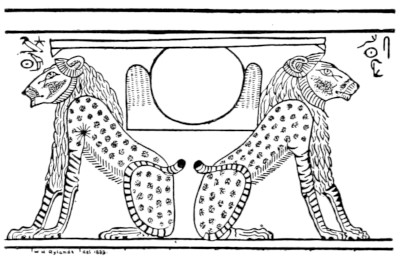
The papyrus of Nebseni and all the subsequent texts give the explanation that Yesterday means Osiris, and the Morrow means Râ. And the vignette in the papyrus of Ani gives the name of Yesterday to one of the Lions and of Morrow to the other.
4.
The earliest texts have either  ‘speak,’ or
 ‘command.’
The meaning is the same in both readings. Strife arose
among the gods at the bidding of Râ: that is every force in nature
45began its appropriate career of activity, necessarily coming into contact
and conflict with the other forces. And of all this collision the
first cause, the origin of all activity and motion, is the Sun.
This mythological cosmology reminds one of the saying of Heraclitos that “Strife is the father and the king of all things,” and the doctrine that all becoming must be conceived as the product of warring opposites—παν´ντα κατ’ ἔριν γίνεσθαι.
5.
The Heron is the bird called 
 bennu, the numerous
pictures of which enable us to identify it with the Common Heron
or Heronshaw. The reason for connecting this bird with the Sun-god
has to be sought in the etymology of its name.
 ben is a
verb of motion, and particularly of ‘going round.’
 benenu is
a ring, also a ‘round pill.’ The Sun therefore is very naturally
called bennu, an appellative like κυκλοέλικτος in the Orphic hymns.

 , ‘of that which is, and of that which cometh into
being.’ Here, as in many other places, , which is a verb of
motion, and really signifies ‘rise up, spring forth,’ is pointedly distinguished
from
 , that which (is). So far from signifying
‘being, that which is,’ it very much more nearly corresponds to
 in the frequent expression
 , ‘that which is and that which
is not yet.’ The sense of ‘good being’ so commonly given to the
divine name Unnefer is utterly erroneous.
6.
The reading of the name  is proved by the numerous
variants of this passage to be Ȧmsu. In M. Naville’s edition, II,
pl. 41, the name, as written in Ce, would seem to be

 ȧm.
But I already in Zeitschr., 1877 (p. 98) pointed out, that in this
manuscript the last sign is at the top of a column, and
that at the foot of the preceding column there is a space where
the signs
 , following (as they still do in the next passage),
have been obliterated. No one from merely looking at M. Naville’s
copy would guess that there was any interval between and .
The god’s name is written 
 on a tablet, Denkm. III,
114 i. And the name is also written
 or
 , which are
ligatures of and .
467.
Note that in this scholion Horus, ‘the avenger of his father,’
calls his father not Osiris but Tmu. In the more recent texts there
are many interpretations of the two Feathers. One is “his two EyesF
are the Feathers.” But the favourite one is “Isis and Nephthys, who
have risen up as two kites” 

 .
8.
The 

 reḫit, by whom the oblation is made,
the present generation as contrasted with the

 pāit, the
past, and
 hammemit, the coming generations.
9.


 Māāāait is supposed to be nitre or
salt, or some other substance used in the process of embalming.
The more recent recensions thus answer the question about the lakes. “Eternity is the name of one, and the Great green one that of the other, the lake of Natron and the lake of Māāt.”
10.
See the picture of this gate on the Vignette, which shows the
Sun-god passing through. One of the later explanations is that from
this gate Shu raised up Heaven. Another is that it was the gate of
the Tuat. Haukar, 

 , means “behind the
Shrine.”
11.
Hu and Sau, sons of Tmu, and his companions in the Solar
bark, are, like so many other gods, Solar appellatives. 
 Hu is the Nourisher,

 Sau, ‘the Knowing One.’ The
god is also called ‘the Seer’
 , ‘He who heareth’
 .
These names are not personifications of the senses but, as in all
cases, appellatives expressing attributes.
13.
The Eye (
 ) being the Sun or Moon, the
period of distress (

 ) is that of obscuration or eclipse,
and the hairy net (

 ) which is removed is the shadow
which passes for a time over the heavenly body.
47The explanation which M. Maspero has recently given (P.S.B.A.
XIV, 314) of the word , as connected with
 ‘health,’ receives confirmation from the scholia in
the papyri, according to which Thoth not only delivered the Eye
from the veil of darkness which oppressed it, but carried it off


 ‘in life, health and strength, without
any damage.’
14. Mehurit is explained in the ancient scholion as ‘the Eye,’ but it is really the Sky, from which the Sun is born daily. The sign of plurality after Mehurit (if it means anything) only indicates the daily succession of the skies whence Râ is born.
15.
The ‘coffined One’ 

 is of course Osiris, as
it is plainly stated in the later scholia, which further add that the
‘Seven glorious ones’ who follow the coffin, or, as they read it, “their
Lord,” are to be sought in the constellation of ‘the Thigh in the
northern sky,’ that is in the seven stars of the Great Bear.
These stars never set, but are perpetually revolving round the
Pole. It is therefore evidently with the Polar Star that we must
identify the coffin of Osiris. The names of the Seven Glorious ones
vary according to the different authoritiesauthorities. And these Stars themselves
receive other mythical forms; that of the Seven Cows and
their Bull is recorded in the 148th chapter. Names like ‘the Red-eyed’

 or the ‘Red-haired’ cow
 seem to
imply double stars. The ‘Red-eyed’ is said to abide in


 ‘house of gauze’ (perhaps a cobweb).
The papyri add the important note that the “day of Come thou hither”! represents the moment “when Osiris says to Râ, Come thou hither”! or, as some read, “Come thou to me.” The speaker adds that he sees the meeting of the two gods in Amenta.
16.

 possessor of completeness, integrity, hence
‘inviolate.’ This name is given to Osiris when restored to his first
condition after having been dismembered and cut into pieces. The
god is called Râ-Tmu-Nebert’er in the great Harris papyrus, 15, 3.
4817.
It is most probable that the Cat became the representative of
the Sun because of the homonymy between the Egyptian name

 mȧȧu of the animal and the attributive

 mau,
‘shining’ said of the Sun. But the Egyptian scribe gives a different
etymological explanation. Sau said of Râ “he is maȧu of what
he hath made.” may, like the Latin exemplar, be either the type
or the prototype, the copy or the original. The creatures of Râ
were made after his likeness. Sanskrit literature, from the Çatapatha
Brahmana down to the Vishnu Purâna, is full of similar etymologies.
The Egyptians from the very first delighted in this play upon words.
18.
Neḥebu-kau, 

 or

 is the son of Seb and Renenut. The etymology of the name is indicated
in the Pyramid texts. neḥbu is to ‘carry, sustain,
support’ (whence
 neḥbet a neck, and

 neḥb a yoke), and the rest of the word is the plural of ka, which is
susceptible of more than one meaning. It might signify the divine or
human ka, but the word is sometimes (e.g., Todt., 125, 32) written
 ‘victuals.’ The god is one of the forty-two judges of the dead,
and in some copies of the Book of the Dead he is described as
coming forth from his

 , a word most frequently used for the
source of the Nile. The serpent which is a most frequent
determinative of the name, is an additional reason for identifying
this god with the Nile: a conclusion which seems fully justified
by the Pyramid texts, which speak of him as Water , and
describe him as


 , “of many windings.”
(See Pepi I, 341 and 487.)
19.
This Devourer has the same functions as the strange animal
called 
 Âmemit in the pictures of the Psychostasia.
The later scholia add that the Devourer comes from the
‘basin of Punit,’ the Red sea. They add other names,

 Mâtes ‘Flint,’ “stationed at the gate of Amenta,” and

 49or
 Baba, who, in ch. 63, 2, is described as the
first born of Osiris. He is a terrible god from whom the deceased
prays in ch. 125, 36, to be delivered. His name implies ‘one who
searches or probes thoroughly,’ as a digger or miner. And such
are his functions at the judgment of the dead.
Instead of  tesem, a ‘hound,’ La reads
 sȧu, a sheep.
20.
The 
 Mesqȧt is a

 ‘a place of scourging.’
The word
 is known as signifying violent treatment
by beating, and has been illustrated by Chabas and Goodwin. See
Zeitschr., 1874, p. 62. In the 72nd chapter the deceased prays that
he may not perish at the Mesqȧt. A kindred word
 Mesqa
signifies ‘a hide.’ We can understand the connection between
δέρω ‘flay, cudgel, thrash’ and δέρμα ‘a hide.’ And we ourselves
have the familiar phrase of ‘giving a hiding.’ But purification as
well as punishment was found at the heavenly mesqȧt. It is
mentioned in the Harris Magical papyrus[6, 3] simply as a heavenly
thing. In the more recent scholia the purifier is said to be Anubis,
who is behind the chest containing the remains of Osiris.
After the scholion which has just been translated the early texts pass on to the 18th chapter.
For the rest of the chapter we are compelled to follow the texts of the papyri. The character of this portion differs considerably from the former part, and is clearly an addition. The speakers rapidly succeed each other. “I am Tmu,” “I am Isis,” “I was conceived by Isis,” “Isis destroyeth what in me is wrong,” and finally “I am Uat’it.”
21. Cher-âbat and Heliopolis like all the localities here mentioned are in heaven not upon earth.
22. Uat’it is literally ‘the pale one,’ a name of the Dawn. But here the fiery dawn is spoken of, ἠώς φλογερά, πυρίβρομος.
23.
Hemen 
 is a divinity seldom, if ever, mentioned
after the “Middle Empire.” In the Pyramid texts he has a Snake
(the River) in his hand.
5024. The last line of the chapter has suffered in all the best papyri. See M. Naville’s collation. In the papyrus of Ani the chapter is unfinished. The later papyri end the chapter by saying that “it has been granted to the speaker by those who are in Tattu to destroy by fire the souls of his adversaries.” This consummation is already found in La.
20. 

 , , praeconium, praeco.
21. The god who lifteth up his arm is  Amsu.
22. 

 ȧnem ‘skin,’ according to Horhotep and the first
coffin of Mentuhotep at Berlin. But the second coffin of Mentuhotep has already
 ȧnḥu ‘eyebrows,’ which afterwards becomes the received
reading. It is that of Queen Mentuhotep.
23. An interpolation in the text of Horhotep.
24. Mission archéologique Française au Caire, II.
25. Ovid, Fast, I, 129, 130.
26. Apocalypse i, 8.
27. The last form of the chapter (as found in the hieratic papyrus T. 16 of Leyden, and others in the British Museum) changes the opening as follows—“I am Atmu, who made the Sky and created all that hath come into being.”
28.  in the historical inscriptions is just like the Greek
γυῖα λέλυντο, λύτο γούνατα καὶ φίλον ἡτορ.
29. It is certain that from the earliest times Heaven as  ‘the Great Weeper,’ was considered as the source of life to gods and men. But
myths must not be mixed. One must not be considered as the explanation of
another.