

 ) of
Osiris.”
O paths which are high above me at Restau: I am the Girdled(2) and the Mighty one, coming forth triumphantly.(3)
I am come: I am come that I may firmly secure my suit in Abydos,(4) and that the path may be open to me at Restau.
Let my suit be made pleasant for me by Osiris.
I am he who produceth the water which balanceth his throne, and who maketh his way from the Great Valley.(5)
Let the path be made for me; for behold I am N the triumphant.(6)
[Osiris is made triumphant over his adversaries, and the Osiris N is made triumphant over his adversaries, and is as one of you, his patron(7) is the Lord of Eternity: he walketh even as ye walk, he standeth as ye stand, he speaketh as ye speak, before the great god, the Lord of Amenta.]
1. This chapter and the following have reference to Restau, one of the Gates between the Netherworld and Heaven.
It is not mentioned in the most ancient recension of chapter 17
(from which my translation was taken), but in all the papyri of the
eighteenth and later dynasties it is stated that Restau was a gate
south of An-aaref and north of the “Domain () of
Osiris.”
The papyrus of Ani has this picture of it,
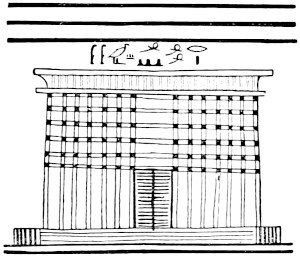
but the most interesting representations of it are in the Dublin papyrus (D. a), where the Sun god is seen passing between the folding doors, and in the papyrus of Hunefer (A. g), where the doors are also open and the god is sitting between them. (See Plates VI, 11 and VIIb.)
The name Restau 

 (the feminine form

 is more frequent in later texts) signifies Gate of the passages. These
are the passages guarded by the faithful attendants of Osiris, but
armed with “hurtful fingers” against the adversaries of Rā, against
whose onslaught the deceased prays Rā for protection in chapter 17.
A mystical interpretation will be found in chapter 119 and note.
2.
Girdled, or stoled, 
 . On the importance attached
to this ritual investiture, the following references may (among many
others) be useful: Unas 66, Teta 149, Pepi I, 395, Merenrā 190,
205Todt. 125 (rubric), 145, 25. The deceased prays (Chapter 82, 4)
that he may be girt by the goddess Tait. A passage in Todt. 78, 26
(Turin text) would be of greater interest were it not an emendation
of those who no longer understood the ancient text.
3.
Coming forth triumphantly. This is the reading of the oldest
authority (Nebseni), but the reading which has prevailed, not
only here, but in Chapter 147, is “coming forth from the Crown,”


 .
4.
That I may firmly secure my suit at Abydos. The scholion
on Chapter 17, referred to in note 1, states that the “place of Maāt
is at Abydos.” It is, of course, the mystical, not the geographicalgeographical,
Abydos which is meant, and the suit 
 (res) which has to be
settled is the final judgment of the deceased.
5.
The throne of Osiris in pictures of the Psychostasia (see
Vignettes to Chapter 125) rests upon water, out of which there
springs a lotus flower; and upon this flower stand the four children
of Horus. In a passage of chapter 147, which is an adaptation of the
present chapter, the deceased says 


 La, “I am he whose stream is secret.” And a Pyramid Text
(Merenrā, 188, 193) after mention of the Great Valley


 and of the investiture (
 ) proceeds,


 ,
“thy water, thy fresh current, is
a great inundation proceeding from thee.” Here the deceased is
identified with the Nile and its inundation, as in Chapter 64 of the
Book of the Dead.
6. The chapter ends here. The passage which follows in the translation is taken from the Paris papyrus Pe.
7.
Patron, 


 , a word supposed by some scholars
to signify uncle. It occurs on funereal monuments among the designations
of persons connected with the deceased, such as brother,
sister, nurse. A man may have several bearing the designation, and
they are not necessarily children of the same parents (see e.g., Mariette,
Cat. d’Abydos, p. 110, where a man has five chenemesu, who cannot
all be brothers either of his father or his mother). The word occurs
repeatedly in the Prisse papyrus. I am inclined to think it means
the legal guardian of a minor.