
Who Was Elizabeth, Mother of John the Baptist?
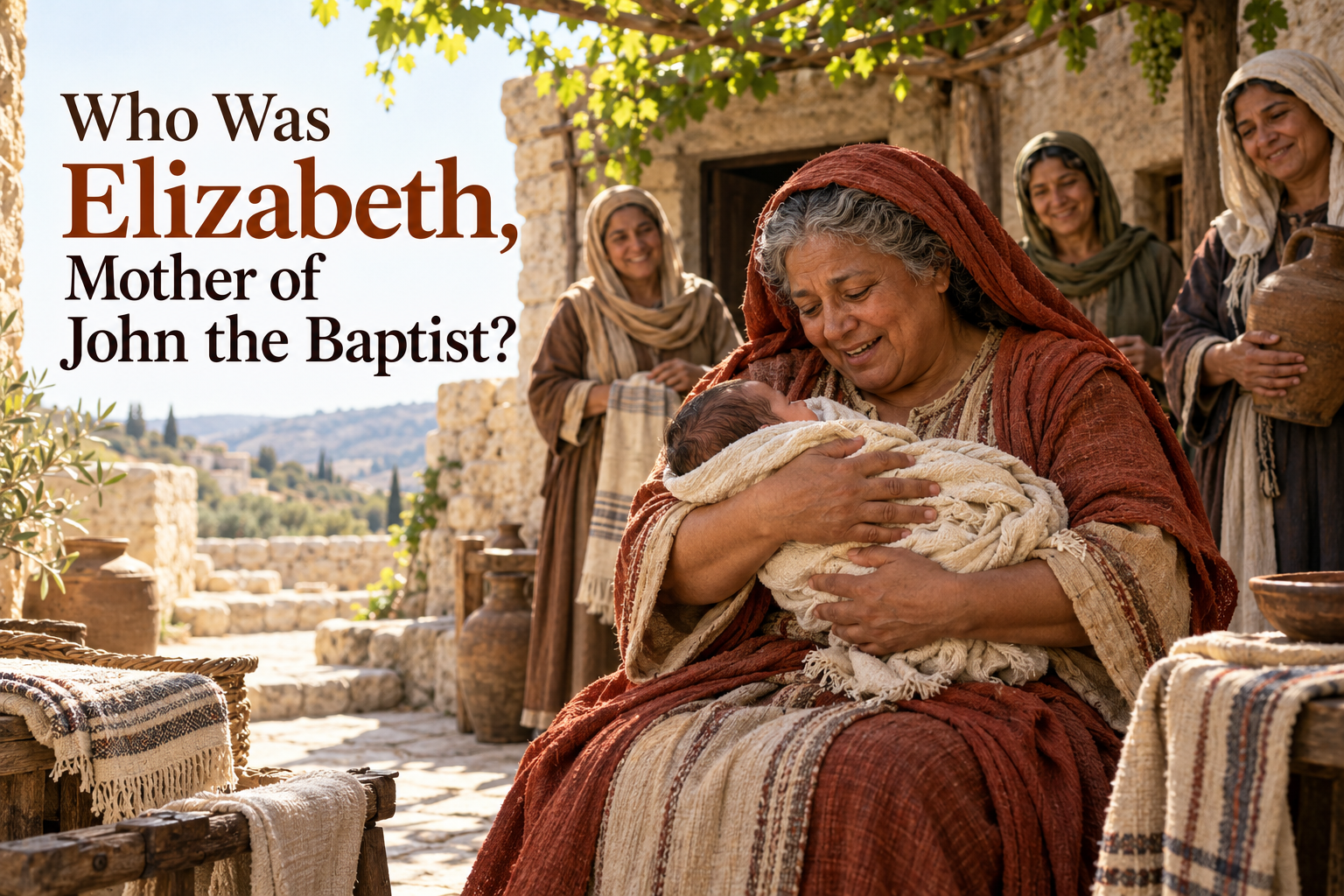
Elizabeth, the mother of John the Baptist, appears only in Luke 1, but she is not merely a supporting character in someone else’s miracle. She lives for years with infertility and social reproach, conceives in old age, interprets Mary’s pregnancy by the Holy Spirit, and refuses family pressure when naming her son. Luke gives her the first Spirit-filled human proclamation about Jesus in the Gospel. Her story is quiet, domestic, and theologically decisive.
A daughter of Aaron
Elizabeth was married to the priest Zechariah and was herself descended from Aaron. Luke calls both of them righteous before God and blameless in their observance of the Lord’s commandments (Luke 1:5–6). That praise does not mean they were sinless. It establishes that their childlessness was not punishment for hidden wickedness, a cruel assumption ancient and modern communities can make about infertility.
Luke says Elizabeth was unable to conceive and that both spouses were advanced in years. The account deliberately recalls Sarah and Abraham and other biblical couples whose promised child arrived after long barrenness. The parallel does not make every detail identical. Elizabeth’s son would prepare Israel for the Lord, not carry the patriarchal promise in the same way Isaac did.
During Zechariah’s temple service, Gabriel announced that Elizabeth would bear a son named John. Zechariah questioned the promise and became unable to speak until its fulfillment. Elizabeth was not present for that encounter, and Luke does not tell us how he first communicated it to her. The narrative returns to her conception rather than filling the household silence with invented dialogue.
Reproach removed
Elizabeth conceived and remained secluded for five months. She said the Lord had looked favorably on her and taken away her public reproach (Luke 1:24–25). In her society, children carried economic, familial, and honor-related importance, while infertility was often blamed on the woman regardless of cause. Her words reveal relief from social shame as well as joy in pregnancy.
The Bible sometimes describes children as blessing and miraculous births as divine favor. That truth should never be turned into a verdict that infertile couples lack faith or divine approval. Luke has already called Elizabeth and Zechariah righteous before the pregnancy. Their years of waiting were not evidence that they had failed a spiritual test.
Elizabeth’s experience also differs from modern fertility stories in ways that deserve respect. Luke reports a unique divine promise connected with salvation history, not a guarantee that every faithful couple will conceive if they wait long enough. Christians can pray for children and receive medical care without converting Elizabeth’s miracle into a formula. Her joy should deepen compassion for those whose stories end differently, not increase their burden.
Elizabeth’s seclusion has prompted guesses about ritual purity, fear of miscarriage, or a desire for private devotion. Luke gives no reason. The five months prepare the narrative timing of Mary’s visit in Elizabeth’s sixth month. We should resist turning a narrative silence into a medical or religious certainty.
The visit from Mary
Gabriel told Mary that her relative Elizabeth had conceived despite her age. Mary traveled to a town in the Judean hill country and entered Zechariah’s house. Luke calls the women relatives but does not specify whether they were cousins or describe the exact family line. Because Elizabeth descended from Aaron and Mary was connected with David through Joseph and Jesus’ royal identity, elaborate genealogical solutions are unnecessary.
When Mary greeted her, the baby leaped in Elizabeth’s womb and Elizabeth was filled with the Holy Spirit. She cried out that Mary was blessed among women and that the fruit of her womb was blessed. She then asked why the mother of her Lord should come to her (Luke 1:39–45). Before Jesus’ birth, Elizabeth recognizes his identity through the Spirit.
Her words have played an important role in Christian devotion, including the later form of the Hail Mary. In Luke, however, the blessing moves toward Jesus and faith. Elizabeth concludes by calling Mary blessed because she believed the Lord’s promise. Honor given to Mary and trust in God’s word are not competing themes in the passage.
The relationship also reverses ordinary expectations of age and status. Elizabeth is older, married to a priest, and carrying a long-awaited miraculous son, yet she calls the younger visitor the mother of her Lord. Mary does not need public standing before Elizabeth can recognize grace in her. Spirit-filled discernment rejoices when God honors someone else.
John’s prenatal leap has also entered debates about infant faith, baptism, and life in the womb. Luke certainly portrays the unborn John as responsive within God’s purpose. It does not turn the episode into a systematic explanation of infant cognition or sacramental practice. The narrative claim should be affirmed without making it answer questions it was not written to settle.
John’s birth and name
Elizabeth gave birth, and neighbors and relatives rejoiced that the Lord had shown her great mercy. On the eighth day they came for circumcision and assumed the child would be named after his father. Elizabeth said, “No; he is to be called John” (Luke 1:57–60). Her answer shows that she knew and embraced the divinely given name.
The relatives objected that no one in the family carried it and appealed to Zechariah. He wrote the same answer on a tablet, and his speech returned. The agreement between husband and wife confirms obedience against customary expectation. John’s identity and calling came from God, not from preserving a family name.
Luke does not describe Elizabeth’s response to Zechariah’s prophecy or narrate John’s childhood in the home. Nor does it say when Elizabeth died. Later traditions sometimes claim she hid John during Herod’s massacre and died while he was young, but those details come from apocryphal literature. Matthew’s massacre narrative does not mention John or Elizabeth.
Elizabeth in later tradition
Christian calendars honor Elizabeth as a saint, often together with Zechariah. Later art pictures the visitation, the two mothers embracing while the promised sons are still unborn. These traditions develop a scene firmly rooted in Luke, though visual details and exact locations go beyond the text.
Tradition associates Elizabeth’s home and John’s birthplace with Ein Karem near Jerusalem. Churches there commemorate the events, but the Gospel names only a town in the hill country of Judah. The identification is ancient and meaningful for pilgrimage, not archaeologically certain biography. No inscription identifies Elizabeth’s house.
Some later stories identify Elizabeth more precisely within Mary’s extended family or supply names for her parents. Luke gives only the word “relative.” Claims of exact cousinship should therefore be labeled tradition or reconstruction. The same restraint applies to calculations of Jesus’ birth date based on Zechariah’s priestly course; the historical rotation is not secure enough to produce an undisputed calendar.
A faithful witness
Elizabeth’s importance lies partly in what she refuses. She refuses to interpret infertility as proof of God’s rejection, refuses to treat Mary’s unexpected pregnancy with suspicion, and refuses to let family custom override the name God chose. Her speech consistently recognizes God’s grace in another person as well as in herself. Years of disappointment did not make her jealous when a younger relative received an even greater calling.
She also helps Luke connect the stories of John and Jesus without confusing their roles. Her child is a miraculous gift and prophet, but Mary’s child is her Lord. Elizabeth can rejoice in John’s calling precisely because she does not need him to be the Messiah. The older woman’s Spirit-filled blessing teaches the entire Gospel how to receive Jesus before he has done anything visible.
Elizabeth disappears from the story without a narrated ending, which fits many faithful lives. She does not preach to crowds or stand before kings. She endures, conceives, welcomes, blesses, gives birth, and names her son in obedience. Luke gives her only one chapter, but in that chapter she recognizes what generations of readers are invited to see.