
Who Was Esau?
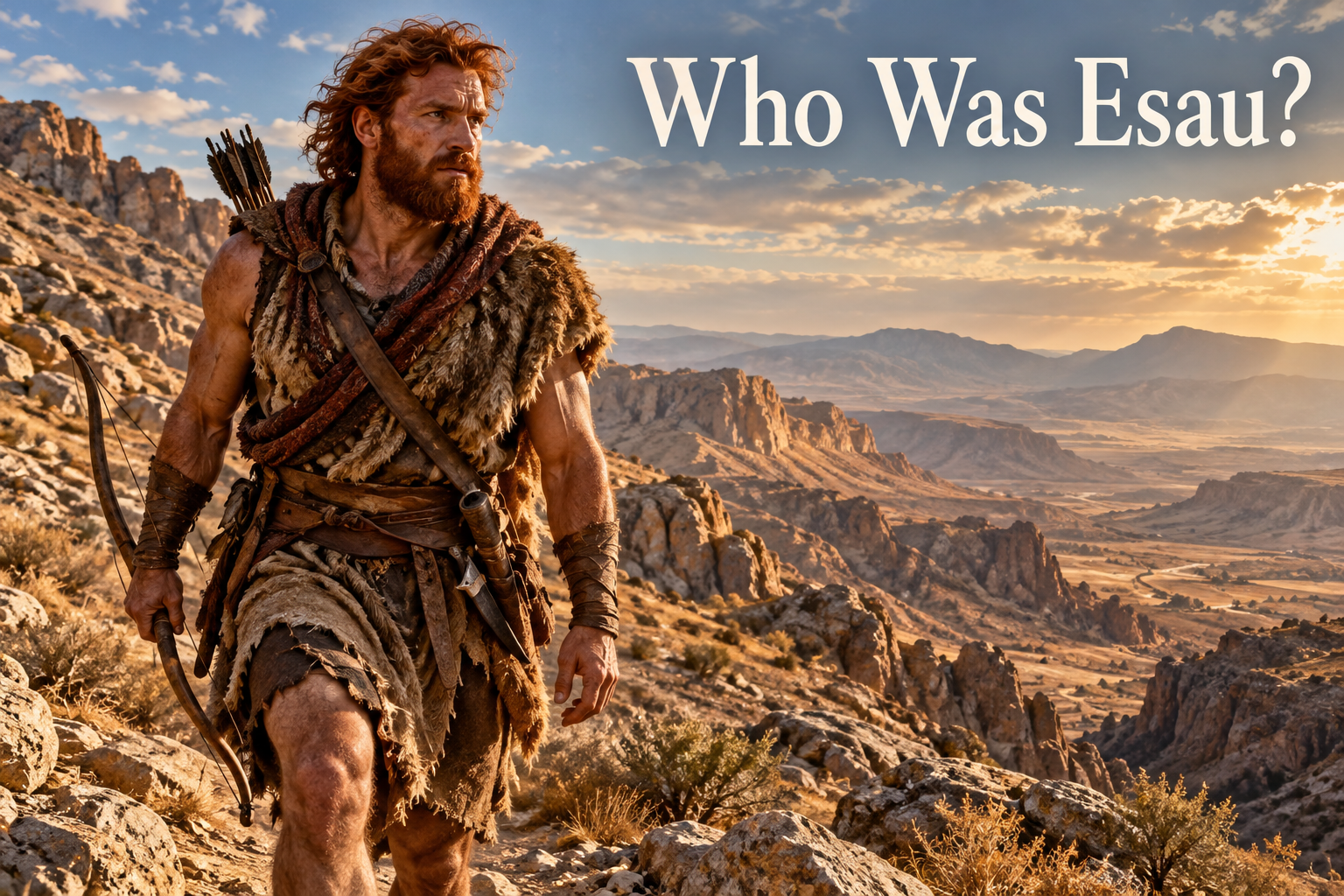
Esau is usually remembered for two things he lost: a birthright traded for a meal and a blessing taken through deception. That summary is accurate as far as it goes, but it leaves out much of the man Genesis actually portrays. Esau is impulsive and capable of murderous anger, yet he is also a wronged son who later welcomes his estranged brother with startling generosity. He becomes the father of Edom, but he shouldn’t be reduced to every later conflict between Edom and Israel. His story is one of the clearest examples of why biblical biography requires more than sorting people into heroes and villains.
The older twin who came second
Esau was the firstborn son of Isaac and Rebekah and the twin brother of Jacob. Genesis 25 describes the brothers struggling before birth, and Rebekah receives an oracle that two nations are in her womb and that the older will serve the younger. Esau is born reddish and covered with hair, details that anticipate his later association with Edom and Seir. He grows into a skilled hunter and a man of the open country, while Jacob is described as a quiet man who stays among the tents. Isaac loves Esau because he enjoys the game Esau brings home, while Rebekah loves Jacob, so the rivalry between the brothers is reinforced by favoritism from both parents.
The prenatal oracle tells the reader where the story is headed, but it doesn’t excuse every action used to get there. Genesis can affirm that Jacob carries the covenant line while also showing Jacob exploiting his brother and Rebekah deceiving her husband. Divine purpose and human conduct aren’t the same category. The narrative repeatedly makes that distinction without stopping to post a moral label beside every scene.
The birthright and the bowl of stew
One day Esau returns from the field exhausted and asks Jacob for some red stew. Jacob demands Esau’s birthright in exchange, and Esau swears it away before eating. A firstborn son’s birthright ordinarily involved family standing and a larger share of the inheritance, so this wasn’t the ancient equivalent of trading dessert. Genesis says Esau despised his birthright, emphasizing his reckless disregard for something valuable. At the same time, Jacob’s willingness to turn his brother’s hunger into leverage is hardly an advertisement for brotherly love.
Later interpretation often makes Esau the sole villain in the scene. Hebrews 12:16 warns against sexual immorality and godlessness, invoking Esau as the example of someone who sold his birthright for a single meal. The warning treats his loss as a serious lesson about despising sacred privileges. That is a legitimate New Testament use of his story, but it doesn’t transform Jacob’s bargaining into an exemplary act. The episode exposes different failures in the two brothers: Esau can’t see beyond an immediate appetite, and Jacob is willing to secure the future by taking advantage of him.
A stolen blessing and a broken family
The conflict becomes far more serious in Genesis 27. When the elderly Isaac prepares to bless Esau, Rebekah overhears and arranges for Jacob to impersonate his brother. Jacob wears Esau’s clothes and covers his hands and neck with goatskins so that his blind father will mistake him for the hairier son. Isaac is suspicious, but he eats the meal and gives Jacob the blessing intended for Esau. When Esau arrives and the deception is uncovered, his anguished request is one of the most painful moments in Genesis: he asks whether his father has only one blessing and weeps aloud.
Isaac does give Esau a secondary pronouncement, but Jacob has received the primary family blessing. Esau then plans to kill Jacob after Isaac dies, and Rebekah sends Jacob away. His threat is wrong, but the narrative lets us see the injury beneath the anger. Esau has been deceived by his twin and, whatever questions surround Isaac’s decision to bless him despite the earlier oracle, he has been treated as a costume to be imitated and displaced. Genesis doesn’t ask readers to approve his intended revenge in order to acknowledge that he suffered a real betrayal.
Marriage, family, and Edom
Esau marries Judith and Basemath, women identified as Hittites, and Genesis says they make life bitter for Isaac and Rebekah. After recognizing that his Canaanite marriages displease his parents, he marries Mahalath, a daughter of Ishmael. The text gives very little information about the women themselves, so readers shouldn’t invent offenses that Genesis doesn’t name. The point in context is that Esau’s marriage choices deepen the distance between him and the covenant household, although his later marriage also suggests an effort to regain parental approval.
Genesis 36 devotes a long genealogy to Esau and identifies him as the ancestor of Edom. His descendants include chiefs and kings, and the chapter presents his household as prosperous and established in the hill country of Seir. That genealogy matters because election in Genesis doesn’t mean that the brother outside the covenant line simply vanishes. Esau isn’t chosen for Jacob’s role, but he still becomes a great people and receives a land of his own.
Edom later became a neighboring nation with a difficult and sometimes violent relationship with Israel. Prophets such as Obadiah condemned Edom for its hostility toward Judah, and Malachi 1 used the contrast between Jacob and Esau to speak about the two peoples. Those later national conflicts shouldn’t be read backward as though the individual Esau personally committed every sin attributed to Edom. Genesis distinguishes the brother from the nation that descended from him, even while connecting their stories.
The brother who ran to meet Jacob
After many years away, Jacob returns to Canaan and learns that Esau is approaching with four hundred men. Jacob expects the worst. He divides his household, sends lavish gifts ahead, and prays for deliverance. Yet when the brothers finally meet, Esau runs to Jacob, embraces him, falls on his neck, kisses him, and weeps. The man last seen planning revenge becomes the one who refuses to keep the family trapped in its worst chapter.
The reconciliation isn’t a return to close domestic life. Esau proposes that they travel together, but Jacob declines, and the brothers settle in different regions. Some interpreters suspect Esau’s offer or Jacob’s excuses; others see a genuine peace wisely accompanied by distance. Genesis doesn’t settle every motive, but it plainly portrays Esau’s welcome as generous. He even tries to refuse Jacob’s gifts because he already has enough, a striking reversal of the younger brother’s earlier efforts to acquire what belonged to the older.
Esau and Jacob appear together once more to bury Isaac. The brief notice doesn’t tell us how much contact they maintained, but it confirms that the threatened fratricide never occurs. Their families separate because their possessions are too great for the land to support them together, not because they resume the old war. Reconciliation in this story is real, even if it doesn’t erase history or make the brothers inseparable.
What history can and can’t establish
Genesis presents Esau as a real ancestor whose family story explains Israel’s kinship with Edom. Archaeology and ancient Near Eastern records can illuminate Edom as a historical people, particularly in the Iron Age, but no independent inscription has been found that identifies the individual Esau. The patriarchal narratives were preserved and shaped as theological family history, and scholars disagree about how directly their details reflect the second millennium BC. Cultural plausibility isn’t the same thing as personal verification, and the absence of direct evidence isn’t proof that a pastoral ancestor never lived.
Later Jewish and Christian traditions sometimes turned Esau into a symbol for hostile empires, including Rome. Paul also cites God’s choice of Jacob over Esau in Romans 9 while discussing Israel, promise, and God’s freedom in carrying out his redemptive purpose. In its Old Testament setting, the choice concerns peoples and covenant vocation, not a statement that the infant Esau was individually predestined to damnation. Genesis itself gives him a future, descendants, possessions, and a moving scene of reconciliation.
Esau’s complicated legacy
Esau made a disastrous bargain and allowed rage to turn toward murder. He also endured calculated deception, built a substantial household, and eventually met fear with embrace rather than violence. Scripture warns through his shortsightedness without requiring readers to deny his dignity or his capacity for mercy. If Jacob’s story shows that God can work through a deeply flawed chosen man, Esau’s story reminds us that the brother not chosen for that role is still more than a cautionary tale.