
Who Was Ezra?
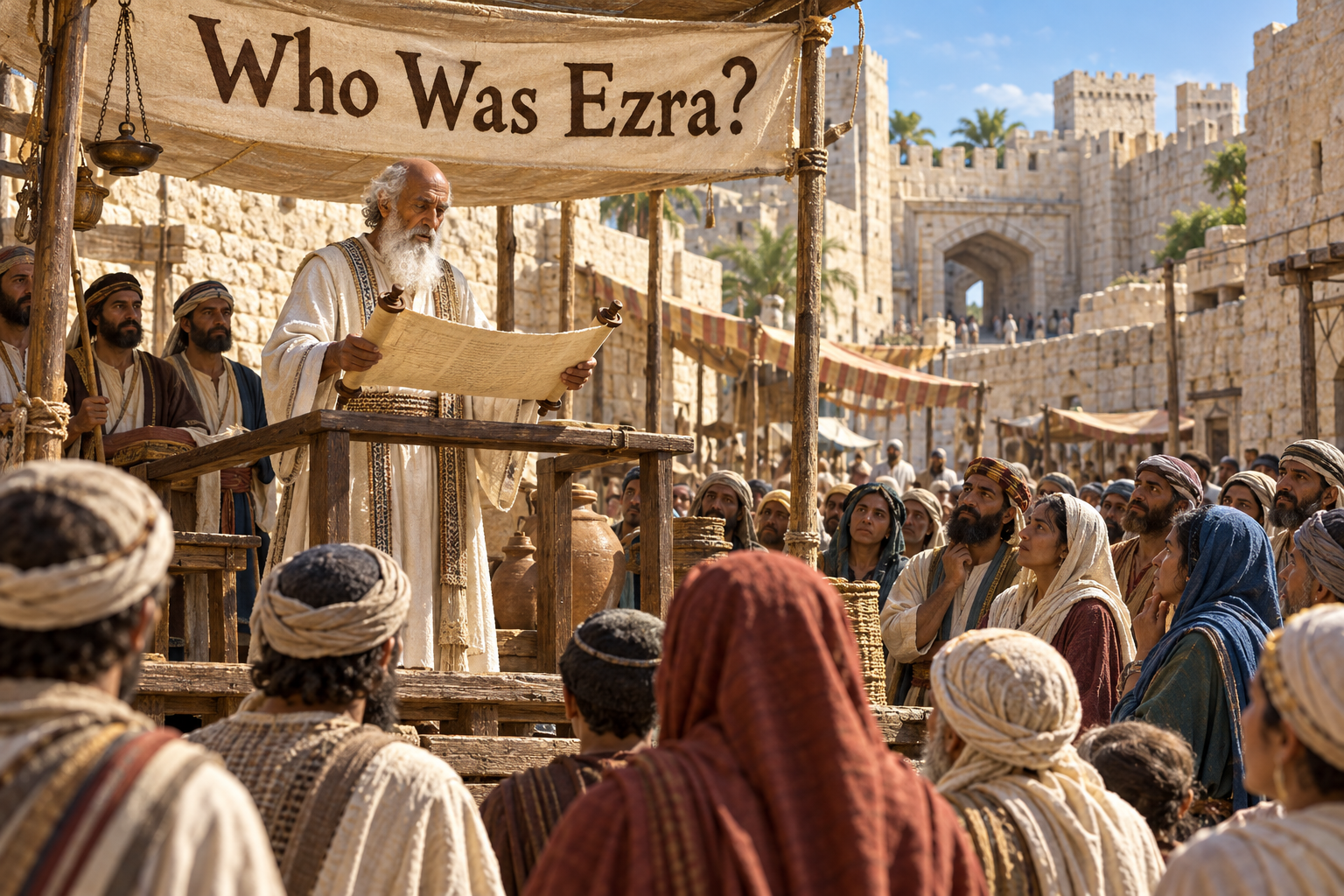
Ezra was a priest, scribe, teacher, and Persian-authorized reformer whose influence reached far beyond the brief portion of Scripture in which he appears. He brought a group of Judeans from Babylon to Jerusalem, taught the law, led public confession, and helped shape the restored community around Scripture. He also oversaw a separation from foreign wives and children that remains one of the Bible’s most painful reform accounts. Calling Ezra faithful does not require pretending every consequence in his story is easy to defend or understand.
Priest and scribe
Ezra 7:1-5 traces Ezra’s ancestry through the priestly line to Aaron. Biblical genealogies can omit generations, so the list establishes family and office more than a complete modern record. Ezra is repeatedly called both priest and scribe. A scribe in the Persian period was not merely someone with tidy handwriting; the role involved education, administration, interpretation, and mastery of authoritative documents.
Ezra 7:6 calls him skilled in the law of Moses, and verse 10 describes the order of his vocation: he set his heart to study the law of the Lord, to do it, and to teach its statutes in Israel. The sequence matters. Ezra’s authority was not supposed to rest on information detached from practice. Study, obedience, and instruction belonged together.
The “law of Moses” in Ezra’s hands is not inventoried book by book. Many scholars understand it as substantially the Torah known today, while others argue that collections and interpretive traditions were still reaching their final forms. The narrative treats the law as authoritative and available, but it does not describe Ezra writing the Pentateuch from scratch. Later claims that he recreated all Scripture after its destruction go beyond the canonical account.
Which Artaxerxes?
Ezra arrived in Jerusalem in the seventh year of King Artaxerxes. The traditional and still common identification is Artaxerxes I, whose seventh year was 458 BC. On that chronology Ezra arrived thirteen years before Nehemiah, and their shared appearance in Nehemiah 8 fits the order in the combined narrative. The king’s commission also resembles Persian policies that used local law and cultic institutions to support provincial order.
Some scholars identify Ezra’s king as Artaxerxes II and date the mission to 398 BC, placing Ezra after Nehemiah. That proposal tries to solve chronological and social tensions between the books, including Ezra’s surprising absence from much of Nehemiah’s memoir. Others rearrange particular passages or question whether every chronological marker originally belonged to the same sequence. No external document names Ezra or supplies a date that ends the debate.
On the conventional chronology, Ezra arrived in 458 BC, though that date remains disputed. The historical Ezra is widely accepted by many scholars, but the exact order of Ezra and Nehemiah remains disputed. Scripture’s theological portrait does not depend on readers being unaware of that discussion.
A commission from the Persian king
Ezra 7:11-26 preserves an Aramaic letter authorizing Ezra to travel to Jerusalem with willing Israelites, carry royal and donated resources, support temple worship, appoint magistrates and judges, and teach those who did not know the law. The decree speaks of both “the law of your God” and “the law of the king.” Persian government could use local religious law as part of imperial administration without adopting Israel’s theology.
Scholars debate whether the letter is a direct copy, a translated and adapted document, or a literary presentation shaped around authentic Persian forms. Its language has parallels with Achaemenid administration, yet its detailed Jewish religious expressions may reflect editorial adaptation. The safest conclusion is that the mission fits Persian provincial practice and may preserve official material, while the precise wording reaches us through the biblical writer.
Ezra praised God for putting such a purpose into the king’s heart. He understood imperial authorization as providence rather than proof that the empire was righteous in everything. The same theological outlook could honor a pagan ruler’s favorable act without placing Persia beyond judgment.
The journey from Babylon
Ezra assembled the returning group by the Ahava canal and discovered that no Levites were present. He sent leaders to recruit temple servants, then proclaimed a fast to seek God’s protection. Ezra had told the king that God’s hand was for good on those who sought him, so he felt ashamed to request soldiers and cavalry for the road. The decision expressed faith, though Scripture does not turn it into a rule that believers must refuse sensible security.
The journey carried people, silver, gold, and temple vessels across dangerous territory. Ezra assigned the treasures by weight to priests and carefully weighed them again after arrival. The administrative detail is part of the spiritual story. Trust in God’s hand did not eliminate accounting, shared custody, or public verification.
The crisis of intermarriage
After Ezra arrived, officials reported that some Judeans, including priests and Levites, had married women from surrounding peoples. Ezra tore his clothing, pulled hair from his head and beard, sat appalled, and later prayed in public confession. Ezra 9 frames the marriages through commands against covenant mixing with peoples associated with idolatry and practices condemned in the law. The issue is not a modern theory of biological race; figures such as Rahab and Ruth show that foreign ancestry itself did not prevent incorporation into God’s people.
Even so, Ezra 10 describes a severe response. Shecaniah proposed a covenant to send away the foreign wives and their children, and Ezra placed leaders under oath to carry it out. A public assembly met in heavy rain, officials investigated cases over several months, and the book ends with a list of implicated men. The narrative does not tell us what became of the women and children or give their voices.
Interpreters disagree about the nature of these unions. Some describe prohibited marriages threatening the restored community’s covenant identity; others emphasize property, lineage, and ethnic boundary concerns in the small province of Yehud. Malachi condemns men who treacherously divorce their Judean wives, while Nehemiah later confronts intermarriage partly over children losing the language of Judah. The Persian-period texts address different situations, and none makes casual divorce a general solution for religiously mixed marriages today.
Christians should resist two opposite evasions. It is wrong to turn Ezra’s reform into permission for racial separation, since Scripture’s covenant boundaries are not modern racial categories. It is also wrong to erase the human cost by treating wives and children as theological clutter removed from the story. The text presents a community convinced that radical separation was necessary; it leaves readers with real moral and pastoral questions about those displaced by the decision.
Reading the law in Jerusalem
Nehemiah 8 brings Ezra before a great assembly at the Water Gate. He stood on a wooden platform, opened the book, blessed the Lord, and read from morning until midday. Levites helped the people understand, which may mean translation, explanation, or both. The event combines public reading with interpretation rather than assuming that hearing words without understanding fulfills the task.
The people wept when they heard the law, but Ezra, Nehemiah, and the Levites told them not to mourn on the holy day. They were to eat, share with those who had nothing prepared, and rejoice because the joy of the Lord was their strength. Conviction did not have to become endless despair. The law that exposed failure also ordered communal joy and generosity.
The assembly then celebrated the Festival of Booths, followed by confession and covenant renewal in Nehemiah 9-10. Ezra’s exact role in every part is not always named, and the final form of Ezra-Nehemiah weaves sources and memories together. Still, his public reading became the defining image of his ministry: restored life required more than walls and a temple; the community needed to hear and understand Scripture.
History and later tradition
No Persian inscription securely identifies Ezra. The Elephantine papyri and other Aramaic documents show Jewish communities operating within Persian administration and confirm that imperial officials engaged with local religious affairs. They provide context, not a second biography. The first-person “Ezra memoir” and embedded documents remain the main evidence for his mission.
Later Jewish tradition greatly expanded Ezra’s reputation. He was associated with the Great Assembly, scribal reforms, the preservation of Scripture, and a role comparable to a second Moses. Some traditions credit him with changing the script used for Hebrew or restoring sacred books lost in the exile. These claims show how later communities understood his importance, but they should be labeled tradition rather than read back into Ezra 7-10.
Ezra’s enduring contribution was to place studied, practiced, and explained Scripture at the center of restored communal life. His story also warns that reform carried out under public pressure and political authority can wound people whose experiences the official record barely preserves. He should be neither dismissed as a narrow legalist nor protected from every hard question. The scribe who taught Israel to read the law still requires readers to do the same work carefully.