
Who Was Hannah?
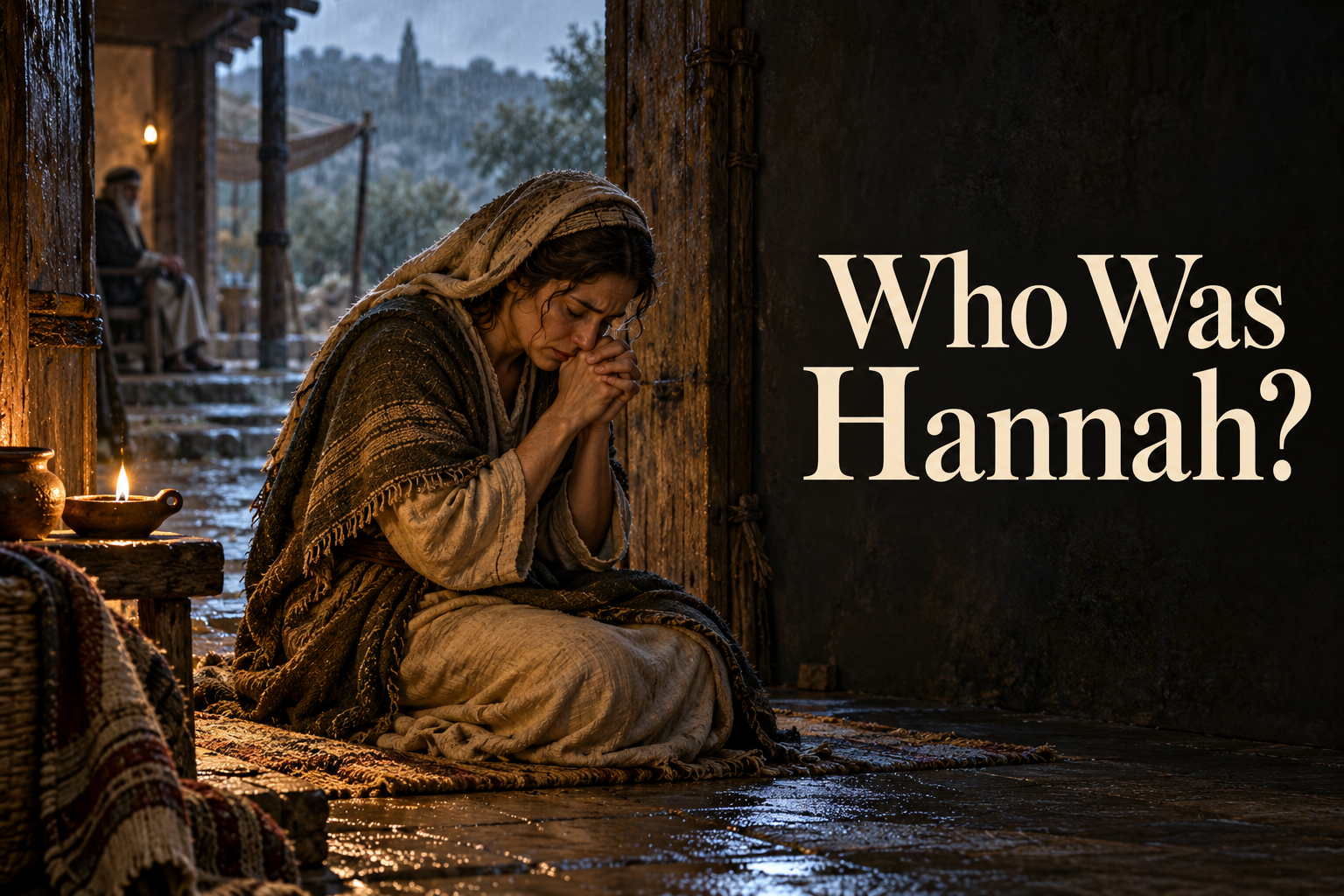
First Samuel introduces Hannah in tears, speaking so quietly that Israel’s high priest mistakes prayer for drunkenness. It isn’t the sort of scene normally associated with a turning point in national history. Yet her prayer, vow, and song introduce the books of Samuel, and the son she dedicates to God will help lead Israel from the troubled period of the judges into the age of kings. Hannah isn’t merely the mother waiting in the wings until the important man arrives. Her words tell readers what kind of story is about to unfold.
A painful life in a divided household
First Samuel identifies Hannah as one of the two wives of Elkanah, a man from the hill country of Ephraim. His other wife, Peninnah, had children, while Hannah had none. The text doesn’t explain how this marriage came to include two wives, and it certainly doesn’t present the arrangement as peaceful. Peninnah repeatedly provoked Hannah, especially when the family traveled to worship and sacrifice at Shiloh. Elkanah loved Hannah and gave her a special portion of the sacrifice, but his attempt at comfort was not especially perceptive: “Am I not more to you than ten sons?” (1 Samuel 1:8). Affection was real, but it didn’t erase Hannah’s grief or the social humiliation attached to childlessness in her world.
The narrator says that the Lord had closed Hannah’s womb. That statement reflects the biblical conviction that life finally rests in God’s hands, but it shouldn’t be turned into a general explanation for every case of infertility. The passage doesn’t accuse Hannah of sin, and it gives no support to anyone who treats childlessness as evidence of weak faith or divine punishment. Hannah is the sympathetic figure in the story, not a spiritual problem to be diagnosed. Scripture is often more honest about anguish than religious people are, and Hannah is allowed to weep before she is ever asked to explain herself.
The prayer Eli misunderstood
During one visit to Shiloh, Hannah went to the sanctuary and poured out her distress before the Lord. She vowed that if God gave her a son, she would give him back to the Lord for his whole life, and no razor would touch his head (1 Samuel 1:11). The uncut hair resembles the Nazirite sign described in Numbers 6 and in the story of Samson, so Samuel is often described as a lifelong Nazirite. That is a reasonable reading, although the wording varies among ancient textual witnesses and the Hebrew text doesn’t use every element of the usual Nazirite formula. What the narrative makes unmistakable is the larger point: Hannah was not asking for a son simply as a possession. She was promising that the answer to her prayer would be devoted to God’s service.
Eli watched her lips move without hearing her voice and concluded that she had been drinking. Hannah answered with remarkable composure. She was not intoxicated, she explained; she was a deeply troubled woman pouring out her soul to the Lord. Eli then blessed her and asked that God grant her request. The scene contains no elaborate technique and no polished public performance. Hannah speaks honestly, God hears, and even the religious authority in the room has to revise his first judgment.
Hannah later conceived and named her son Samuel, connecting his name with her request to the Lord. The precise wordplay is easier to hear in Hebrew than to reproduce in English, and scholars have long discussed the relationship between Samuel’s name and the Hebrew verb for asking. The story’s theological emphasis doesn’t depend on solving every linguistic question. Hannah understands Samuel as a child received in answer to prayer, and that conviction governs what she does next.
Giving Samuel to the Lord
Hannah did not return to Shiloh until Samuel had been weaned. Ancient children were often nursed longer than is usual in many modern Western settings, but the text doesn’t state his exact age, so confident estimates go beyond the evidence. When the time came, Hannah brought Samuel to Eli along with sacrificial offerings and identified herself as the woman who had prayed there. She had asked for this child, and now she entrusted him to the Lord’s service (1 Samuel 1:24-28). Her vow was costly precisely because her love for Samuel was not in doubt.
It would be misleading, however, to describe Hannah as abandoning her son. Samuel served before the Lord under Eli, and Hannah continued to visit him. Each year she made a small robe and brought it when the family came for the annual sacrifice (1 Samuel 2:19). That modest detail keeps the story human. Samuel belonged to God’s service, but he was still the boy whose mother thought about how much he had grown since the previous year.
Eli blessed Hannah and Elkanah, and Hannah later had three more sons and two daughters. Their arrival doesn’t make Samuel replaceable or turn the earlier pain into a neat formula in which every faithful person receives the same earthly outcome. Biblical narratives tell us what God did in a particular life; they don’t promise that every story will follow the same sequence. Hannah’s experience encourages honest prayer and faithful response without giving Christians permission to make guarantees Scripture itself does not make.
A song larger than one family
Hannah’s song in 1 Samuel 2 begins with personal rejoicing, but it quickly widens beyond her household. She praises the God who humbles the proud, feeds the hungry, raises the poor, and guards the faithful. The barren woman bears children while the one with many children languishes. The song does not celebrate random reversals for their own sake; it announces that human status is not secure against the justice of God. Strength, wealth, and public importance don’t place anyone beyond his rule.
The song also speaks of the Lord judging the ends of the earth, giving strength to his king, and exalting the horn of his anointed. That language points beyond the immediate birth story and prepares readers for the rise and fall of kings in the chapters ahead. Saul will be raised and then brought low. David, the overlooked younger son, will be lifted from obscurity, though he too will discover that a crown doesn’t exempt anyone from accountability. Hannah’s theology provides the lens through which the books of Samuel examine power.
Many scholars think the song may have circulated as a poem before it was placed in Hannah’s mouth, partly because its scope is national and it mentions a king before Israel has one in the narrative. Others stress how naturally its reversals grow out of Hannah’s own experience and how deliberately it frames the story that follows. We don’t have to pretend that the literary question has been settled. In the book as Scripture has given it to us, Hannah sings the song, and its placement makes her the first major interpreter of the events to come.
Christian readers often hear an echo of Hannah in Mary’s praise in Luke 1:46-55. Both songs celebrate God as the one who remembers the lowly and overturns proud assumptions about power. Luke never says that Mary was simply reciting Hannah’s words, and the two songs belong to different moments in the biblical story. The resemblance nevertheless places Mary’s praise within Israel’s long memory of God’s faithfulness. The coming of Jesus is new, but it is not disconnected from the God Hannah worshiped.
Hannah in later tradition
Later Jewish tradition treated Hannah as a model of prayer and, in rabbinic teaching, counted her among Israel’s prophetesses. The biblical narrative itself doesn’t call her a prophetess, so that title should be identified as a later interpretation rather than quietly read back into 1 Samuel. The interpretation isn’t arbitrary, since her song speaks about God’s rule and the future of his anointed with a vision far beyond her immediate circumstances. Still, there is a difference between what the text explicitly calls Hannah and what later readers discern in her words.
Hannah has also been remembered primarily as an example for women longing for children. That connection is understandable, but it can become painful when her story is reduced to a promise that persistent prayer will always end infertility. Hannah’s importance is broader than that. She brings grief to God without disguise, corrects Eli without contempt, keeps an extraordinarily costly vow, and sees the politics of Israel through the character of God. Her story makes room for lament, but it never lets pain have the final word about who God is.
Why Hannah matters
Hannah stands at the opening of Samuel because her life introduces the pattern of the whole work. God hears someone the powerful have misjudged, raises the lowly, and brings his purposes into history through faithfulness that few people initially notice. The kings will occupy more pages, armies will make more noise, and public failures will carry national consequences. Before any of that begins, a grieving woman prays at Shiloh and understands that power belongs to the Lord.