
Who Was Huldah?
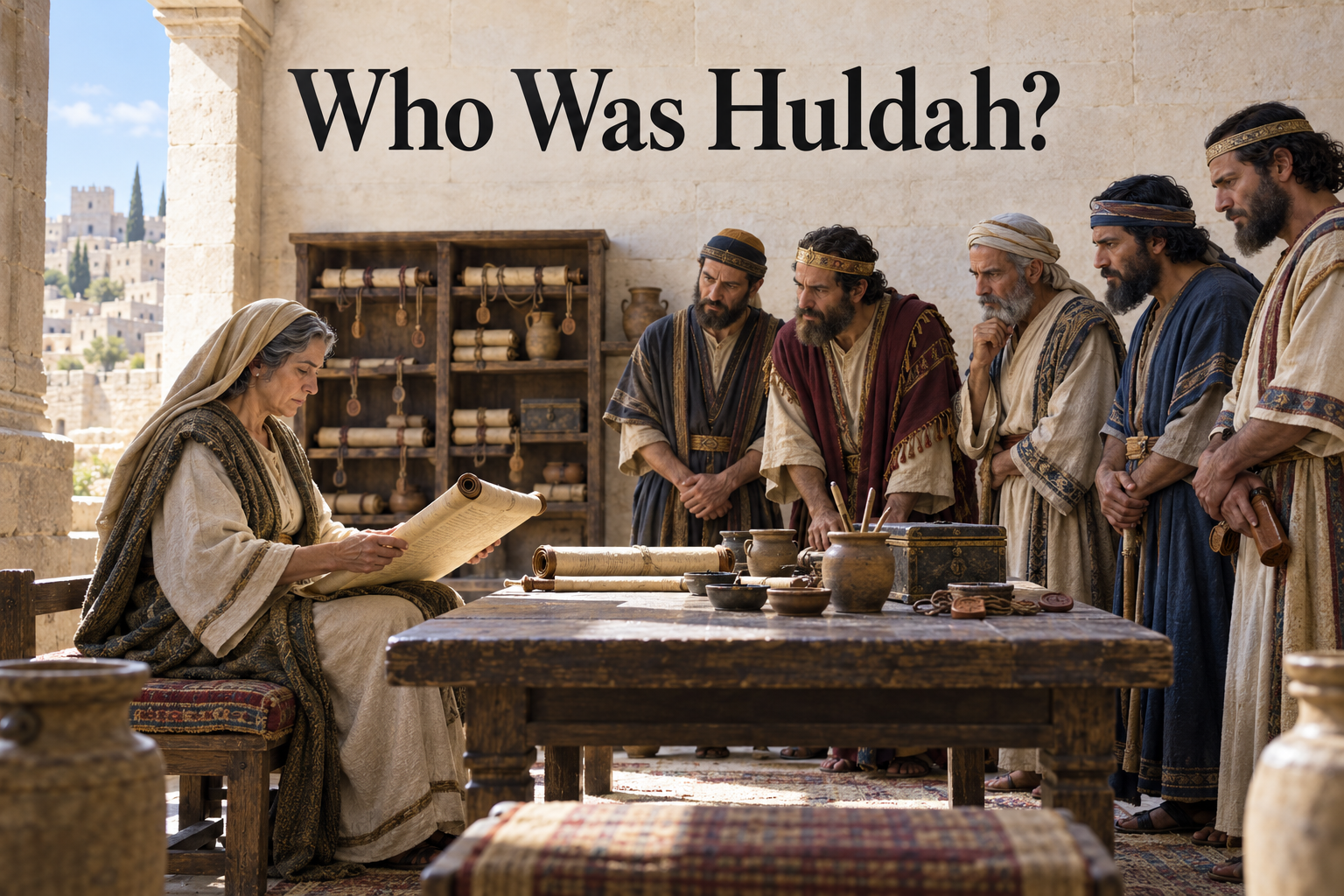
When workers found a scroll during repairs to the Jerusalem temple, King Josiah did not assume that discovery settled the matter. He heard its words, tore his robes, and sent a delegation to inquire of the Lord. The officials went to Huldah, a prophet living in Jerusalem, and she delivered the word that shaped the king’s response. Scripture gives us only a few verses about her, but those verses place her at one of the most consequential moments in Judah’s final century.
A scroll discovered in Josiah’s reign
Huldah appears in 2 Kings 22 and in the parallel account of 2 Chronicles 34. Josiah became king of Judah as a child after the assassination of his father, Amon. In the eighteenth year of his reign, conventionally dated to about 622 BC, he ordered repairs to the temple. During that work, the high priest Hilkiah reported finding “the Book of the Law” in the house of the Lord. The royal secretary Shaphan read it, then brought it to Josiah and read it before the king.
Josiah’s response was alarm rather than antiquarian interest. He tore his robes because he believed Judah had failed to obey the covenant demands in the scroll and had therefore come under judgment. He commissioned Hilkiah, Shaphan, and other royal officials to inquire of the Lord for himself, the people, and all Judah. They went to Huldah. The narrative offers no explanation for why she was selected, which suggests that her authority required no introduction for the people involved.
Huldah is explicitly called a prophetess, the wife of Shallum son of Tikvah, who was keeper of the wardrobe. She lived in Jerusalem in an area called the Mishneh, often translated the Second Quarter or newer district (2 Kings 22:14). Some older interpretations associated the location with a school or place of instruction, but the geographical sense is more likely. Beyond those details, Scripture tells us nothing certain about her family, age, training, or previous ministry. A short notice is not an invitation to manufacture a full biography.
Why did the delegation go to Huldah?
Readers often ask why Josiah’s officials consulted Huldah when Jeremiah and Zephaniah were also associated with Judah in this general period. The question is fair, but the Bible doesn’t answer it. Jeremiah’s call is dated to Josiah’s thirteenth year, while Zephaniah prophesied during Josiah’s reign, so simple claims that neither man was available are speculative. Huldah may have been especially accessible, particularly respected for inquiries of this kind, or chosen for reasons the narrator did not consider necessary to record.
What we can say is more significant than what we cannot. The high priest and leading royal officials sought Huldah’s word, received it as the word of the Lord, and reported it to the king. The story shows no embarrassment about a woman exercising recognized prophetic authority over the nation’s most powerful men. Huldah was not the only female prophet in Scripture; Miriam, Deborah, Noadiah, Isaiah’s unnamed wife, and Anna are also called prophets or prophetesses in their respective settings. Their ministries weren’t identical, but their presence prevents us from treating female prophecy as an accidental category created by modern readers.
Huldah’s message to Judah and Josiah
Huldah began with the standard prophetic formula, “Thus says the Lord.” Her first word concerned the nation: God would bring the disaster described in the scroll because the people had abandoned him and burned incense to other gods. His anger would not be quenched (2 Kings 22:15-17). This was not the reassuring answer a royal delegation might have preferred. Temple repairs and a responsive king did not erase generations of entrenched idolatry and injustice.
Her second word addressed Josiah personally. Because he had responded with humility, torn his robes, and wept before the Lord, he would be gathered to his grave in peace and would not see the coming disaster. Josiah later died in battle at Megiddo when he confronted Pharaoh Neco of Egypt (2 Kings 23:29-30; 2 Chronicles 35:20-24). That creates an obvious interpretive question: how could a violent death in battle fulfill a promise of burial in peace?
Many interpreters understand Huldah’s words to mean that Josiah would die before Judah’s national catastrophe and be gathered to his ancestors with the customary honors, not that his death would occur without violence. Second Chronicles explicitly records his burial in the tombs of his ancestors and the mourning that followed. Others see the tension as evidence that the narrative preserves different historical or theological layers. The text doesn’t give us enough information to eliminate every difficulty. It does clearly distinguish Josiah’s personal response from Judah’s accumulated judgment: his humility is honored, but one good reign does not instantly undo the nation’s long rebellion.
What was the Book of the Law?
The biblical account calls the discovery the Book of the Law and, later, the Book of the Covenant. It never supplies a table of contents. Traditional Jewish and Christian readers have often understood it as the Mosaic law, sometimes imagining a complete copy of the Torah. Many modern scholars identify it more specifically with some form of Deuteronomy, especially because Josiah’s subsequent reforms resemble Deuteronomy’s commands concerning covenant loyalty and centralized worship. Even among those scholars, proposals differ over how much of Deuteronomy existed at the time and how the text developed.
There is also debate over the event itself. Some understand the account as the straightforward rediscovery of an older scroll that had been neglected during previous reigns. Others think the scroll was newly composed or substantially edited in Josiah’s time and presented through a discovery story. Still others emphasize the account’s literary function without claiming that every detail can be reconstructed historically. The book of Kings presents the scroll as an authoritative covenant document found in the temple, and it presents Huldah as confirming that its warnings truly applied to Judah. Responsible interpretation can state that clearly while admitting that the surviving evidence doesn’t settle every question about the scroll’s extent or prior history.
Huldah is sometimes described as the woman who canonized Scripture. That makes a memorable headline, but it says more than the passage does. She did not assemble a biblical canon or issue a ruling about a collection of books. She delivered an oracle confirming the authority and relevance of the discovered law for her own generation. Her role was still remarkable. Priests found the scroll, a scribe read it, a king feared its judgment, and a prophetess declared what the Lord was saying through it.
Kings, Chronicles, and the order of reform
The accounts in Kings and Chronicles agree on Huldah’s identity and preserve substantially the same oracle, but they arrange Josiah’s reform differently. In 2 Kings, discovery of the scroll leads to covenant renewal and the campaign against idolatrous worship. In 2 Chronicles, Josiah begins purging idolatry earlier, while still young, and the scroll is found later during the temple repair. The difference should be acknowledged rather than hidden under a forced chronology.
The writers are emphasizing related truths from different angles. Kings shows how the recovered covenant document exposes Judah’s disobedience and propels reform. Chronicles portrays Josiah’s earlier search for God and presents the discovery as deepening a reform already underway. Both place Huldah at the decisive moment when the written word is interpreted as a present summons from God. Neither account treats reform as mere building maintenance, however valuable repairing a neglected temple may have been.
Huldah and the question of women’s ministry
Huldah regularly appears in Christian debates about women in ministry, and understandably so. She is not simply offering private encouragement or passing along information from her husband. She speaks in the Lord’s name to a delegation representing the king, priesthood, and nation. Any account of biblical ministry that makes such authority impossible has failed to account for Huldah before the modern discussion has even begun.
At the same time, one narrative cannot by itself answer every question about ordination, church offices, or how Old Testament prophecy relates to New Testament congregational leadership. Those questions require attention to other passages and to the differences among biblical covenants and ministries. Huldah should neither be made to carry an entire modern argument nor quietly removed from it. The honest starting point is that Scripture explicitly recognizes her as a prophet whose word redirected the leaders of Judah.
Huldah in later tradition
Rabbinic tradition included Huldah among seven female prophets of Israel and expanded her story in various ways. Later Jewish and Christian traditions also associated different Jerusalem sites with her tomb, while some traditions linked her name with gates near the temple area. These traditions testify to the honor attached to her memory, but they do not give us secure biographical information about the woman in 2 Kings. Several competing burial traditions are a useful reminder that a revered memory and a verifiable location are not the same thing.
Huldah’s biblical legacy doesn’t depend on those additions. When political and religious leaders needed to know what a troubling text required of them, they listened to her. She did not soften judgment to reward their attention, and she did not mistake Josiah’s humility for proof that consequences had vanished. Her few recorded words show prophetic ministry at its clearest: hear the word of God, apply it honestly to the present, and refuse to tell power only what it wants to hear.