
Who Was Isaac?
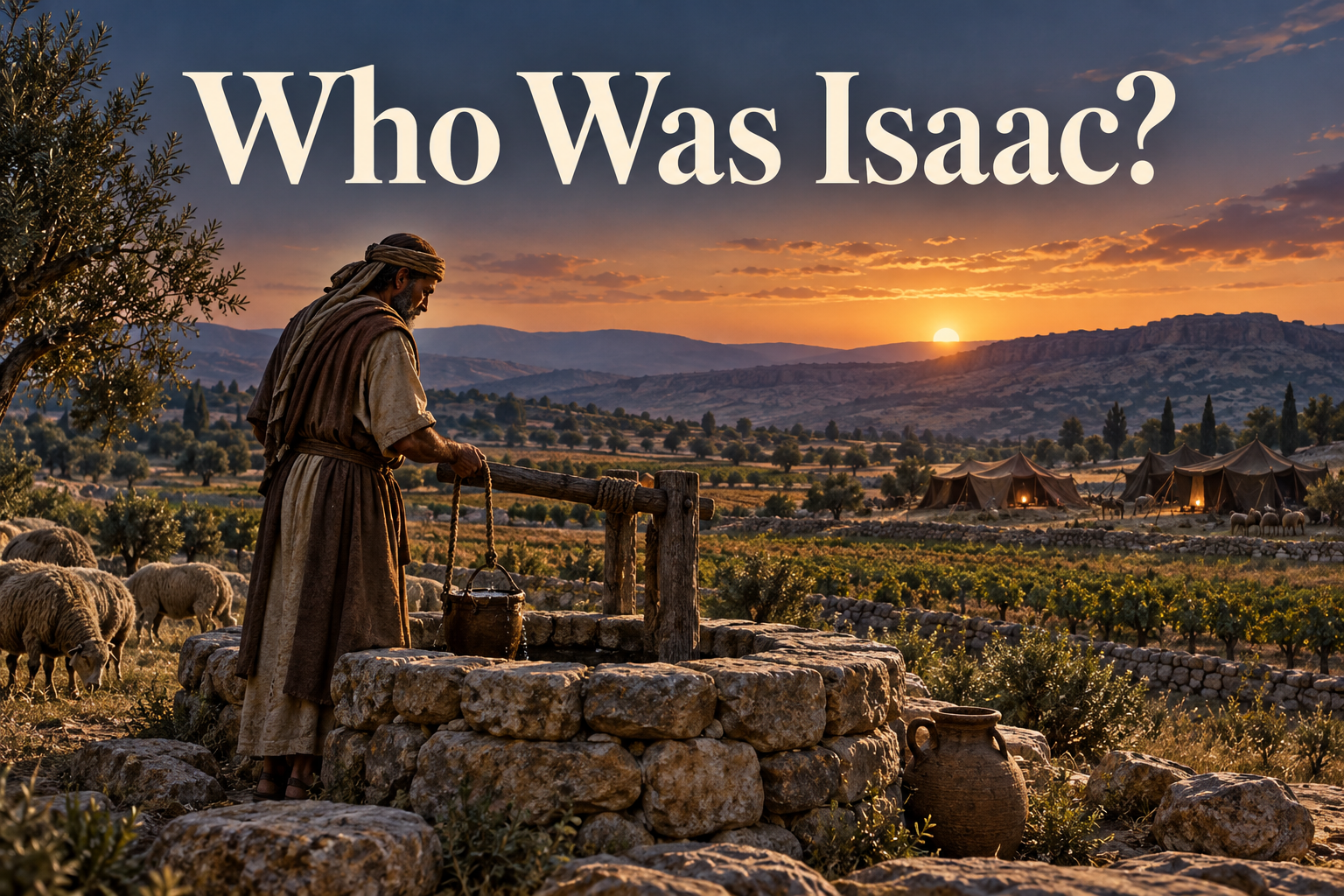
Isaac is the promised son who spends much of Genesis between more forceful personalities. Abraham’s faith dominates the story of his birth, Rebekah takes decisive action in the next generation, and Jacob and Esau fill the family with conflict. That can make Isaac seem passive or unimportant. Yet his quiet place in the narrative is part of his significance. The covenant promise does not advance only through dramatic journeys and daring speeches; it also passes through a man whose life is marked by receiving, remaining, digging, blessing, and being carried through dangers he did not create.
The child named for laughter
God promised Isaac by name before he was conceived. Abraham and Sarah were old, Sarah had been unable to bear children, and both laughed when told that she would have a son. God did not allow Abraham’s son Ishmael to be treated as though he had no future; Ishmael also received a promise of numerous descendants. Still, Genesis identifies Isaac as the son through whom God would establish the covenant line (Genesis 17:18–21). This is a choice of vocation within the biblical story, not a declaration that God loved only one branch of the family.
Sarah bore Isaac at the appointed time, and Abraham circumcised him on the eighth day. Sarah’s laughter changed from incredulity to delight, and the boy’s name, meaning “he laughs” or “he will laugh,” preserved the whole surprising history. At Isaac’s weaning, conflict over inheritance led Sarah to demand the expulsion of Hagar and Ishmael. Isaac benefits from that separation, but he is a child within the episode, not its decision-maker. Genesis holds together God’s particular promise through Isaac and God’s rescue of Ishmael in the wilderness.
Bound on the altar
The best-known event in Isaac’s early life is one in which he has remarkably little voice. Genesis 22 says God tested Abraham by commanding him to offer Isaac. Father and son traveled to Moriah, Isaac carried the wood, and he asked the obvious question: they had fire and wood, but where was the lamb? Abraham answered that God would provide. Isaac was bound and placed on the altar before the angel of the Lord stopped Abraham and a ram was offered instead.
Jewish tradition calls the episode the Akedah, or binding, and later interpretations sometimes portray Isaac as an adult who willingly cooperated. Genesis does not state his age or explicitly describe his consent. Christian readers have often seen a pattern that anticipates Christ, the beloved Son who is given, though the parallels shouldn’t erase the major difference: Isaac is spared, while Jesus goes to the cross. Hebrews 11 interprets Abraham as reasoning that God could raise the dead. The story tests Abraham and ends with God’s provision; it does not commend child sacrifice, which the Law and prophets condemn.
We aren’t told how Isaac remembered the event or what it did to his relationship with Abraham. That silence has invited novels, sermons, paintings, and psychological speculation, but speculation remains speculation. Responsible reading can acknowledge the terror within the scene without claiming access to thoughts the text does not reveal. The next direct notice of Isaac places him near Beer-lahai-roi, the well associated with God’s care for Hagar, while Abraham’s servant is returning with Rebekah.
Isaac and Rebekah
Genesis 24 gives an unusually long account of finding Isaac a wife. Abraham sends his senior servant to his extended family rather than allowing Isaac to marry among the Canaanites. The servant prays for guidance, and Rebekah’s energetic hospitality identifies her as the woman he seeks. Her family asks whether she will go, and she agrees. Although the negotiations reflect ancient household arrangements rather than modern courtship, Genesis does record Rebekah’s own answer at the decisive moment.
Isaac meets her after going out into the field near evening. He takes Rebekah as his wife, loves her, and is comforted after Sarah’s death. That simple statement of love is notable in Genesis. It does not mean their marriage remained untouched by secrecy or favoritism, but it prevents us from viewing the union only as a family contract. Their life together begins with comfort and soon encounters the same infertility that had burdened the previous generation.
Isaac prayed for Rebekah, and after twenty years of marriage she conceived twins. The pregnancy was so difficult that she inquired of the Lord. God told her that two nations were in her womb, that they would be divided, and that the older would serve the younger. Esau emerged first and Jacob followed holding his heel. The oracle establishes a reversal that will shape the story, but it does not instruct the parents to manipulate their sons or excuse the deception that eventually divides the household.
Wells, conflict, and room to live
Genesis 26 is the only chapter centered primarily on Isaac’s adult activity. During famine, God tells him not to go down to Egypt but to remain in the land, renewing the promises made to Abraham. Isaac stays among the Philistines in Gerar and, like his father, says that his wife is his sister because he fears being killed on account of her beauty. King Abimelech discovers the deception and protects the couple with a public order. Isaac’s fear doesn’t endanger Rebekah as far as Abraham’s deception endangered Sarah, but it repeats the same moral failure.
Isaac prospers until his wealth provokes envy. The Philistines stop the wells Abraham’s servants had dug, and Abimelech asks Isaac to move away. Isaac reopens old wells and digs new ones, but local herders dispute his claims at Esek and Sitnah. Rather than escalating every conflict, he moves and digs again until no one quarrels over the well at Rehoboth. His response isn’t cowardice. In a dry land, surrendering a functioning well was costly, and his willingness to create space for peace displays a strength different from Abraham’s military rescue of Lot.
At Beersheba the Lord appears to Isaac, tells him not to fear, and reaffirms the covenant. Isaac builds an altar, pitches his tent, and digs another well. Abimelech then seeks a treaty because it has become evident that the Lord is with him. The sequence joins worship, ordinary work, and peacemaking. Isaac’s servants spend a surprising amount of the chapter digging holes, but in his world wells meant survival, property, and a future for the household.
A divided family and a stolen blessing
Isaac loved Esau because he enjoyed the game Esau hunted, while Rebekah loved Jacob. Genesis states the favoritism without approving it, and the consequences spread through the family. When Isaac was old and his eyesight had failed, he prepared to give Esau a formal blessing after a favorite meal. Rebekah overheard, dressed Jacob in Esau’s clothes, covered his skin to imitate his hairy brother, and prepared food. Jacob entered his father’s tent and directly lied about his identity and even invoked God to explain his quick success.
Isaac was suspicious. The voice sounded like Jacob, though the clothing, hair, and food persuaded his other senses. He blessed Jacob with agricultural abundance, authority over peoples and brothers, and the covenantal pattern of blessing those who blessed him. When Esau arrived, Isaac trembled violently but did not revoke what had happened. He gave Esau a secondary blessing that included a future of struggle and eventual freedom from his brother’s yoke.
Some readers reason that because God had said the older would serve the younger, Rebekah and Jacob were simply accomplishing God’s will. Genesis never says deception was required. Divine purpose and human wrongdoing can operate within the same narrative without becoming identical. The scheme fractured the household, fueled Esau’s murderous anger, and sent Jacob into a long exile where he would learn what it felt like to be deceived.
Isaac’s place in the promise
Isaac lived to see Jacob return to Canaan. Genesis reports that Jacob and Esau buried their father at the age of 180, a moment of shared duty after years of rivalry. Isaac’s later life receives little detail, and Scripture does not record his deathbed words beyond the earlier blessings. His importance rests less on the quantity of scenes than on his place in the covenant formula: the God of Abraham, Isaac, and Jacob.
No external inscription or archaeological discovery independently identifies Isaac. Material evidence can illuminate ancient settlement, herding, wells, treaties, and family structures, but it cannot verify the private episodes Genesis records. Scholars disagree about the date and formation of the patriarchal narratives, and older claims that a single custom proves a precise patriarchal age should be treated cautiously. For Christian readers, Isaac’s historical and theological significance is known through the biblical witness.
Isaac is neither merely Abraham’s miracle child nor merely Jacob’s aging father. He is a recipient of promise who must trust it during famine, infertility, hostility, and family breakdown. His failures are real, especially his deception and favoritism, yet his life also shows prayer, affection, patient endurance, and peace pursued at personal cost. The promise continues through him, not because he controls everyone around him, but because the God who called Abraham remains faithful to another imperfect generation.