
Who Was James, Brother of Jesus?
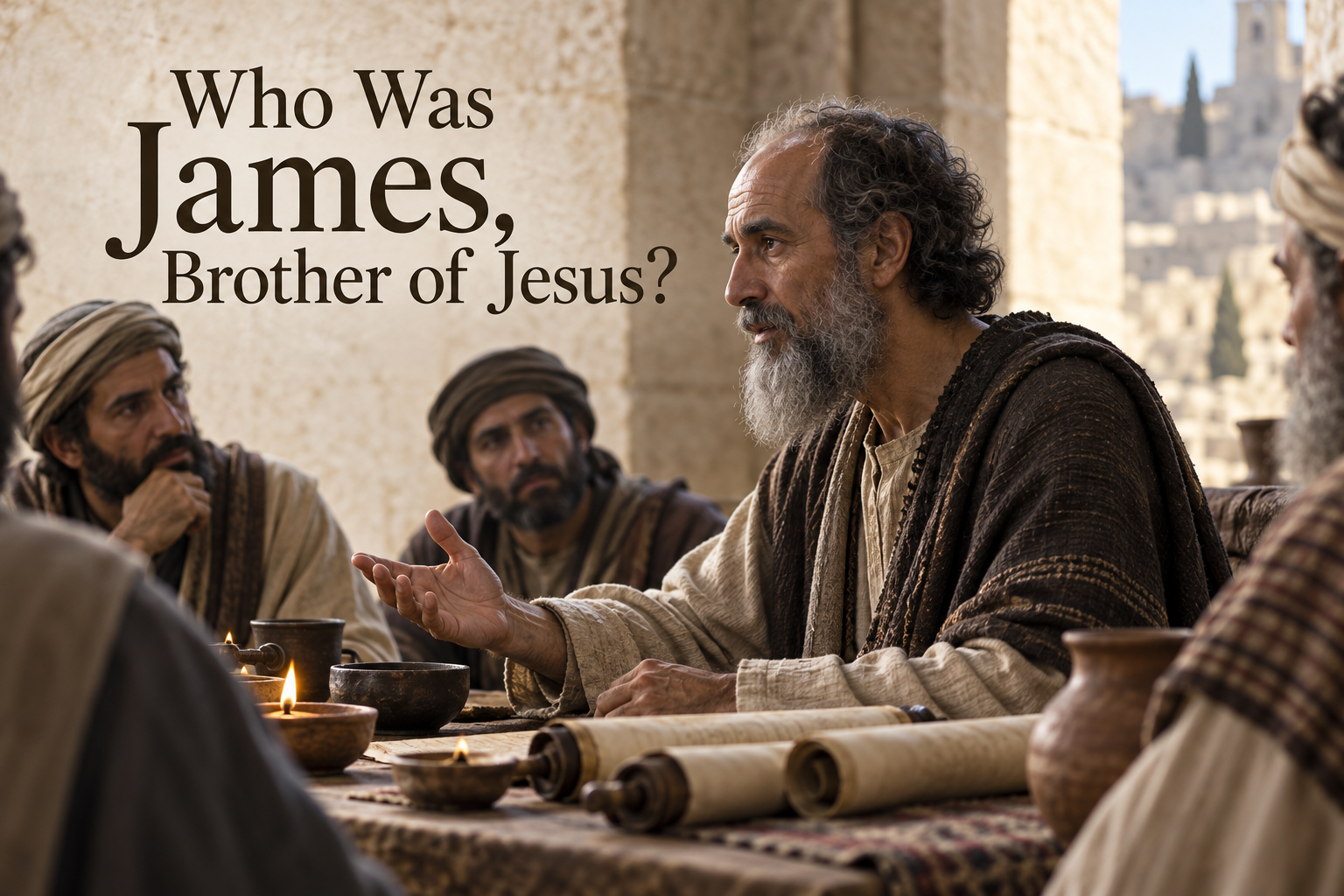
James the brother of Jesus became the leading figure of the Jerusalem church after the resurrection. During Jesus’ ministry, the Gospels place his brothers among family members who didn’t understand or believe in him. Paul later reports that the risen Jesus appeared to James, and Acts shows him guiding a difficult decision about Gentile converts. His movement from family skepticism to respected leadership is striking, even though no book narrates the transition in detail.
This James must be distinguished from James, Son of Zebedee, the apostle and brother of John, who was executed by Herod Agrippa I. He also differs from James son of Alphaeus, another member of the Twelve. James the brother of Jesus is often called James the Just or James of Jerusalem in later tradition. The New Testament usually identifies him through his relationship to Jesus, his leadership, or simply the prominence that made “James” enough.
What Does “Brother of Jesus” Mean?
Mark names Jesus’ brothers as James, Joses, Judas, and Simon and also mentions unnamed sisters (Mark 6:1-3). The most straightforward reading of “brothers” in ordinary Greek is siblings, and many Protestants understand them as younger children born to Mary and Joseph after Jesus. On that view, James was Jesus’ younger half-brother because Christians confess Jesus was conceived by the Holy Spirit. The Gospels never explicitly say Mary later had other children, but this interpretation takes the family language in its usual sense.
Eastern Orthodox tradition generally maintains the Perpetual Virginity of Mary by understanding the brothers as Joseph’s children from an earlier marriage. That stepbrother view appears in early apocryphal traditions, especially the second-century Protoevangelium of James, though it isn’t stated in the canonical Gospels. Roman Catholic tradition has often favored a cousin or close-relative explanation associated especially with Jerome. Greek and Semitic family language can extend beyond full siblings, and proposed identifications connect James with another Mary mentioned near the cross.
No interpretation removes every difficulty. The biological-brother view fits the word’s normal force; the stepbrother and cousin views preserve Mary’s perpetual virginity and appeal to broader kinship usage or later tradition. Christians should represent all three fairly. The New Testament establishes a close familial relationship publicly described as brotherhood; the precise relationship remains disputed among churches.
From Skepticism to Resurrection Faith
During Jesus’ ministry, his family once came to restrain him because people were saying he was out of his mind. Later John says plainly that even his brothers didn’t believe in him (Mark 3:20-21; John 7:1-5). These passages don’t single James out by name, so it is an inference that he shared every word or action. Still, as one of the named brothers, he likely belonged to the family skepticism John describes. Familiarity with Jesus didn’t automatically produce faith in his identity.
Paul supplies the turning point when he summarizes early resurrection testimony: Jesus appeared to Cephas, the Twelve, more than five hundred believers, James, all the apostles, and finally Paul (1 Corinthians 15:3-8). No canonical Gospel narrates the appearance to James, so its setting and dialogue are unknown. Later texts filled that silence, but Paul’s earlier testimony should remain primary. The appearance explains James’s changed place in the movement without telling us every step of his response.
After the ascension, Jesus’ brothers are among the believers praying with the apostles and women in Jerusalem (Acts 1:12-14). James isn’t individually named there, but he soon emerges as a leader. His faith wasn’t a claim to authority based solely on family status. In the sources, encounter with the risen Jesus and service within the community stand behind his recognized role.
Leader of the Jerusalem Church
When Peter escapes prison, he tells the believers to report the news to “James and the brothers” (Acts 12:6-17). By the time of the meeting often called the Jerusalem Council, James gives the concluding judgment. He listens to Peter, Paul, and Barnabas, interprets the mission through the prophets, and proposes that Gentiles not be required to become Jews while observing several practices needed for holiness and table fellowship (Acts 15:6-21). The gathering agrees and sends a letter in the name of the apostles and elders.
James’s role shows authority exercised through discernment rather than domination. He doesn’t claim that family relationship settles the issue. He weighs testimony, Scripture, and the practical unity of Jewish and Gentile believers. Interpreters debate the exact meaning and continuing application of the four requirements, but the central decision is clear: Gentile inclusion rests on God’s grace, not circumcision and full conversion to Judaism.
Paul independently calls James, Cephas, and John acknowledged pillars and says they recognized his mission to the Gentiles (Galatians 2:7-10). Paul also reports a later conflict at Antioch when Peter withdrew from eating with Gentiles after people “from James” arrived (Galatians 2:11-14). The phrase may mean they were sent by James, claimed his authority, or merely came from his circle. Paul blames Peter’s hypocrisy but doesn’t directly accuse James of ordering the withdrawal, so historians should resist turning ambiguity into a feud.
On Paul’s final recorded visit to Jerusalem, he meets James and the elders. They rejoice over Gentile conversions but worry that reports about Paul’s teaching will inflame Jewish believers, so they propose a public act demonstrating his respect for the law (Acts 21:17-26). The plan doesn’t prevent a riot. Acts portrays James navigating a church in which devotion to Jesus, Jewish identity, Gentile mission, and volatile public suspicion had to be held together.
Did James Write the Letter of James?
The letter opens, “James, a servant of God and of the Lord Jesus Christ,” without further identification (James 1:1). Christian tradition commonly attributes it to Jesus’ brother, whose prominence could explain why no extra title was needed. Its emphasis on practical obedience, care for the poor, disciplined speech, and resistance to status fits what we know of a leader concerned with communal holiness. The letter also echoes teachings associated with Jesus, especially the Sermon on the Mount.
Modern scholars remain divided. The letter’s polished Greek, rhetorical skill, broad audience, and lack of personal recollection lead many to date it after James’s death and view it as anonymous or pseudonymous wisdom written in his name. Others argue that a Galilean Jew could acquire Greek competence, use a secretary, or authorize teaching later shaped for circulation. Style alone can’t prove or disprove authorship, but neither should traditional attribution be presented as uncontested fact.
The book never says “I am the brother of Jesus,” and its author’s humility could be either authentic restraint or a literary choice. A responsible conclusion is that James the brother of Jesus is the traditional and plausible candidate, while direct authorship remains disputed. The letter is canonical because the church received it as Scripture, not because modern historians can reconstruct its writing desk with certainty. Its teaching shouldn’t be made hostage to more confidence than the evidence permits.
James’s discussion of faith and works is sometimes cast as an attack on Paul. James argues against a claim to faith that produces no mercy or obedience, while Paul argues that Gentiles aren’t justified by “works of the law” and boasts only in Christ. Their vocabulary overlaps, but their opponents and questions differ. The tension deserves serious study, yet James’s leadership alongside recognition of Paul’s mission warns against imagining two unrelated religions.
Death Under the High Priest
The Jewish historian Josephus provides important evidence outside the New Testament. Writing near the end of the first century, he reports that the high priest Ananus convened a council during a gap between Roman governors and brought “James, the brother of Jesus who was called Christ,” and others before it. They were accused of breaking the law and executed by stoning, generally dated to AD 62. Josephus’s account focuses on Ananus’s unlawful opportunism and says some respected citizens protested.
Most scholars accept the James reference as substantially authentic, although a minority questions whether the phrase identifying Jesus was altered by a Christian copyist. Unlike later Christian martyrdom stories, Josephus doesn’t say James was thrown from the temple, beaten with a club, or killed after a long public speech. Those details come through Hegesippus and other later traditions preserved by Eusebius. They may contain memories, but they shouldn’t be merged with Josephus as though all sources reported the same scene.
James’s death was an abuse of religious and political power. Calling him a martyr doesn’t sanctify mob violence or make every later embellishment true. It remembers that a leader of the Jerusalem believers was killed in a contested legal action. His death also came only a few years before the Jewish revolt and Jerusalem’s destruction, events that would transform both Jewish and Christian life.
James the Just in Later Memory
Later Christians called him “the Just” and portrayed him as exceptionally devoted to prayer and Jewish piety. Some descriptions say his knees became hard like a camel’s from kneeling, a memorable image found in later hagiography rather than the New Testament. Communities with competing theological agendas also appealed to James as an authority. His name appears in apocryphal works that he almost certainly didn’t write.
These traditions reflect a real historical impression: James was closely associated with Jerusalem, Torah-observant Jewish Christianity, and moral seriousness. Yet they can also turn him into a symbol used against Paul or against Gentile Christianity. The earliest evidence shows disagreement and negotiation, but also recognition, fellowship, and shared confession of the risen Jesus. James need not be diminished for Paul to matter, and Paul need not be rejected for James to retain his Jewish identity.
A Brother Who Became a Pillar
James’s biography is a story of changed conviction. Family closeness didn’t spare him from misunderstanding Jesus, and leadership didn’t remove him from hard disputes. He became a pillar by helping a diverse church discern how God’s promises to Israel embraced Gentiles without requiring them to become Jews. That work demanded theological clarity and patient attention to communities living with real cultural strain.
His relationship to Jesus differs across Christian traditions, and the authorship of the letter bearing his name remains debated. Neither uncertainty erases the man in early sources: brother of the Lord, resurrection witness, Jerusalem leader, partner in recognizing the Gentile mission, and victim of unlawful execution. James moved from not believing to helping the church understand what belief required. That is more substantial than any later title could make him.