
Who Was Jeremiah?
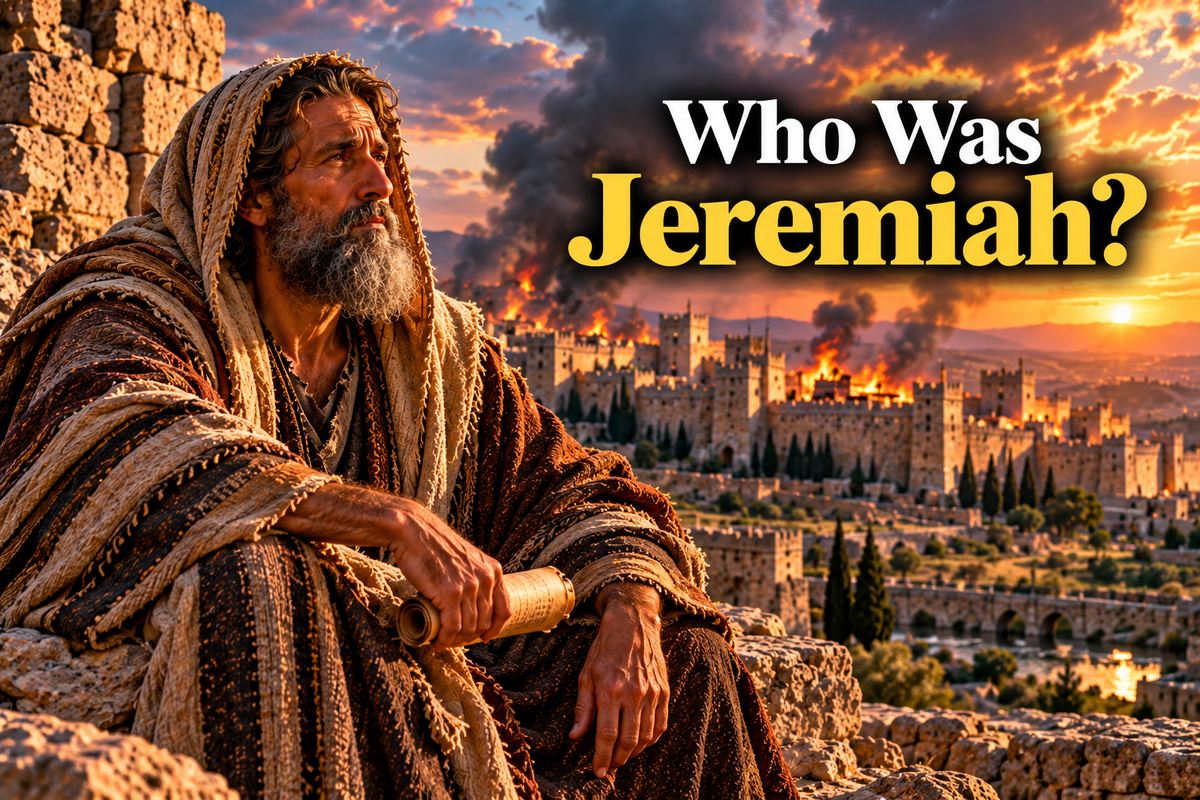
Jeremiah spent much of his life warning people about a disaster they were determined not to believe could happen. Judah had its temple, its priests, its kings, and the memory of God’s promises to David. Surely Jerusalem couldn’t fall while all of that remained in place. Jeremiah’s answer was uncomfortable: religious institutions weren’t a substitute for covenant faithfulness, and the presence of the temple didn’t give the nation permission to ignore the God worshiped there. His ministry unfolded during the final decades of Judah’s kingdom, when Babylon’s rise made the consequences of that misunderstanding impossible to avoid.
The book identifies Jeremiah as the son of Hilkiah, one of the priests at Anathoth, a town in Benjamin’s territory (Jeremiah 1:1). His prophetic calling began in the thirteenth year of King Josiah, generally dated around 627 BC. He continued speaking through the reigns that followed, including the years leading to Jerusalem’s destruction in 586 BC. That long span matters because Jeremiah wasn’t delivering a single warning and disappearing. He watched successive rulers make decisions, saw hopes for reform rise and falter, and endured the growing hostility of people who resented his message.
Jeremiah’s calling begins with a striking exchange. God tells him that he was appointed a prophet before his birth, and Jeremiah objects that he doesn’t know how to speak because he is young (Jeremiah 1:4–10). God doesn’t answer by praising Jeremiah’s natural ability. He promises to be with him and gives him words to speak. The commission includes both tearing down and building up, which anticipates the two major movements of Jeremiah’s ministry: judgment on entrenched wrongdoing and hope beyond the coming catastrophe.
Jeremiah wasn’t opposed to worship or the temple. He opposed the assumption that worship could cancel out injustice. In his temple sermon, he confronts people who invoke the Lord’s house while stealing, oppressing, and following other gods (Jeremiah 7). He points them to Shiloh, an earlier place associated with God’s presence that had not been protected from judgment. The argument was devastating precisely because it challenged something many Judeans regarded as their greatest source of security. Jeremiah insisted that the Lord cared about how people lived after leaving the sanctuary, not only what they said while standing inside it.
His warnings also reached into Judah’s political life. As Assyria declined and Babylon became the dominant regional power, rulers in Jerusalem searched for alliances that might preserve their independence. Jeremiah warned that resistance to Babylon would bring destruction, and at certain moments he urged submission as the least disastrous course (Jeremiah 27–28). That was hardly a popular message in a city whose leaders were trying to rally national confidence. Opponents accused him of undermining morale, and the prophet Hananiah publicly contradicted his prediction of a long exile. Jeremiah’s conflict with other prophets shows that the problem wasn’t a shortage of religious voices. It was the difficulty of discerning which voice was telling the truth.
The book doesn’t portray Jeremiah as emotionally untouched by the burden of his calling. He complains about his isolation, describes ridicule, and at one point wishes he had never been born (Jeremiah 20). Those passages are sometimes called his confessions, though they are closer to prayers of anguish than formal confessions of wrongdoing. He continues speaking, but he doesn’t pretend that obedience is painless. The prophet who warned an entire nation could still feel abandoned, exhausted, and frightened. His honesty makes him one of the Bible’s most recognizable portraits of the personal cost of public faithfulness.
Jeremiah’s ministry included symbolic actions that made his warnings difficult to ignore. He broke a pottery flask to illustrate judgment on Jerusalem, wore a yoke to represent Babylonian domination, and remained unmarried under a specific divine instruction connected with the suffering ahead (Jeremiah 16; 19; 27). These weren’t publicity stunts meant to attract attention to his personality. They were enacted messages that brought a future danger into the present. Their unusual character also helps explain why Jeremiah could be regarded as a troublemaker even when he was speaking from within Judah’s own religious tradition.
The prophet’s words were preserved with help from Baruch son of Neriah, his scribe. Jeremiah 36 describes Baruch writing down prophetic messages and reading them publicly after Jeremiah was barred from entering the temple. King Jehoiakim responded by cutting the scroll apart and burning it piece by piece. A second scroll was then prepared, with additional words. The episode gives a rare glimpse into the transmission of prophetic material, and it shows the difference between destroying a document and silencing its message. The book of Jeremiah itself has a complicated textual history: the ancient Greek version is shorter and arranged differently from the traditional Hebrew text, a reminder that the collection developed through a process of preservation and editing.
As Jerusalem’s situation worsened, Jeremiah was beaten, confined, accused of disloyalty, and eventually lowered into a muddy cistern (Jeremiah 37–38). He survived through the intervention of Ebed-melech, a Cushite official who persuaded the king to have him rescued. The episode is easy to overlook, but it matters. One of the few people who acted decisively to protect the prophet was an outsider to Judah’s ruling religious establishment. Jeremiah’s suffering also makes clear that a prophet’s faithfulness was not measured by popularity, freedom, or immediate success.
The destruction Jeremiah had foretold finally came when Babylon captured Jerusalem, burned the temple, and carried many Judeans into exile. Yet the book doesn’t end with the idea that God had simply abandoned his people. Jeremiah had already spoken of a future return, a restored relationship, and a covenant written on the heart rather than merely known as an external obligation (Jeremiah 30–33). In Jeremiah 31:31–34, the Lord promises a new covenant with the houses of Israel and Judah, marked by forgiveness and a deeper knowledge of God. Christians understand that promise in connection with Jesus and the new covenant announced at the Last Supper and discussed in Hebrews. Jewish readers have their own long history of interpreting Jeremiah’s promise within Israel’s covenant life.
One of Jeremiah’s most surprising acts of hope came while Jerusalem was under siege. He bought a field at Anathoth and carefully recorded the transaction (Jeremiah 32). Buying property when an invading army was about to overrun the land hardly looked like sensible financial planning. But that was the point. The deed testified that houses, fields, and vineyards would one day be bought again. Jeremiah’s hope wasn’t a denial of the disaster he had predicted; it was confidence that disaster would not have the last word.
After Jerusalem fell, Jeremiah remained for a time among those left in Judah. When a group fled toward Egypt despite his warning, they took him and Baruch with them (Jeremiah 43). Scripture doesn’t give a clear account of Jeremiah’s death, and later traditions about his end cannot be established with certainty. What remains is a ministry that held together two truths people often prefer to separate: God’s judgment is real, and so is his willingness to restore. Jeremiah refused to offer comforting promises that ignored wrongdoing, but he also refused to treat judgment as the end of God’s purposes for his people.