
Who Was Simeon at the Temple?
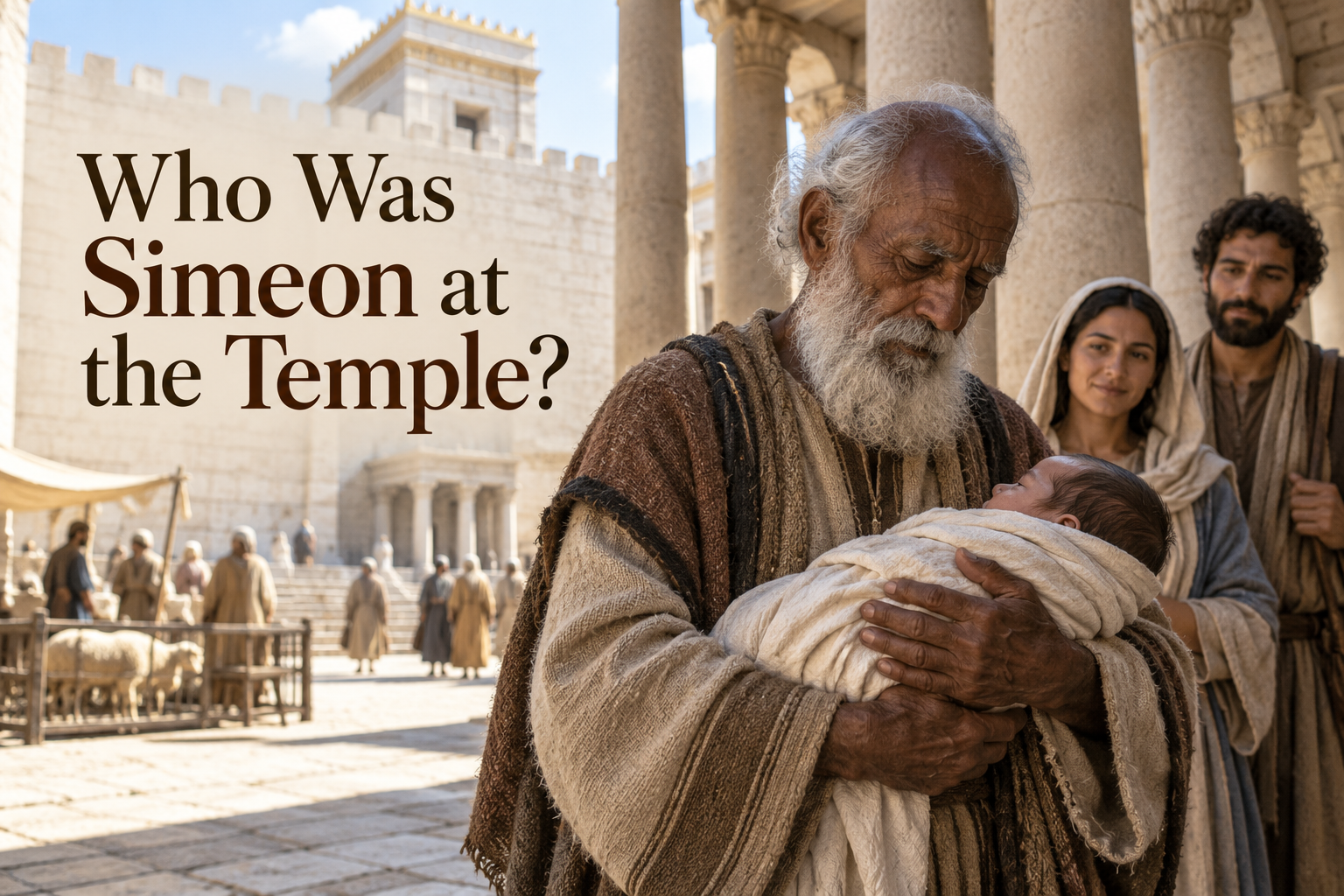
Simeon appears only briefly in the New Testament, but his few minutes in the story carry an astonishing amount of weight. Luke describes him as a righteous and devout man in Jerusalem who was waiting for “the consolation of Israel” (Luke 2:25). He wasn’t one of the Twelve, and the Gospel never calls him a priest, a scribe, or a public official. He was simply a faithful Israelite who had learned to wait for God’s promise without losing hope. When Mary and Joseph brought the infant Jesus to the temple, Simeon recognized what almost everyone else in the crowded courts would have missed.
This is the Simeon associated with Jesus’ presentation at the temple, not Simon Peter, Simon the Zealot, Simeon called Niger, or the patriarch Simeon in Genesis. English Bibles use both Simon and Simeon for several men because the names represent related forms, but Luke’s setting makes the identity clear. Everything Scripture tells us directly about this Simeon comes from Luke 2:25-35. Later Christian art and preaching often picture him as an elderly priest, yet neither his age nor his office is stated in the text. Those details may suit the scene, but they shouldn’t be mistaken for biography.
A Man Who Was Waiting
Luke introduces Simeon by character rather than ancestry or occupation. To call him righteous and devout doesn’t mean he was morally flawless. In Luke’s narrative, the description marks him as a person whose life was oriented toward God and Israel’s hope. He was waiting for the consolation of Israel, language that recalls prophetic promises of comfort after judgment and exile. Isaiah opens one great section of promise with the command to comfort God’s people, then looks toward God’s saving arrival (Isaiah 40:1-5).
Simeon’s waiting was therefore more than private optimism about better times. Israel lived under Roman power, and many Jews longed for God to restore his people, defeat evil, forgive sin, and keep the promises made through the prophets. Different groups imagined that restoration in different ways, so we shouldn’t pretend everyone held one detailed messianic program. Luke tells us what distinguished Simeon’s hope: the Holy Spirit was upon him, had disclosed that he would see the Lord’s Messiah before death, and guided him into the temple at the decisive moment (Luke 2:26-27). His recognition of Jesus rests in the story on divine revelation, not on social status or clever deduction.
Meeting Jesus at the Temple
Mary and Joseph came to Jerusalem in obedience to the law connected with childbirth and the consecration of a firstborn son. Leviticus prescribed a sacrifice after a mother’s period of purification and allowed two birds when a family couldn’t afford a lamb (Leviticus 12:6-8). Luke says Jesus’ parents offered the pair of birds, which suggests modest means, although it doesn’t tell us everything about their long-term economic condition. The consecration of the firstborn also recalled Israel’s deliverance from Egypt (Exodus 13:2). Jesus enters the temple story within Israel’s covenant life, not as a stranger to it.
Simeon took the child in his arms and blessed God. That action is intimate, but Luke doesn’t explain whether Simeon knew the family, asked permission, or was performing an official role. The point lies in what he saw in this ordinary-looking child. He believed God’s promise had reached its appointed moment, so he could face death in peace. His words have become known by their Latin opening, Nunc Dimittis, meaning “now you dismiss,” but the label came later than the Gospel.
Salvation for Israel and the Nations
Simeon calls Jesus God’s salvation, prepared in the presence of all peoples: a light for revelation to the Gentiles and glory for Israel (Luke 2:29-32). That declaration won’t allow Jesus’ mission to be reduced either to a private spiritual experience or to a rejection of Israel. The child embodies God’s faithfulness to Israel, and through Israel God’s light reaches the nations. Luke will develop that widening mission throughout his Gospel and Acts. Simeon announces it before Jesus can speak a word.
The language strongly resembles Isaiah’s servant songs, where God’s servant becomes a light to the nations and carries salvation to the earth’s ends (Isaiah 49:6). That connection is an interpretation of Luke’s scriptural texture, not a quotation that Simeon explicitly identifies by chapter and verse. Even so, it fits the Gospel’s repeated insistence that the good news fulfills Israel’s Scriptures. Gentile inclusion isn’t an embarrassing backup plan after Israel failed. In Simeon’s blessing, it belongs to the scope of God’s saving purpose from the start.
Simeon’s peaceful readiness to depart has often been read as a prayer at the end of life, and Christians have used his words in evening worship for centuries. Luke, however, never says Simeon died that day. The promise was that he wouldn’t see death before seeing the Messiah, not that death would follow immediately afterward. His peace comes from fulfillment rather than weariness: God has kept his word, and Simeon can release the future into God’s hands. That makes the prayer appropriate at life’s end without turning it into a death certificate.
A Sign That Would Be Opposed
The scene grows darker when Simeon blesses the family and speaks directly to Mary. Jesus is appointed for the falling and rising of many in Israel and for a sign that will be opposed, so that the thoughts of many hearts will be revealed (Luke 2:34-35). Salvation will expose as well as comfort. People won’t remain neutral before Jesus, and their responses will disclose loyalties that respectable appearances can hide. Luke’s later narrative bears this out as the humble receive good news while confident religious and political powers often resist it.
Simeon then tells Mary that a sword will pierce her own soul. Christians commonly connect this with the anguish she would experience at Jesus’ rejection and crucifixion, and that reading makes good narrative sense. The saying may also encompass the painful division Jesus’ mission creates, including the strain visible when his family doesn’t fully understand him. Luke doesn’t spell out one exclusive fulfillment, and the line shouldn’t be embellished into a prediction that Mary herself would die by a sword. It is a sober warning that participation in God’s work won’t shelter her from grief.
Nor does Luke suggest that opposition to Jesus was good merely because it was foretold. The narrative reports betrayal, false accusation, political calculation, torture, and execution as human sins even while God brings salvation through the cross. Biblical prophecy can describe what God will accomplish amid evil without approving every act that contributes to the outcome. Simeon’s warning preserves both truths: Jesus’ mission belongs to God’s purpose, and the resistance he meets reveals hearts in need of judgment and mercy.
What We Can and Cannot Know
No known inscription or contemporary non-Christian source identifies Simeon, which isn’t surprising for a private resident of Jerusalem. His historical profile depends on Luke’s account. The setting is recognizably Jewish: temple worship, Torah observance, messianic expectation, prayer, and prophetic hope all belong to the world of first-century Judaism. Those broad features provide context, but archaeology can’t verify Simeon’s encounter or the words he spoke. Christians receive them as part of Luke’s inspired testimony, while historians must acknowledge the limits of independent evidence.
Later tradition filled some of those gaps. Simeon became “Simeon the God-receiver” in Eastern Christian memory, and Western churches made his song a regular part of night prayer. Artists generally show him as an old man, partly because he speaks as someone ready to die and partly because he is paired with the elderly Anna. Yet Luke explicitly calls Anna advanced in years and says no such thing about Simeon. The traditional image may be fitting, but honest interpretation keeps it on the tradition side of the line.
The claim that Simeon was a priest is similarly uncertain. He was in the temple and held the child, but ordinary worshipers also entered appropriate temple courts, and Luke never says he offered the sacrifice. Attempts to identify him with a particular rabbi or historical dignitary go beyond the evidence as well. A famous name can make a story feel more secure, but Luke’s point is nearly the opposite: a man with no stated title recognized the Messiah because the Spirit had prepared him to see.
Why Simeon Matters
Simeon stands at a threshold. He represents faithful Israel waiting on promises given through the law and prophets, yet he also looks ahead to a mission that will embrace the nations. He doesn’t discard Israel’s story when he welcomes Jesus; he sees that story reaching its God-given goal. His hope is patient without being passive, scriptural without being narrow, and Spirit-led without becoming self-important. Those qualities explain why his short appearance has endured in Christian worship.
His testimony also corrects the idea that faith always means having a detailed map of what God will do next. Simeon knew he would see the Messiah, but Luke doesn’t say he knew how Jesus would minister, die, rise, or send witnesses to the nations. He received enough light to recognize the child and enough honesty to name the conflict ahead. The old promises were being fulfilled, but not through a painless triumph. In Simeon’s arms, salvation is present as a vulnerable infant, and faith recognizes him before the world does.