
Who Was the Prophet Amos?
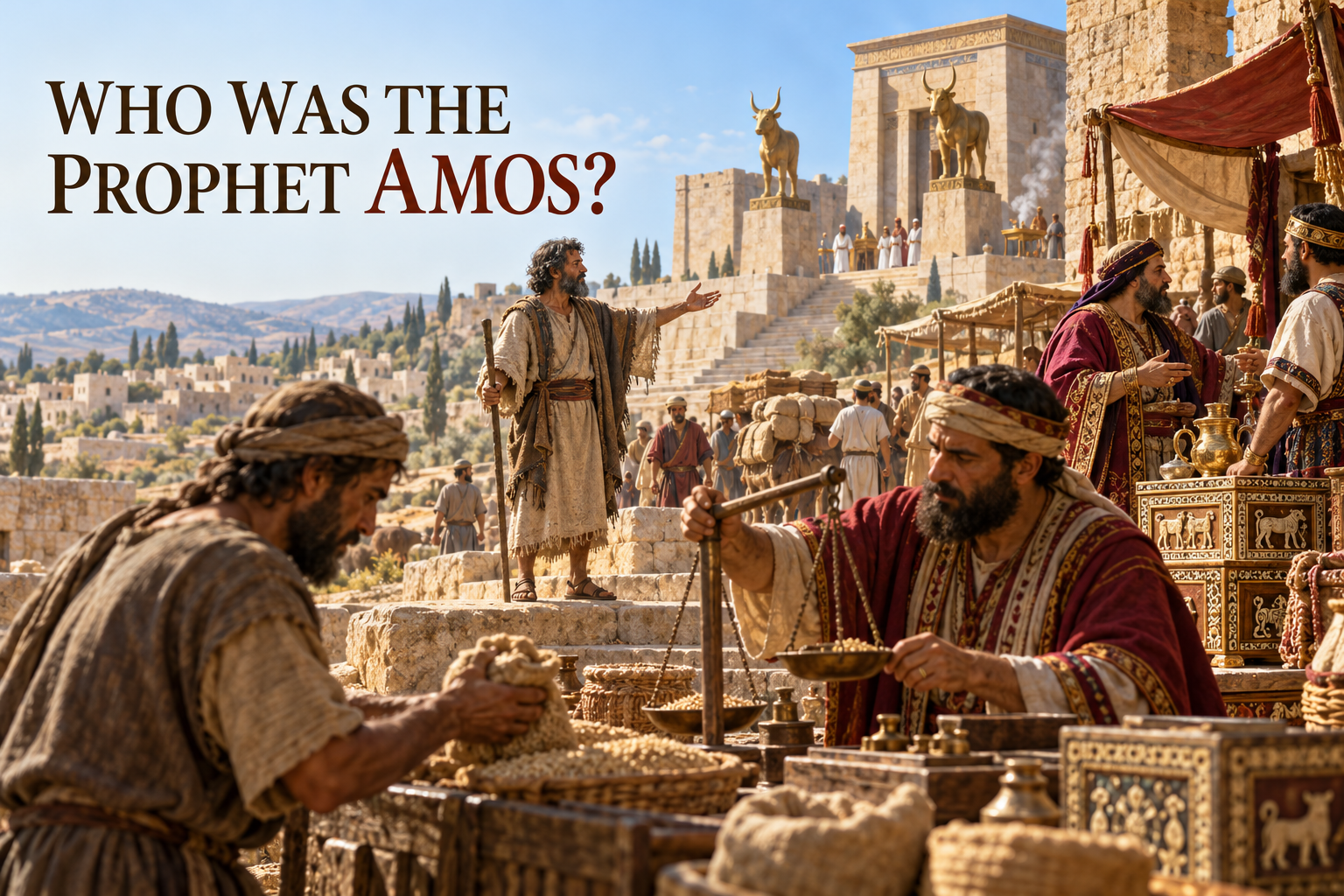
Amos is often remembered as the shepherd who became a prophet, which is true as far as it goes. It can also leave the impression that he wandered in from a pasture, delivered a few homespun observations, and wandered back out again. The book that bears his name is anything but unsophisticated. Its poetry is vivid, its arguments are carefully arranged, and its message goes directly after the comfortable assumptions of a prosperous nation. Amos came from outside Israel’s religious establishment, but he understood exactly where to press.
A Man From Tekoa in a Prosperous Age
Amos 1:1 identifies him as one of the livestock breeders from Tekoa, a town in the hill country of Judah south of Jerusalem. He prophesied during the reigns of Uzziah in Judah and Jeroboam II in Israel, placing his ministry in the middle of the eighth century BC. The book adds that his words came two years before an earthquake, an event apparently memorable to its first readers even though we can’t date it with precision. Amos was a Judean sent north to address the kingdom of Israel, so he spoke as both a covenant insider and a political outsider. That combination helps explain why his preaching was so difficult for Israel’s leaders to dismiss and so easy for them to resent.
Jeroboam II presided over a period of renewed strength in the northern kingdom. According to 2 Kings 14:23-29, Israel recovered territory that had previously been lost, while the Book of Amos reflects a society in which at least some people enjoyed expensive homes, elaborate furniture, plentiful food, music, and leisure. National success could easily be interpreted as evidence that God was pleased. Amos looked at the same prosperity and saw corruption beneath it: courts that favored the well-connected, merchants eager to cheat, and wealthy people whose comfort depended upon the vulnerability of the poor. The problem wasn’t that anyone owned a decent house or enjoyed a good meal. It was that luxury had become strangely compatible with dishonesty, exploitation, and indifference.
Amos 7:14 describes him as a herdsman and a dresser of sycamore figs. Exactly what those occupations tell us about his economic standing is uncertain. Some readers have pictured him as a poor laborer, while others have argued that managing livestock and working with trees may indicate broader agricultural interests. The text doesn’t give us enough information to settle the matter, and we don’t need to turn Amos into either an impoverished farmhand or a wealthy rancher to understand him. What matters is that prophecy wasn’t his career plan. He earned his living outside the prophetic establishment and went to Israel because the Lord sent him.
“The Lord Took Me”
The clearest account of Amos’s call appears during his confrontation with Amaziah, the priest of Bethel. Amaziah tells him to return to Judah, earn his bread there, and stop prophesying at Bethel because it is the king’s sanctuary and a royal temple (Amos 7:10-13). Amos replies that he was not a prophet or a prophet’s son, but that the Lord took him from following the flock and commanded him to prophesy to Israel. The Hebrew of verse 14 can be translated in either the past or present tense, so Amos may be saying that he had not previously been a prophet or that he wasn’t a professional prophet. In either case, he isn’t denying the mission described in the next verse. He is denying Amaziah’s suggestion that he crossed the border to make money preaching.
The expression “son of a prophet” probably refers to membership in a prophetic company rather than biological descent. Amos had no institutional position to protect, no royal appointment, and no family trade in prophecy. His authority rested on God’s call, not on a title supplied by the palace or sanctuary. That didn’t make every outsider automatically trustworthy, of course; the Bible is quite capable of warning about false prophets. It does mean that official recognition and divine authorization aren’t always the same thing. Amaziah had the recognized position at Bethel, while Amos had the unwelcome word of the Lord.
The Trap in Amos’s Opening Sermon
Amos begins with a series of judgments against Israel’s neighbors. Damascus, Gaza, Tyre, Edom, Ammon, and Moab are each condemned for brutal acts committed against other peoples. An Israelite audience could have listened approvingly as judgment moved around the map. Then Amos turned toward Judah, and finally toward Israel, where the indictment became longer and more detailed. What sounded at first like a sermon about everybody else’s sins became a summons for God’s own people to answer for theirs.
The arrangement makes an important theological point. The Lord wasn’t merely a tribal deity concerned only with Israel’s religious affairs. He judged the nations for violence, cruelty, enslavement, and the desecration of human dignity, even when Israel wasn’t the direct victim. Yet Israel’s covenant relationship with God didn’t give it immunity from the same moral government. “You only have I known of all the families of the earth,” the Lord says in Amos 3:2, “therefore I will punish you for all your iniquities.” Election brought privilege and vocation, but it also brought accountability. Israel couldn’t appeal to its special relationship with God while living in a way that denied his character.
When Prosperity Conceals Injustice
Amos’s accusations are specific. He condemns those who sell the righteous for silver and the needy for a pair of sandals, trample the poor, accept bribes, and deny justice to the needy at the city gate (Amos 2:6-7; 5:10-12). The city gate was where legal and civic business was conducted, so corrupting judgment there meant that the poor could be wronged with little hope of appeal. Amos also addresses merchants who can hardly wait for religious observances to end so they can resume selling grain, manipulating measures, raising prices, and using dishonest scales (Amos 8:4-6). Their observance of sacred time had not changed what they intended to do when business reopened.
This is one reason Amos can’t be reduced to a vague slogan about “social justice.” He isn’t offering a modern political platform or treating economics as a subject detached from worship. He is applying covenant faithfulness to courts, markets, debts, land, and the treatment of people with less power. Righteousness in Amos is not merely private sincerity, and justice is not an optional interest for unusually political believers. A community that praises God while arranging ordinary life to benefit the powerful at the expense of the weak has misunderstood the God it claims to praise.
Amos doesn’t condemn wealth simply because it is wealth. Abraham had possessions, Solomon’s abundance was celebrated before it became entangled with idolatry, and Scripture regularly treats material provision as a gift to be received with gratitude. Amos’s target is self-indulgence joined to moral indifference. He describes people reclining on ivory-adorned beds, feasting, singing, and anointing themselves with fine oils while remaining unconcerned about the ruin of Joseph (Amos 6:4-6). Enjoyment had become insulation. Their comforts helped them avoid seeing the condition of the nation that made those comforts possible.
Worship God Refuses to Receive
Some of Amos’s most severe language concerns Israel’s worship. The people visited sanctuaries, brought sacrifices, observed festivals, sang songs, and offered gifts. From the outside, this looked like religious vitality. Yet the Lord declares that he hates their festivals, refuses their offerings, and will not listen to their music (Amos 5:21-23). The famous demand follows: “Let justice roll down like waters, and righteousness like an ever-flowing stream” (Amos 5:24).
That passage is sometimes read as though Amos opposed worship itself, but that conclusion goes beyond his argument. The Old Testament doesn’t condemn sacrifice, prayer, music, or sacred assemblies as such; God had given Israel forms of worship. Amos condemns the attempt to use religious observance as a substitute for obedience. Sacrifice couldn’t bribe God into overlooking crooked courts, and enthusiastic songs couldn’t drown out the cries of people being cheated. The answer was not less devotion to God but devotion that reached beyond the sanctuary and reshaped public and private conduct.
Amos also exposes the danger of treating sacred places as spiritual insurance. Bethel and Gilgal had histories that mattered to Israel, but their associations with the past couldn’t protect worshipers who persisted in rebellion. Amos 4:4-5 even invites the people sarcastically to keep bringing their offerings because their religious activity has become another way of multiplying transgression. That is a frightening possibility for any religious community. The habits that should express repentance can become mechanisms for avoiding it.
The Day of the Lord Will Be Darkness
Israel apparently expected the “day of the Lord” to bring victory over its enemies. Amos overturns that confidence: “Why would you have the day of the Lord? It is darkness, and not light” (Amos 5:18). He compares it to a man who escapes a lion, encounters a bear, reaches home, and is bitten by a snake when he puts his hand against the wall. The humor is dark because the point is deadly serious. People who longed for God to intervene had not considered that his intervention would expose them too.
This warning follows naturally from Amos’s understanding of election. God’s presence is not automatically comforting to people who invoke his name while resisting his ways. The day of the Lord is good news when God sets things right, but setting things right necessarily involves judging what is wrong. Amos therefore calls Israel to seek the Lord, seek good rather than evil, hate evil, love good, and establish justice at the gate (Amos 5:4, 14-15). Judgment is not presented as a subject for detached speculation. The proper response is repentance.
Visions, Intercession, and a Royal Sanctuary
The later chapters of Amos contain a series of visions. Amos sees locusts consuming the land and then a devastating fire, and in both cases he pleads for Jacob because the nation is small. The Lord relents, showing that Amos wasn’t eager to watch his hearers suffer. He announced judgment because he believed the word came from God, yet he also interceded for the people who opposed him. Biblical prophets weren’t simply angry men with unusually religious vocabularies. They often stood between divine judgment and the people, speaking hard truth in one direction and pleading for mercy in the other.
The pattern changes with the vision commonly translated as a plumb line in Amos 7:7-9. Judgment is no longer withdrawn, and the sanctuaries of Israel and the house of Jeroboam come under threat. At this point Amaziah reports Amos to the king as a conspirator and orders him to leave Bethel. His description of Bethel as the king’s sanctuary and the temple of the kingdom reveals the problem: an institution meant for worship had become closely identified with royal power. Amos’s message was treated as treason because criticism of the nation’s spiritual condition also challenged the arrangements supporting the throne.
Another vision uses a basket of summer fruit as a sign that the end has come upon Israel, a wordplay that is clear in Hebrew even though it disappears in English (Amos 8:1-2). The final vision pictures the Lord standing by the altar and announcing judgment from the very place where the people expected security (Amos 9:1-4). Neither political strength nor religious location could provide an escape. The northern kingdom eventually fell to Assyria in 722 BC, several decades after the setting described in Amos 1:1. Scripture gives us no account of Amos’s later life.
Judgment Is Not the Book’s Last Word
Amos is among the Bible’s sternest books, but it doesn’t end with destruction. The Lord promises not to destroy the house of Jacob completely, even while describing a severe sifting among the nations (Amos 9:8-10). The fallen shelter of David will be raised, ruins will be rebuilt, and the closing picture is one of extraordinary fruitfulness and restored settlement (Amos 9:11-15). The hope is not based on Israel pretending that judgment was unnecessary. Restoration comes from the God who remains faithful after exposing and judging covenant unfaithfulness.
In Acts 15, James appeals to Amos 9:11-12 while the Jerusalem council considers the inclusion of Gentile believers. He understands the rebuilding of David’s fallen house in connection with God calling people from the nations by his name. That Christian use of Amos doesn’t erase the prophet’s concern for Israel, nor does it settle every later question about Israel and the church. It does show that the promise reaches beyond national recovery to the gathering of a people under the reign of David’s greater Son. The God who judges the nations also intends to redeem people from among them.
Why Amos Still Matters
Amos remains uncomfortable because he removes several excuses religious people find useful. Prosperity doesn’t prove that God approves of everything producing it. Correct worship practices don’t compensate for dishonest conduct. Belonging to God’s people doesn’t make accountability less serious, and national confidence doesn’t turn injustice into a minor concern. Amos forces worshipers to ask whether the God addressed in their songs is also honored in their contracts, courts, spending, employment, and treatment of people who can do little for them in return.
At the same time, Amos shouldn’t be recruited as a mascot for every program that borrows the language of justice. His standard is the character and covenant of God, not whatever a political tribe happens to call righteous. The prophet joins worship and ethics because both answer to the same Lord. He came from outside the centers of power, but his message has outlasted the palace that tried to silence it. The lion had roared, and Amos understood that the important question was not whether he possessed the right resume, but whether Israel would hear the word of the Lord.