
Who Was the Prophet Haggai?
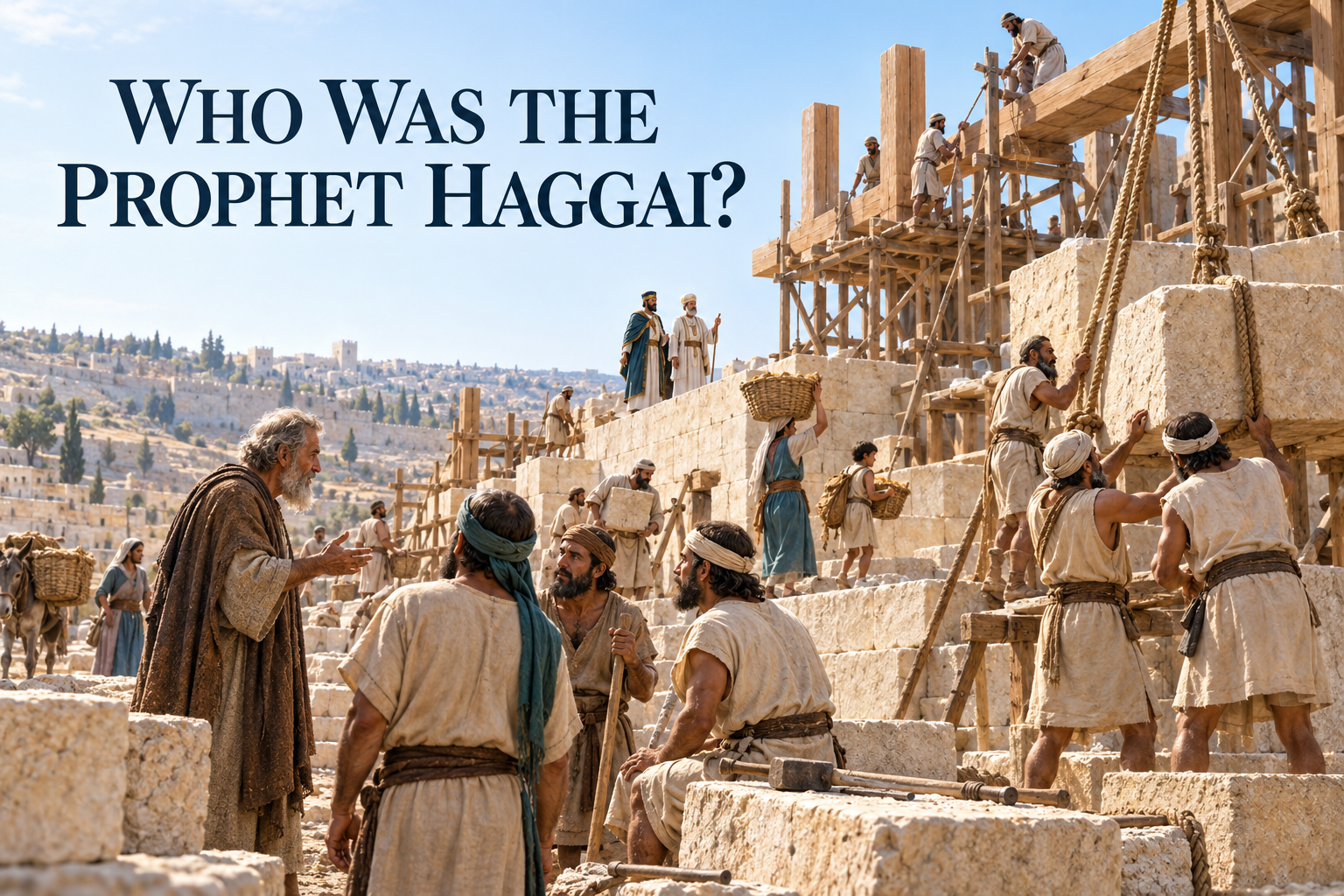
Some prophets spoke for decades and left behind books that range across kings, wars, and national disasters. Haggai’s recorded ministry fits within a few months in 520 BC, yet it helped restart a project that had stalled for years. His concern was the ruined temple in Jerusalem, but he wasn’t merely campaigning for a building. He believed the community’s neglected sanctuary exposed a deeper problem with its priorities, its worship, and its confidence in God’s presence.
A Prophet With a Remarkably Precise Calendar
The book tells us almost nothing about Haggai’s personal history. It gives no father’s name, birthplace, occupation, or account of his call. Suggestions that he was old enough to remember Solomon’s temple are possible but unproven. In Haggai 2:3, he asks whether anyone among the people had seen the former temple in its glory; the question doesn’t tell us whether Haggai himself had seen it. Scripture gives us no account of his later life.
What the book does provide is a series of exact dates tied to the second year of Darius I, king of Persia. These place Haggai’s messages between the sixth and ninth months of 520 BC. Judah was no longer an independent kingdom. It was a small province within the Persian Empire, governed by Zerubbabel, a descendant of David, while Joshua the high priest oversaw the priestly leadership. Haggai and his contemporary Zechariah also appear in Ezra 5:1-2 and 6:14, where their preaching is connected with the renewed work on the temple.
Consider Your Ways
The returned community had reasons for feeling overwhelmed. Its resources were limited, harvests had disappointed, and Jerusalem still bore the marks of Babylonian destruction. The people concluded that the time to rebuild the Lord’s house had not yet come. Haggai challenged that conclusion by contrasting the temple’s ruins with their own finished houses. The point wasn’t that having a decent roof was sinful. It was that postponement had become a settled habit, while personal concerns always seemed to find room in the schedule.
Haggai repeatedly told the people to consider their ways. They sowed much and harvested little, earned wages that seemed to disappear, and never had quite enough. The prophet interpreted these conditions as covenant discipline resulting from their neglect of God’s house (Haggai 1:5-11). We should be careful about turning that message into a universal formula in which every drought or financial difficulty proves that someone has failed spiritually. Haggai was addressing a particular covenant community through a specific prophetic word. His broader challenge remains: people can explain away disobedience so patiently that delay begins to sound like wisdom.
The response was unusually direct. Zerubbabel, Joshua, and the remnant of the people obeyed, and work resumed less than a month after Haggai’s first dated message. Haggai then delivered the assurance the builders most needed: “I am with you” (Haggai 1:13). Ezra records that the temple was eventually completed in the sixth year of Darius, commonly dated to 515 BC. Haggai didn’t complete the project by himself, but his preaching helped move it from intention back to action.
When the New Temple Looked Unimpressive
Once construction began, another problem surfaced. The new work seemed modest beside memories of the former temple. Haggai didn’t deny the visible difference or try to improve morale with architectural salesmanship. He told Zerubbabel, Joshua, and the people to be strong and work because God’s Spirit remained among them (Haggai 2:4-5). The significance of the temple would not finally depend on whether the builders could reproduce the scale of Solomon’s achievement.
Haggai promised that God would shake the nations, fill the house with glory, and grant peace there. The “latter glory” would exceed the former (Haggai 2:6-9). Interpreters differ over how the language about the nations and their treasures should be understood, but the passage plainly looks beyond what the builders could accomplish with their own resources. Hebrews 12:26 later draws on Haggai’s language of shaking heaven and earth when it describes the removal of what can be shaken and the permanence of God’s kingdom. The Christian use of the passage extends its horizon without making the original temple-building setting irrelevant.
Holiness, Blessing, and Zerubbabel
Haggai also questioned the priests about holiness and defilement. His exchange in Haggai 2:10-14 makes a sobering point: sacred work doesn’t automatically make the people doing it holy. Defilement spreads in the illustration, while holiness isn’t transferred by casual contact. Rebuilding the temple could not serve as a religious shortcut around repentance and obedience. A holy project doesn’t excuse unholy participants, a principle broad enough to make nearly every generation of religious builders uncomfortable.
The book ends with a promise to Zerubbabel. God calls him his servant and says he will make him like a signet ring when the kingdoms of the nations are shaken (Haggai 2:20-23). Because Zerubbabel belonged to David’s line, the promise naturally raised hopes connected with the Davidic covenant. Yet Haggai doesn’t say that Zerubbabel became king, and history gives us no record that he did. The New Testament includes him in the genealogies of Jesus (Matthew 1:12-13; Luke 3:27), allowing Christians to see his place in the continuing line that leads to the Messiah without inventing a reign the text never reports.
Why Haggai Matters
Haggai spoke to people who had survived upheaval, returned to a damaged land, and learned to live with reduced expectations. His message wasn’t that buildings matter more than people. The temple represented God’s covenant presence and the restored worship of a community that claimed to belong to him. Their willingness to rebuild showed whether that claim would shape their common life or remain a respectable memory.
The book also refuses to measure faithfulness by immediate impressiveness. The new temple looked small to some who remembered the past, but Haggai directed attention away from nostalgia and toward God’s presence, Spirit, and promise. The people were responsible to obey with the materials and opportunities they actually had. God would decide what their work ultimately meant.