
Who Was the Prophet Hosea?
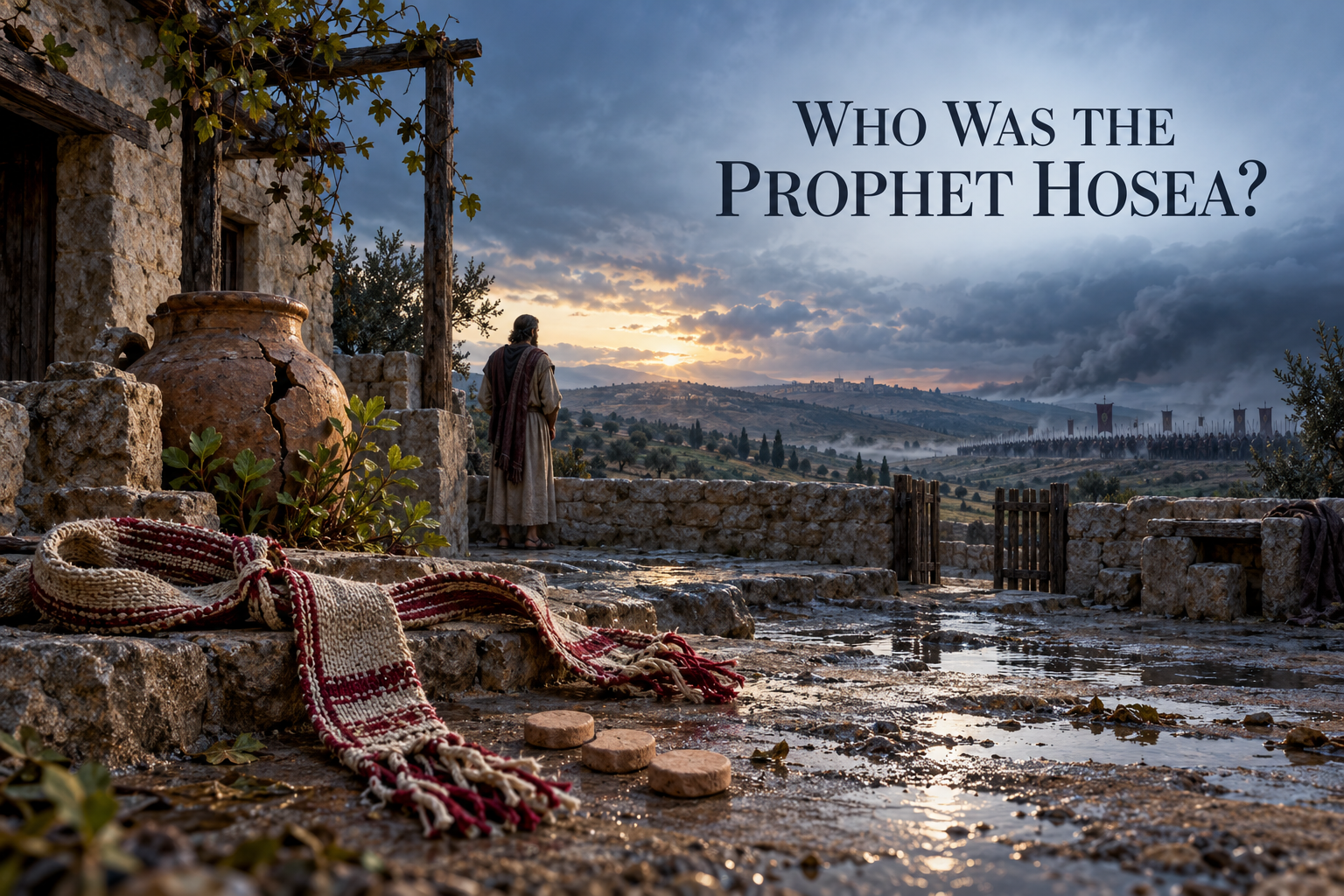
Few prophetic books ask the reader to enter through a doorway as unsettling as Hosea’s marriage. That relationship became part of his message, but the book can’t be reduced to a tidy story about a faithful husband and an unfaithful wife. Hosea’s preaching moves through betrayal, political collapse, divine anger, parental tenderness, and the stubborn possibility of restoration. He spoke to the northern kingdom of Israel while the nation was running out of time. Its deepest problem, he insisted, wasn’t Assyria. Israel no longer knew the God whose name it still used.
A Prophet in Israel’s Final Decades
The book identifies Hosea as the son of Beeri, but it tells us nothing else about his parents, birthplace, education, or occupation. His name is related to the Hebrew word for salvation or deliverance, the same word family behind the names Hoshea and Joshua. Hosea stands first among the twelve books Christians call the Minor Prophets, although “minor” refers to their length, not their importance. In the Hebrew Bible, these writings form a single collection known simply as the Book of the Twelve.
Hosea 1:1 places his ministry during the reigns of Uzziah, Jotham, Ahaz, and Hezekiah in Judah, along with Jeroboam II in Israel. That heading covers a long span, and scholars differ over how much of it represents Hosea’s active preaching and how much reflects the later shaping of the book. The safest conclusion is that his ministry began during or near the latter part of Jeroboam II’s reign and continued into the unstable years that followed. Although the heading names several Judean kings, Hosea’s message is directed mainly to the northern kingdom, which he often calls Ephraim after its dominant tribe.
Jeroboam II had presided over a period of territorial expansion and prosperity, but prosperity can hide rot remarkably well. After his death, Israel passed through a succession of kings, coups, assassinations, and desperate alliances. Assyria was expanding westward, and Israel’s leaders alternated between submitting to Assyria and seeking help from Egypt. Hosea compares the nation to a foolish dove fluttering between the two powers (Hosea 7:11). Diplomacy wasn’t wrong in itself, but Israel treated foreign alliances as a substitute for covenant faithfulness and ordinary political cunning as a substitute for wisdom.
The northern kingdom finally fell to Assyria when Samaria was captured in 722 BC. We don’t know whether Hosea lived to see that event. We do know that his preaching reflects the pressures that led to it: imperial domination, burdensome tribute, violent competition for power, and leaders who imagined that one more bargain might save them. The prophetic verdict was more severe. Israel’s political crisis had exposed a spiritual and moral crisis that was already well advanced.
When a Marriage Became a Prophetic Sign
Hosea’s book opens with God commanding him to marry Gomer, the daughter of Diblaim, described in Hebrew by a phrase often translated “a wife of prostitution,” “a promiscuous woman,” or more bluntly, “a wife of whoredom.” The wording is shocking, and it’s also less precise than many retellings suggest. The text doesn’t use the ordinary Hebrew noun for a professional prostitute, and it never calls Gomer a temple prostitute. That once-common explanation depends on a reconstruction of Canaanite fertility religion that the passage itself doesn’t establish.
Interpreters have understood the marriage in several ways. Some regard the account as a vision, allegory, or literary parable rather than an event in Hosea’s life. The most natural reading of chapters 1 and 3 treats it as a real prophetic sign-act, much like other prophets who embodied their messages through unusual public actions. Even then, we don’t know whether Gomer was sexually unfaithful before the marriage, became unfaithful afterward, or is described from the outset in language that anticipates what she would later do. The book gives Gomer no speech of her own, so confident claims about her motives, history, or personality usually tell us more about the interpreter than about Gomer.
Hosea 3 creates another question. God tells the prophet to love a woman who is loved by another man and is committing adultery, and Hosea pays silver and barley for her. Many readers understand this woman to be Gomer and the episode to describe a later attempt at reconciliation. Others think chapter 3 presents a second woman or another version of the sign-act. The connection with Gomer is likely, especially because the command echoes chapter 1, but the text doesn’t name her. It also doesn’t explain whether Hosea’s payment was a purchase from slavery, the settlement of a debt, or some other legal arrangement. “Hosea bought Gomer back from the slave market” may preach well, but it says more than the passage actually says.
The point of the sign is stated plainly: Israel had been unfaithful to the Lord by pursuing other gods. Hosea’s painful family story became a living picture of that covenant betrayal and of God’s continuing love for a people who had turned elsewhere. That doesn’t make every detail easy, and it certainly doesn’t make Hosea’s marriage a template for dealing with adultery, separation, or abuse. A prophetic sign directed to eighth-century Israel isn’t a command for a spouse to remain in danger or tolerate mistreatment.
The Children Whose Names Preached
Hosea and Gomer had three children, and each received a name that announced judgment. The first was Jezreel, named for the place associated with the bloody rise of Jehu’s dynasty. God declared that he would punish the house of Jehu for the bloodshed at Jezreel and end the kingdom of Israel. This creates a genuine tension with 2 Kings 9-10, where Jehu’s assault on Ahab’s house follows a prophetic commission. Hosea doesn’t explain whether Jehu exceeded that commission, whether his dynasty perpetuated the same violence it had been used to judge, or whether the prophet is evaluating the entire episode from another angle. We shouldn’t force a solution the text doesn’t provide.
The second child was Lo-Ruhamah, a name meaning “no compassion” or “not pitied.” The third was Lo-Ammi, “not my people.” Those names reversed the covenant language Israel took for granted. The people assumed that national identity, inherited worship, and connection to their ancestors guaranteed divine protection. Hosea’s children announced that covenant privileges couldn’t be separated from covenant loyalty.
Judgment, however, doesn’t have the last word even in the naming of the children. Hosea 1:10-2:1 immediately turns toward reversal: those called “not my people” will be called children of the living God, while “no compassion” gives way to compassion. Later, in Hosea 2:23, God promises again to say, “You are my people,” and the people answer, “You are my God.” The severe names were real warnings, but they weren’t declarations that mercy had become impossible.
What Israel’s Unfaithfulness Looked Like
Hosea’s marriage imagery is memorable, but the prophet doesn’t leave “unfaithfulness” as a vague religious accusation. Israel credited Baal with the grain, wine, oil, silver, and gold that the Lord had provided (Hosea 2:8). Its worship mixed devotion to the Lord with practices and assumptions drawn from the worship of other gods. The issue wasn’t merely that people had selected the wrong religious label. They had attributed God’s gifts to rival powers and then ordered their lives around those powers.
The corruption spread well beyond the sanctuary. Hosea 4:1-2 charges the land with lying, murder, stealing, adultery, and bloodshed. Priests benefited from the people’s sin, merchants used dishonest scales, rulers became consumed with intrigue, and kings rose and fell through violence. Hosea could therefore move from idolatry to economics, from worship to foreign policy, and from sexual misconduct to political assassination without changing subjects. Covenant unfaithfulness affected the whole life of the nation.
This is why Hosea 6:6 says that God desires steadfast love rather than sacrifice and the knowledge of God rather than burnt offerings. The Hebrew word often rendered “steadfast love” carries the sense of loyal, covenantal love. “Knowledge of God” means more than possessing correct information about him; it involves recognizing him, trusting him, and living faithfully in relationship with him. Hosea wasn’t abolishing sacrifice. He was denying that religious ceremony could compensate for lives organized around disloyalty, exploitation, and violence.
Jesus quoted Hosea 6:6 when religious leaders objected to his welcome of sinners and again when they condemned his disciples over Sabbath observance (Matthew 9:13; 12:7). In both cases, he used Hosea exactly where it hurts: against people who knew how to defend religious practice while missing the character and purpose of God. Ritual without mercy hadn’t improved with age.
Judgment Complicated by Love
Some of Hosea’s language is brutal. Chapter 2 describes exposure, deprivation, and punishment through the conventions of an ancient marriage dispute. The imagery comes from a patriarchal world and can sound horrifying when transferred directly into human relationships. Readers shouldn’t sanitize that language, and pastors shouldn’t use it to give divine cover to humiliation, control, or domestic abuse. The metaphor compares Israel’s covenant relationship with God to a marriage; it doesn’t make a human husband God or authorize him to imitate divine judgment.
At the same time, Hosea doesn’t portray God as coldly enforcing a contract. In chapter 11, the metaphor changes from husband to parent. God remembers teaching Ephraim to walk, taking Israel by the arms, and bending down to feed his child. Yet the child turned away without recognizing the one who had healed him. When judgment appears unavoidable, the passage breaks into divine anguish: “How can I give you up, Ephraim?” God’s holiness isn’t presented as indifference but as the reason his anger doesn’t simply consume Israel.
This tension runs throughout the book. Israel must face the consequences of its choices, and Hosea doesn’t treat repentance as a sentimental apology followed by business as usual. The people repeatedly speak words of return without displaying lasting faithfulness; their love is like morning mist that disappears quickly (Hosea 6:4). Real return requires abandoning idols, refusing to trust military power, and admitting that Assyria cannot save them. Mercy is freely given, but it isn’t permission to preserve the betrayal that made mercy necessary.
How the New Testament Uses Hosea
The New Testament draws on Hosea several times, though not always in the way a modern reader might expect. Matthew 2:15 applies “Out of Egypt I called my son” to Jesus. In Hosea 11:1, the line looks backward to Israel’s exodus rather than forward as a simple prediction of the Messiah. Matthew reads it typologically: Jesus relives Israel’s story as God’s Son and carries that story toward its intended fulfillment. Recognizing that context gives Matthew’s use of Hosea more depth, not less.
Paul draws on the reversal of Lo-Ammi and Lo-Ruhamah in Romans 9:25-26 while explaining God’s call of people from among both Jews and Gentiles. First Peter 2:10 uses the same language for believers who were once “not a people” but are now God’s people and have received mercy. Neither writer erases Hosea’s original message to Israel. They see in that message a pattern of divine grace: God can create a people where there appeared to be no people and extend mercy where judgment had been announced.
Those later uses shouldn’t tempt Christians to turn Hosea into a collection of detached predictions. His message first addressed a real kingdom making disastrous religious, moral, and political choices. The New Testament writers found that Israel’s story reached beyond that setting because the God revealed in it remained faithful to his purpose. Judgment was serious, human presumption was exposed, and grace opened a future that failure had seemed to close.
The Prophet Who Wouldn’t Separate Truth from Mercy
Hosea’s closing chapter calls Israel to return to the Lord with honest words of repentance. The nation must confess that Assyria won’t save it, military strength won’t save it, and the work of its own hands isn’t God. The Lord then promises to heal Israel’s apostasy and love the people freely. The book ends not with Gomer, Assyria, or even the fall of Samaria, but with God’s invitation to wisdom: the Lord’s ways are right, and the righteous walk in them while rebels stumble over them.
That ending keeps Hosea from becoming either a romance about unconditional acceptance or a tirade about deserved punishment. The prophet refuses to treat sin lightly, especially when it hides beneath religious activity and national confidence. He also refuses to imagine that judgment exhausts the character of God. For Hosea, the God who exposes covenant betrayal is also the only one who can heal it.