
Who Was the Prophet Zechariah?
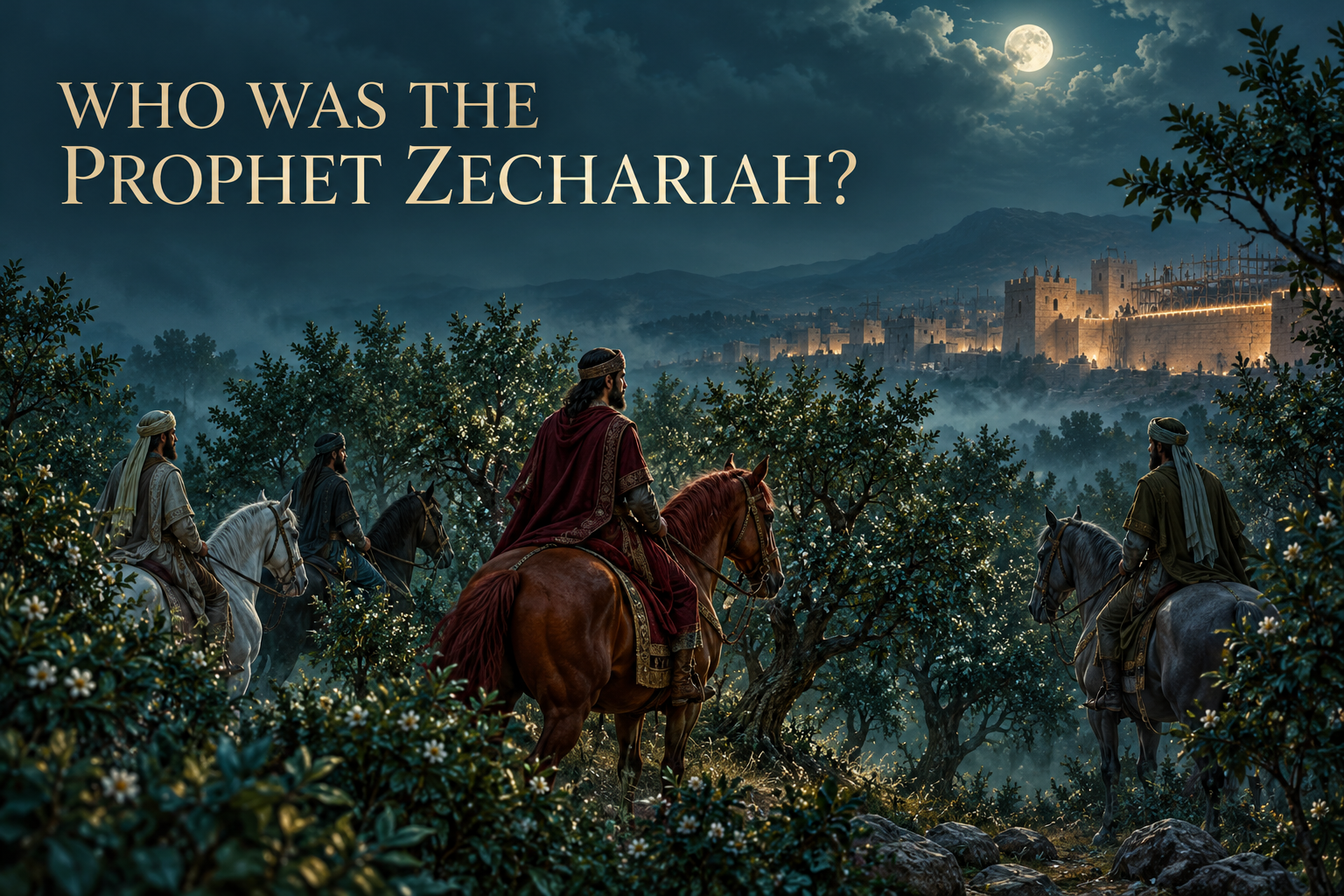
Few prophetic books change gears as dramatically as Zechariah. It begins with dated messages to a discouraged postexilic community, moves through horsemen, horns, lampstands, flying scrolls, and chariots, and ends with undated oracles about kings, shepherds, Jerusalem, and the day of the Lord. The imagery can be difficult, but it isn’t there merely to make the book mysterious. Zechariah used visions to tell a small and vulnerable community that its present weakness did not place it outside God’s purposes.
A Prophet in the Days of Rebuilding
Zechariah 1:1 identifies the prophet as the son of Berechiah and grandson of Iddo. Ezra 5:1 and 6:14 call him the son of Iddo, probably using the family name or a shortened genealogy. He began prophesying in the second year of Darius I, in 520 BC, shortly after Haggai’s ministry began. Zechariah 7:1 provides another date in Darius’s fourth year, around 518 BC. Beyond these notices, Scripture gives us little reliable biographical information, and Zechariah was a common name in the biblical world. He shouldn’t be casually identified with every other Zechariah mentioned in Scripture.
The setting explains the urgency of his work. Some Judeans had returned from Babylonian exile, but they remained subjects of Persia, Jerusalem was still recovering, and the temple stood unfinished. Earlier prophetic promises of restoration must have seemed much larger than the community’s visible circumstances. Zechariah didn’t solve that tension by pretending Judah had already recovered its former strength. He called the people to return to the Lord and assured them that the Lord had returned to them in mercy (Zechariah 1:3, 16).
Visions for a Discouraged Community
Zechariah 1-6 records a sequence commonly described as eight night visions. The prophet sees horsemen reporting on the earth, horns and craftsmen, a man measuring Jerusalem, the high priest Joshua standing under accusation, a lampstand supplied by olive trees, a flying scroll, a woman carried away in a basket, and four chariots going out from between bronze mountains. An interpreting angel helps him understand what he sees, although some details remain difficult even after the explanations. Apocalyptic imagery has a way of humbling the reader before it enlightens him.
The visions address the community’s actual needs. Hostile powers will not have the last word. Jerusalem will be restored, wickedness will be judged and removed, and the priesthood will be cleansed for service. In chapter 3, Joshua the high priest stands in filthy garments while the accuser charges him. The Lord rebukes the accuser, removes Joshua’s guilt, and clothes him in clean garments. The vision isn’t an announcement that leadership failures no longer matter; Joshua is also charged to walk in God’s ways. Grace restores him to responsible service.
Zechariah 4 turns to Zerubbabel and the unfinished temple. The governor’s task will be accomplished “not by might nor by power, but by my Spirit” (Zechariah 4:6). That verse is often quoted as a general statement about spiritual dependence, which it certainly supports, but its immediate setting is wonderfully practical: Zerubbabel is supposed to finish a building. Dependence on the Spirit doesn’t eliminate work. It puts human effort in its proper place and denies that visible strength is the final measure of what God can accomplish.
Fasting, Justice, and Real Restoration
Two years after the night visions, a delegation asked whether the community should continue a fast associated with Jerusalem’s destruction. Zechariah answered by questioning the motives behind the fasting. Were the people truly fasting for God, or had the practice become another religious habit centered on themselves? He recalled the message of the earlier prophets: administer true justice, show mercy and compassion, and do not oppress widows, orphans, foreigners, or the poor (Zechariah 7:9-10).
This keeps Zechariah’s temple message from shrinking into a construction campaign. A restored sanctuary surrounded by the same injustice that had characterized earlier generations would not amount to covenant renewal. Yet the prophet’s answer is not merely negative. Zechariah 8 envisions the fasts becoming joyful feasts, elderly people once again sitting safely in Jerusalem, children playing in its streets, and people from the nations seeking the Lord there. Restoration includes worship, public justice, security, and the blessing of the nations.
One Book With a Difficult History
Zechariah 9-14 differs noticeably from the first eight chapters. The dates and visions disappear, Zechariah is not named, and two large sections begin with the heading “oracle” or “burden.” Many scholars therefore distinguish Zechariah 1-8 from the later material and argue that chapters 9-14 came from one or more later prophetic voices. Other interpreters defend the unity of the book or believe the differences can be explained by a change in subject and literary form. Proposed dates for the later chapters have varied widely.
The evidence deserves to be acknowledged without pretending that the question has been settled beyond dispute. Scripture presents the fourteen chapters together as the book of Zechariah, and Christians receive the whole book as Scripture. That theological judgment does not require us to claim more certainty about the human process of composition than the text supplies. Inspiration can include genuine authors, editors, collected oracles, and normal literary development without making the finished book less trustworthy.
The King, the Shepherd, and the Pierced One
The later chapters contain several passages that became central to Christian understanding of Jesus. Zechariah 9:9 announces a righteous and humble king coming to Jerusalem on a donkey; all four Gospels connect that image with Jesus’s entry into the city. Zechariah 11 describes the rejected shepherd and the payment of thirty pieces of silver, language used in Matthew’s account of Judas and the potter’s field. Zechariah 12:10 speaks of mourning over one who has been pierced, which John 19:37 applies to Jesus’s crucifixion. Jesus also uses Zechariah 13:7, “Strike the shepherd, and the sheep will be scattered,” when speaking of his disciples’ coming flight (Matthew 26:31; Mark 14:27).
These New Testament uses are not an excuse to ignore the passages’ place in Zechariah. The prophet speaks within Israel’s hopes for faithful kingship, purified leadership, Jerusalem’s deliverance, and the Lord’s reign. Nor should every difficult image be assigned a modern counterpart as though Zechariah had supplied a coded newspaper. Christian interpretation recognizes that the book’s themes reach their fulfillment in Christ because the New Testament itself makes those connections, while still allowing the earlier prophetic setting to speak in its own voice.
Why Zechariah Matters
Zechariah joins spiritual dependence with moral seriousness. The temple will be rebuilt by God’s Spirit, but the people must work. Joshua is cleansed, but he must obey. Fasting can become feasting, but only a community committed to truth, justice, mercy, and peace can honestly call that change restoration. Hope is not permission to ignore the present; it gives the community a reason to live faithfully within it.
The book’s final horizon is larger than the Persian province of Judah. It looks toward a humble king, a rejected shepherd, a cleansed people, the Lord’s victory over evil, and the nations coming to worship the King. Zechariah’s imagery is sometimes difficult because the future he describes exceeds the ordinary categories available to him. The proper response isn’t to force every symbol into a chart, but to hear the summons that holds the book together: return to the Lord, trust his Spirit, practice justice, and wait for his kingdom.