
Who Was Thomas the Apostle?
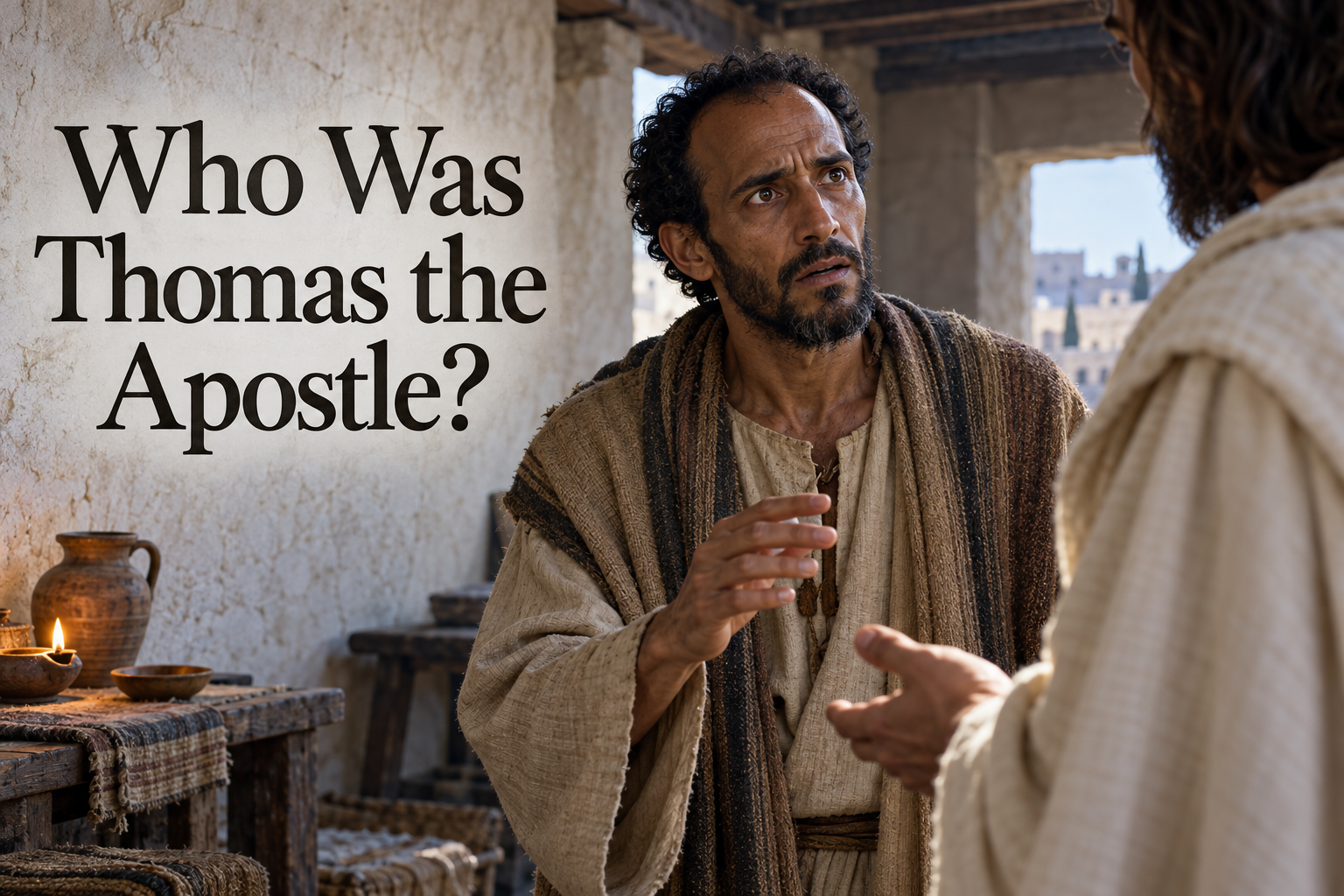
Thomas the apostle is remembered almost entirely for one week of doubt. The label “Doubting Thomas” has become so familiar that it can obscure the man John’s Gospel actually portrays: candid, loyal enough to face danger, slow to accept secondhand testimony, and finally the speaker of one of the Gospel’s strongest confessions about Jesus. Thomas wasn’t the only disciple who struggled to understand the resurrection. He was the one willing to state exactly what he needed before he could believe.
The first three Gospels name Thomas among the Twelve but give no individual stories about him. John brings him forward at three critical moments: the journey toward Lazarus’s tomb, Jesus’ farewell teaching, and the appearances after the resurrection. His name comes from an Aramaic word meaning “twin,” and John supplies the Greek equivalent, Didymus (John 11:16). Scripture never names his twin. Suggestions that the twin was Matthew, a woman named Lysia, or even Jesus belong to later speculation, not New Testament biography.
The Disciple Called the Twin
Thomas appears in each New Testament list of the Twelve (Matthew 10:2-4). Those lists establish that he belonged to the group Jesus appointed as representative witnesses, but they don’t tell us where he was born, what work he did, or how he was called. Unlike Peter and the sons of Zebedee, Thomas has no stated fishing background. Unlike Matthew, he isn’t identified as a tax collector. Filling those silences with guesses may make the story smoother, but it doesn’t make it more accurate.
John consistently calls him “Thomas, who was called the Twin.” Since both names carry the same meaning in different languages, this is probably an explanatory double name rather than two unrelated personal names. The missing identity of the other twin has invited imaginative readings, some of them treating every disciple as Thomas’s spiritual twin. That may work as a sermon, but it isn’t what John says. The biographical fact stops at the nickname.
Ready to Die With Jesus
Thomas first speaks when Jesus decides to return to Judea after Lazarus dies. The disciples remind Jesus that opponents there had recently tried to stone him. When Jesus insists on going, Thomas tells the others, “Let us also go, that we may die with him” (John 11:7-16). His words may carry resignation or grim irony, but they also show loyalty. Thomas expects the trip to end badly and goes anyway.
This isn’t mature resurrection faith. Thomas doesn’t yet understand that Jesus will raise Lazarus, much less that Jesus himself will rise. Yet courage doesn’t require perfect understanding. The disciple who later demands evidence is already willing to follow Jesus into a place he considers deadly. Reducing him to a skeptic erases the first thing John lets him say.
“How Can We Know the Way?”
Thomas speaks again during Jesus’ final meal with his disciples. Jesus tells them he is going to prepare a place for them and says they know the way. Thomas answers that they don’t know where he is going, so how can they know the way? Jesus responds, “I am the way, and the truth, and the life” (John 14:1-6). One of Christianity’s best-known sayings comes as an answer to Thomas’s refusal to pretend he understands.
The exchange reveals a useful pattern. Thomas’s questions aren’t sophisticated theological puzzles; they are plain objections to statements that seem unclear. Jesus doesn’t shame him for asking. He redirects the question from a route to a person: access to the Father is found in Jesus himself. Thomas still won’t grasp everything that night, but his question opens a fuller disclosure for the whole group.
Absent on Easter Evening
On the evening of the resurrection, Jesus appears to gathered disciples behind locked doors. Thomas isn’t with them, and John gives no reason for his absence. Claims that he had abandoned the community in despair or was courageously working elsewhere are inventions. When the others say they have seen the Lord, Thomas refuses to accept their report without seeing the nail marks and touching Jesus’ wounds (John 20:19-25). He asks for physical confirmation that the living figure is the same Jesus who was crucified.
His demand is strong, but it isn’t uniquely disgraceful. In the other Gospels, disciples also doubt or disbelieve resurrection testimony. The risen Jesus shows wounds to the group before Thomas makes his request, so Thomas asks for evidence the others have already received. John does place him in tension with trustworthy apostolic witness, but the scene isn’t a contest between foolish evidence and admirable blind faith. Christian proclamation itself rests on the claim that witnesses encountered the risen Jesus.
“My Lord and My God”
Eight days later, Thomas is with the disciples when Jesus appears again. Jesus repeats Thomas’s conditions almost word for word and invites him to examine the wounds. John never says whether Thomas actually touches him. The invitation itself brings the answer: “My Lord and my God!” (John 20:26-29). The disciple who wanted the most concrete verification responds with the Gospel’s most direct personal confession of Jesus’ divine identity.
Jesus tells him not to be unbelieving but believing, then blesses those who haven’t seen and yet believe. That blessing addresses later readers who won’t receive Thomas’s opportunity. It doesn’t commend believing any religious claim without reasons; John immediately says he has selected signs and written testimony so readers may believe (John 20:30-31). Thomas moves from demanding firsthand sight to becoming part of the witness on which later faith depends.
The wounds remain significant. The risen Jesus isn’t presented as a replacement for the crucified one or a spirit with no continuity to his body. Thomas recognizes the Lord through marks of violence that resurrection has overcome without erasing from the scene. The crucifixion was an act of human injustice, not something made morally good because God raised Jesus. Resurrection vindicates the victim and defeats death; it doesn’t approve the cruelty that produced the wounds.
Thomas After the Resurrection
Thomas appears once more beside the Sea of Tiberias. He is among seven disciples who fish through the night and then eat breakfast with the risen Jesus (John 21:1-14). He has no individual dialogue there, but his presence shows that the previous episode ended in restored fellowship rather than permanent suspicion. Acts then names Thomas among the apostles gathered in Jerusalem before Pentecost (Acts 1:13-14). After that, the New Testament is silent about his work.
That silence matters when later claims are evaluated. Scripture doesn’t say Thomas went east, founded churches, or died as a martyr. Those possibilities must be assessed from post-biblical sources. They may preserve memories, but they don’t carry the same evidentiary weight as John and Acts.
Did Thomas Go to India?
Ancient Christian tradition strongly associates Thomas with lands east of the Roman Empire, especially India. The Acts of Thomas, probably composed in Syriac in the third century, tells a dramatic missionary story involving an Indian king, conversions, ascetic teaching, miracles, and martyrdom. Its late date and novel-like features prevent historians from treating it as a straightforward travel diary. Even so, its eastern setting shows that the Thomas-India connection was established relatively early in Syriac Christianity.
Christians of India’s Malabar Coast have long identified themselves with Thomas’s mission, and traditions place his death near Mylapore in modern Chennai. The continuity and depth of that community deserve respect. Historical evidence, however, doesn’t allow every detail of the traditional itinerary or the often-cited year AD 52 to be verified. Trade routes connected the Mediterranean, Persian Gulf, and India, so such travel was possible; possibility isn’t proof that the apostle made it.
Other traditions connect Thomas with Edessa in Syria and claim that his remains were transferred there. These accounts need not be entirely incompatible with an Indian mission, but their development is difficult to trace. The most responsible conclusion is that an early and persistent eastern tradition links Thomas with India, while the New Testament leaves his later destination unknown. Faithful retelling doesn’t require certainty the sources can’t provide.
Did Thomas Write a Gospel?
The Gospel of Thomas is a collection of sayings attributed to Jesus, discovered in Coptic at Nag Hammadi in 1945, with earlier Greek fragments known from Oxyrhynchus. It opens by associating the sayings with Didymus Judas Thomas. Scholars debate the date of parts of the collection and whether some sayings preserve early traditions, but very few regard the surviving work as a book personally written by the apostle. It contains no continuous story of Jesus’ ministry, death, and resurrection.
Calling the work noncanonical doesn’t answer every historical question about its individual sayings, and calling it “Gnostic” without qualification can flatten a complicated text. What can be said clearly is that the church didn’t receive it as one of the four canonical Gospels and that its apostolic attribution is disputed. It should not be used as though it gives Thomas’s own autobiography or private version of Jesus. The same caution applies to the Acts of Thomas and later works bearing his name.
Faith That Asked to See
Thomas’s questions serve John’s readers precisely because they aren’t polished. He expects danger, admits confusion, and refuses to claim belief he doesn’t yet possess. Jesus answers him with revelation rather than flattery. The result isn’t a celebration of doubt for its own sake but a movement through doubt toward a confession grounded in the risen Christ.
The nickname “Doubting Thomas” catches one moment and misses the trajectory. Thomas was also the disciple who urged the others toward Judea, asked the question that drew out Jesus’ claim to be the way, and addressed the risen Jesus as Lord and God. His story doesn’t teach that every demand for evidence is virtuous, but it does show that honest questions need not be the enemy of faith. In John’s hands, the skeptic becomes a witness.