
Who Was Zechariah, Father of John the Baptist?
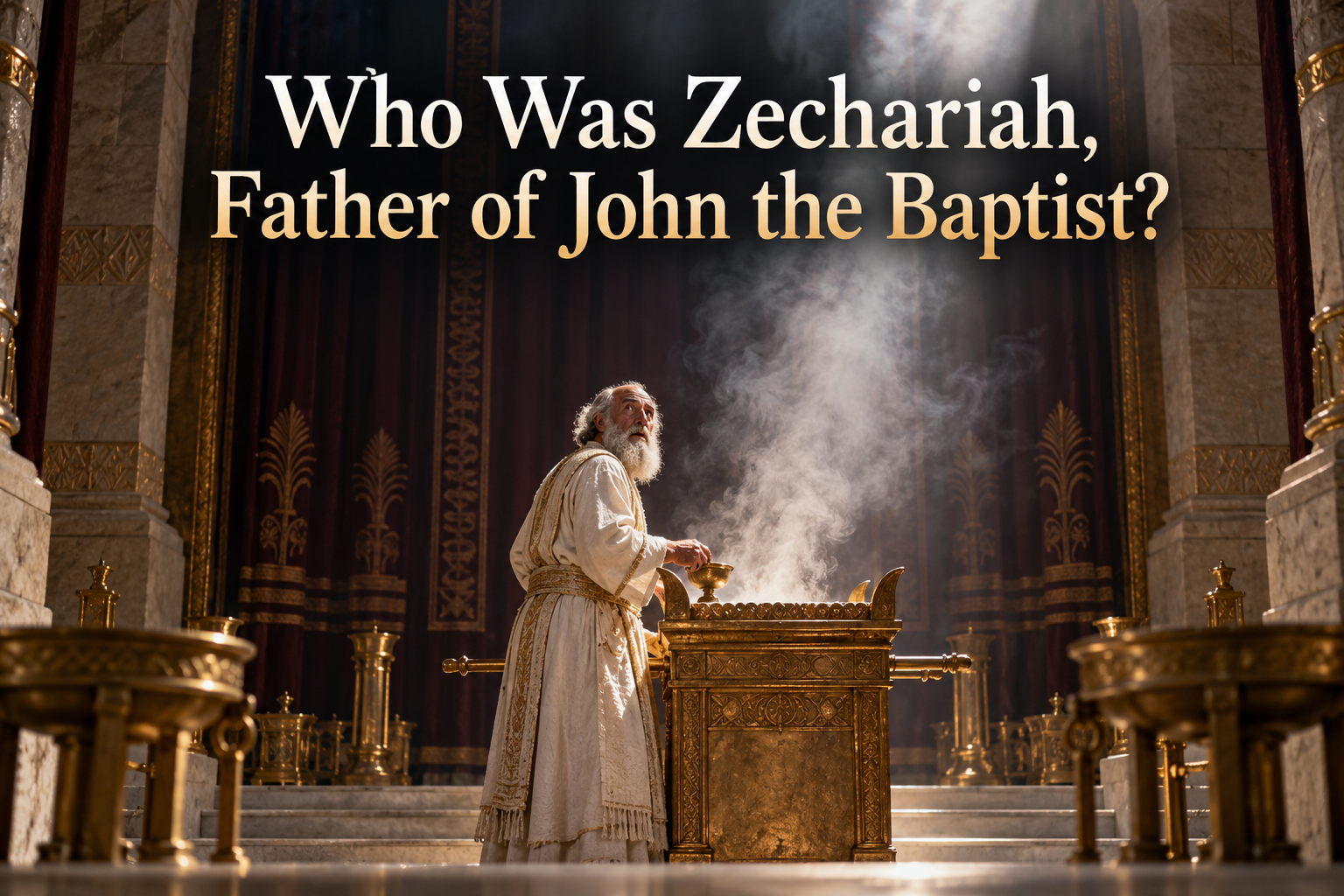
Zechariah, the father of John the Baptist, should not be confused with the Old Testament prophet Zechariah or the many other biblical men who bore the name. He was a priest in the days of Herod the Great, married to Elizabeth, and childless into old age. Luke presents him as righteous and prayerful, yet slow to believe a promise delivered in the temple itself. His story moves from speech to silence and back to Spirit-filled prophecy.
A priest of the division of Abijah
Zechariah belonged to the priestly division of Abijah, while Elizabeth was descended from Aaron. First Chronicles lists Abijah as the eighth of twenty-four priestly courses organized for temple service (1 Chronicles 24:10). By the first century, priests served in rotations and gathered more broadly for major festivals. Luke’s detail places Zechariah within the ordinary working priesthood rather than identifying him as the high priest.
Some teachers use the course of Abijah to calculate an exact date for John’s conception and then Christmas. The attempt depends on knowing where the rotation fell in that particular year and how interruptions and festival service affected it. The evidence does not provide a stable consensus. Luke gives historical and priestly context, not a hidden liturgical calendar for determining December 25.
Priestly ancestry carried honor, but it did not place every priest among Jerusalem’s wealthy elite. Most members of the divisions lived outside the capital and came to serve when their course was called. Zechariah’s selection by lot should therefore be pictured as sacred service within a large body of priests, not as the daily routine of a permanent high official.
Luke calls Zechariah and Elizabeth righteous and blameless in their conduct, then immediately says they had no child. This ordering rejects the assumption that infertility proved divine punishment. Zechariah had presumably prayed for a child for years. By the time an answer came, the request may have felt too old even to recognize.
The lot and the angel
While Zechariah’s division served, a lot selected him to enter the sanctuary and offer incense. Because the priestly population was large, this may have been a rare or once-in-a-lifetime privilege. Worshipers prayed outside while incense rose within. In that sacred and carefully ordered moment, Gabriel appeared beside the altar.
Zechariah was terrified, but the angel told him not to fear. Elizabeth would bear a son named John, many would rejoice, and he would be filled with the Holy Spirit from the womb. He would turn many in Israel to the Lord and go ahead in the spirit and power of Elijah (Luke 1:11–17). The answer joined a personal prayer for a child with Israel’s hope for restoration.
Zechariah asked how he could know this, since he and Elizabeth were old. His words resemble Abraham’s question and Mary’s later question, but Gabriel treated Zechariah’s response as unbelief. Differences in wording, posture, and narrative role may explain the different outcomes; the text itself explicitly names his failure to believe. Spiritual office and sacred surroundings did not make trust automatic.
Gabriel identified himself as one who stands in God’s presence and announced that Zechariah would be unable to speak until the promise came true. The Greek may imply deafness as well as muteness, since relatives later make signs to him, though the narrative emphasizes loss of speech. The sign was discipline and mercy together. Zechariah’s silence did not cancel the promise.
Silence at home
When Zechariah emerged, he could not pronounce the expected blessing, and the people realized he had seen a vision. He completed his period of service before returning home. Elizabeth then conceived. Luke does not narrate how Zechariah communicated Gabriel’s message to her or what their months of waiting were like.
For much of Luke 1, Zechariah can observe but cannot explain. Mary arrives, Elizabeth prophesies, and the unborn John leaps, while the priest remains silent in the narrative. The reversal is striking: women outside formal priestly office speak by the Spirit while the temple priest waits. Luke does not demean priesthood, but he refuses to confine revelation to its expected officeholders.
At John’s birth, neighbors rejoiced, and on the eighth day the family gathered for circumcision and naming. Elizabeth insisted on John, but relatives objected that the name was not in the family. Zechariah asked for a writing tablet and wrote, “His name is John” (Luke 1:63). The present tense matters: he does not propose a name but acknowledges the identity already given by God.
The Benedictus
Zechariah’s mouth opened, and his first recorded speech was praise. Filled with the Holy Spirit, he prophesied in the song traditionally called the Benedictus from its Latin opening, “Blessed be the Lord God of Israel.” The song celebrates God’s visit and redemption, the raising of a horn of salvation in David’s house, covenant mercy, and rescue for holy service (Luke 1:67–75).
Only after praising God’s saving work does Zechariah address his own child. John will be prophet of the Most High, go before the Lord, give knowledge of salvation through forgiveness, and prepare the way of peace. The father does not make his long-awaited son the center. John’s greatness consists in pointing to the coming one.
The song draws heavily on Israel’s Scriptures and can be read as Jewish messianic hope expressed before the cross. Rescue from enemies and service without fear carry political resonance under Herodian and Roman power, yet Luke will unfold salvation through forgiveness, mercy, and Jesus’ mission. Zechariah’s prophecy is not wrong because it awaits the Gospel’s fuller definition; it stands at the beginning of that unfolding.
Was Zechariah murdered?
Luke does not mention Zechariah after John’s birth. Later Christian tradition tells stories of his death, often claiming Herod’s agents killed him when he refused to reveal John’s location during the massacre of Bethlehem’s children. The Protoevangelium of James contains an influential version. It was written in the second century and should not be treated as an omitted chapter of Luke.
Jesus condemned Jerusalem for bloodshed from Abel to Zechariah son of Berechiah, killed between the sanctuary and altar (Matthew 23:35). That description creates an identification problem because Chronicles tells of Zechariah son of Jehoiada being killed in the temple court, while the prophetic book identifies Zechariah son of Berechiah. Some later interpreters identify the victim with John’s father, but the New Testament never calls him son of Berechiah or states that he was murdered. The identification is speculative.
No inscription or external historical source independently identifies Zechariah. The priestly divisions, Herodian temple, incense service, and social world can be studied from Jewish texts and archaeology, but his vision and family life are known from Luke. Historical context can make the scene intelligible without converting theological events into artifacts.
From unbelief to witness
Zechariah is sometimes treated as the negative counterpart to Mary, since he questioned and was silenced while she believed and sang. The contrast is present, but it should not erase Luke’s opening praise of his righteousness or his later Spirit-filled prophecy. A faithful person can fail at a decisive moment and still be restored to meaningful service. Luke lets the correction become part of Zechariah’s testimony rather than the cancellation of it.
His discipline also matched his calling. The priest whose son would become a voice in the wilderness had to learn silence before he could speak rightly. When speech returned, he did not defend his question or complain about nine months without a voice. He blessed God and placed his son’s story inside God’s larger covenant purpose. His restored voice became an act of worship rather than self-explanation.
Zechariah’s life ends in canonical silence, but his song remains part of Christian worship. He saw only the beginning: a newborn son, an unborn Messiah, and promises not yet visibly fulfilled. He spoke as though God’s redemption was already arriving because God’s word made the future dependable. That is the mature faith of a man who once asked for proof.