

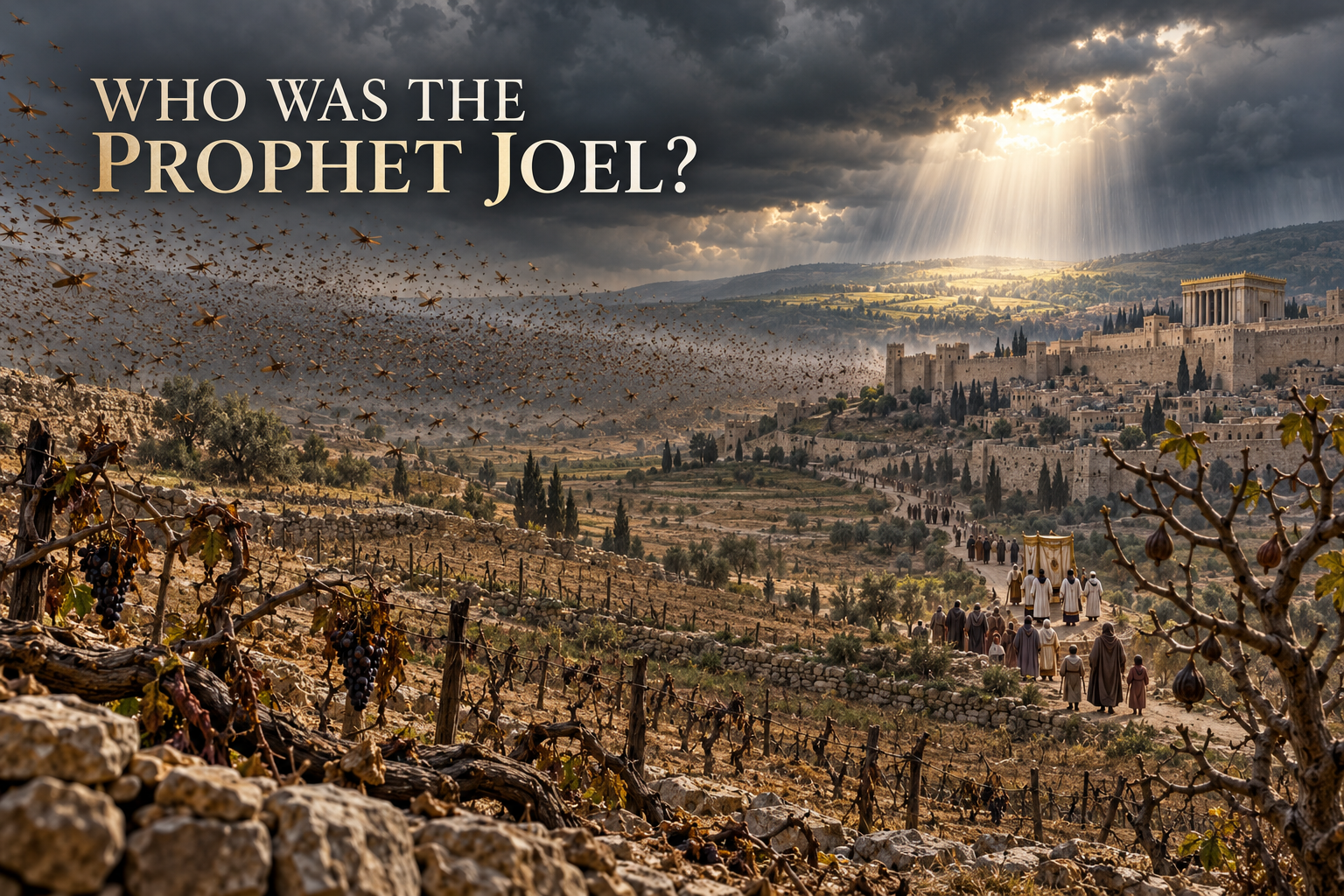
Joel’s name is far more familiar than his life. The book identifies him only as “Joel, the son of Pethuel” (Joel 1:1), and Scripture tells us nothing else about his family, occupation, or later life. His name means “The Lord is God,” which certainly fits his message, but a fitting name isn’t a biography. Unlike Isaiah, Jeremiah, or Hosea, Joel doesn’t tell us about a call experience or place his ministry during the reign of a particular king. He steps forward, delivers an urgent word to Judah, and leaves the focus where he clearly intended it to remain: on the Lord and the crisis facing his people.
Joel addressed Judah and Jerusalem, with particular attention to the temple and those who ministered there. He called elders, priests, farmers, winegrowers, and the whole population to pay attention. That broad summons matters because the disaster he described was not confined to one class of people. The fields had failed, the food supply had collapsed, and the grain and drink offerings normally presented at the temple had been interrupted. This was a national emergency with economic, social, and religious consequences, and Joel refused to let anyone treat it as somebody else’s problem.
When Did Joel Prophesy?
Dating Joel is unusually difficult because the book names no king and gives no event that can be matched with certainty to an outside chronology. Some interpreters have placed Joel in the ninth century BC, partly because of his position near Hosea and Amos in the Book of the Twelve and because kings aren’t prominent in his account. Others date the book after the Babylonian exile, often during the Persian period, pointing to the prominence of priests and elders, apparent references to Jerusalem’s earlier devastation, and Joel’s use of language found elsewhere in the prophets. Many modern scholars favor a postexilic date, but none of those clues amounts to a date printed at the top of the manuscript. The evidence deserves consideration without pretending that it settles what the text itself leaves open.
The uncertainty affects how we reconstruct the background, but it doesn’t make Joel’s message uncertain. Whether he spoke before the exile or after the people had returned, his audience knew what it meant for the land, worship, and national life to be devastated. The book assumes an organized community centered on Jerusalem and the temple, yet it doesn’t depend on our identifying a particular king, invading army, or year. Joel’s lack of chronological markers may frustrate anyone hoping to fit every prophet neatly into a timeline. It also keeps readers from avoiding his message by treating it as a response to only one long-forgotten emergency.
Locusts, Drought, and an Invading Army
Joel begins with a ruinous invasion of locusts. One wave has consumed what another left behind, vines have been stripped, fruit trees have withered, and grain has disappeared from the fields. A drought appears to have intensified the damage, leaving animals without pasture and streams without water. Joel asks whether anything like this has happened in the memory of the people or their ancestors, then tells them to pass the account to later generations (Joel 1:2-4). He isn’t offering an agricultural report. He is teaching Judah to recognize a catastrophe that demands a spiritual response.
Interpreters have long debated whether Joel’s locusts were literal insects, a metaphor for a human army, or both. Chapter 1 reads naturally as the description of an actual plague, complete with damaged crops, suffering animals, and interrupted offerings. Yet Joel also calls the invaders a nation and gives them the teeth of a lion. In chapter 2, the imagery becomes even more military: the attackers charge like warriors, scale walls, and enter houses, while the earth and heavens tremble before them. Some readers understand that chapter as a poetic description of the same locust swarm; others see a human or apocalyptic army whose advance resembles one.
The book itself encourages the comparison without removing every ambiguity. Locusts really do advance in overwhelming swarms, darken the sky, consume the countryside, and enter openings that seemed secure. Armies can do much the same thing to a nation. Joel 2:25 returns explicitly to the several kinds of locusts, while the reference to a northern invader in Joel 2:20 sounds to many readers like more than an insect infestation. We don’t have to flatten the poetry into a single literal referent to understand its force. The disaster already before Judah becomes a picture of something larger: the day when the Lord confronts a people who cannot protect themselves.
Return to the Lord
Joel calls for fasting, mourning, prayer, and a solemn assembly. Priests are to lament, elders are to gather, and even newly married couples are summoned from their celebrations. But the prophet is not satisfied with public sorrow as a religious performance. “Rend your hearts and not your garments” is his memorable demand in Joel 2:13. Tearing clothing was a recognized sign of grief; Joel insists that the outward sign must correspond to an inward return to God.
The appeal rests on God’s character, not on the people’s ability to produce a sufficiently impressive ceremony. Joel describes the Lord as gracious, merciful, slow to anger, and abounding in steadfast love, drawing on the language of Exodus 34:6. At the same time, he asks, “Who knows?” whether God may turn and leave a blessing (Joel 2:14). That question isn’t doubt about God’s goodness. It is humility about human attempts to manage him. Repentance is not a lever that forces a desired result; it is the proper response to the God whose mercy gives sinners reason to return at all.
Joel doesn’t identify a catalog of particular sins behind the crisis, as Amos and Micah often do. That absence should make us cautious about using the book to explain every natural disaster as punishment for some sin we think we’ve detected. Joel was speaking prophetically into Judah’s covenant relationship with God, not giving Christians permission to assign divine motives to every hurricane, drought, or crop failure. What the book does teach clearly is that crisis should strip away complacency. The right response is honest examination, corporate prayer, and renewed dependence on the Lord.
The Day of the Lord
The “day of the Lord” is the theological center of Joel. In the prophets, that phrase describes decisive intervention by God in judgment and deliverance. It can refer to acts of judgment within history, but it also reaches toward the final reckoning when God will set things right. Joel uses the devastation of the land as both a present day of judgment and a warning of a still greater day ahead. What has happened in the fields is not the whole story, but it teaches Judah what helplessness before divine judgment looks like.
This is why the day of the Lord can sound terrifying in one passage and hopeful in another. For the complacent, the violent, and the unrepentant, it overturns the illusion that God will never call anyone to account. For those who return to him, it brings restoration, safety, and the presence of God among his people. Joel’s horizon appears to move between an immediate crisis, later judgment on hostile nations, and the ultimate day of the Lord. We should respect those connections without assuming that every verse must describe one event on one calendar date.
“I Will Pour Out My Spirit”
After the call to repentance and the promise of restoration, Joel announces that God will pour out his Spirit “on all flesh” (Joel 2:28). The lines that follow explain the breadth of the promise: sons and daughters will prophesy, old and young will receive dreams and visions, and even male and female servants will receive the Spirit. In the Old Testament, the Spirit’s empowering presence was often associated with particular leaders, prophets, judges, and kings. Joel looks forward to a remarkable widening of prophetic activity across distinctions of sex, age, and social position. The promise doesn’t erase every difference among people, but it makes status an inadequate measure of whom God may empower.
Peter quotes this passage on the day of Pentecost to explain the coming of the Holy Spirit and the prophetic speech of Jesus’ followers (Acts 2:16-21). He does not present Pentecost as an interesting resemblance to Joel; he says, “This is what was spoken by the prophet Joel.” The risen and exalted Jesus has poured out the promised Spirit, and the last-days work anticipated by Joel has begun. Pentecost therefore belongs to the fulfillment of Joel’s promise, not merely to its illustration.
That doesn’t require us to claim that every feature of Joel’s prophecy was exhausted that morning. Joel also speaks of cosmic signs, the great day of the Lord, deliverance for those who call on the Lord, and later judgment among the nations. Christians differ over how those features relate to Pentecost, subsequent history, and Christ’s return. The safest conclusion is that Pentecost inaugurated what Joel promised while the prophecy’s wider horizon still points toward God’s final work. The outpouring of the Spirit was not a brief display meant to expire as soon as the crowd went home. It marked the life of the new-covenant community, in which the Spirit continues to empower God’s people for witness, service, and prophetic ministry that remains subject to biblical testing.
Judgment Among the Nations
Joel’s final movement turns from Judah’s devastation to God’s judgment of the nations. They are charged with scattering God’s people, dividing the land, and selling boys and girls into slavery (Joel 3:2-6). The prophet reverses the language of war: nations are told to beat farm tools into weapons and assemble for judgment. The point is not that war has become virtuous. Joel is summoning the powers that exploited the vulnerable to appear before the Judge they had ignored.
The “valley of decision” in Joel 3:14 is sometimes used as though it described people deciding whether to accept God. In context, however, the decision is God’s. The nations have been gathered to receive his verdict, not to conduct an evangelistic rally. The precise geographical identification of the Valley of Jehoshaphat is uncertain, and its name itself communicates the main point: the Lord judges. Joel’s vision assures an abused and scattered people that empires, traffickers, and conquerors do not escape accountability simply because they once had the power to write the terms.
Why Joel Still Matters
Joel brings together themes Christians are sometimes tempted to separate. He speaks of judgment without making God reluctant to show mercy, and of mercy without pretending repentance is unnecessary. He treats material devastation seriously while looking beyond it to the spiritual condition of the community. He promises the Spirit across familiar social boundaries while keeping that gift connected to the larger work of God in history. And he looks toward a final day when oppression will be answered and the Lord will dwell with his people.
We may not know when Joel preached or much about the man himself, but the book’s central summons is difficult to misunderstand. Return to the Lord with your whole heart, call upon his name, and recognize that history is moving toward his judgment and restoration. Joel’s prophecy doesn’t satisfy our curiosity about every date or symbol. It does something more useful: it directs our attention to the God who warns, restores, pours out his Spirit, and will not allow evil to have the final word.