
Who Was Mary Magdalene?
Mary Magdalene has acquired a biography the New Testament never gives her. She has been called a prostitute, identified with several other women, turned into Jesus’ wife, and made the keeper of secret teachings. Those portraits range from venerable tradition to modern fiction, but none should be confused with the woman described in the Gospels. There Mary appears as a disciple whom Jesus delivered from severe spiritual oppression, a supporter of his ministry, a witness to his death and burial, and one of the first witnesses to his resurrection. That is already an extraordinary story. It doesn’t need embellishment.
Delivered and called to follow
Her name associates her with Magdala, a town on the western shore of the Sea of Galilee. Luke first names her among women who traveled with Jesus and the Twelve and helped support the ministry from their own resources (Luke 8:1-3). He says that seven demons had gone out from her. Mark’s longer ending also mentions this deliverance, although most scholars regard Mark 16:9-20 as a later conclusion to the Gospel rather than part of its earliest recoverable text. Luke’s earlier notice is enough to establish that Mary experienced profound deliverance and then joined the circle of traveling disciples.
The reference to seven demons tells us that her bondage had been severe; in biblical symbolism, seven can suggest completeness. It does not tell us that she had been sexually immoral. The Gospels sometimes distinguish demonic oppression from physical illness and sometimes describe effects that modern readers might associate with illness, but Mary’s symptoms aren’t given. We shouldn’t diagnose her from twenty centuries away, and we certainly shouldn’t convert deliverance from demons into a coded reference to prostitution. The text connects her past with Jesus’ restoring power, not with a sexual history.
Luke’s description of women providing for the ministry also deserves attention. The verb can refer to practical service, and the mention of their resources suggests that these women supplied material support as the group traveled. Mary wasn’t a passing beneficiary who vanished after receiving help. She became part of the movement around Jesus and invested what she had in its work. The Gospels don’t specify whether she was wealthy, widowed, unmarried, or connected to a household. Those are possible reconstructions, not facts.
At the cross and the tomb
Mary’s importance becomes especially clear during Jesus’ final days. The Gospel accounts differ in which women they name and in some details of sequence, but all four place Mary Magdalene within the resurrection narratives. Mark and Matthew name her among the women who watched the crucifixion and saw where Jesus was buried. John places her near the cross with several other women and then at the tomb early on the first day of the week. Luke speaks more generally of the women who had followed Jesus from Galilee at the cross and burial, then identifies Mary when they report the empty tomb to the apostles.
This continuity matters. Mary didn’t arrive after the danger had passed and mistake an unfamiliar grave. The Gospel tradition remembers her in connection with Jesus’ death, the location of his burial, the discovery of the empty tomb, and the announcement that he had risen. In a culture where women’s public testimony was often discounted, the early church didn’t replace these women with witnesses who would have looked more impressive to its neighbors. Their presence is built into the story the church received and proclaimed.
Each Gospel tells the Easter morning events with its own emphasis. In Mark, Mary Magdalene, Mary the mother of James, and Salome find the stone moved and hear that Jesus has risen. Matthew describes Mary Magdalene and “the other Mary” meeting the risen Jesus as they go to tell the disciples. Luke names Mary Magdalene, Joanna, Mary the mother of James, and other women whose report initially sounds like nonsense to the apostles. The variations shouldn’t be flattened, but they agree on the point most relevant to Mary’s identity: she was among the first people entrusted with the resurrection news.
Mary’s encounter with the risen Jesus
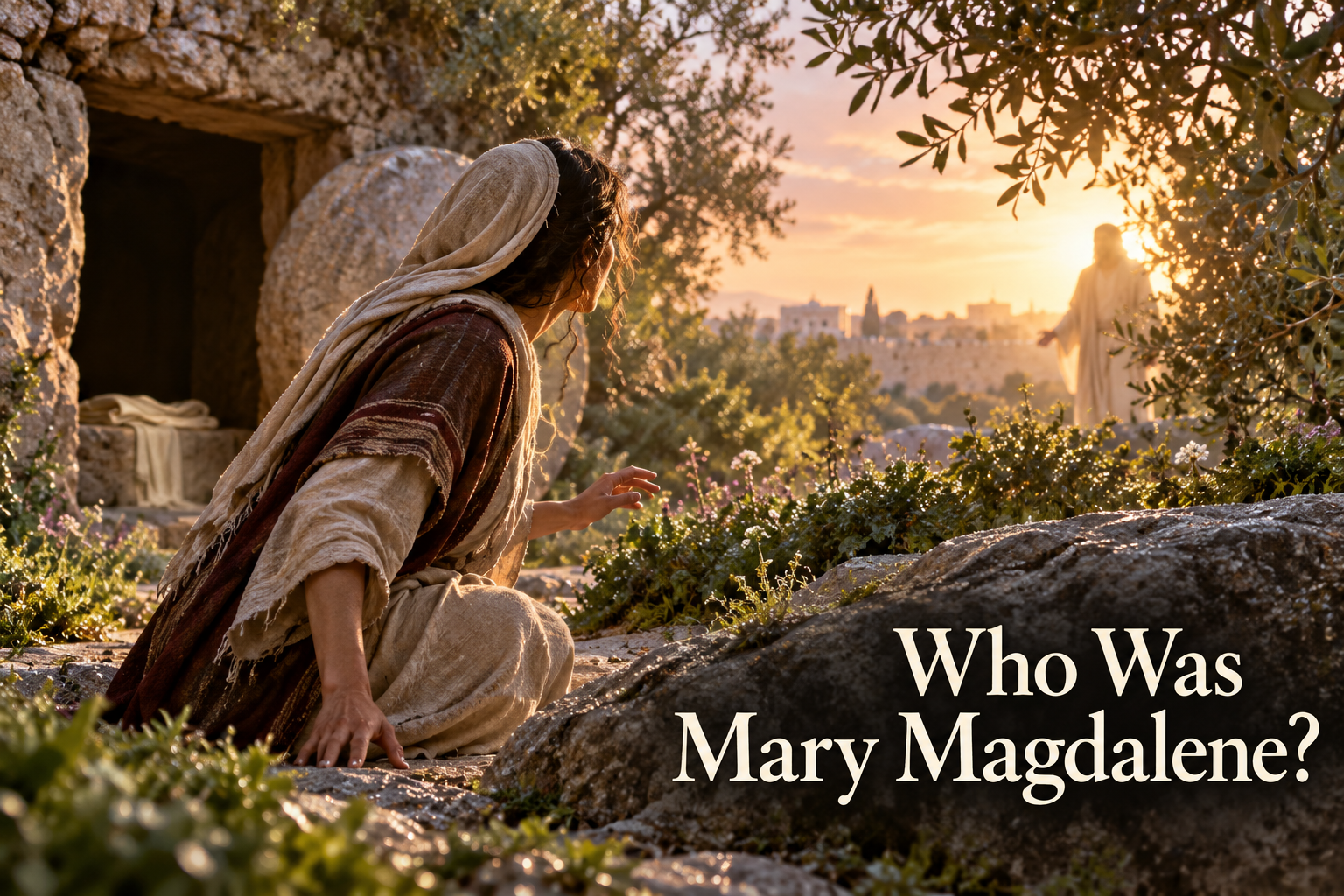
John gives the fullest individual portrait. Mary finds the tomb open, alerts Peter and the beloved disciple, and later remains outside weeping. She sees Jesus but initially assumes he is the gardener. Only when he calls her by name does she recognize him and answer, “Rabboni,” an Aramaic form of “Teacher.” The scene isn’t sentimental decoration. It moves from grief and confusion to recognition, then immediately to commission.
Jesus tells Mary not to hold on to him and sends her to his “brothers” with the message that he is ascending to his Father and their Father, his God and their God (John 20:17). She goes and announces, “I have seen the Lord.” Later Christians therefore called her “apostle to the apostles,” not because the New Testament places her among the Twelve, but because she was sent to carry the resurrection announcement to them. The title is later, yet it recognizes something the biblical account plainly says: before the apostles preached the risen Christ to the world, Mary Magdalene brought the news to them.
Paul’s summary of resurrection appearances in 1 Corinthians 15 doesn’t mention Mary or the other women. Scholars have offered several explanations, including Paul’s use of an already established summary focused on recognized apostolic witnesses. His list is selective, since it also omits several appearances narrated in the Gospels. It shouldn’t be used to erase the Gospel accounts, nor do the differences require us to pretend that every writer was trying to provide an exhaustive chronology. Together the sources show that the earliest Christian proclamation rested on multiple witnesses and that women stood at the beginning of the Easter announcement.
She wasn’t the unnamed sinful woman
The most persistent misunderstanding identifies Mary Magdalene with the unnamed woman in Luke 7 who anointed Jesus’ feet. Luke calls that woman a sinner but doesn’t name her or describe her sin as prostitution. He then begins a new section in chapter 8 by naming Mary Magdalene and explaining her deliverance. Nothing in the text says the two women are the same. They shouldn’t be merged simply because their stories appear near each other.
Mary Magdalene also wasn’t Mary of Bethany, the sister of Martha and Lazarus who anointed Jesus in John 12. Mary was a common Jewish name, and the Gospels distinguish these women by their locations and relationships. In a homily delivered in AD 591, Pope Gregory the Great brought Mary Magdalene, Mary of Bethany, and Luke’s unnamed sinful woman together in a single portrait. That identification became highly influential in Western Christianity, while Eastern Christian tradition generally kept them distinct. Its long history explains the familiar image of the repentant prostitute, but longevity doesn’t turn an inference into a biblical fact.
The opposite modern legend, that Mary was Jesus’ wife, has no support in the New Testament or in reliable early historical evidence. Later writings such as the Gospel of Mary give her a prominent role in debates among disciples, and other noncanonical texts portray her as a recipient of special revelation. These works are valuable evidence for the diversity and arguments of later Christian communities, but they were written too late to function as straightforward biographies of Mary’s relationship with Jesus. Prominence isn’t the same thing as marriage, and a gap in the record isn’t permission to fill it with whatever story a novel requires.
A witness before she became a symbol
Traditions eventually sent Mary to places ranging from Ephesus to southern France, and competing sites claimed her relics. These accounts arose well after the New Testament period and can’t be verified as a continuation of her biblical life. We don’t know where she went after the events described in the Gospels, how long she lived, or where she died. The church can honor later traditions without presenting them as established history.
Mary Magdalene matters because of what the Gospels actually preserve. Jesus restored her, welcomed her among his followers, and entrusted her with news at the center of the Christian faith. She remained near when public association with a condemned man was dangerous, and she went to the tomb expecting to care for the dead, not manufacture a resurrection. Before later generations made her a composite sinner, secret apostle, or romantic partner, she was Mary of Magdala, a disciple who could say what every Christian proclamation has echoed since: she had seen the Lord.