

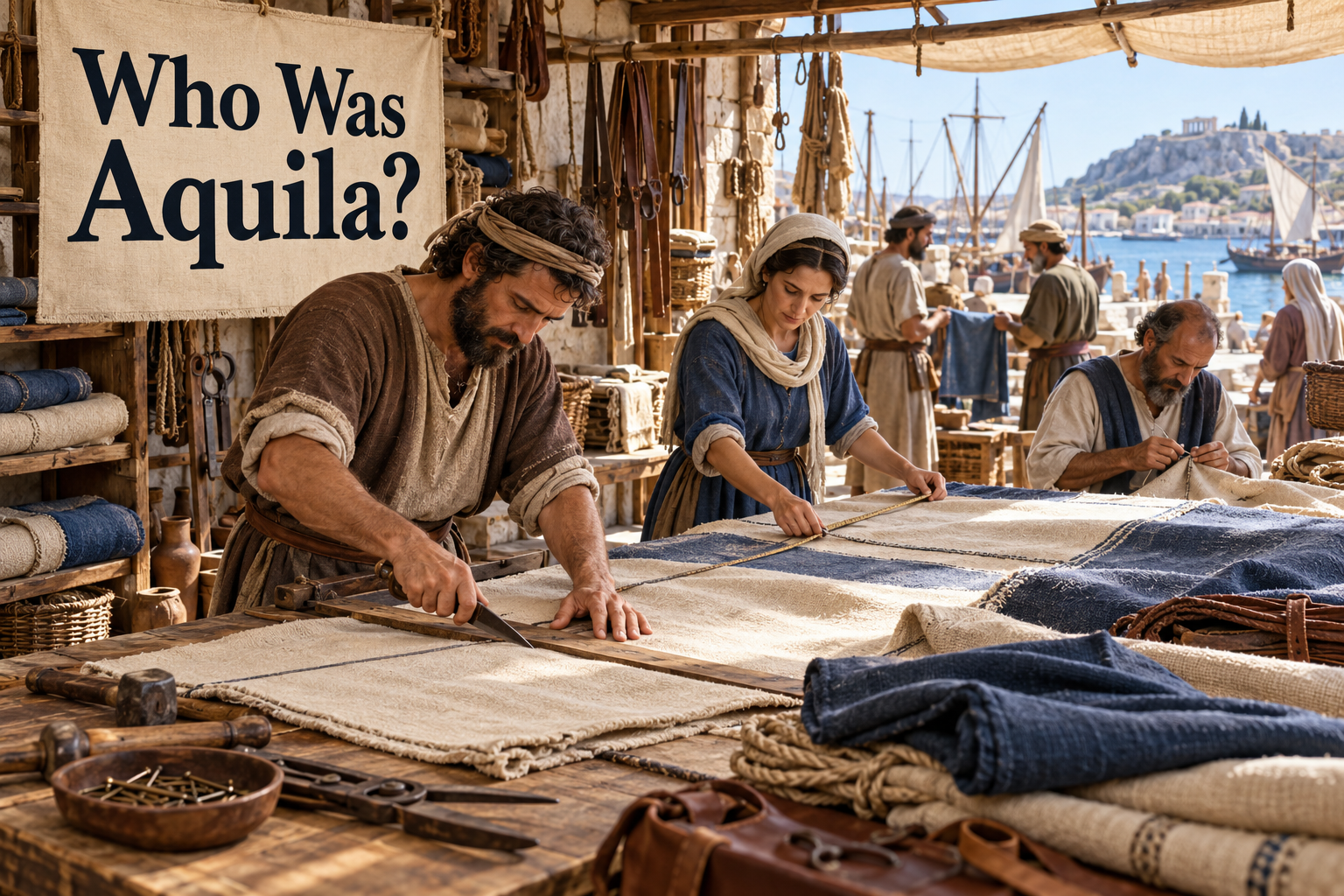
Aquila is rarely mentioned without Priscilla, and that’s appropriate: the New Testament presents them as a married couple who worked, traveled, taught, hosted churches, and risked themselves together. Yet Aquila has a biography of his own. He was a Jew from Pontus, a migrant craftsman displaced from Rome, and one of Paul’s earliest partners in Corinth. His story traces the movement of the gospel through workshops, rented homes, trade routes, and ordinary decisions about where to live.
From Pontus to Rome to Corinth
Acts 18 calls Aquila a Jew and a native of Pontus, a region along the southern coast of the Black Sea. By the time Paul met him, however, Aquila and his wife Priscilla had been living in Italy. They had recently arrived in Corinth because the emperor Claudius had ordered Jews to leave Rome. The Roman writer Suetonius also reports an expulsion associated with unrest among Rome’s Jews, although the scope, date, and cause of the action are still discussed. Acts gives the practical result for this couple: imperial policy uprooted their life and pushed them eastward.
We aren’t told whether Aquila and Priscilla became followers of Jesus before or after meeting Paul. Acts introduces them without narrating a conversion, and they soon appear as mature partners in Christian work. That may suggest they were already believers when Paul arrived, but it remains an inference. The narrative is more interested in what happened when their paths crossed than in supplying their earlier spiritual history.
Paul stayed and worked with them because they shared the same trade. English translations often call them tentmakers, though the Greek term can refer more broadly to artisans who worked with leather or woven materials. Whatever they produced, the work supported them and created a natural setting for partnership. Paul’s manual labor wasn’t a decorative lesson in humility; it helped fund the mission and placed him inside the working life of the city.
Aquila’s trade also reminds us that mobility in the Roman world could arise from necessity as much as strategy. He didn’t first reach Corinth because a mission board assigned him there. He and Priscilla were displaced people rebuilding a livelihood. Yet the skills and relationships formed in that disruption became part of Paul’s ministry. God’s providence in the story doesn’t make Claudius’s decree just; it shows that unjust circumstances didn’t prevent useful work from emerging.
Partners in Work and Mission
After a lengthy stay in Corinth, Paul sailed for Syria with Priscilla and Aquila and stopped at Ephesus. Paul moved on, but the couple remained. There they heard Apollos, an educated Jewish teacher from Alexandria, speaking boldly in the synagogue. He taught accurately about Jesus but knew only John’s baptism, so Priscilla and Aquila took him aside and explained the way of God more accurately.
The scene is important for both members of the couple. Aquila participated in instructing an already capable teacher, which shows that his ministry included more than hospitality and financial support. Priscilla is named first in Acts 18:26 in the usual Greek text, as she is in several other references to the pair. Scholars have proposed that this order reflects her social standing or prominence in ministry. It may, but the text doesn’t explain the reason. What it does make unmistakable is that she wasn’t a silent accessory to Aquila’s work, and Aquila’s biography shouldn’t be told by diminishing hers.
First Corinthians 16:19 places Aquila and Priscilla in Ephesus when Paul wrote to Corinth. They sent greetings along with the church that met in their house. A house church wasn’t simply a weekly gathering placed in a spare room. Opening a household to a Christian community required resources, organization, and exposure to social risk. Their home became part of the church’s infrastructure before Christians had dedicated buildings of their own.
Romans 16 finds the couple back in Rome, assuming the chapter originally belonged to the letter in its present destination, as most interpreters hold. Paul calls Prisca and Aquila his coworkers in Christ Jesus and says they risked their necks for his life. He adds that all the Gentile churches were grateful to them and again greets a church meeting in their house. Paul doesn’t describe the danger they faced, so attempts to attach it to a specific riot or imprisonment remain guesses. His gratitude is clear even when the incident is not.
A Mobile Household
The references to Aquila form a remarkable geographical pattern: Pontus by birth, Italy before the expulsion, Corinth afterward, then Ephesus, and later Rome again. Second Timothy 4:19 sends greetings to Prisca and Aquila, which many readers understand to place them once more in or near Ephesus. Because the authorship and date of 2 Timothy are disputed, that final move isn’t equally certain for all scholars. Even without it, the undisputed Pauline greetings confirm that the couple’s relationship with Paul outlasted their first meeting in Corinth.
It’s tempting to turn every move into a deliberate church-planting strategy. Some surely involved missionary purpose, especially their decision to remain in Ephesus and their hosting of congregations. Others may have been driven by work, family, legal conditions, or opportunities Scripture doesn’t mention. Ancient craftspeople often depended on networks across cities, and Roman roads and sea lanes carried both commerce and ideas. Aquila’s work and ministry weren’t competing stories; they were woven together.
That combination helps explain why the household was so valuable. Aquila and Priscilla could support themselves, welcome traveling workers, teach believers, and provide a stable meeting place in cities where the Christian movement was still small. Their ministry didn’t depend on public office. It depended on competence, hospitality, theological understanding, and a willingness to put their property and safety at the service of the gospel.
What We Know and What Tradition Added
Later Christian traditions made Aquila a bishop in various locations and sometimes described both spouses as martyrs. Those accounts aren’t uniform, and the New Testament says nothing about their deaths. Aquila should also be distinguished from the Aquila of Sinope who produced an influential Greek translation of the Hebrew Scriptures in the second century. The shared name and connection with Pontus have occasionally caused confusion, but they were different men living in different periods.
Within Scripture, Aquila never delivers a recorded speech, writes a surviving letter, or receives a formal title. That lack of public material can make his contribution look smaller than it was. Paul’s own words correct that impression. A coworker for whom the Gentile churches gave thanks, a teacher who helped prepare Apollos, and a host whose home became a church wasn’t standing at the edge of the mission.
Aquila’s life shows how the gospel traveled through durable relationships. He built things with his hands, adapted after forced migration, shared his home, and worked alongside a wife whose ministry was plainly her own. Scripture leaves many details unanswered, including when he believed and how he died. But it gives us enough to see why Paul remembered him with gratitude: Aquila made his livelihood, his movements, and his household available for the work of Christ.