

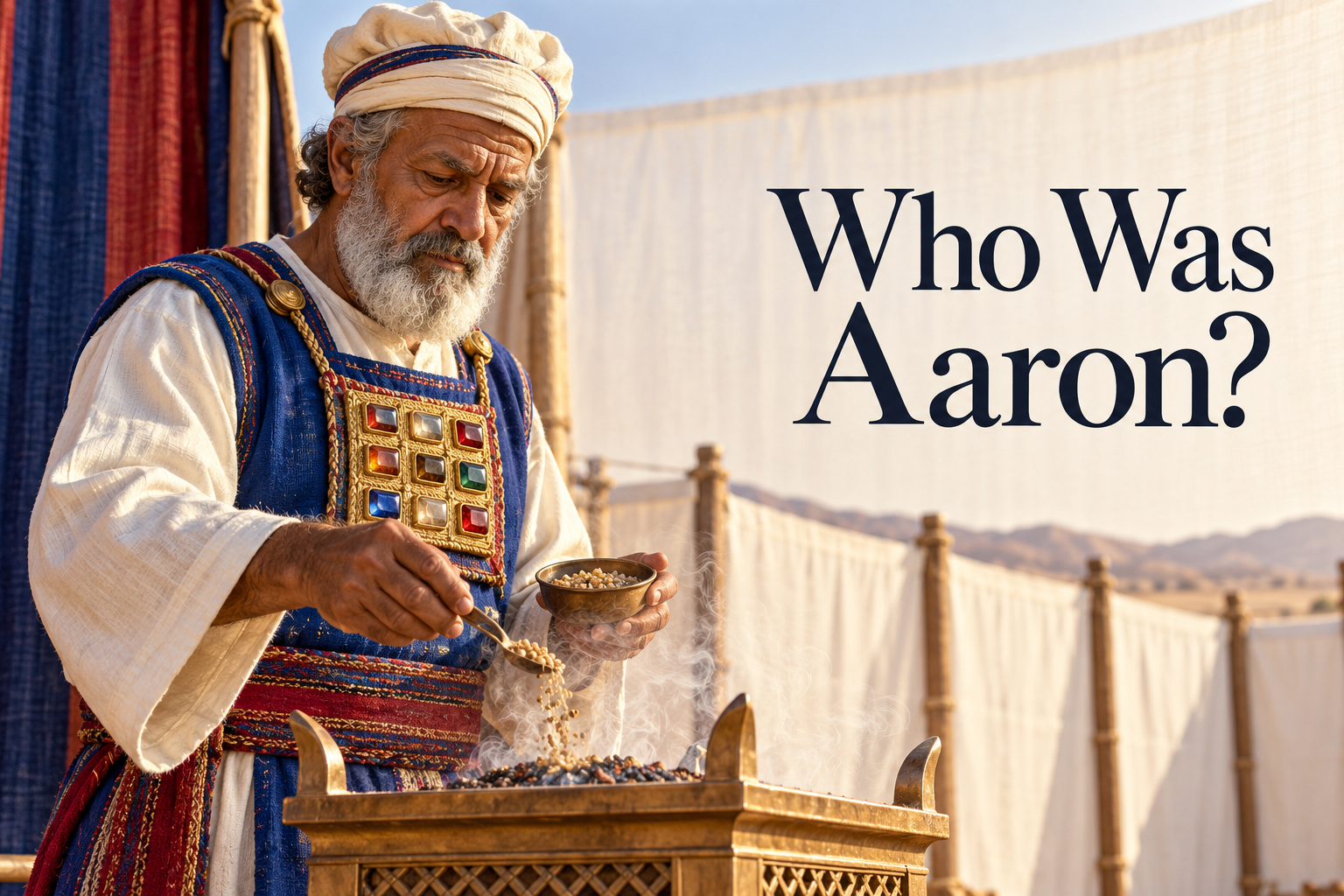
Aaron is often introduced simply as Moses’ brother, which is accurate but inadequate. He speaks when Moses is afraid to speak, stands with him before Pharaoh, becomes Israel’s first high priest, and blesses the people with words still used in worship. He also makes the golden calf, joins Miriam in criticizing Moses, and shares responsibility for the failure at Meribah. Aaron’s life is not a steady climb from assistant to saint. It is the story of a gifted religious leader whose calling is genuine and whose failures show why priestly office cannot be confused with moral perfection.
Moses’ spokesman
Aaron was a Levite, the son of Amram and Jochebed, brother of Miriam and Moses. Exodus 7:7 says he was eighty-three when he and the eighty-year-old Moses confronted Pharaoh. When Moses objected that he was not eloquent, God appointed Aaron to speak for him. The arrangement is described with striking language: Moses would be as God to Aaron, and Aaron would be his mouth. That language concerns delegated communication, not Aaron’s deity or Moses’ elevation into a god.
God sent Aaron to meet Moses in the wilderness, and the brothers returned to Egypt together. Aaron spoke to Israel’s elders and performed signs, then accompanied Moses before Pharaoh. In some plague scenes Aaron stretches out the staff; in others Moses acts; in still others God acts without either brother’s gesture. The variation keeps Aaron from being a ceremonial bystander while also making clear that the power is not his. The signs announce the Lord’s authority over Egypt and its king.
Aaron’s family became central to Israel’s worship. His wife was Elisheba, and their sons were Nadab, Abihu, Eleazar, and Ithamar. At Sinai, Aaron, his sons, and seventy elders ascended partway with Moses and saw the God of Israel in a covenant meal (Exodus 24:9–11). The description is extraordinary but restrained, focusing on what was beneath God’s feet rather than offering a physical portrait. Aaron encountered holiness before he was consecrated to serve it.
The golden calf
While Moses remained on the mountain, the people asked Aaron to make gods who would go before them. Aaron collected gold earrings, fashioned a calf, built an altar, and announced a festival to the Lord. The wording suggests that the calf may have been intended as an image associated with Israel’s God rather than a simple switch to an unrelated deity, but that does not make the act less idolatrous. The covenant had already forbidden making an image for worship. Aaron gave visible form to the people’s impatience and then presided over the celebration.
When Moses confronted him, Aaron blamed the people and offered an almost comic account of the calf’s manufacture: he threw the gold into the fire, and out came this calf. Exodus had already said he shaped it with a tool, so the excuse is exposed by the narrative itself. Deuteronomy 9 adds that the Lord was angry enough with Aaron to destroy him, but Moses interceded for him. Aaron’s survival and later priesthood are therefore acts of mercy, not evidence that the calf was a harmless liturgical experiment.
The aftermath included Moses’ destruction of the image and the killing of about three thousand men by the Levites. Aaron did not carry out that slaughter, but his leadership helped create the crisis. Religious leaders can be tempted to give a fearful community something immediate and manageable, especially when God seems distant and the recognized leader is absent. Aaron’s calf warns that meeting popular demand is not the same as shepherding people faithfully.
Israel’s first high priest
Exodus 28–29 describes Aaron’s priestly garments and consecration. The high priest bore the names of Israel’s tribes on his shoulders and over his heart, entered sacred space on the people’s behalf, offered sacrifices, and carried the Urim and Thummim used in seeking divine judgment. Leviticus 8–9 narrates the ordination and the beginning of ministry. Aaron did not appoint himself, and his ornate clothing was not a costume for personal celebrity. Every element marked a vocation of representing a sinful people before a holy God.
The priestly blessing of Numbers 6:24–26 is given to Aaron and his sons: the Lord blesses, keeps, shines upon, shows grace, turns his face toward, and gives peace. Priests place God’s name on the people, but God supplies the blessing. That distinction matters in every age. The minister speaks and serves; God remains the source.
The joy of Aaron’s first service was followed immediately by the deaths of Nadab and Abihu, who offered unauthorized fire before the Lord. Fire came from the divine presence and consumed them. Moses told Aaron not to display the ordinary signs of mourning while on duty, and Aaron remained silent. Later in the chapter, Aaron explained why he had not eaten a required offering after such events, and Moses accepted his reasoning. The text presents holiness as dangerous and priestly duty as costly, but it does not tell us all we might want to know about the sons’ motives or the precise nature of their offense.
Conflict, envy, and intercession
Numbers 12 reports that Miriam and Aaron spoke against Moses because of his Cushite wife and challenged his unique authority. The identity of the woman and her relationship to Zipporah are debated; Scripture does not explain whether she was the same woman or another wife. God defended Moses’ distinctive prophetic role, and Miriam was struck with a severe skin condition. Aaron confessed that he and Miriam had acted foolishly and begged Moses not to let her remain afflicted. Moses prayed, and Miriam was restored after seven days outside the camp.
Readers reasonably ask why Miriam alone suffered the visible punishment when Aaron also spoke. The chapter does not answer directly. Miriam may be named first as the leading speaker, and Aaron’s priestly status may affect the narrative, but those are inferences rather than explicit explanations. The uneven consequence should not be used to suggest that Aaron was innocent. His own confession includes himself.
A later rebellion led by Korah, Dathan, and Abiram challenged the leadership of Moses and the priesthood of Aaron. The earth swallowed some rebels, fire consumed 250 incense bearers, and a plague followed further complaint. Aaron ran into the assembly with incense and stood between the dead and the living until the plague stopped. His budding staff then served as a sign of God’s choice of his house for priestly service. The episode affirms Aaron’s vocation, though Christians should not use an ancient theocratic judgment to shield modern leaders from accountability or legitimate questions.
Meribah and Aaron’s death
At Meribah, the community quarreled over the lack of water. God told Moses to take the staff, gather the assembly with Aaron, and speak to the rock. Moses instead addressed the people angrily and struck the rock twice. Water came, but God told both brothers that because they had not trusted him to uphold his holiness before Israel, they would not bring the assembly into the land. Moses performs the visible action, yet Aaron is included in the judgment as a participating leader.
Near Mount Hor, God announced that Aaron would die because he and Moses had rebelled at Meribah. Moses took Aaron and Eleazar up the mountain, removed Aaron’s priestly garments, and placed them on Eleazar. Aaron died there at 123, and Israel mourned him for thirty days. The transfer of clothing made the theological point with unusual clarity: the priest dies, but the office and the community continue. Aaron was necessary to his generation without being indispensable to God.
No contemporary Egyptian or archaeological source independently identifies Aaron. His name, like Moses’ and Phinehas’, has often been discussed in relation to Egyptian language, but etymology is uncertain and cannot establish a biography. Historical study also distinguishes the Aaron portrayed in the Pentateuch from later development of Aaronide priestly claims within Israel. The biblical text presents him as the founding high priest; theories about how priestly traditions reached their final literary form belong to historical reconstruction and should be labeled accordingly.
The New Testament remembers Aaron’s priesthood as real but limited. Hebrews says that no one takes priestly honor upon himself but must be called by God, as Aaron was, and then presents Jesus as a greater high priest in the order of Melchizedek. Aaron offered repeatedly and needed sacrifice for his own sins; Christ’s priesthood and self-offering are final. That contrast does not belittle Aaron. It places his ministry within the larger biblical movement from mediated access under the old covenant to the sufficient work of Christ.
Aaron should be remembered neither as Moses’ harmless assistant nor as the man whose calf cancels everything else. He spoke courageously before Pharaoh, carried Israel’s names before God, blessed the people, interceded amid judgment, yielded to pressure, made excuses, envied his brother, and died under discipline. His biography is a sober account of grace in public ministry. God truly calls flawed people, and the reality of that call makes their responsibility greater, not smaller.