

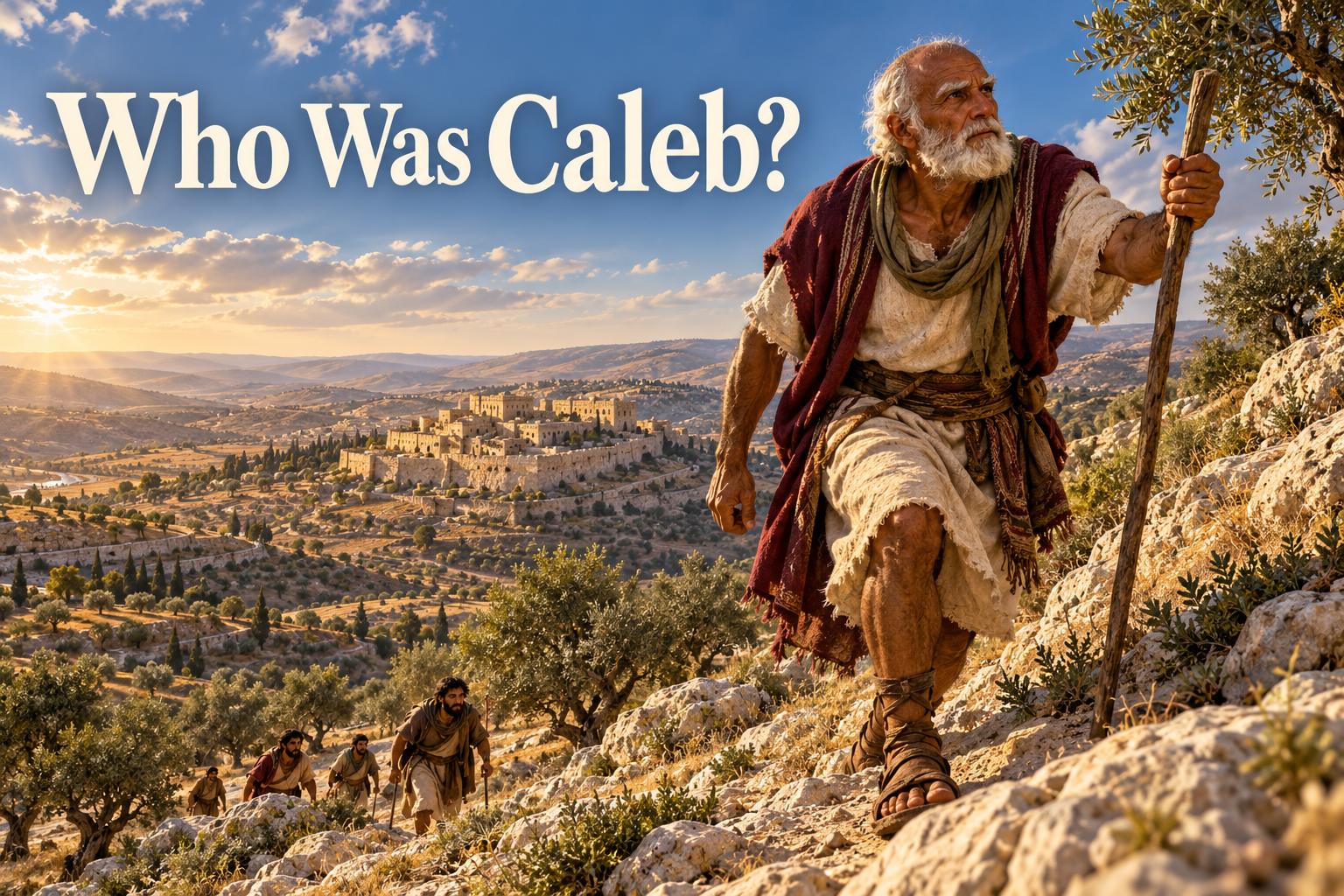
Caleb is one of the Bible’s clearest examples of long obedience without much public attention. He stands against a frightened majority at about forty, wanders with Israel for decades because the nation refuses to listen, and at eighty-five asks for the hill country still occupied by formidable people. Joshua becomes Moses’ successor and gives his name to a biblical book; Caleb receives no comparable office. His distinction is simpler and harder to manufacture: Scripture repeatedly says that he followed the Lord wholeheartedly.
The scout who gave a different report
Caleb was the son of Jephunneh and represented the tribe of Judah among the twelve men sent from the wilderness of Paran to scout Canaan. He should not be confused with other men named Caleb in the genealogies of 1 Chronicles. The scouts traveled through the land, observed its cities and inhabitants, and returned carrying impressive produce. They agreed that the land was fruitful, but most concluded that Israel could not take it.
Caleb quieted the people before Moses and urged immediate action, saying Israel was certainly able to overcome the land. Numbers 14 later places Joshua alongside him in tearing his clothes and pleading with the assembly not to rebel against the Lord. The difference was not that Caleb saw small enemies while everyone else saw large ones. He saw the same fortified cities and powerful inhabitants but interpreted them within God’s promise. Biblical faith is not the refusal to gather intelligence; it is the refusal to let intelligence become unbelief.
The majority report spread through the camp until the people wept, blamed Moses and Aaron, and proposed choosing a leader to return to Egypt. They even threatened to stone Joshua and Caleb. God judged that generation to die in the wilderness, with Caleb and Joshua as the exceptions among the adult scouts. Caleb nevertheless spent the remaining wilderness decades, and then the opening years in Canaan, living with the consequences of the people’s decision. Faithfulness did not spare him from every communal consequence.
What does “wholeheartedly” mean?
God described Caleb as having a different spirit and following fully. Deuteronomy repeats that he followed the Lord wholeheartedly, and Joshua 14 makes the phrase the refrain of Caleb’s own recollection. The description does not claim that Caleb was sinless or that he never felt fear. It means that in the decisive crisis he gave undivided allegiance to God’s promise while the nation turned back in heart toward Egypt.
Caleb’s courage was also remarkably unselfish in its first appearance. He was not defending a private possession already secured or campaigning for an office. He argued that the whole people should trust God and enter the land. Only much later did he request the particular inheritance promised to him. His public loyalty came before his personal reward.
Numbers 13 lists only Caleb as quieting the people at the initial report, while Numbers 14 joins Joshua with him. Deuteronomy 1 emphasizes Caleb before later mentioning Joshua’s commissioning. These different emphases do not require us to choose which faithful scout existed. They show that the tradition can focus on Caleb’s immediate response while also remembering Joshua’s agreement and later leadership.
Caleb the Kenizzite
Caleb is repeatedly called “the Kenizzite” as well as a representative of Judah. Kenaz is associated elsewhere with Edomite genealogies, and scholars debate whether Caleb’s clan had non-Israelite origins and was incorporated into Judah. The biblical text does not narrate a conversion or adoption ceremony for Caleb. It simply places him fully within Judah while preserving the Kenizzite designation.
That combination may offer a glimpse of Israel’s identity as more than a matter of uncomplicated biological descent. Rahab joins Israel from Jericho, Ruth later joins from Moab, and Caleb’s clan label may preserve another story of incorporation. Still, this is a historical inference, not an explicit biography supplied by Joshua. It would be equally careless to erase the Kenizzite title or to build an entire migration story from it.
Some genealogical passages in 1 Chronicles connect Calebite families with towns in Judah, including areas around Hebron and Bethlehem, but the name Caleb appears in complex lines that may involve more than one person or clan tradition. Genealogy in the ancient world can map social and territorial relationships as well as biological descent. These passages are valuable for the later memory of Caleb’s people, but they do not let us reconstruct every generation with modern precision.
Give me this hill country
After the major campaigns, Caleb approached Joshua at Gilgal and recalled the promise made through Moses. He was forty when sent to scout the land and now claimed to be eighty-five, still strong for battle. He asked for the hill country around Hebron, where the Anakim lived and the cities were large and fortified. Caleb did not request the easiest retirement parcel. He asked for the place that embodied the fears expressed by the earlier scouts.
His confidence remained properly conditional: perhaps the Lord would be with him, and he would drive them out as promised. That “perhaps” does not signal unbelief. It recognizes that confidence in God is not control over God. Caleb knew the promise and was ready to act, but he did not speak as though courage entitled him to dictate the process.
Joshua blessed Caleb and gave him Hebron as an inheritance. Other passages say Joshua took Hebron and that the tribe of Judah or Caleb drove out its inhabitants. Ancient battle accounts can attribute a victory to a commander, a campaign, a tribe, and an individual participant without describing four unrelated conquests. The texts may also preserve different stages or traditions associated with the region. We should acknowledge the variation rather than forcing all references into a sequence the Bible never explicitly lays out.
Hebron already carried deep ancestral significance as the area where Abraham lived and where the patriarchal family was buried. It later became David’s first royal center. Caleb’s inheritance therefore joined his personal faithfulness to a region central in Judah’s memory. The land was not merely a trophy for having a better attitude forty-five years earlier; it was a demanding vocation that still required action.
Othniel, Achsah, and the family inheritance
Caleb next appears in the taking of Debir, also called Kiriath-sepher. He offered his daughter Achsah in marriage to the man who captured it, and Othniel son of Kenaz succeeded. The arrangement reflects a patriarchal and martial society in which a father could use a daughter’s marriage to reward military achievement. The narrative reports the practice without asking modern readers to adopt it as an ideal of consent or courtship.
Achsah is not passive within the limits placed around her. She urged Othniel to ask her father for a field, then personally requested springs because the land Caleb had given her was dry. Caleb granted both upper and lower springs. Water determined whether land could sustain a household, so her request was economically intelligent rather than ornamental. Caleb responded generously, giving resources that made the inheritance usable.
Othniel later becomes Israel’s first named judge and delivers the people from oppression, though Judges does not say Caleb trained him for that role. Caleb’s family thus remains connected with leadership after Caleb’s own story recedes. Scripture does not narrate Caleb’s death or give his age at death. Later sites and traditions claim his tomb, but no identification can be established from the biblical text or archaeology.
Caleb, conquest, and historical evidence
Caleb’s story participates in the conquest accounts and therefore shares their moral difficulty. The dispossession and killing of Canaanite peoples cannot be treated as a cheerful backdrop for motivational lessons about taking your mountain. The biblical narrative frames the conquest as divine judgment and fulfillment of promise, while also insisting that Israel itself will be judged for comparable evil. Christian interpreters debate how conventional war rhetoric, literary shaping, historical memory, and unique divine command relate in these texts.
Whatever position one takes, Caleb’s campaign is not a standing authorization for Christians to seize land or use violence against religious or ethnic enemies. The church is not ancient Israel operating as a covenant nation with territorial commands. Jesus sends disciples to make disciples of the nations, not to conquer them. A Christian appropriation of Caleb must pass through the teaching and example of Christ.
Archaeology cannot independently identify Caleb or verify his personal conquest of Hebron. Hebron was an ancient and important settlement, but linking particular occupation levels to one named individual is not possible. The Merneptah Stele confirms that a people called Israel was present in Canaan by the late thirteenth century BC, not how Caleb’s clan acquired its territory. Scholarly proposals about Calebite settlement and Judah’s formation are reconstructions built from texts, archaeology, and social models rather than direct records of Caleb.
Caleb’s legacy rests on sustained allegiance across an unusually long delay. He told the truth when fear was popular, lived with the consequences of a decision he opposed, and remained ready when his opportunity finally came. Yet the point is not that determined people can claim any mountain they name. Caleb acted within a specific promise and still said, in effect, that success depended on the Lord’s presence. His courage was not confidence in confidence; it was confidence disciplined by obedience, patience, and the freedom of God.