
Who Was Samson?
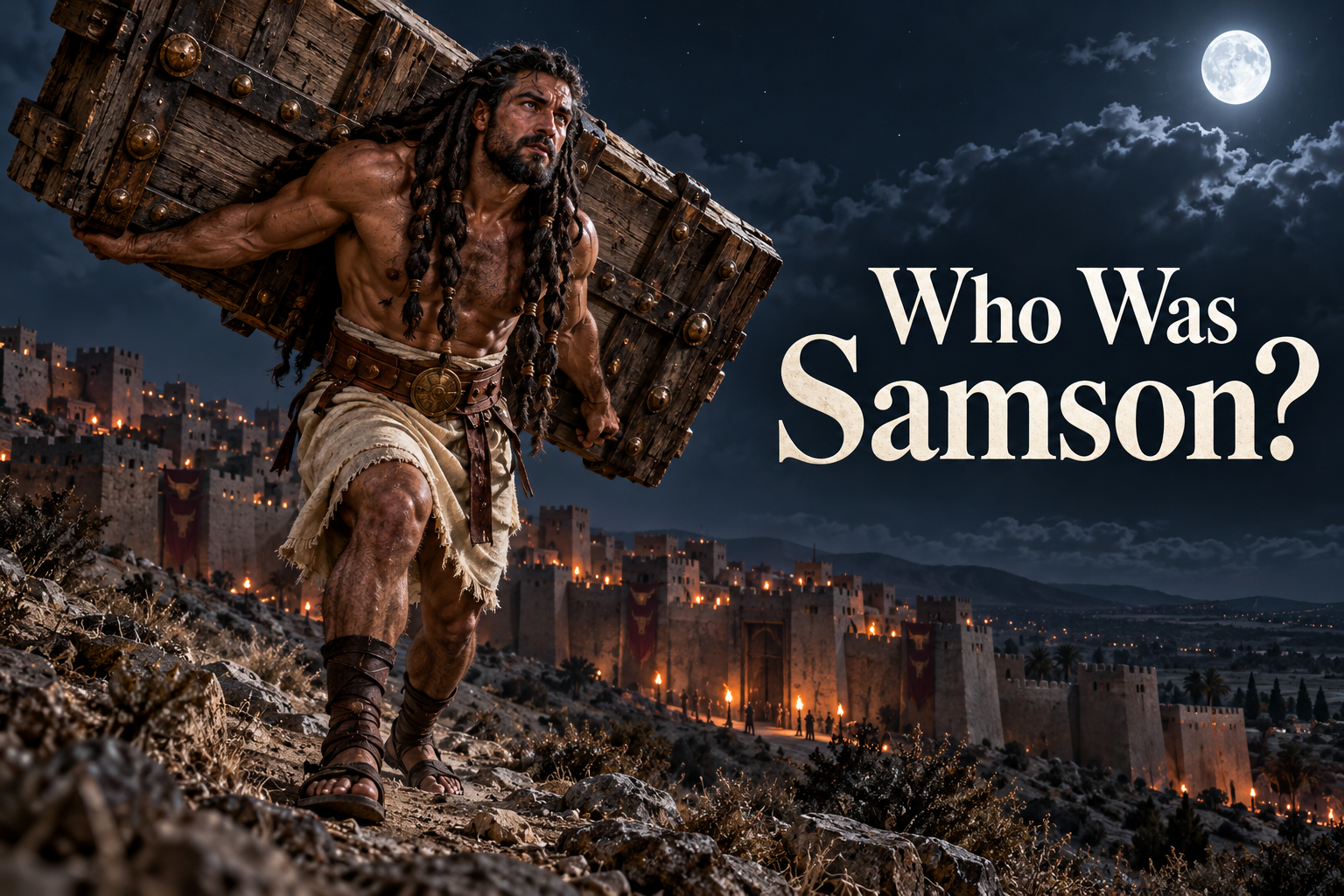
Samson had strength enough to tear a lion apart and weakness enough to tell Delilah what she wanted after repeatedly seeing what she did with the information. He was set apart before birth, empowered by the Spirit of God, and used against Philistine domination. He was also driven by desire, retaliation, pride, and anger. The book of Judges doesn’t hide any of that. Samson is not a clean children’s hero with unusually long hair; he is the final major judge in a book whose leaders and society are coming apart.
A promised child
Judges 13 opens with Israel under Philistine rule for forty years. An angel of the Lord appears to the unnamed wife of Manoah, who has been unable to have children, and promises that she will bear a son. She is told to avoid wine, strong drink, and unclean food because the boy will be a Nazirite to God from the womb. He will begin to deliver Israel from the Philistines, language that promises a beginning rather than complete liberation.
A Nazirite was a person specially consecrated to God under practices described in Numbers 6, including abstaining from grape products, avoiding corpse impurity, and leaving the hair uncut. Samson’s lifelong calling is unusual because it begins before he can choose it, and the instructions are first given to his mother. His hair isn’t a magical battery. It is the visible sign of a consecration whose true source is God’s calling and Spirit.
Manoah asks for further instruction, but the angel largely repeats what the woman has already been told. When Manoah offers a sacrifice, the angel ascends in the flame, and Manoah fears they will die because they have seen God. His wife reasons more clearly: if the Lord intended to kill them, he would not have accepted the offering or announced a child. She is unnamed, but she is neither passive nor spiritually obtuse. In the opening chapter, Samson’s mother is often the steadiest person in the room.
Desire in Timnah
As a young man Samson goes to the Philistine town of Timnah, sees a woman, and tells his parents to get her for him because she is right in his eyes. His parents object to a marriage outside Israel, while the narrator adds that the matter was from the Lord, who was seeking an occasion against the Philistines. That statement describes divine purpose working through a volatile situation; it doesn’t require us to call Samson’s demanding desire wise or his later treatment of the woman loving.
On the way to Timnah, Samson kills a lion when the Spirit of the Lord rushes upon him. Later he finds bees and honey in the carcass, eats some, and gives some to his parents without telling them its source. Contact with a carcass sits uneasily with Nazirite consecration. At the wedding feast he turns the incident into a riddle and wagers garments with thirty Philistine companions. The text calls the event a feast, but it never explicitly says Samson drank wine, so claims about that particular violation remain inference.
The companions threaten to burn Samson’s bride and her father’s household unless she gets the answer. After days of weeping and pressure, she extracts it from Samson and gives it to them. Samson responds by killing thirty men in Ashkelon, taking their clothing to pay the wager, and leaving in anger. His wife is then given to another man. Nearly everyone in the episode uses somebody else, and the Spirit’s empowerment of Samson for conflict doesn’t turn threats, manipulation, or retaliatory killing into a pattern for personal conduct.
A spiral of retaliation
When Samson returns and learns that his wife has been given away, he captures three hundred foxes or jackals, ties torches between their tails, and burns Philistine grain, vineyards, and olive groves. The Philistines answer by burning the woman and her father to death, fulfilling the threat she had tried to escape. Samson then attacks them brutally in revenge. Each side treats its own violence as an answer to the other side, which is how vengeance keeps finding fresh permission.
Judahite men eventually bind Samson and hand him over to the Philistines rather than risk the consequences of his private war. The Spirit rushes upon him, his ropes fall away, and he kills a thousand men with a donkey’s jawbone. After boasting about the slaughter, he becomes desperately thirsty and finally cries to God. God provides water, and Samson revives. The scene holds together divine rescue, remarkable courage, self-regard, and dependence; Judges rarely lets Samson stay in a single moral category for long.
Gaza and Delilah
Samson later goes to Gaza and visits a prostitute. When the city’s men plan an ambush, he gets up at midnight, tears out the city gate with its posts and bar, and carries it toward Hebron. The feat humiliates a fortified Philistine city, but the narrator gives no approval to the sexual encounter that brought him there. Empowerment for a calling doesn’t mean every choice made by the empowered person carries God’s endorsement.
Samson then falls in love with Delilah, a woman from the Valley of Sorek. The text doesn’t call her a Philistine and doesn’t explicitly say they were married or had sex, though later retellings often supply those details. Philistine rulers offer her an enormous payment to discover the source of Samson’s strength. She accepts and repeatedly asks him to explain how he can be subdued.
Samson gives three false answers, and each time Delilah tests the method while Philistines wait nearby. He therefore knows exactly what she intends when he finally tells her about his uncut hair. Judges says she pressed him daily until he was sick to death of it, language that echoes the pressure his Timnite wife used over the riddle. Delilah has become a stock symbol of seductive female betrayal, but the text never portrays Samson as an unsuspecting innocent. He sees the trap three times and stays.
Strength lost and sight taken
Delilah has Samson sleep on her lap, calls for a man to shave his seven locks, and summons the Philistines. Samson wakes expecting to escape as before, but he doesn’t know that the Lord has left him. They seize him, gouge out his eyes, bind him with bronze shackles, and make him grind grain in prison. The man who repeatedly pursued what was right in his eyes loses those eyes and becomes an object of public control.
The narrative says his hair begins to grow again, but regrowth isn’t an automatic spell. At a festival for Dagon, the Philistines bring Samson out for entertainment and place him between the temple pillars. He asks a servant to guide his hands, then prays for strength one more time so he can avenge his eyes. God grants the strength, Samson pushes down the pillars, and he dies with thousands of Philistines as the structure collapses.
Samson knowingly causes his own death while killing enemy rulers and worshipers. Some later interpreters call this suicide, others treat it as a wartime act of self-sacrifice, and still others focus on its troubling resemblance to indiscriminate vengeance. Judges states that he killed more at his death than during his life, but it doesn’t turn his prayer for personal revenge into a universal ethic. This is a violent ending inside an ancient conflict, not a template for private individuals claiming divine permission to kill themselves and a crowd.
What Samson accomplished
Samson judged Israel for twenty years, yet he never mustered the tribes, established a court, or completed Israel’s deliverance. Most of his attacks grew from personal conflicts with Philistines, while God used those conflicts to resist an oppressive power. His calling announcement had carefully said he would begin deliverance. The larger victory over Philistine dominance would belong to the era of Samuel, Saul, and David.
Hebrews 11 names Samson among people who acted by faith and whose weakness was turned to strength. The reference honors real trust without rewriting Judges into a spotless biography. Samson prayed, experienced the Spirit’s power, and struck Israel’s enemy; he also treated women poorly, made reckless choices, and repeatedly converted personal injury into escalating violence. Faith can be genuine in a life that remains badly disordered.
History and later memory
Archaeology and Egyptian records confirm that the Philistines were a real people with roots connected to the Aegean world who settled along Canaan’s southern coast around the beginning of the Iron Age. Excavated Philistine cities illuminate the setting of Judges, including the friction between coastal centers and communities in the neighboring foothills. No inscription independently names Samson, Delilah, or the destruction of a temple. The narrative may preserve memories of local conflict, but archaeology cannot verify its individual exploits.
Jewish and Christian art, preaching, and literature have repeatedly reinvented Samson as national champion, failed ascetic, Christ-like deliverer, romantic victim, or tragic hero. Delilah has been turned into the definitive femme fatale, sometimes with more imagination than attention to the other coercive men and women in the story. Those traditions reveal the story’s power, but they shouldn’t replace the text’s sharper portrait of a man undone partly by his own choices.
Samson’s strength was never the most important fact about him. God gave a compromised man power to begin resisting Philistine rule, and that man confused gift with immunity until captivity taught him dependence again. His final prayer shows renewed appeal to God, but his stated motive still includes vengeance. Judges lets the deliverance and the damage stand together, which is why Samson remains memorable after the feats of strength have stopped being impressive.