
Who Was King Saul?
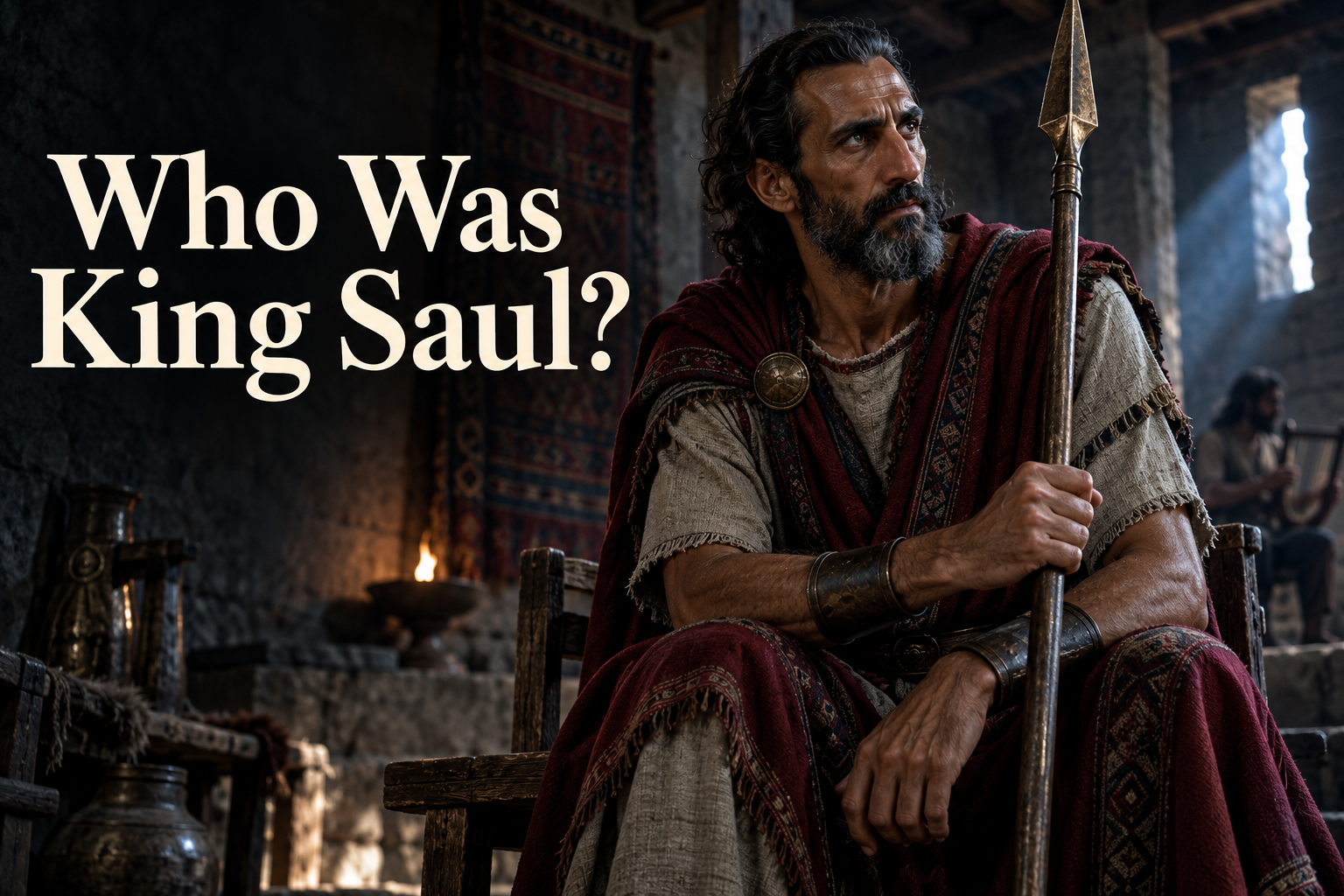
King Saul was Israel’s first monarch, not merely the bitter ruler who tried to kill David. This is Saul son of Kish, not Saul of Tarsus, the apostle Paul, who lived many centuries later. He began as a hesitant Benjaminite searching for lost donkeys, received the Spirit of God, rescued a threatened city, and showed mercy to political opponents. He later disobeyed prophetic commands, grew consumed by fear of David, slaughtered priests, hunted his own son-in-law, and died on a battlefield with his sons. Saul’s life is tragic because the promise at the beginning was real. A flat villain would be easier to dismiss, but he would not be the Saul described in 1 Samuel.
From lost donkeys to a throne
Saul was the son of Kish from the tribe of Benjamin. First Samuel describes him as an impressive young man who stood a head taller than anyone else in Israel. He first meets Samuel while looking for his father’s missing donkeys, an ordinary errand that places him in the path of a national calling. Samuel privately anoints him, gives him signs, and says that the Spirit of the Lord will transform him.
Saul is later chosen publicly by lot, but he is found hiding among the baggage. That detail may reflect humility, fear, or both; the text doesn’t diagnose him. Some people acclaim him while others despise him and question whether he can save Israel. Saul initially holds his peace, an early restraint that makes his later obsession with threats to his status more painful.
First Samuel tells Saul’s rise through private anointing, public selection, and popular confirmation after battle. Scholars often identify different traditions within these accounts, some friendly to monarchy and some suspicious of it. The final narrative doesn’t force them into a single flat ceremony. Saul is chosen by God, recognized by Israel, and still subject to the warnings Samuel gave about royal power.
The king who rescued Jabesh-gilead
Saul’s first major act was a rescue. Nahash the Ammonite besieged Jabesh-gilead and offered a humiliating treaty that required gouging out the right eye of every man. When Saul heard, the Spirit of God came powerfully upon him, and he summoned Israel with a dramatic threat against anyone refusing to join. The resulting victory broke the siege and established Saul’s credibility as the military leader Israel had requested.
Afterward, supporters wanted to execute those who had rejected Saul’s kingship. Saul refused, saying no one would be put to death on a day when the Lord had brought deliverance. This is Saul at his best: empowered, decisive, and unwilling to convert victory into revenge against domestic critics. Samuel then gathered the people at Gilgal to renew the kingship.
War with the Philistines
Saul’s monarchy developed under pressure from the Philistines, a well-organized people established along the southern coastal plain. First Samuel portrays Israel as technologically and militarily disadvantaged, even saying at one point that only Saul and Jonathan possessed swords while Israelites depended on Philistines to sharpen agricultural tools. The precise economic picture is debated, but the narrative’s point is clear: Saul did not inherit a secure state with a professional army and settled borders.
At Gilgal, Saul waited for Samuel while his troops scattered before a Philistine force. When Samuel did not arrive within the appointed period, Saul offered the sacrifice himself. Samuel appeared immediately afterward and announced that Saul’s dynasty would not continue. The text doesn’t say that every king who offered sacrifice was automatically condemned; the issue here is Saul’s failure to keep the command he had been given under pressure.
Jonathan then led a daring attack that helped send the Philistines into panic. Saul, however, placed the army under a rash oath forbidding food before evening. Jonathan, unaware of the oath, tasted honey and regained strength. When the violation was discovered, Saul was prepared to execute his own son even after learning that Jonathan’s action had helped Israel, but the troops intervened and rescued him. The king who once spared opponents now treated his word as more important than his son’s life and the army’s welfare.
The rejection of Saul
First Samuel 15 records the decisive break. Samuel commanded Saul to place Amalek under total destruction as judgment for its attack on Israel. Saul won the battle but spared King Agag and kept the best animals. When Samuel arrived, Saul claimed to have obeyed until the sound of livestock contradicted him, then blamed the people and presented sacrifice as the reason for keeping the animals.
Samuel replied that obedience is better than sacrifice and announced that God had rejected Saul as king. Saul confessed, though he also asked Samuel to honor him before Israel’s elders. Samuel killed Agag, and the two men separated while Samuel mourned. The chapter’s warfare command, including destruction of civilians, is morally severe; the narrative treats it as divine judgment and faults Saul for selective obedience. It cannot responsibly be used as a standing warrant for modern religious or national violence.
The chapter says that God regretted making Saul king while also saying that God does not lie or change his mind like a human being. Those statements aren’t careless opposites. God’s purpose and judgment remain reliable, yet Scripture describes real divine grief over the course Saul freely chose. Saul was not created for failure merely so David could replace him; his disobedience mattered because another path had genuinely stood before him.
David enters Saul’s court
After the Spirit of the Lord departed from Saul, 1 Samuel says a harmful spirit from the Lord tormented him. David was brought to play music, and Saul found relief. Interpreters have described Saul in terms of depression, trauma, paranoia, demonic oppression, or ancient beliefs about divine causation. Some features resemble conditions recognized today, but the text doesn’t give a modern clinical diagnosis, and mental illness should not be equated with moral evil or demonic activity.
David’s military success soon became intolerable to Saul. When women celebrated that Saul had slain thousands and David tens of thousands, Saul heard a threat to the kingdom. He hurled a spear at David, offered daughters in marriage as a trap, and demanded a lethal bride-price from the Philistines. David survived and became more successful, which only increased Saul’s fear.
Saul’s jealousy also wounded his own family. Jonathan defended David and later helped him escape, so Saul insulted Jonathan and threw a spear at him. Michal, Saul’s daughter and David’s wife, helped David flee and was later given to another man. The king’s fear of losing a dynasty drove away the children whose loyalty he most needed.
Nob and the pursuit of David
When the priest Ahimelech unknowingly assisted the fleeing David, Saul accused the priests of conspiracy. His Israelite guards refused an order to kill them, but Doeg the Edomite obeyed and massacred eighty-five priests before the town of Nob was put to the sword. Abiathar alone escaped. The act is one of the clearest signs of Saul’s collapse: the king commissioned to defend Israel destroyed a priestly community on suspicion.
Saul repeatedly hunted David through the wilderness. David twice had opportunities to kill him and refused, once cutting Saul’s robe and once taking his spear and water jar. Saul acknowledged David’s righteousness and even blessed him, but the pursuit resumed after the first encounter. His remorse could recognize truth in a moment without producing stable change. That is more tragic than simple ignorance because Saul sometimes understood exactly what he had become.
The medium at Endor
Before the final battle with the Philistines, Saul was terrified and received no answer through dreams, the Urim, or prophets. Although he had expelled mediums and necromancers, he disguised himself and consulted a woman at Endor. She feared Saul’s own law, and he swore she would not be punished. The ruler who had rejected available prophetic words now sought forbidden access to the dead when legitimate guidance fell silent.
The woman saw a figure the narrative identifies as Samuel, and the message confirmed Saul’s defeat and death. Some interpreters understand an exceptional appearance of the real Samuel; others propose a deceptive spirit, fraud, or vision. The passage doesn’t explain how the appearance occurred, but it does not present necromancy as a useful technique. Saul receives no new strategy, only the judgment Samuel had already announced.
The woman then showed Saul more practical compassion than he had shown many of his subjects. Seeing him exhausted, she prepared food and urged him to eat before leaving. Saul walked into the night toward a battle he now knew he would lose. First Samuel makes the forbidden medium a surprisingly humane figure without approving her practice.
Death on Mount Gilboa
The Philistines defeated Israel on Mount Gilboa and killed Saul’s sons Jonathan, Abinadab, and Malchi-shua. Badly wounded by archers, Saul asked his armor-bearer to kill him rather than let the Philistines abuse him. When the man refused, Saul fell on his own sword, and the armor-bearer did the same. The Philistines displayed Saul’s body at Beth-shan, but men from Jabesh-gilead recovered the bodies and gave them burial, repaying the king who had once rescued their city.
In 2 Samuel 1, an Amalekite tells David that he killed the wounded Saul at Saul’s request. His report differs from 1 Samuel 31, and many readers understand him to be inventing a story in hopes of reward after finding Saul’s crown and armlet. The text never pauses to settle the discrepancy in modern documentary fashion. David orders the messenger executed for claiming to kill the Lord’s anointed and then leads a lament for Saul and Jonathan rather than celebrating his rival’s death.
History and Saul’s legacy
No contemporary inscription securely names Saul, and archaeology cannot verify individual scenes from his reign. The Philistine cities and broader early Iron Age setting are well attested, while the scale and organization of Israel’s earliest monarchy remain disputed. Many historians regard traditions in Samuel as preserving genuine memories of early state formation, though shaped by later authors and editors. Since the narrative ultimately explains David’s rise, its criticism of Saul deserves attention alongside the sympathy with which it also portrays him.
Saul is sometimes used as a sermon illustration in which insecurity explains everything. Insecurity was certainly part of his collapse, but the Bible gives a fuller moral account: he repeatedly chose appearance over obedience, treated people as instruments of dynastic survival, and refused to accept limits on his power. He also showed courage, received the Spirit, saved lives, loved David for a time, and mourned the kingdom he could not hold. None of those early graces excuses the later harm, but they explain why Israel’s first king remains a tragedy rather than a cartoon.
Saul’s story warns that gifting and calling don’t make character inevitable. He was genuinely chosen and genuinely responsible; divine sovereignty did not turn his decisions into theater. His finest public act was refusing revenge after God gave victory, while his worst years were spent attacking anyone he imagined might take his throne. Saul lost the kingdom long before Gilboa because preserving his position had become more important than being the kind of king the position required.