
Who Was Rehoboam?
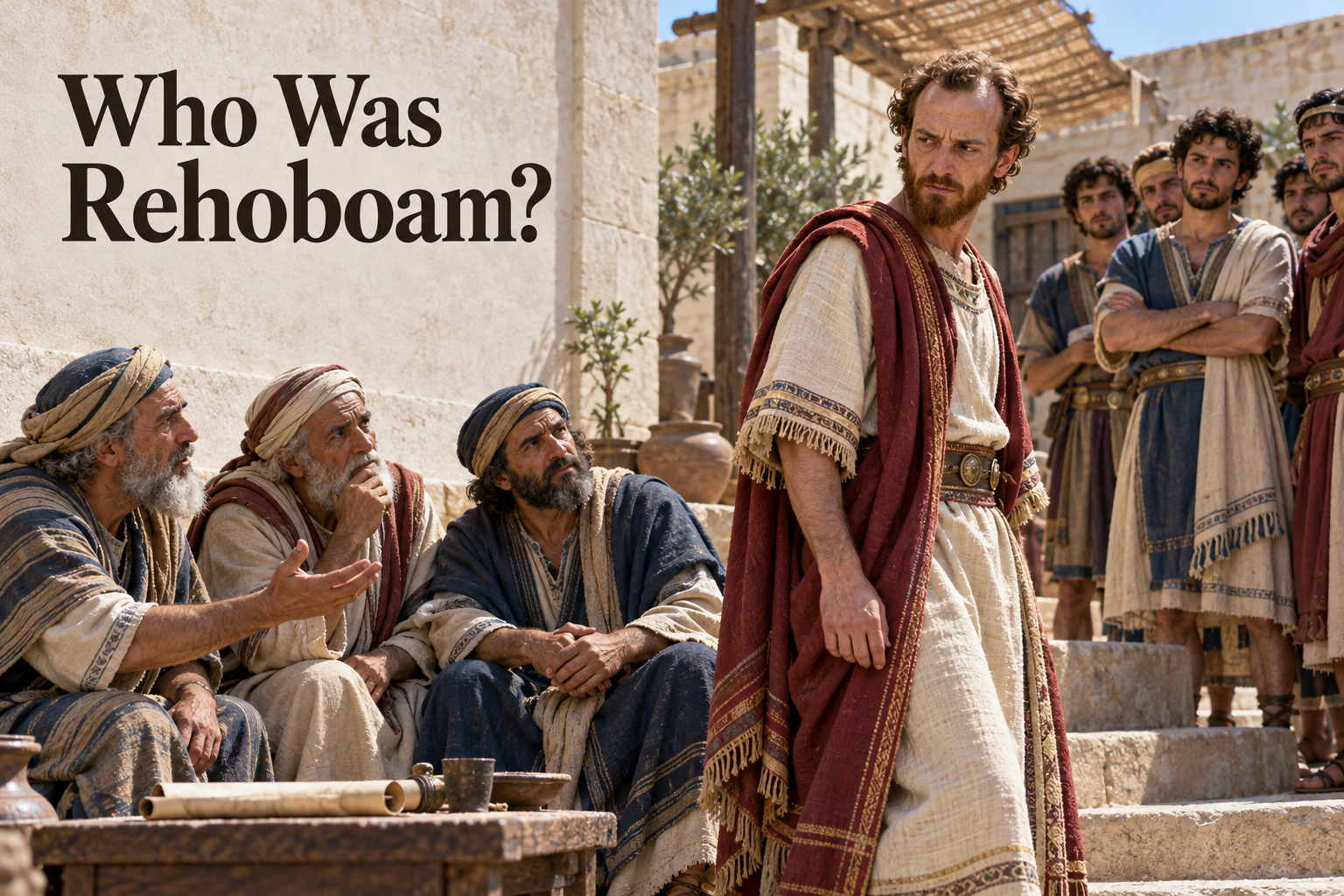
Rehoboam inherited Solomon’s throne, treasury, officials, building projects, and unresolved grievances. Within days, he lost most of the kingdom. His famous mistake was listening to younger advisers who told him to answer a request for relief with threats, but the division of Israel was not created by one foolish speech alone. Solomon’s forced labor, tribal resentment, divine judgment, and Jeroboam’s ambition were already in motion. Rehoboam became the king who turned a serious political crisis into a permanent rupture because he confused intimidation with strength.
Solomon’s son and successor
Rehoboam was the son of Solomon and Naamah, an Ammonite woman. According to 1 Kings 14:21, he was forty-one when he began to reign and ruled seventeen years in Jerusalem. He inherited the Davidic throne, but the kingdom beneath it was less united than Solomon’s wealth made it appear. Northern tribes had supplied labor and taxes for royal projects, and the resentment surfaced as soon as a new king needed public recognition.
The people gathered at Shechem to make Rehoboam king, which suggests that hereditary succession still required acceptance from Israel’s tribal leadership. Jeroboam son of Nebat returned from Egypt and joined the assembly in asking Rehoboam to lighten Solomon’s hard service and heavy yoke. The request did not reject monarchy. It offered loyalty in exchange for relief, giving the new king a chance to turn inherited power into a workable covenant with his subjects.
The counsel he rejected
Rehoboam asked for three days and consulted the elders who had served Solomon. They advised him to become a servant to the people, speak kindly, and thereby secure their lasting service. Their counsel was politically shrewd because it recognized that royal authority could be strengthened by restraint. A king did not become weak by hearing people whose labor sustained his court.
He rejected that advice and turned to men who had grown up with him and now attended him. They urged an answer built on humiliation: Rehoboam’s little finger would be thicker than Solomon’s waist, and where Solomon disciplined with whips, he would use scorpions. “Scorpions” may refer to harsher scourges rather than literal creatures, but the meaning was unmistakable. The young king promised that a burden already described as heavy would become heavier.
First Kings 12:15 says the turn of events was from the Lord in fulfillment of the word spoken through Ahijah to Jeroboam. That theological statement doesn’t remove Rehoboam’s responsibility or make arrogant counsel righteous. God can bring judgment through choices people genuinely make for their own reasons. Rehoboam was not forced to despise wise advice; his contempt became the means by which Solomon’s house experienced the announced consequence of covenant unfaithfulness.
The kingdom divides
The northern tribes answered that they had no share in David and returned to their tents. When Rehoboam sent Adoram, the official over forced labor, the assembly stoned him to death. Sending the very officer associated with compulsory service showed how little Rehoboam understood the grievance. He escaped to Jerusalem in a chariot while Jeroboam became king over the northern tribes.
Rehoboam gathered 180,000 men from Judah and Benjamin to restore the kingdom by force. The prophet Shemaiah told him not to fight their Israelite relatives because the division was from God, and the army went home. This is one of Rehoboam’s better moments. The king who had answered words with threats accepted a prophetic limit before civil war turned a political break into mass bloodshed.
The resulting political map was more complicated than a clean division of ten tribes against two, since populations, towns, priestly groups, and loyalties crossed territorial lines. Still, the basic change endured: Rehoboam ruled the southern kingdom centered in Jerusalem, while Jeroboam I ruled the northern kingdom usually called Israel. The books of Kings then describe continuing warfare or hostility between the two kings throughout their reigns.
Fortifications, worship, and royal family
Second Chronicles 11 credits Rehoboam with strengthening fortified cities across Judah and provisioning them with commanders, food, oil, wine, shields, and spears. It also says priests and Levites from the northern kingdom came south because Jeroboam excluded them from his new cultic system. These notices portray an initially strengthened Judah gathered around Jerusalem’s temple. Chronicles has a special interest in temple loyalty, so its theological emphasis should be recognized even when the movements it describes may preserve historical memory.
Rehoboam’s household also displayed the scale and inequality of ancient royal marriage. Second Chronicles 11:21 says he had eighteen wives, sixty concubines, twenty-eight sons, and sixty daughters. The text describes his preference for Maacah and his decision to designate her son Abijah as successor. It does not ask whether the women had meaningful choice in arrangements that served dynasty, diplomacy, and status. Polygyny could expand a king’s household while also turning wives and children into parts of a succession system.
Rehoboam distributed his sons among fortified cities and supplied them generously. That policy may have secured territory and reduced rivalry at court, but Chronicles soon reports that after his rule was established, he abandoned the law of the Lord. Political consolidation did not produce covenant faithfulness. The institutions grew stronger while the king’s obedience weakened.
Shishak invades Judah
In Rehoboam’s fifth year, Pharaoh Shishak invaded Judah and advanced on Jerusalem. Shishak is widely identified with Shoshenq I of Egypt’s Twenty-second Dynasty, whose campaign in the southern Levant is recorded on the Bubastite Portal at Karnak. The Egyptian place-name list does not clearly name Jerusalem, so it should not be presented as a line-by-line confirmation of Kings or Chronicles. It does independently establish a major Egyptian campaign in the region during the period traditionally associated with Rehoboam.
First Kings 14:25-28 says Shishak took the treasures of the temple and palace, including Solomon’s gold shields. Rehoboam replaced them with bronze shields carried ceremonially by the guard. The substitution is more than an inventory detail. Solomon’s golden display had become bronze imitation within one generation, and the guard still brought out the replacements whenever the king entered the temple as though the ceremony could conceal the loss.
Second Chronicles 12 adds that Shemaiah confronted Rehoboam and Judah’s leaders, who humbled themselves and acknowledged God’s justice. Jerusalem was not destroyed, though it became subject to Egypt and lost its wealth. Chronicles uses the episode to distinguish repentance from exemption from consequences. Humility brought mercy, but it did not put the gold back in the treasury or restore the divided kingdom.
A divided religious legacy
First Kings gives Rehoboam a negative religious evaluation. Judah built high places, sacred pillars, and Asherah poles, and the text mentions male cult prostitutes in the land. Some of these practices may have developed under broader social and royal influence rather than by a single decree from Rehoboam, but Kings places them within his reign and responsibility. The king who governed the city of the temple did not ensure exclusive worship of the Lord.
Chronicles gives a more varied picture: three years of strength, subsequent abandonment, prophetic rebuke, humility during invasion, and some measure of good remaining in Judah. The difference is not necessarily a contradiction between a wholly good king and a wholly bad one. Both accounts portray a reign in which moments of obedience failed to become a settled direction. Rehoboam could listen to Shemaiah in a crisis and still fail to seek the Lord consistently.
History and later judgment
Rehoboam is not named in a known contemporary inscription. Shoshenq’s campaign supplies a strong external anchor for the world of his reign, while archaeology continues to debate the size, administration, and chronology of Judah in the tenth century BC. The biblical writers explain the kingdom’s division through both political cause and divine judgment. Historical analysis can examine forced labor, tribal negotiation, and Egyptian power without deciding that theology contributed nothing to the account.
Later readers often treat Rehoboam as a simple warning against young advisers. Age was not the decisive problem; the older men offered service and the younger men offered domination. A foolish elder could have given the same advice, and a wise younger counselor could have opposed it. The real failure was a ruler choosing the counsel that flattered his power rather than the counsel that understood his people.
Rehoboam kept Jerusalem, the Davidic dynasty, and a reduced kingdom. He also became the man under whom Israel’s political unity ended. His reign shows that inherited authority can disappear quickly when leaders regard legitimate burdens as insolence. Solomon had made the yoke heavy, but Rehoboam announced with remarkable clarity that he preferred the kingdom to break rather than the yoke to lighten.