
Who Was King Josiah?
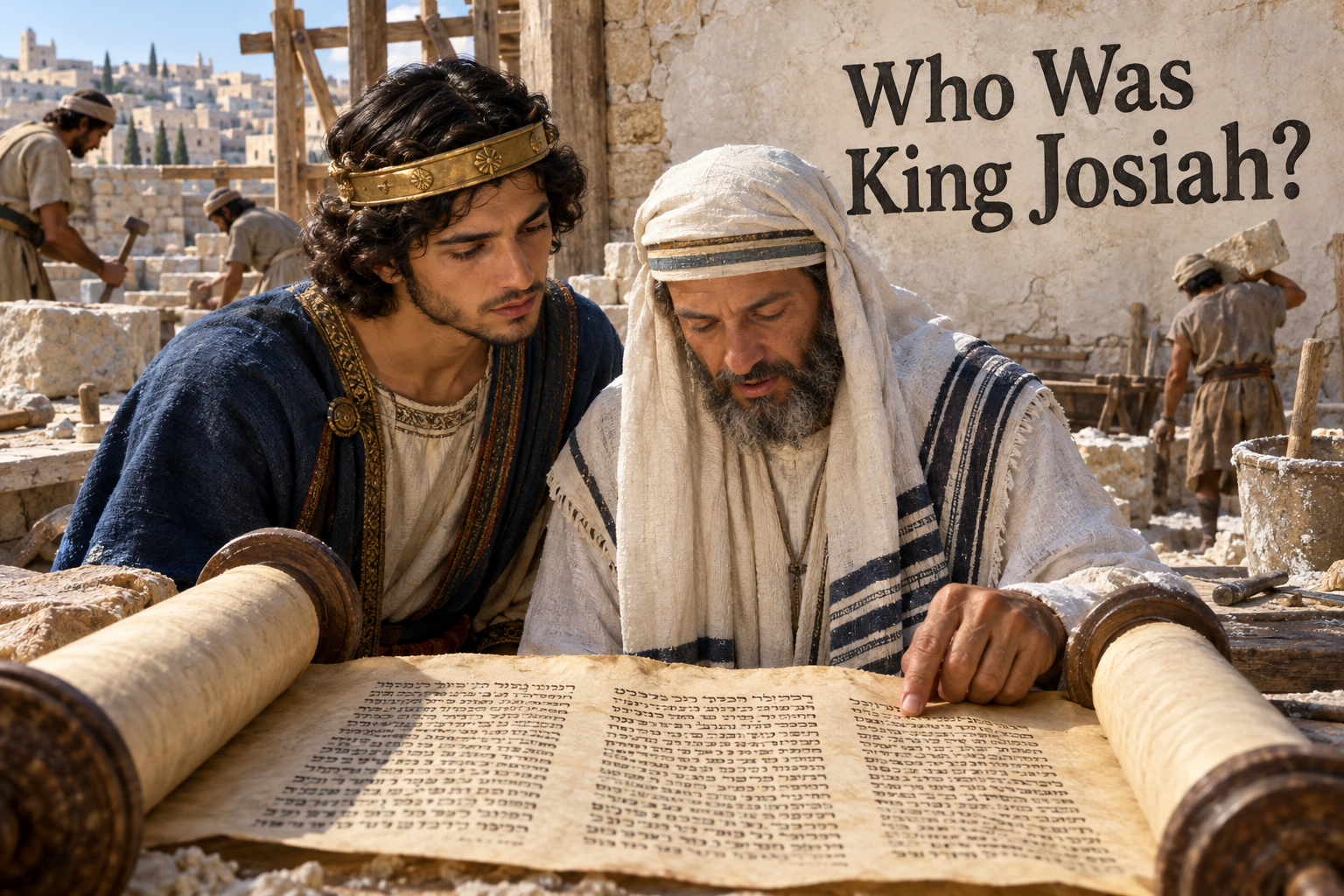
Josiah became king of Judah at eight years old after his father was assassinated. He is remembered for discovering a book of the law, renewing the covenant, destroying idolatrous sites, and celebrating an extraordinary Passover. Second Kings praises him more strongly than any other king for turning to the Lord with all his heart, soul, and strength. Yet his reform did not cancel the judgment already hanging over Judah, and he died unexpectedly in an encounter with Pharaoh Necho at Megiddo. Josiah’s story is therefore about genuine renewal without the illusion that one faithful reign can instantly heal generations of violence and corruption.
A child on a dangerous throne
Josiah was the son of Amon and grandson of Manasseh. After Amon’s servants killed him, the people executed the conspirators and placed Josiah on the throne (2 Kings 21:23–24). The Bible does not describe who governed during his childhood or how court factions shaped his early years. Any detailed reconstruction of a regency is inference rather than explicit narrative.
Second Chronicles says that in the eighth year of his reign Josiah began to seek the God of David and in his twelfth year began purging Judah and Jerusalem of high places and images (2 Chronicles 34:3). Kings organizes the story around the temple repair and law book in his eighteenth year. The accounts may describe stages of one reform or arrange the material according to different theological interests. Chronicles emphasizes Josiah’s early personal devotion; Kings emphasizes reform prompted and defined by the recovered instruction.
Josiah ruled as Assyrian power weakened rapidly. Nineveh fell to a Babylonian-Median coalition in 612 BC, and Egypt moved north to support the remains of Assyria against Babylon. The retreat of imperial control may have given Judah room to extend influence into former northern territory and remove Assyrian-associated worship. That political opportunity helps explain the setting, but the biblical writers attribute Josiah’s central motive to covenant loyalty.
The book found in the temple
Josiah ordered repairs to the temple, and the high priest Hilkiah reported finding “the book of the law” there. Shaphan read it before the king. Josiah tore his clothes after realizing how seriously Judah had violated its words and sent officials to inquire of the Lord (2 Kings 22:8–13). The discovery did not flatter the administration; it exposed it.
Most scholars connect the found book especially with some form of Deuteronomy because Josiah’s reform and covenant ceremony reflect its language and centralization of worship. Traditional interpreters may identify it with the Mosaic Torah more broadly, while critical reconstructions debate whether the scroll was newly composed, expanded, or genuinely recovered. The text itself says it was found; it does not provide a modern account of its production history. Calling the discovery an obvious fraud goes beyond the narrative, while refusing to acknowledge literary-history questions goes beyond the surviving evidence.
The delegation went to Huldah the prophetess, who authenticated the word of judgment and announced that disaster would come because Judah had forsaken the Lord. Because Josiah humbled himself, he would be gathered to his grave in peace and would not see the coming destruction (2 Kings 22:14–20). “In peace” cannot mean he would die quietly of old age, since he was killed at Megiddo. It may refer to being spared Jerusalem’s catastrophe or being gathered to his ancestors before it arrived.
Huldah’s role is easy to overlook. Priests, scribes, and royal officials sought God’s interpretation from a recognized female prophet in Jerusalem. She did not merely echo Josiah’s hopes; she delivered both unavoidable judgment and personal mercy. Her authority in the narrative is assumed rather than defended.
Covenant renewal and reform
Josiah gathered Judah’s elders and people, read the book publicly, and renewed the covenant to follow the Lord. He then ordered the removal of vessels made for Baal, Asherah, and the host of heaven. He deposed idolatrous priests, destroyed houses connected with cultic prostitution, defiled Topheth where children had passed through fire, removed horses dedicated to the sun, and demolished illicit altars (2 Kings 23:4–14). The campaign was broad, forceful, and royal.
At Bethel, Josiah destroyed the altar associated with Jeroboam I and burned human bones upon it, fulfilling an older prophetic word in the narrative of Kings. He spared the grave of the prophet who had announced the judgment. The reform extended into towns of the former northern kingdom, suggesting that Josiah claimed religious and perhaps political authority beyond Judah’s older borders.
Modern readers may rightly feel tension over state-enforced religious reform and the desecration of graves. Kings presents the destruction of idolatry as covenant faithfulness within ancient Israel’s theocratic life. The church is not authorized to reproduce Josiah’s methods against other religions. Christian mission proceeds through proclamation, persuasion, service, and the work of the Spirit, not royal coercion or destruction of neighbors’ property.
Josiah then commanded a Passover according to the covenant book. Kings says no such Passover had been observed since the days of the judges in the manner associated with this celebration (2 Kings 23:21–23). Chronicles supplies extensive details about priests, Levites, offerings, and participants. The claim is comparative, not necessarily a statement that Israel had observed no Passover at all for centuries; Hezekiah’s earlier celebration is narrated in Chronicles itself.
Did reform change the people?
Kings praises Josiah without qualification, yet immediately says the Lord did not turn from fierce anger provoked by Manasseh. This does not make Josiah’s obedience meaningless. It distinguishes a king’s genuine response from the accumulated effects of national sin. Reform can be real without being deep enough or early enough to prevent every historical consequence.
Jeremiah began prophesying in Josiah’s thirteenth year, and Zephaniah is also dated to his reign. Their books condemn idolatry, violence, injustice, and superficial religion, suggesting that official reform did not automatically transform every household or official. Jeremiah later warned people not to trust in the temple as a protective slogan. A cleaned sanctuary could coexist with unchanged hearts.
Some scholars therefore describe Josiah’s reform as limited court ideology or question how fully it was implemented. The prophets certainly show continuing sin, but continuing sin does not prove no reform occurred. Royal orders, local practice, personal belief, and long-term social change are different things. Scripture itself allows Josiah’s faithfulness and Judah’s persistent corruption to stand together.
Death at Megiddo
In 609 BC Pharaoh Necho II marched north toward the Euphrates as Egypt tried to assist the collapsing Assyrian remnant against Babylon. Second Kings says Josiah went to meet him and was killed at Megiddo (2 Kings 23:29–30). It does not explain Josiah’s motive or describe the encounter as a full battle. Political explanations include opposition to renewed Egyptian control, support for Babylon, or an attempt to defend northern claims, but these remain reconstructions.
Second Chronicles gives a fuller and somewhat different account. Necho says he has no quarrel with Josiah and claims God has ordered his mission; Josiah disguises himself, enters battle, is wounded by archers, and dies after being taken to Jerusalem (2 Chronicles 35:20–24). Kings sounds as though death occurred at Megiddo, while Chronicles narrates mortal wounding there and death after removal. Interpreters offer harmonizations, but it is more honest to recognize the difference in narrative detail.
Recent work at Megiddo has connected Egyptian and East Greek pottery with an Egyptian presence in the late seventh century, but the dating and interpretation remain contested. Archaeologists disagree over how closely the finds relate to Necho’s activity and whether the Greek pottery points to mercenaries, merchants, or other contacts. The material may illuminate the regional setting; it does not establish the precise circumstances of Josiah’s death.
Jeremiah composed laments for Josiah according to Chronicles, though the canonical book of Lamentations does not name him and should not simply be identified with that lost or traditional lament. Judah mourned a king whose death must have seemed to contradict the momentum of renewal. Within months Egypt controlled the succession, deposed Josiah’s son Jehoahaz, and installed Jehoiakim. Political freedom and reform collapsed together.
Josiah’s legacy
Josiah was buried in Jerusalem and remembered as a king who turned to the Lord with his whole being. His sons and grandson would rule during Judah’s rapid fall between Egypt and Babylon, but none sustained his course. The book discovered under his authority continued to shape Israel after the monarchy failed. A scroll proved more durable than the throne that sponsored its reading.
No known contemporary inscription names Josiah, though the international events surrounding his death are well established from Egyptian, Assyrian, Babylonian, and archaeological evidence. Seal impressions bearing names of officials associated with his period are sometimes proposed, but disputed identifications should not be promoted as direct proof of the king. Josiah’s historical profile rests primarily on Kings and Chronicles within a well-attested late seventh-century setting.
His life offers no formula that national reform guarantees immediate security. Josiah listened, humbled himself, acted courageously, and still died before fifty. His obedience mattered because God’s word was worthy of obedience, not because it purchased an easy ending. The judgment Judah had stored up remained, but so did the covenant word Josiah brought back into public hearing.