
Who Was King Zedekiah?
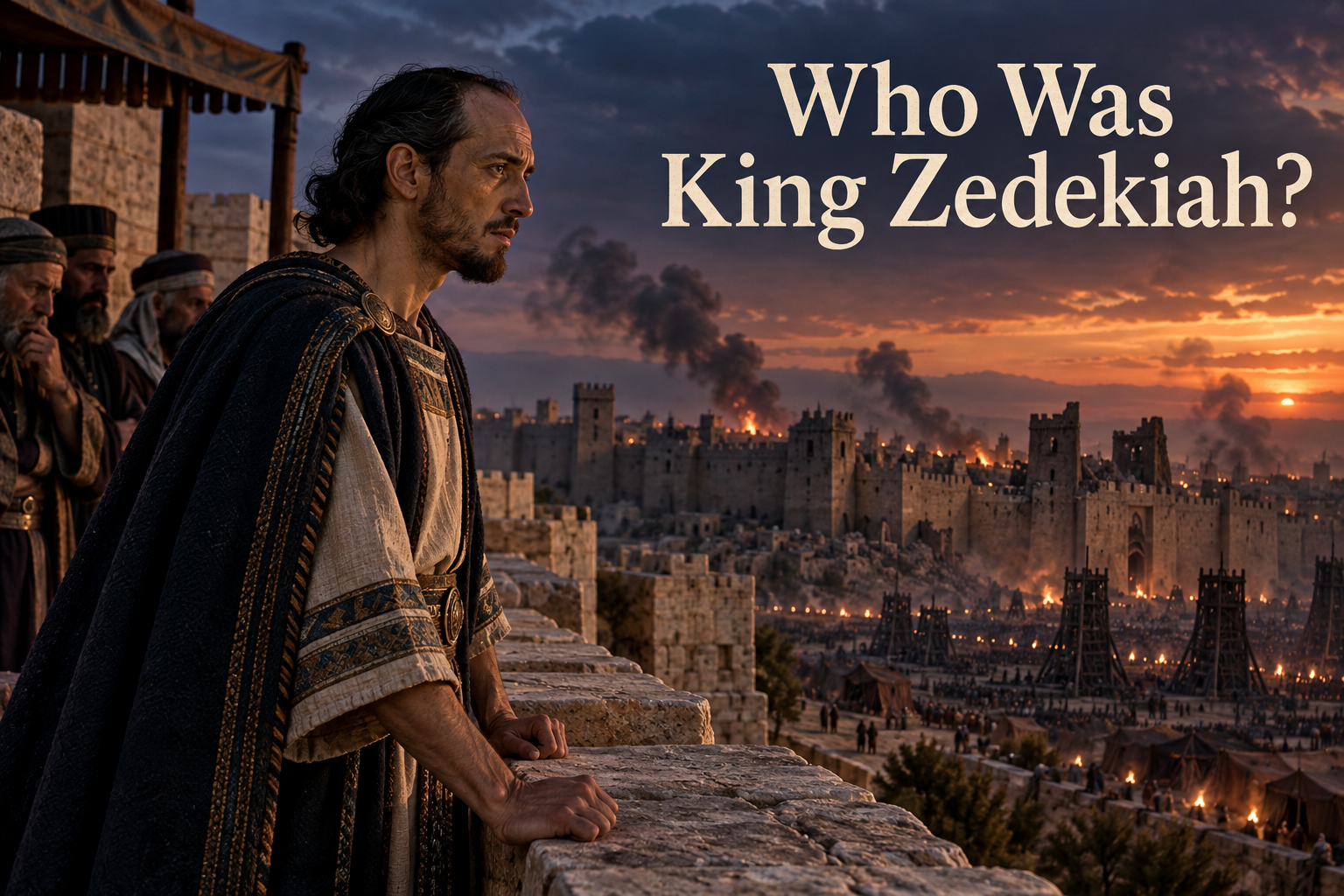
Zedekiah was the last reigning king of Judah before Babylon destroyed Jerusalem and the first temple. He did not inherit a stable kingdom and then casually ruin it. He governed a frightened vassal state caught between Babylonian power, Egyptian promises, divided officials, and prophetic demands that sounded like surrender. Yet Scripture does not excuse his choices. Zedekiah repeatedly sought Jeremiah’s word, recognized that the prophet spoke truth, and still lacked the courage to act on it.
A king appointed by Babylon
Zedekiah was a son of Josiah and originally named Mattaniah. In 597 BC Nebuchadnezzar captured Jerusalem, deported King Jehoiachin and leading citizens, and installed Mattaniah as king, changing his name to Zedekiah (2 Kings 24:10–17). The name change publicly marked Babylonian authority. Zedekiah was twenty-one and reigned eleven years.
The Babylonian Chronicle independently records Nebuchadnezzar’s 597 campaign against the “city of Judah,” its capture, the seizure of its king, and the appointment of a ruler of Babylon’s choice. It does not name Zedekiah in the surviving line, but the event corresponds closely with the biblical transition from Jehoiachin to Zedekiah. Cuneiform ration tablets from Babylon later name Jehoiachin, king of Judah, and his sons among royal dependents, further confirming the exile’s historical setting.
Zedekiah swore loyalty to Nebuchadnezzar in God’s name, according to Chronicles, but eventually rebelled. Ezekiel interprets the rebellion as both political treachery and oath-breaking before God (Ezekiel 17:11–21). Judah sought Egyptian support, a familiar strategy for small Levantine states between empires. The calculation was understandable and disastrous.
Prophets and officials did not offer Zedekiah one unanimous political program. Some promised that Babylon’s yoke would soon break and that the temple vessels and exiles would return quickly. Jeremiah wore a yoke to dramatize submission and confronted Hananiah’s optimistic prophecy (Jeremiah 27–28). Zedekiah therefore had to discern between competing religious voices, but the existence of false counsel did not remove his responsibility after Jeremiah’s warnings repeatedly proved reliable.
Jeremiah and the frightened king
Jeremiah’s ministry dominated Zedekiah’s reign. The prophet announced that Babylon’s victory was God’s judgment and urged the king and people to submit rather than fight. To patriotic officials, that sounded like treason and demoralization. To Jeremiah, resistance was rebellion against the judgment God had already decreed.
Zedekiah sent delegations to ask Jeremiah for prayer, consulted him privately, and at times protected him from death. He also allowed officials to imprison the prophet and lower him into a muddy cistern, where he would have died without Ebed-melech’s intervention (Jeremiah 38:1–13). Zedekiah then met Jeremiah secretly and promised not to kill him. The king wanted revelation without the political cost of obedience.
Jeremiah told him that surrender would preserve his life and prevent the city from being burned. Zedekiah admitted fear that Judeans who had already defected would abuse him. Jeremiah assured him that he would not be handed over to them (Jeremiah 38:17–23). The exchange makes Zedekiah’s failure painfully human. He did not lack information; he feared humiliation more than he trusted the word he had requested.
The king also participated in a covenant to free Hebrew slaves during the siege. When Babylonian pressure temporarily lifted, owners took the freed people back into slavery. Jeremiah condemned the reversal as profaning God’s name (Jeremiah 34:8–22). The episode exposes desperate religion that lasts only while danger is immediate. Zedekiah’s government could perform reform under threat without sustaining justice when circumstances seemed easier.
The final siege
Nebuchadnezzar’s army began the final siege in Zedekiah’s ninth year. An Egyptian force came out, and the Babylonians temporarily withdrew, encouraging false hopes. Jeremiah insisted they would return and burn the city even if Judah somehow struck down nearly the entire army (Jeremiah 37:5–10). Egypt did not provide lasting rescue.
Famine became severe, the city wall was breached, and Zedekiah fled at night toward the Arabah. Babylonian forces captured him in the plains of Jericho and brought him to Nebuchadnezzar at Riblah. There the conqueror killed Zedekiah’s sons before his eyes, executed Judah’s officials, blinded the king, bound him, and took him to Babylon (2 Kings 25:1–7). The last thing Zedekiah saw was the destruction of his dynasty.
Jeremiah had prophesied that Zedekiah would see the king of Babylon and go there, while Ezekiel said he would be brought to Babylon yet not see it. The blinding provides a coherent narrative fulfillment of both statements, although neither prophet pauses to present the relationship as a riddle and solution. Zedekiah saw Nebuchadnezzar, then entered Babylon without sight.
The Babylonians burned the temple, palace, and major houses, tore down Jerusalem’s walls, executed leading officials, and deported more of the population. The fall is commonly dated to 587 or 586 BC depending on regnal-year calculations. Archaeological destruction layers in Jerusalem and sites such as Lachish strongly attest the Babylonian devastation, while research also shows that the land was not left entirely empty. Poorer residents remained, and areas such as Benjamin experienced a different pattern from the ruined capital.
The Lachish letters, Hebrew messages written on pottery shortly before Judah’s collapse, preserve military anxiety from the final years of the kingdom. One letter refers to watching signal fires from Lachish because Azekah could no longer be seen, language often compared with Jeremiah 34:7, where those two fortified cities remain. The letters do not name Zedekiah or describe Jerusalem’s capture, so their value is contextual. They let us hear something of the strained communications within Judah as Babylon closed in.
What happened to Zedekiah?
Second Kings ends Zedekiah’s active story with his imprisonment in Babylon. Jeremiah 52:11 says he remained imprisoned until the day of his death but does not provide a date or burial place. Later traditions supply additional details, but none can be treated as established history. Unlike Jehoiachin, whose later release is narrated, Zedekiah receives no recorded restoration.
A passage in Jeremiah says Zedekiah would die in peace and be mourned with royal burnings (Jeremiah 34:4–5). Readers have long wrestled with how this fits his brutal capture and imprisonment. “In peace” may mean a natural death rather than execution, with mourning among exiles, or the prophecy may be understood as conditional within Jeremiah’s call to surrender. The text does not give enough later biography to settle every detail.
History and disputed artifacts
No surviving Babylonian inscription names Zedekiah with the clarity given to Jehoiachin in ration texts. The Babylonian Chronicle anchors the 597 appointment, but its preserved narrative ends before the final destruction of Jerusalem. For the last siege, historians correlate biblical sources, Babylonian chronology, and archaeological evidence. That combination provides strong historical context while leaving many court conversations known only through Jeremiah and Kings.
Seal impressions bearing the names Gedaliah son of Pashhur and Jehucal son of Shelemiah, officials named together in Jeremiah 38, have been found in Jerusalem and are widely discussed. The names and period fit, but identifying common ancient names with the exact biblical individuals remains a probability rather than absolute proof. A seal can attest an official name in the right setting without preserving a complete biography.
The last king and the surviving promise
Zedekiah is often reduced to cowardice, and the charge has force. He shifted between factions, hid consultations, yielded to officials, broke an oath, and refused a clear path that might have spared lives. Yet his fear grew within real imperial terror. The Bible’s moral judgment is strongest when it does not require pretending obedience would have been easy.
Jerusalem’s fall ended Zedekiah’s reign but did not end the Davidic story. Second Kings closes not with Zedekiah but with Jehoiachin released and honored in Babylon, a small sign that the royal line had not vanished. Christians read the larger promise as reaching Jesus, not as vindication of every Davidic ruler. Zedekiah’s crown failed because kingship, temple, and city could not substitute for covenant faithfulness.
His tragedy was not that God remained silent. Jeremiah spoke until the message could scarcely be misunderstood. Zedekiah’s tragedy was hearing truth, believing enough to fear it, and refusing to stake his life on it. He wanted a word from God that would remove the need for courage, and no such word came.