
Who Was Mordecai?
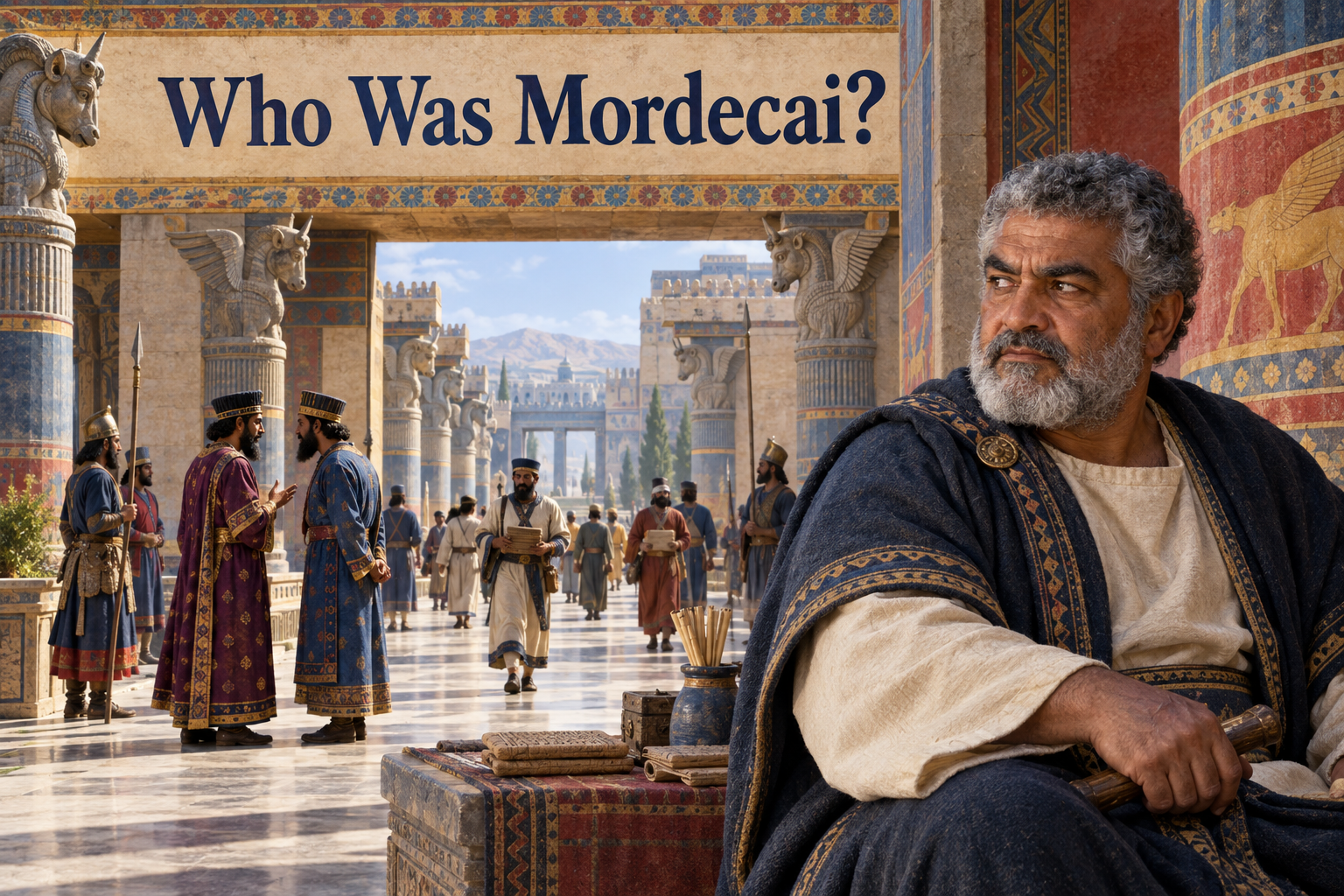
Mordecai is the Jewish court figure who raised Esther, uncovered a plot against the Persian king, refused to bow to Haman, and helped turn a planned genocide into Jewish deliverance. He is also a character in one of the Bible’s most debated historical books. The story places him in a recognizable Persian court under a king usually identified as Xerxes I, but no external record securely identifies Mordecai himself. Reading him responsibly means allowing Esther to be theological narrative without advertising disputed name matches as archaeological proof.
A Jew in Susa
Esther 2:5 introduces Mordecai as a Jew in the citadel of Susa, a Benjaminite descended from Kish. His name resembles Babylonian names associated with the god Marduk, which was not unusual for Jews living in the diaspora. A foreign name does not show that Mordecai worshiped Marduk any more than Joseph’s Egyptian name proves he abandoned Israel’s God. Diaspora Jews could participate in imperial society while maintaining a distinct identity.
Esther’s Hebrew grammar leaves some ambiguity about who was taken into exile with King Jehoiachin in 597 BC. If the statement refers directly to Mordecai, he would be implausibly old during the reign of Xerxes, more than a century later. Many interpreters therefore understand the exiled person as Kish, Mordecai’s ancestor, or take the genealogy as compressed family history. The repeated exile language locates Mordecai within the memory and identity of displaced Judeans rather than requiring him to have made the journey personally.
The link to Kish also recalls the family of King Saul, another Benjaminite associated with a man named Kish. Haman is later called an Agagite, evoking Agag, the Amalekite king whom Saul failed to destroy. Many readers see a deliberate literary replay of the Saul-Amalek conflict. The echoes are strong, but Esther never pauses to provide a biological pedigree from Agag to Haman, so typology is more certain than a reconstructed genealogy.
Guardian of Hadassah
Mordecai had raised his cousin Hadassah, also called Esther, because she had lost both parents. Esther 2:7 says she was the daughter of his uncle, and Mordecai took her as his own daughter. That relationship explains his continued concern after she entered the royal household.
When the king’s officials gathered young women for the palace after Queen Vashti’s removal, Esther was taken with them. The process belonged to royal power, not a modern voluntary pageant. Mordecai instructed Esther not to reveal her Jewish identity, and she continued following his direction after becoming queen. The text does not explain his motive, though fear and prudent concealment in a vulnerable minority setting are reasonable inferences.
Mordecai walked daily near the women’s court to learn how Esther was doing. His access to the king’s gate later suggests some official or judicial role, though the precise office is not named. He was close enough to court to hear political news but not powerful enough at first to protect Esther openly. Their strategy depended on navigating an empire whose favor could elevate a person quickly and remove her just as quickly.
The assassination plot
Mordecai learned that two royal eunuchs, Bigthan and Teresh, planned to assassinate Ahasuerus. He told Esther, who reported the information to the king in Mordecai’s name. The charge was investigated, the men were executed, and the event was recorded in the royal chronicles. Mordecai received no immediate reward.
That delay becomes one of the story’s central reversals. Much later, the king cannot sleep, hears the chronicle read, and discovers that nothing was done for Mordecai. Haman enters at precisely that moment intending to request Mordecai’s execution, only to be ordered to lead Mordecai through the city in royal honor. Esther presents providence through timing and irony without once naming God in its Hebrew form.
Why Mordecai would not bow
After Haman’s promotion, royal servants bowed before him, but Mordecai refused. The servants asked why he transgressed the king’s command, and Mordecai told them he was a Jew. The text never says exactly why Jewish identity prevented this act. Israelites could bow respectfully before human authorities in other biblical narratives, so a universal prohibition against civil honor does not explain everything.
Some interpreters think the gesture carried worshipful meaning; others connect Mordecai’s refusal with the Agagite-Benjaminite rivalry or with Haman’s character. Pride, conscience, ancestral conflict, and religious resistance have all been proposed. Because Esther withholds Mordecai’s explanation, readers should resist making their preferred motive explicit Scripture. What is explicit is that Haman answered one man’s refusal with a plan to destroy an entire people.
“For such a time as this”
Haman cast the pur, or lot, to select a date and persuaded the king to authorize destruction of Jews throughout the empire. When Mordecai learned of the decree, he tore his clothes, wore sackcloth and ashes, and cried publicly. Esther initially sent clothing, then learned the reason for his grief. Mordecai supplied a copy of the decree and charged her to approach the king.
Esther replied that entering uninvited could bring death unless the king extended the golden scepter. Mordecai warned that palace status would not guarantee her escape and said that relief and deliverance would arise for the Jews from another place if she remained silent. He then asked who knew whether she had attained royalty for such a time as this. He did not claim a direct revelation about God’s secret plan; he combined confidence that the Jewish people would survive with a searching interpretation of Esther’s opportunity.
Esther asked Mordecai to gather the Jews of Susa for a three-day fast, and he did everything she instructed. The relationship had shifted. The guardian who once commanded Esther now followed the queen’s plan, while Esther accepted the mortal risk he had placed before her. Their cooperation, not either person’s solitary courage, drives the deliverance.
From the gallows to royal robes
Haman built a towering wooden structure for Mordecai, variously translated as gallows or stake. Persian execution could involve impalement or public display, so the traditional image of a hanging scaffold may be too specific. Before Haman could use it, the sleepless king ordered him to honor Mordecai publicly. At Esther’s second banquet, the queen exposed Haman’s plot, and the king ordered Haman executed on the structure he had prepared.
Esther received Haman’s estate, Mordecai received the king’s signet ring, and Esther placed him over Haman’s property. Mordecai left the palace in royal robes and a crown, producing joy among the Jews. The threatened outsider had become an imperial official.
The counter-decree and its violence
Because the first edict could not simply be revoked, Esther and Mordecai wrote a counter-decree. It permitted Jewish self-defense and used severe language that included women and children, though the casualty reports speak of men and enemies. Esther 9 reports five hundred killed in Susa on the first day, three hundred on a second day requested by Esther, and seventy-five thousand in the provinces. Haman’s ten sons were killed and then publicly displayed.
The narrative frames the violence as defense against people seeking Jewish destruction and repeatedly says the Jews did not take plunder. That distinction matters because it separates survival from enrichment and recalls the Saul-Amalek story. Even so, the scale is severe, and Esther’s request for an additional day in Susa troubles many readers. Celebration of rescue should not require delight in bodies or pretending ancient imperial violence resembles modern due process.
Mordecai and Esther established annual observance of Purim, named after Haman’s lot. The festival turned days intended for destruction into feasting, gladness, gift-giving, and provision for the poor. It preserves the memory of threatened annihilation and reversal. The Hebrew book’s refusal to name God makes the celebration no less theological; hidden providence is carried by coincidence, courage, fasting, and events that reverse one another with almost comic precision.
Second only to the king
Esther ends with Mordecai second in rank to King Ahasuerus, great among the Jews, and accepted by many of his kindred. He sought the good of his people and spoke peace to all his descendants. “Many” rather than “all” may suggest that political prominence still attracted criticism, though the text does not explain dissent. Serving at the top of an empire remained more complicated than a victory parade.
History and disputed identification
Ahasuerus is usually identified with Xerxes I, who ruled from 486 to 465 BC, because the name and broad imperial setting fit his era. Yet Esther’s symmetry, exaggeration, compressed court procedures, and debated details lead scholars to classify it anywhere from court history to a historical novella set in Persia.
Persepolis administrative texts mention officials with names rendered Marduka or similar forms, and one has been proposed as the biblical Mordecai. The name was not unique, the tablets do not identify the man as Jewish, and matching an official name to a narrative character requires more than similarity. The evidence shows that Mordecai’s name fits the Persian period; it does not prove that a particular tablet names Esther’s guardian.
No contemporary Persian text confirms Haman’s decree, Esther’s queenship, Mordecai’s promotion, or the empire-wide conflict. Incomplete archives cannot decide the genre by themselves, but the biblical book remains our only source for Mordecai’s biography.
Later versions and Mordecai’s legacy
Greek versions of Esther add prayers, dreams, explicit references to God, and other material absent from the Hebrew book. In those additions, Mordecai receives a symbolic dream that is later interpreted through the conflict. Catholic and Orthodox Bibles preserve these additions in different canonical arrangements, while Jewish and Protestant Bibles use the shorter Hebrew form. The additions are important reception history but should not be quoted as though they appear in Hebrew Esther.
Later Jewish tradition honored Mordecai as a righteous leader and expanded his prophetic or scholarly stature. Iranian tomb traditions associate sites with Esther and Mordecai, but they do not archaeologically identify their remains.
Mordecai’s courage is inseparable from his ambiguity. His refusal helped trigger Haman’s rage, his challenge moved Esther toward action, and his later authority helped Jews survive. The text neither names God nor lets imperial power have the final word. Mordecai lived inside a court capable of both promotion and extermination, and he learned to use its doors before they closed on his people.