
Who Was Peter the Apostle?
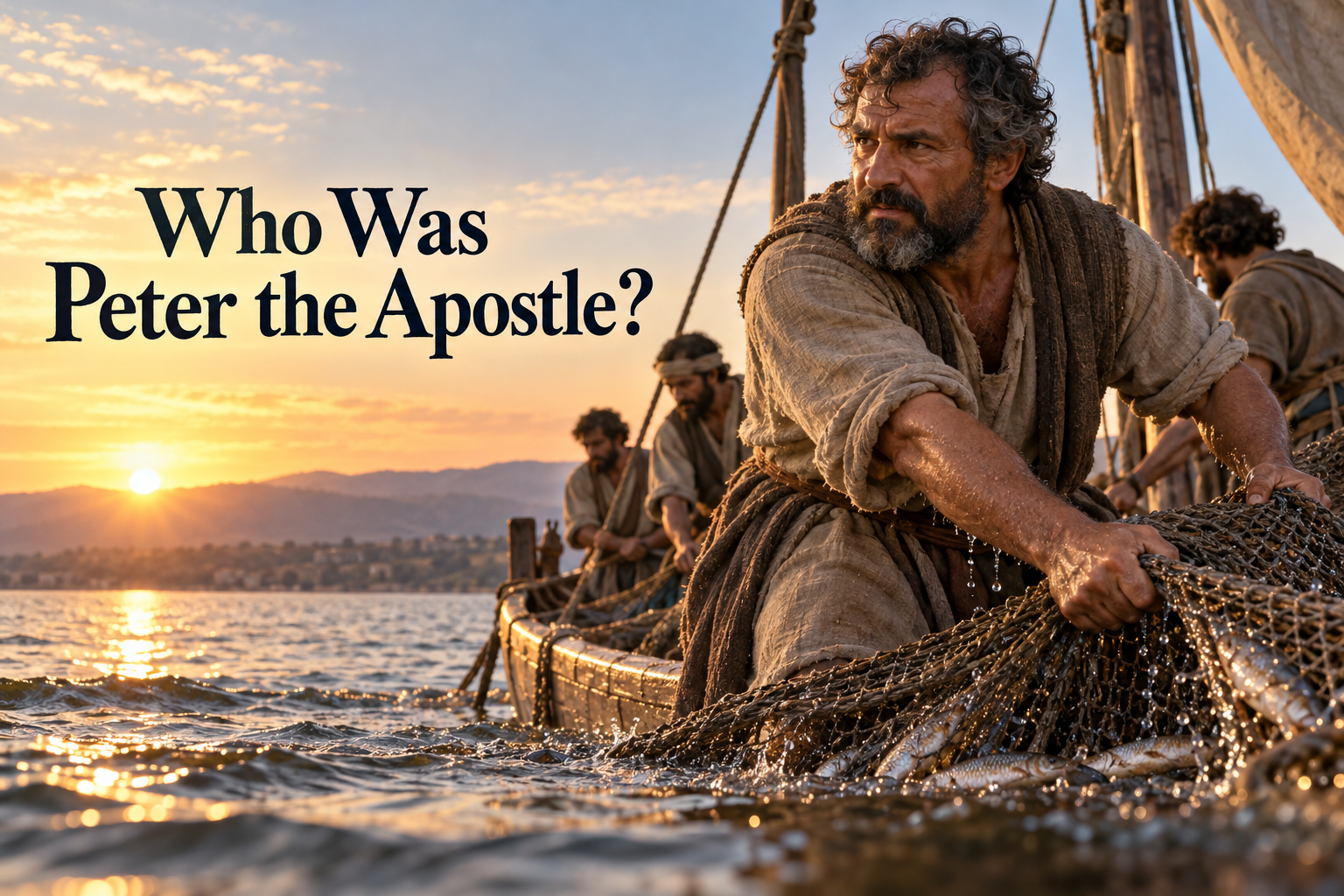
Peter is the most visible disciple in the Gospels and the leading apostolic voice in the opening chapters of Acts. He leaves his nets, walks briefly on water, confesses Jesus as Messiah, rebukes Jesus for speaking of the cross, promises loyalty, denies him three times, and is restored. The New Testament does not polish those contradictions away. Peter becomes a shepherd of the church precisely as a man who knows both brave faith and humiliating failure.
Simon the fisherman
Peter’s original name was Simon, a common Jewish name. He was the son of John or Jonah and the brother of Andrew. Jesus gave him the Aramaic name Cephas, translated into Greek as Petros, or Peter, both carrying the idea of rock (John 1:40–42). The nickname became so familiar that readers can forget it began as a word spoken over a man whose stability was still developing.
Simon came from Bethsaida and worked as a fisherman on the Sea of Galilee. He later had a house in Capernaum, where Jesus healed his mother-in-law, so Peter was married (Mark 1:29–31). Paul later refers to Cephas traveling with a believing wife, though he does not name her (1 Corinthians 9:5). Scripture gives no further reliable biography of her.
John portrays Andrew bringing Simon to Jesus, while the Synoptic Gospels emphasize Jesus calling the brothers from their nets. Luke expands the scene with a miraculous catch that leaves Simon confessing his sinfulness. Jesus tells him not to fear because from then on he will catch people (Luke 5:1–11). The accounts highlight different moments or narrative emphases; they need not be forced into one compressed conversation.
First to speak, quick to stumble
Peter became part of the inner group with James and John. He witnessed Jairus’s daughter raised, Jesus’ transfiguration, and the agony in Gethsemane. He frequently spoke for the Twelve, which shows leadership but not always understanding. Peter’s mouth often arrived a few seconds before his theology.
When Jesus walked on the sea, Matthew says Peter asked to come to him. He stepped from the boat and walked toward Jesus before fear took over and he began to sink. Jesus caught him and challenged his little faith (Matthew 14:28–31). The episode is neither a simple triumph nor a cheap joke about failure. Peter alone got out of the boat, and Peter still needed rescue.
At Caesarea Philippi, Peter confessed Jesus as the Messiah, the Son of the living God. Jesus called him blessed and spoke of the rock on which he would build his church, giving him the keys of the kingdom (Matthew 16:13–19). Catholics understand this as foundational for Peter’s unique primacy and the papal office. Orthodox Christians affirm Peter’s leading place but reject later universal papal jurisdiction, while Protestants commonly identify the rock as Peter’s confession, Christ, or Peter in his apostolic role without accepting later claims for papal succession.
The text can recognize Peter personally without settling every later argument about church government. Jesus immediately spoke of suffering and death, and Peter rebuked him. Jesus answered, “Get behind me, Satan,” because Peter was thinking in human rather than divine terms (Matthew 16:21–23). The man called rock could become a stumbling block when he tried to separate Messiahship from the cross.
At the transfiguration, Peter offered to build three shelters for Jesus, Moses, and Elijah. Mark explains that he did not know what to say because they were terrified. The divine voice redirected attention to Jesus: “Listen to him” (Mark 9:2–8). Peter later appealed to the event as eyewitness testimony to Christ’s majesty (2 Peter 1:16–18), though authorship of 2 Peter is debated.
The night of denial
At the Last Supper, Peter resisted Jesus washing his feet, then demanded that Jesus wash his hands and head as well. Jesus corrected both reactions. Peter also promised to lay down his life, and Jesus predicted that he would deny him three times before the rooster crowed (John 13:6–10; 13:36–38). Sincerity was not the same as self-knowledge.
In Gethsemane, Peter slept when Jesus asked him to watch and pray. During the arrest, John identifies him as the disciple who cut off the right ear of Malchus, the high priest’s servant. Jesus commanded him to put away the sword and healed the wounded man (John 18:10–11; Luke 22:50–51). Peter was willing to fight for Jesus and unprepared to follow Jesus’ chosen way.
Peter followed into the high priest’s courtyard and denied knowing Jesus three times. Luke says Jesus turned and looked at him after the final denial. Peter remembered the warning and wept bitterly (Luke 22:54–62). The Gospels do not soften the failure of a future leader or blame the servants who recognized him.
After the resurrection, Jesus appeared personally to Cephas according to Paul (1 Corinthians 15:5). John 21 narrates a public restoration beside another miraculous catch. Three times Jesus asked whether Peter loved him and three times commissioned him to feed or tend his sheep (John 21:15–19). The repetition addresses the denial without trapping Peter forever inside it.
Peter in Acts
Peter led the believers as they waited for the Holy Spirit and guided the replacement of Judas. At Pentecost he interpreted the outpouring through Joel, proclaimed Jesus’ resurrection and lordship, and called the crowd to repent and be baptized (Acts 2:14–41). The fisherman who denied Jesus before a small courtyard audience now spoke openly in Jerusalem.
Peter and John healed a man unable to walk at the temple gate, then refused to stop speaking about Jesus when the council threatened them. Peter insisted that salvation is found in no other name (Acts 3:1–26; 4:1–20). His boldness came through the Spirit, not a late discovery that he had always been fearless.
The deaths of Ananias and Sapphira after lying about a gift form one of Acts’s hardest episodes. Peter exposed their deception, but the text attributes their deaths to immediate divine judgment rather than saying Peter executed them (Acts 5:1–11). The passage warns against hypocrisy in a Spirit-formed community; it does not authorize church leaders to punish financial dishonesty with violence.
In Samaria, Peter and John prayed for baptized believers to receive the Holy Spirit and confronted Simon Magus when he tried to buy spiritual authority. Peter later healed Aeneas and raised Tabitha in Joppa (Acts 8:14–24; 9:32–43). These signs echoed Jesus’ ministry and served the gospel rather than establishing Peter as an independent wonder-worker.
Cornelius and the Gentile mission
Peter’s encounter with Cornelius transformed his understanding of the mission. In a vision he saw animals considered unclean and was told not to call impure what God had cleansed. The immediate application was people: Peter entered a Gentile home and confessed that God shows no partiality (Acts 10:9–35). The Holy Spirit fell before the visitors were baptized, forcing Jewish believers to recognize God’s initiative.
Peter defended the decision in Jerusalem by recounting what God had done. Later, at the Jerusalem council, he argued that Gentiles should not be burdened with the full Mosaic yoke as the condition of salvation because God cleansed their hearts by faith (Acts 11:1–18; 15:7–11). Peter’s authority functioned through testimony and discernment within the gathered church, not by preventing discussion.
Peter still struggled to live consistently with that insight. In Antioch, he withdrew from table fellowship with Gentiles when visitors associated with James arrived. Paul confronted him publicly because his conduct did not align with the gospel (Galatians 2:11–14). The episode shows apostolic authority without apostolic impeccability. Peter could teach a truth, defend it, and then act from fear in a way that undermined it.
Prison, departure, and letters
Herod Agrippa I imprisoned Peter after executing James son of Zebedee. An angel led Peter from the prison while the church prayed, and he arrived at the house of Mary, mother of John Mark. He told believers to report the escape to James and then went to another place (Acts 12:1–17). Acts shifts attention increasingly toward Paul and does not provide a continuous itinerary for Peter afterward.
First Peter presents itself as written by Peter from “Babylon,” commonly understood as a coded reference to Rome, with Silvanus involved in its transmission. It addresses suffering believers and repeatedly joins Christian hope with holy conduct. Many scholars accept Petrine authorship or substantial Petrine origin, while others date the letter later and view it as written in his name. The letter’s polished Greek and historical setting feature in the debate; the use of a skilled secretary is one traditional response.
Second Peter also names Peter but has faced stronger authorship doubts since antiquity because of style, relationship to Jude, and apparent perspective on the apostolic generation. Conservative scholars continue to defend its authenticity, sometimes emphasizing different scribal assistance or occasion. The traditional attribution deserves serious consideration, while modern doubts deserve a fair hearing rather than being dismissed as attempts to avoid apostolic teaching.
Death in Rome and later tradition
Jesus told Peter that when he was old others would stretch out his hands and take him where he did not want to go. John interprets this as indicating the kind of death by which Peter would glorify God (John 21:18–19). The verse implies martyrdom but does not name Rome, Nero, or the exact method.
First Clement, written from Rome near the end of the first century, remembers Peter enduring suffering and martyrdom. Later second-century testimony locates the deaths of Peter and Paul at Rome, and the tradition became widespread without an ancient rival location. Peter’s martyrdom in Rome under Nero is therefore historically strong early Christian tradition, though the New Testament does not narrate it.
The detail that Peter requested crucifixion upside down appears in the later Acts of Peter and is quoted by Origen in a tradition preserved by Eusebius. It may preserve real memory, but it is not as early or secure as the basic Roman martyrdom tradition. Claims about exact prison cells, chains, and footprints belong to still later devotion.
Archaeology beneath St. Peter’s Basilica has revealed an early Roman burial area and a site venerated as Peter’s tomb. The evidence demonstrates ancient commemoration at that location, but identifying surviving bones as Peter’s is disputed and cannot be established with certainty. Veneration and forensic identification are different claims.
Peter’s lasting place
Peter was not the church’s savior, and the New Testament takes care to show it. Christ called him, rescued him, corrected him, prayed for him, restored him, and entrusted sheep to him. Peter’s authority was substantial but derivative. When Cornelius bowed, Peter made him stand because he too was only human (Acts 10:25–26).
His life refuses two easy readings. Peter’s failures do not make leadership meaningless, and his leadership does not make failure harmless. He becomes dependable not by discovering an invulnerable personality but by learning to depend on grace and the Spirit. The rock is a forgiven disciple who finally follows Jesus down the road he once promised to walk by his own strength.