
Who Was Matthew the Apostle?
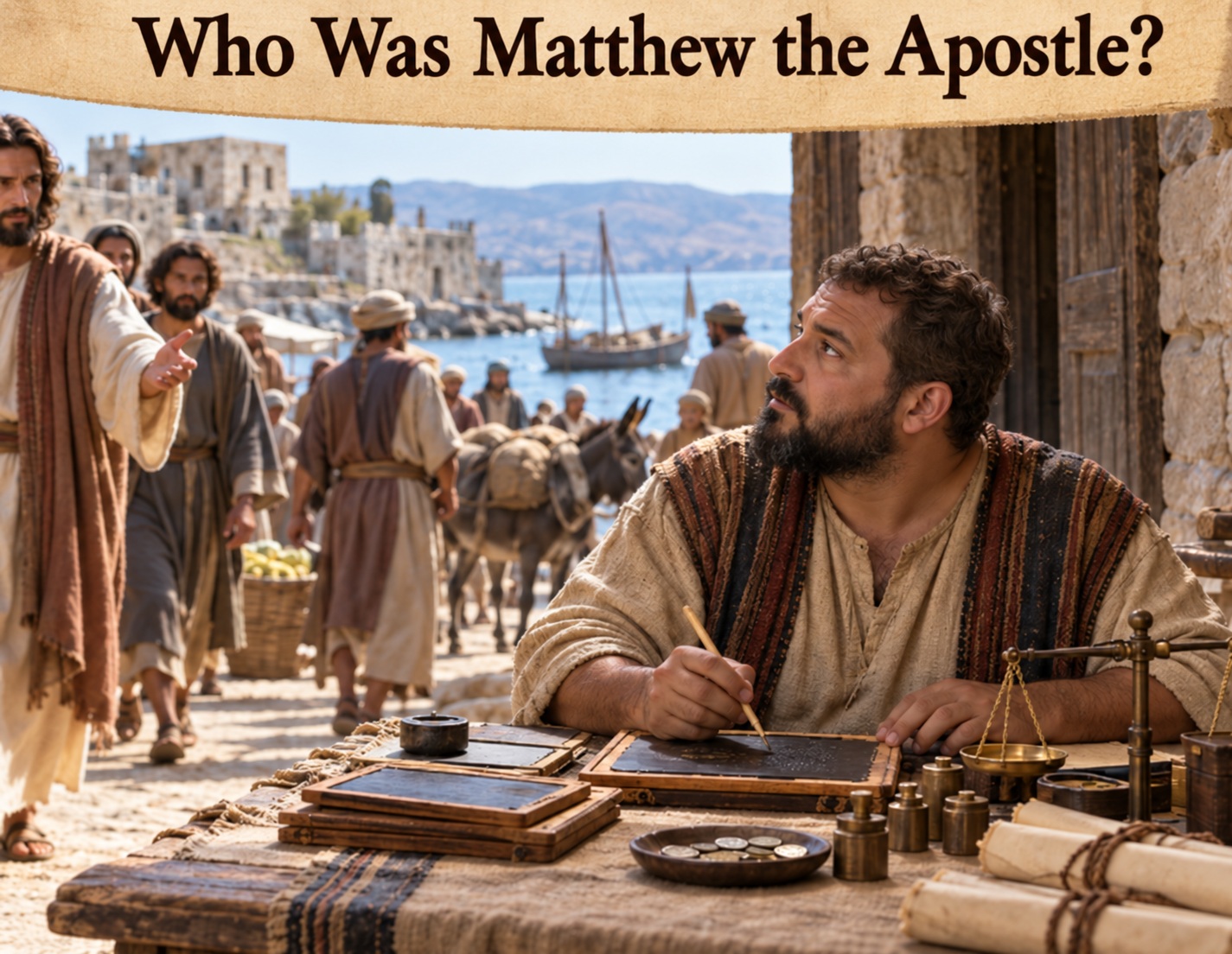
Matthew was one of the Twelve and is traditionally identified as the tax collector who became the author of the Gospel bearing his name. The New Testament says surprisingly little about his later life. Even his relationship to Levi, the tax collector named in Mark and Luke, requires interpretation. The early and widespread Matthew tradition deserves serious consideration, even though the Gospel does not explicitly identify its author.
The tax collector Jesus called
Matthew’s Gospel says Jesus saw a man named Matthew sitting at the tax booth and commanded him to follow. Matthew rose and followed him (Matthew 9:9). Mark and Luke narrate a nearly identical call but name the man Levi; Mark also identifies him as a son of Alphaeus (Mark 2:13–14; Luke 5:27–28). All three then describe a meal with tax collectors and sinners.
Christian tradition usually identifies Matthew and Levi as the same person with two names, like Simon Peter or Saul Paul. The close narrative parallels support that conclusion. Yet no Gospel explicitly says, “Levi was also called Matthew,” and the apostolic lists name Matthew without Levi. Some scholars therefore suggest Matthew’s Gospel transferred Levi’s call story to the apostle Matthew. The traditional identification is plausible and ancient, not an indisputable statement of the text.
Tax collectors in Galilee worked within a system tied to Herodian and Roman revenue. The precise job at this booth may have involved tolls on goods and travel rather than direct collection of every imperial tax. Such officials were resented because the system served ruling powers and invited overcollection. Luke’s separate account of Zacchaeus shows that abuse was common enough to require restitution, though Scripture does not accuse Matthew personally of a specific fraud.
Leaving the booth meant more than walking away from a desk. Fishermen might return to boats, but an official who abandoned a revenue post could not assume the position would wait. The Gospels do not calculate Matthew’s financial loss, yet the call involved a decisive break with an occupation that had defined his public identity.
A meal and a controversy
Matthew says Jesus reclined at a meal with many tax collectors and sinners. Luke says Levi gave a great banquet in his house, which supports identifying the host with the called tax collector even though Matthew’s wording is less explicit (Matthew 9:10–13; Luke 5:29–32). The meal became a visible sign of Jesus’ mission.
Pharisees asked why Jesus ate with such people. Jesus answered that the healthy do not need a physician but the sick, then quoted Hosea: God desires mercy rather than sacrifice. He had come to call sinners, not the righteous. The statement does not mean some people need no repentance; it confronts those who cannot recognize their own need while objecting to grace offered to others.
Matthew’s calling therefore should not become a story about Jesus endorsing corrupt systems. Fellowship opened a path to repentance and discipleship. Jesus welcomed the tax collector and also called him away from the booth. Mercy and transformation belong together.
Matthew among the Twelve
The apostolic lists include Matthew, and Matthew’s own list calls him “the tax collector” (Matthew 10:2–4). The description may reflect humility, historical memory, or simply identification. The other lists name Matthew without the occupation. No canonical narrative records an individual speech, miracle, or later journey by him.
Matthew shared the mission of the Twelve, receiving authority to heal and proclaim that God’s kingdom had drawn near. He also shared their misunderstandings, flight at Jesus’ arrest, and later resurrection commission. Matthew 28 records Jesus sending the disciples to make disciples of all nations, baptize, and teach obedience (Matthew 28:16–20). Whether Matthew personally composed the scene or stands behind the Gospel does not change that he belonged to the commissioned group.
Acts lists Matthew among the apostles praying in Jerusalem after the ascension (Acts 1:12–14). He then disappears by name. The silence prevents a canonical map of his mission. Later traditions try to supply one, but they disagree widely.
Did Matthew write the Gospel of Matthew?
The Gospel itself is formally anonymous. Its narrative never steps forward to say that Matthew wrote it, and the title “According to Matthew” belongs to the early manuscript tradition rather than the body of the text. This does not make the title meaningless. Gospel titles appear early and consistently, with no competing author attached to this book in surviving church tradition.
Papias of Hierapolis, writing in the early second century and quoted later by Eusebius, said Matthew arranged or compiled the logia in the Hebrew dialect, and each interpreted them as able. The statement is the earliest surviving attribution associated with Matthew. Its meaning is debated: logia may refer to sayings, oracles, or a Gospel-like account, while “Hebrew dialect” may mean Hebrew or Aramaic language.
The surviving Gospel of Matthew is a polished Greek work and shows extensive literary relationship with Mark. Most modern scholars believe it used Mark as a source, alongside other traditions. They therefore question whether Papias was describing our Gospel in its present form or another collection connected with Matthew. Many conclude that the canonical Gospel was written anonymously by a Jewish Christian author or community in the late first century.
Defenders of traditional authorship respond that an apostle could use sources, write in Greek, or work through scribes, and that Papias and the unanimous ancient title deserve substantial weight. Some propose that Matthew first collected sayings in a Semitic language and later composed or contributed to the Greek Gospel. This is possible but cannot be demonstrated from a surviving Hebrew Matthew, since no agreed original Semitic version exists.
The responsible conclusion is not that tradition is worthless or that doubt is faithless. Matthew’s authorship has early external support and remains defensible, but the internal evidence does not make it certain. The Gospel’s authority as Scripture rests on God’s inspiration and the church’s reception of the canonical text, not on overstating what can be proven about its final writer.
The Gospel associated with Matthew
The First Gospel emphasizes Jesus as Messiah, Son of David, new Moses, authoritative teacher, and fulfillment of Israel’s Scriptures. Five large teaching sections give the book a carefully ordered shape, though interpreters debate whether they deliberately echo the five books of Moses. The Gospel joins Israel’s story with a mission to all nations rather than treating the church’s Gentile mission as rejection of everything Jewish.
Its sharp disputes with scribes and Pharisees reflect an intense Jewish argument over Scripture, authority, and faithfulness. Christians have sometimes ripped those passages from their first-century setting and used them to justify contempt for Jews. That is a misuse. Jesus, Matthew, the apostles, and the earliest disciples were Jewish, and the Gospel’s polemic is an internal and developing conflict, not permission for antisemitism.
The Gospel also displays special concern for righteousness, mercy, the kingdom of heaven, discipleship, and the church. It alone uses the Greek word commonly translated “church” in the Gospels. If the apostle Matthew stands behind the work, the former revenue official became a meticulous teacher of Jesus’ commands. If another early Jewish Christian shaped the final text, the canonical achievement remains the same.
Mission and martyrdom traditions
Early and medieval sources assign Matthew missionary work in various places, including Judea, Ethiopia, Persia, Parthia, and regions around the Black Sea. “Ethiopia” in ancient texts can refer broadly to lands south of Egypt and is not always the modern nation. The conflicting itineraries make it impossible to reconstruct a secure route.
Traditions also disagree over Matthew’s death. Some say he died naturally, while others make him a martyr by sword, spear, fire, or other means in different locations. The New Testament says nothing about his death. A confident account of exactly how and where he was martyred would choose among legends without adequate historical grounds.
The apocryphal Acts and Martyrdom of Matthew contain imaginative narratives that influenced devotion and art. They should be studied as later Christian literature, not as eyewitness continuation of Acts. Relic claims in Salerno and elsewhere likewise testify to veneration rather than provide certain identification.
Matthew’s legacy
The securely known Matthew is a tax collector called by Jesus, one of the Twelve, and a witness within the resurrection community. That is less information than later biographies prefer, but it is not insignificant. Jesus chose a man identified with an unpopular revenue system and placed him in a group that also included Simon the Zealot. The kingdom created a fellowship no ordinary political movement would have assembled.
Matthew’s traditional connection with the Gospel has shaped Christianity beyond calculation. The Sermon on the Mount, the Lord’s Prayer, the Great Commission, and many of Jesus’ parables have reached generations through this book. Historical honesty about authorship does not require detachment from that legacy.
Matthew rose from the booth when Jesus called. Whether he personally wrote every line attributed to him or his testimony stands at an earlier point in the Gospel’s history, the movement of his life is clear enough. Mercy met him in a compromised occupation, brought him to a table with Jesus, and sent him into a mission defined by making disciples rather than collecting revenue.