
Who Was Judas Iscariot?
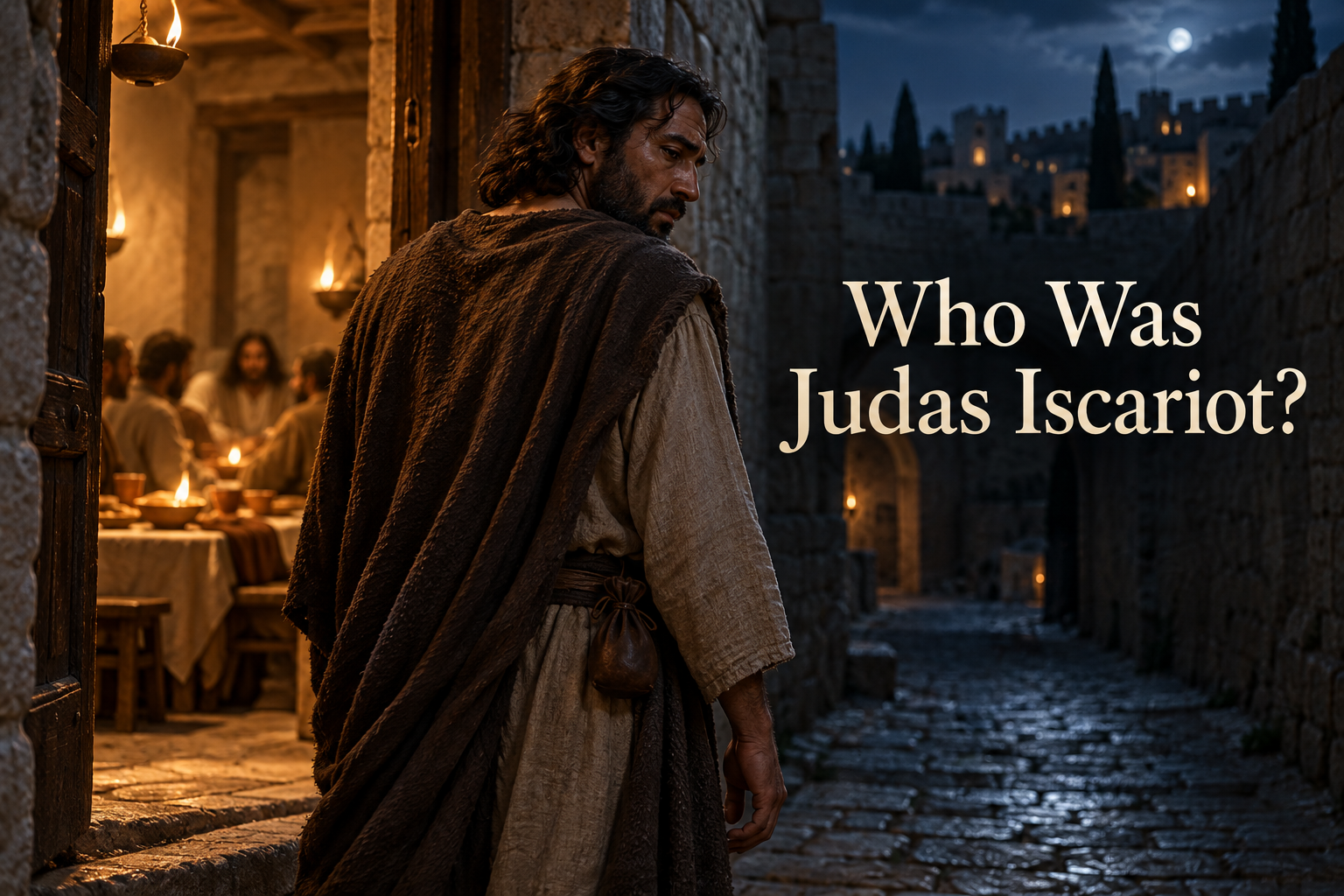
Judas Iscariot was one of Jesus’ twelve apostles and the disciple who handed him over to the authorities. His name became a synonym for betrayal, but familiarity can make the story seem simpler than the Gospels allow. Judas was chosen, traveled with Jesus, participated in the group’s ministry, shared meals with him, and then made a deliberate choice that helped set the arrest in motion. Scripture neither excuses that choice nor turns Judas into a cartoon villain who was never truly part of the circle.
He must be distinguished from other men named Judas in the New Testament. Another apostle is called Judas son of James, and Jesus had a brother named Judas, usually rendered Jude in English. Judas Iscariot is consistently marked by the surname or descriptor “Iscariot” and by his role as betrayer. The meaning of Iscariot is uncertain. “Man of Kerioth” is a common proposal, but connections with assassins, falsehood, or an Aramaic word for a red-colored person remain disputed.
Chosen Among the Twelve
Each Gospel names Judas among the Twelve, usually adding that he betrayed Jesus (Mark 3:13-19). That placement creates an uncomfortable fact: the betrayer wasn’t merely an outsider who slipped past Jesus’ defenses. He belonged to the appointed group, heard the teaching, and was present as the disciples were sent to preach and exercise authority. The texts don’t isolate him from every shared experience before the final week. His later treachery is terrible partly because real trust preceded it.
The Gospels give almost no family background. John calls him “Judas son of Simon Iscariot,” but nothing further is securely known about Simon or their home (John 6:70-71). We don’t know Judas’s trade, age, marital status, or political program. Popular portraits sometimes make him a disappointed revolutionary who wanted to force Jesus into armed action. That theory is possible as imaginative psychology, but no Gospel says it was his motive.
Money and the Common Purse
John says Judas kept the group’s money box. During a meal at Bethany, Mary anoints Jesus with costly perfume, and Judas objects that it could have been sold and the proceeds given to the poor. John comments that Judas didn’t care about the poor but was a thief who stole from the common funds (John 12:1-6). That is the narrator’s moral judgment, not a conclusion we can independently verify from financial records. Within John’s portrait, greed was already corrupting Judas before the betrayal.
The Synoptic Gospels don’t mention theft from the purse, but Matthew connects the betrayal explicitly with payment. Judas asks the chief priests what they will give him, and they count out thirty pieces of silver (Matthew 26:14-16). Matthew later links the money with scriptural themes from Zechariah, although interpreters debate the exact relationship among the texts he cites. The amount shows that Judas’s choice had an economic dimension, but the Gospels don’t reduce his interior motive to one tidy explanation.
Money may have mattered alongside disappointment, fear, resentment, or spiritual hardening. Luke and John also say Satan entered Judas. That language places the betrayal within a larger conflict with evil, but it doesn’t erase Judas’s agency or make demonic influence an excuse (Luke 22:1-6). The Gospels continue to describe him as acting, planning, receiving payment, and leading the arresting party. Human responsibility and spiritual evil are presented together.
The Betrayal at the Meal
At the final meal, Jesus announces that one of the Twelve will betray him. The disciples are grieved and ask whether they might be the one, a response that refuses to make Judas look obviously monstrous across the table. In Matthew, Judas also asks, “Surely not I, Rabbi?” and Jesus answers indirectly (Matthew 26:20-25). John depicts Jesus giving Judas a morsel and telling him to do quickly what he is going to do (John 13:21-30). The others misunderstand, apparently because Judas’s role with the money box still makes an ordinary errand plausible.
The Gospel accounts differ in details of the meal and the moment Satan enters Judas, but they agree that Jesus knew betrayal was coming and that Judas acted from within the intimate circle. Divine foreknowledge doesn’t make betrayal morally approved or Judas a puppet with no meaningful choice. Biblical writers often hold God’s purpose and human accountability together without explaining the mechanics. God brings salvation through the cross, but treachery, false testimony, torture, and execution remain evil acts.
Some readers ask whether Judas participated in the Lord’s Supper. The chronology and meal details vary enough among the Gospels that confident sacramental conclusions are difficult. Luke narrates the cup and bread before the betrayal discussion, while John doesn’t narrate the institution of the meal in the same form. The texts are more interested in the shock of betrayal at Jesus’ table than in answering later debates about precisely when Judas departed.
The Kiss in Gethsemane
Judas knows where Jesus and the disciples gather. He leads an armed group to the garden and identifies Jesus with a kiss, a conventional sign of greeting turned into a signal for arrest (Mark 14:43-46). Jesus doesn’t resist arrest by organizing violence, and he stops his followers from making the kingdom another armed faction. Judas’s action is therefore not heroic assistance to a plan Jesus secretly asked him to perform. The Gospels consistently condemn it as betrayal.
That point matters because some modern retellings recast Judas as the only disciple who truly understood. A later text called the Gospel of Judas portrays him in a very different theological framework, but it was written generations after the events and wasn’t authored by Judas Iscariot. It offers evidence about some second-century Christian debates, not eyewitness correction of the canonical passion narratives. Historical fairness does not require treating late, incompatible portraits as equally early sources.
Remorse and Death
Matthew says Judas saw that Jesus was condemned, regretted what he had done, returned the silver, confessed that he had betrayed innocent blood, and hanged himself (Matthew 27:3-5). The chief priests refuse responsibility for the money and use it to buy the potter’s field as a burial place for foreigners. Matthew calls it the Field of Blood and reads the episode through prophetic Scripture (Matthew 27:6-10). Judas’s remorse is real in the narrative, but Matthew doesn’t describe him seeking help from the disciples or living toward restoration.
Acts gives a different account while explaining the need to replace him. It says Judas acquired a field with the reward of wickedness, fell headlong, and suffered a gruesome death; the field became known as the Field of Blood (Acts 1:15-20). Readers have proposed harmonizations in which the rope or branch failed after the hanging and the priests bought the field with Judas’s money. That is possible, but neither Matthew nor Acts supplies the combined sequence. Honest interpretation should acknowledge distinct emphases rather than claiming the texts narrate the death identically.
The differences don’t change their shared judgment: Judas’s betrayal ended in horror, shame, and death, and the money became attached to a blood-stained place. His suicide shouldn’t be romanticized as noble payment for sin or used to speak carelessly about people who die by suicide now. The narratives don’t provide a clinical account of his mental state, and his act doesn’t heal the damage he caused. Christian care for suicidal despair must move toward protection, treatment, mercy, and the possibility Judas could no longer imagine.
Was Judas Predestined to Be Lost?
Jesus speaks of Scripture being fulfilled and calls the betrayer the “son of destruction” in John’s prayer (John 17:12). Acts likewise interprets Judas’s vacancy through the Psalms. Some theologians conclude that Judas was individually predestined to betrayal and condemnation; others argue that foreknowledge and fulfillment don’t remove the genuine contingency of his decisions. The texts affirm both fulfillment and guilt, but they don’t offer a philosophical explanation of freedom and providence.
Christians have also debated Judas’s final destiny. Jesus’ severe words give no basis for casual optimism, and the New Testament never reports his repentance in the fuller sense of returning to God and the community. Yet assigning any person’s eternal sentence remains God’s prerogative. We can say what the texts say about his ruin without pretending we possess the judgment seat.
History and Later Memory
No contemporary non-Christian record independently identifies Judas Iscariot. Our earliest sources are Christian: Paul refers to Jesus being “handed over” but doesn’t name Judas, while the Gospels and Acts provide the personal narrative. Whether Paul’s wording refers primarily to Judas, human authorities, divine self-giving, or several layers at once is debated. Historical reconstruction therefore depends mainly on the Gospel tradition.
Later legends multiplied punishments, family stories, and explanations for Judas’s character. Some medieval Christians also used Judas as a vehicle for anti-Jewish caricature. That is a serious distortion: Judas was Jewish, but so were Jesus, the other apostles, and the first believers. His personal betrayal can’t justify blaming the Jewish people, then or now, for Jesus’ death.
The Warning Inside the Circle
Judas remains frightening because he was close enough to know better. He heard Jesus, received responsibility, and could perform the gestures of discipleship while moving toward betrayal. The story warns against imagining that proximity to holy things automatically produces a faithful heart. Office, access, and public ministry can coexist with concealed greed and destructive choices.
Yet Judas isn’t the dark force that defeats Jesus. His act is wicked, but it cannot overturn God’s saving purpose. The cross exposes what betrayal and power do to the innocent, while the resurrection declares that such violence won’t have the final word. His story calls for honesty without excuses, sensationalism, or hatred: a chosen disciple betrayed his Lord, remorse did not become restoration, and his end shows how terrible sin becomes when hope is abandoned.