
Who Was Matthias the Apostle?
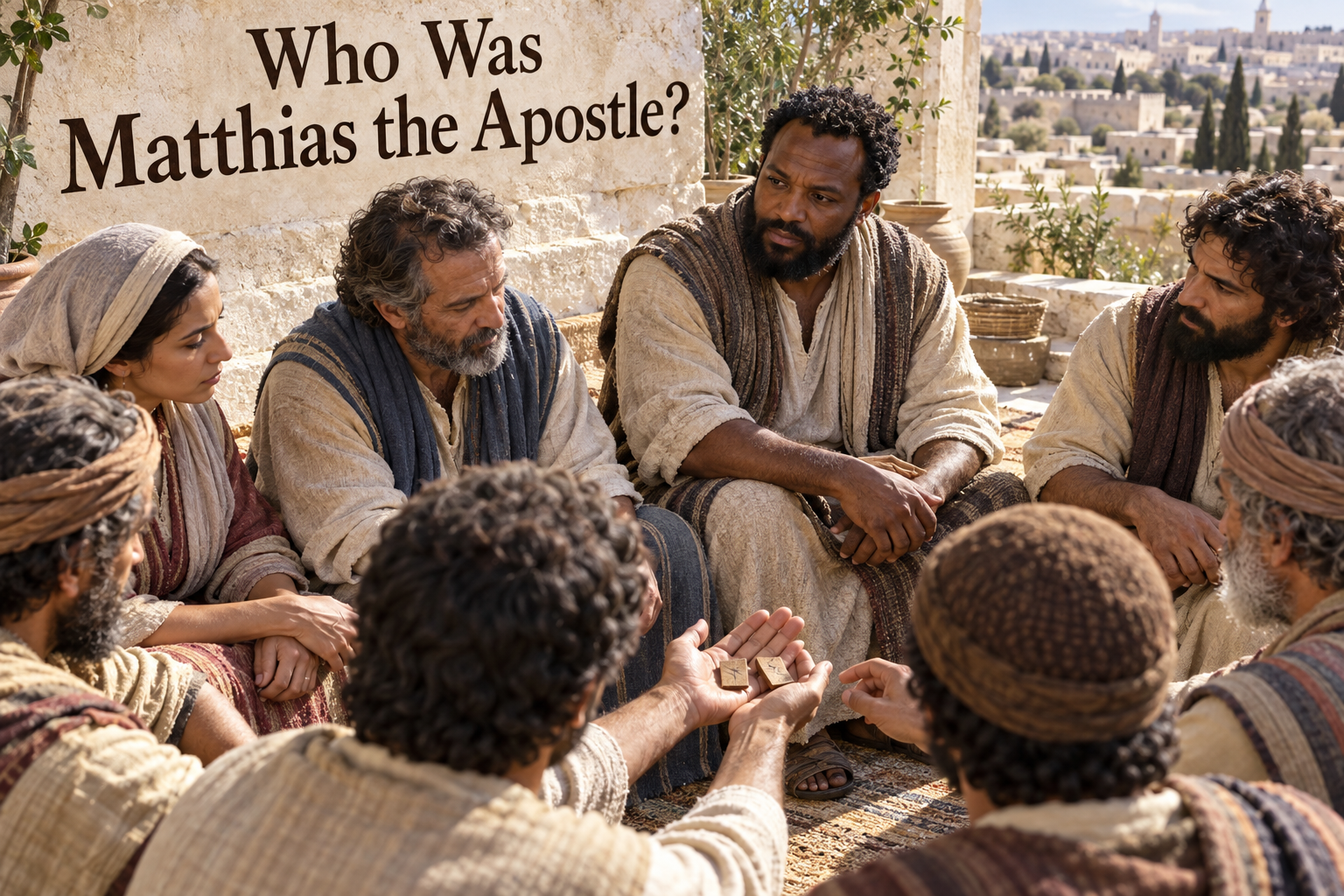
Matthias was chosen to take Judas Iscariot’s place among the Twelve after Jesus’ ascension and before Pentecost. His selection occupies a compact scene in Acts, and the New Testament never mentions him by name again. That silence has made Matthias easy to dismiss as an administrative footnote or even as the apostles’ mistaken choice before Paul arrived. Acts presents him differently: he was a long-term witness to Jesus, prayerfully selected, and counted with the eleven apostles.
Matthias shouldn’t be confused with Matthew, the tax collector traditionally associated with the first Gospel. Their names look similar in English, but Acts treats Matthias as a separate man. Nor was he one of the original Twelve named during Jesus’ ministry. He belonged to the wider circle of disciples and became one of the Twelve only after Judas’s death created a vacancy.
Why Replace Judas?
Acts opens with the risen Jesus teaching his followers and promising the Holy Spirit. After the ascension, about 120 believers gather in Jerusalem, including the eleven remaining apostles, women who had followed Jesus, Mary his mother, and his brothers. Peter then addresses the problem left by Judas’s betrayal and death (Acts 1:12-20). The concern isn’t merely that the group is short-staffed. The Twelve carry symbolic weight connected with Israel’s twelve tribes and the renewed people Jesus was forming.
Peter reads Judas’s fall through two psalms, one concerning a desolate dwelling and another calling for someone else to take an office. The application is apostolic interpretation, not the plain historical subject of the original psalms. Early Christians believed Israel’s Scriptures found fuller patterns of fulfillment in Jesus and the community formed around him. Recognizing that interpretive method is more honest than pretending the psalmist named Judas centuries in advance.
The decision takes place before Pentecost, but Acts gives no hint that acting before the Spirit’s outpouring made it illegitimate. The group is already obeying Jesus by waiting in Jerusalem, and prayer frames the choice. The Spirit’s later arrival empowers the restored Twelve rather than overturning their action. Claims that the apostles should have waited for Paul are arguments from silence, not Luke’s assessment of the scene.
The Qualifications for the Vacancy
Peter says the replacement must have accompanied the disciples throughout Jesus’ public ministry, from John’s baptism until the ascension, and must become a witness to the resurrection (Acts 1:21-22). Those requirements explain why readers haven’t encountered Matthias earlier. Many disciples traveled in the wider company without receiving individual stories in the Gospels. Matthias’s qualification rested on sustained presence, not sudden prominence.
The phrase “from the baptism of John” probably marks the opening period of Jesus’ ministry, not necessarily that Matthias witnessed the exact moment of Jesus’ baptism. “Witness to the resurrection” involves more than knowing a doctrine. The candidate needed to belong to the group that could testify to continuity between Jesus’ ministry, death, resurrection, and ascension. Apostolic witness in Acts is public testimony grounded in experienced events.
Two men meet the stated standard: Joseph called Barsabbas, also known as Justus, and Matthias. We know even less about Joseph than about the man selected. The community’s willingness to put both forward suggests that neither was an obvious token candidate. Acts doesn’t say Matthias won a campaign or possessed a more impressive personality. Both had the history; the final choice was entrusted to God.
Prayer, Lots, and Selection
The believers pray to the Lord who knows everyone’s heart and ask him to show which man he has chosen. They then cast lots, and the lot falls to Matthias, who is added to the eleven apostles (Acts 1:23-26). Casting lots had Old Testament precedents for distributing responsibilities or discerning a decision. It wasn’t presented as gambling for private gain. In this setting, it follows clear qualifications, communal nomination, and prayer.
Acts doesn’t explain the physical method. Marked stones, tablets, or other objects may have been used, but a precise reconstruction would be guesswork. More importantly, this is the last New Testament scene in which lots are used to select a church leader. The narrative doesn’t command every congregation to imitate the method, just as it doesn’t condemn later discernment involving discussion and appointment.
Some Christians have argued that choosing Matthias was a well-intentioned error and that Jesus meant Paul to be the twelfth apostle. That view doesn’t fit Acts’s wording. Luke says Matthias “was counted with the eleven,” and the next chapter presents Peter standing “with the eleven,” a total of twelve (Acts 2:14). Paul later defends his own apostleship, but neither he nor Acts says he displaced Matthias. The New Testament can use “apostle” more broadly than the Twelve, so Paul’s calling doesn’t require Matthias’s rejection.
Matthias and Paul
Paul’s apostleship rests on the risen Christ’s call and his commission to the Gentiles. He didn’t accompany Jesus from John’s baptism through the ascension, so he wouldn’t have met the specific qualifications for Judas’s place. Paul calls himself one “untimely born” after listing resurrection appearances to Cephas, the Twelve, and others (1 Corinthians 15:3-9). His language distinguishes his unusual calling without treating the Twelve as a closed definition of every apostle.
Barnabas is also called an apostle in Acts, and Paul names other commissioned workers with apostolic language. The term can refer narrowly to the Twelve or more broadly to authorized messengers, depending on context. Matthias belongs to the restored Twelve; Paul belongs to the wider apostolic mission with a singular calling. Making them rivals imposes a contest the sources don’t create.
Why Does Matthias Disappear?
After his selection, Matthias receives no individual scene. That doesn’t mean he immediately failed or vanished from Christian service. Most of the Twelve also recede as Acts concentrates first on Peter and then on Paul. Narrative attention isn’t a ranking of faithfulness. Luke tells the story of the gospel’s movement toward Rome, not a complete biography of every apostle.
Matthias may be included whenever Acts refers collectively to “the apostles,” but he isn’t individually identified, so particular actions can’t be assigned to him with confidence. He would presumably have shared in the Spirit’s coming at Pentecost and in the community’s teaching and witness, since he had been counted among the Twelve. That is a reasonable narrative inference, not an explicit sentence saying where he stood or what he spoke. The distinction keeps a likely conclusion from becoming a quotation Acts never gives.
Mission and Martyrdom Traditions
Later Christian writers tried to complete Matthias’s story. Traditions sent him to Judea, Cappadocia, the region around the Caspian Sea, or Ethiopia, and accounts of his death range from peaceful death to stoning, beheading, or crucifixion. The locations sometimes depend on ancient geographic names that later readers understood differently. Their variety makes it impossible to construct one secure itinerary.
A work called the Acts of Andrew and Matthias places him in a fantastic land of cannibals before Andrew rescues him. It belongs to the world of later apocryphal adventure, not reliable first-century reporting. Another lost or fragmentary “Gospel of Matthias” is mentioned by ancient writers, but no surviving evidence shows Matthias authored a Gospel. Attaching an apostolic name was a common way for later texts to claim authority.
Churches in different places have also claimed relics of Matthias. Such claims are part of devotional history, but they can’t all be verified or reconciled. No known contemporary inscription independently confirms his mission or burial. The historically secure account remains Acts’s description of his qualifications and selection.
A Witness Chosen From the Wider Circle
Matthias matters because he reminds readers that Jesus’ movement was always larger than the few disciples whose conversations were recorded. He had apparently followed through the whole public ministry without becoming a leading character. When a trustworthy witness was needed, that quiet history became his qualification. Long faithfulness can prepare a person for responsibility without attracting earlier notice.
His selection also shows the church responding to failure without pretending the failure never happened. Judas’s betrayal left grief, scandal, and an empty place. The believers turned to Scripture, named sensible requirements, prayed, and moved forward. Matthias didn’t erase Judas’s history, and he didn’t need to become famous to validate his calling. Acts simply counts him with the eleven, then lets him serve beyond the edge of the page.