
Who Was Paul the Apostle?
Paul the apostle began as a zealous persecutor of the Jesus movement and became its most influential missionary to Gentiles. He traveled across the eastern Roman Empire, founded and advised churches, endured imprisonment and violence, and wrote letters that form a large part of the New Testament. Paul didn’t invent Christianity, replace Jesus, or single-handedly carry the gospel to the entire world. He joined a movement already announcing Jesus’ resurrection and spent the rest of his life arguing that Israel’s Messiah had opened God’s covenant blessings to the nations.
Reconstructing Paul requires care because our two main sources are different kinds of writing. Seven letters are accepted by nearly all scholars as authentically Pauline: Romans, 1 Corinthians, 2 Corinthians, Galatians, Philippians, 1 Thessalonians, and Philemon. Acts provides a sustained narrative written about Paul from another author’s perspective. The sources broadly agree on the dramatic reversal and Gentile mission, but their chronologies and emphases don’t always align neatly, so Paul’s own undisputed letters deserve priority for his self-description.
Saul, Paul, and His Jewish Identity
Acts first calls him Saul, a Jewish name shared with Israel’s first king, and later begins using Paul, his Roman name (Acts 13:9). Jesus doesn’t rename Saul on the Damascus road. A Jewish person operating in Greek- and Latin-speaking settings could use more than one name, and Acts simply shifts to the name appropriate for Paul’s wider mission. The popular contrast between “Saul the persecutor” and “Paul the Christian” makes a good slogan but poor biography.
Paul identifies himself as an Israelite, a descendant of Abraham, and a member of the tribe of Benjamin. He says he was circumcised on the eighth day and was a Pharisee whose zeal led him to persecute the church (Philippians 3:4-6). Acts adds that he was born in Tarsus and educated in Jerusalem under Gamaliel (Acts 22:1-3). It also says he possessed Roman citizenship (Acts 22:25-28). Historians debate how to fit every detail together, but nothing inherently prevents a diaspora-born Jew from receiving education in Jerusalem or holding citizenship.
Paul never describes accepting Jesus as abandoning Israel’s God. He believes the God of Abraham raised Israel’s Messiah and called him to announce that fulfillment among the nations. Even when he sharply criticizes reliance on Torah observance as the basis for Gentile inclusion, he continues to quote Israel’s Scriptures as authoritative. Calling his experience a “conversion” captures a radical change of allegiance and mission; calling it a prophetic “call” captures the continuity Paul himself emphasizes. Both terms can help if neither erases half the story.
Persecutor of the Church
Paul admits repeatedly that he persecuted the church of God and tried to destroy it (Galatians 1:13-14). Acts introduces Saul approving Stephen’s execution and then dragging believers from their homes (Acts 7:58; Acts 8:1-3). The letters don’t describe his exact methods, while Acts gives the narrative detail. Whatever the precise scope, Paul’s violence wasn’t imaginary rhetoric; it became the dark background against which he understood grace.
His persecution probably arose from zeal for Israel’s faithfulness rather than hostility toward religion. The claim that a crucified man was Messiah, the behavior of the new communities, and the widening welcome of Gentiles could all appear dangerous to someone guarding ancestral tradition. Explaining that motivation doesn’t excuse coercion. Paul later knew from the receiving end what religious violence does to bodies and communities.
The Risen Jesus and the Damascus Road
Paul’s own shortest account says God revealed his Son to him so that he might proclaim Christ among the Gentiles (Galatians 1:15-17). He also includes himself among those to whom the risen Jesus appeared, calling himself one untimely born (1 Corinthians 15:8-10). For Paul, the encounter was revelation, resurrection appearance, call, and mercy. It overturned both his judgment about Jesus and the direction of his zeal.
Acts narrates the event three times, with Paul traveling toward Damascus under authority to seize believers. A heavenly light, Jesus’ voice, Paul’s blindness, and the ministry of Ananias form the central account (Acts 9:1-19). The retellings differ in wording about what companions heard or saw and in how Paul’s commission is delivered. These are narrative variations of emphasis, not three separate conversions, but they shouldn’t be flattened into identical transcripts.
Ananias is easy to overlook. He receives a dangerous command to visit the persecutor, protests honestly, and then addresses him as “Brother Saul.” Acts doesn’t praise Paul’s suffering as payment sufficient to erase his victims’ pain. Grace interrupts his violence, makes him dependent on a member of the community he attacked, and redirects him toward service. The former persecutor will carry the name of Jesus through suffering rather than impose faith through force.
An Apostle to the Gentiles
Paul insists that his apostleship came through Jesus Christ, not human appointment. After his call he went into Arabia, returned to Damascus, and only after three years visited Jerusalem, where he met Cephas and James the Lord’s brother (Galatians 1:18-20). Acts arranges the early period differently and describes Barnabas introducing him to apostles in Jerusalem. The accounts may be reconcilable in broad outline, but Paul’s point is his commission’s independence, while Acts stresses connection with the existing church.
Barnabas later brings Saul into ministry at Antioch, a diverse congregation that becomes a base for mission. Acts depicts the Holy Spirit commissioning Barnabas and Saul, who travel through Cyprus and parts of Asia Minor, preaching first in synagogues and then to wider audiences (Acts 13:1-3). Paul’s letters confirm extensive work among Gentiles but rarely retell journeys as travel narrative. His goal was to plant communities where Christ was not yet named and let those communities embody a new allegiance.
Paul’s Gentile mission raised an urgent question: must non-Jews be circumcised and take on full Torah observance to belong to God’s people? Galatians records fierce opposition to requiring circumcision, because Paul believed Gentiles received the Spirit through faith in Christ. Acts 15 describes the Jerusalem Council, which also rejects circumcision as an entrance requirement while asking Gentiles to observe several practices. Scholars debate whether Acts’s meeting is the same visit Paul narrates in Galatians 2, but both sources show the issue was negotiated, not obvious from the beginning.
Grace, Faith, and the Law
Paul’s theology grew in the work of forming churches rather than in an abstract system. He proclaimed that people are justified by God’s grace through faith apart from “works of the law” and that boasting is excluded (Romans 3:21-28). Christians debate whether the phrase focuses on boundary markers such as circumcision and food laws, human achievement more generally, or both. Paul’s consistent point is that neither Jews nor Gentiles can establish superiority before God.
That doesn’t make obedience irrelevant. Paul expects the Spirit to produce love, holiness, generosity, sexual integrity, patience, and reconciliation. “Faith working through love” summarizes the shape of life he seeks (Galatians 5:5-6). Grace is not permission for exploitation, and freedom isn’t a license to consume other people. Communities belong to Christ, so status based on ethnicity, wealth, gender, and social power must be confronted even when Paul’s own applications remain debated.
Paul’s statements about Judaism have often been weaponized against Jews. That misuse ignores his own identity and anguish for Israel. Romans warns Gentile believers not to boast over Jewish branches and insists that God’s gifts and calling are irrevocable (Romans 11:17-29). Interpreters disagree over how Paul expects Israel’s future salvation to unfold, but contempt for Jews is the opposite of his warning.
Churches, Conflict, and Care
Paul founded or nurtured assemblies in cities including Philippi, Thessalonica, Corinth, and Ephesus. They met in homes, crossed some social boundaries, and carried every kind of conflict into their new life. Corinth struggled with factions, lawsuits, sexual misconduct, class division at the Lord’s Supper, and rivalry over spiritual gifts. Paul answered firmly, sometimes sarcastically, yet also with the language of a parent who had labored to form them.
His ministry was collaborative. Letters name coworkers such as Barnabas, Silvanus, Timothy, Titus, Phoebe, Prisca, Aquila, Junia, and many others. Paul could defend his authority vigorously, but he didn’t operate as a solitary genius. Women hosted churches, carried letters, labored in mission, and received titles including deacon and coworker; Junia is associated with the apostles in a famously debated phrase (Romans 16:1-7). Any biography that turns Paul into a lone founder erases the network visible in his own greetings.
Paul also had serious conflicts. He and Barnabas separated over whether to take John Mark on another journey, and Paul publicly confronted Peter at Antioch over withdrawal from Gentile meals (Acts 15:36-40; Galatians 2:11-14). Narrated conflict isn’t automatically approved in every detail. The sources show leaders exercising conviction, making judgments, and sometimes failing to agree, while the mission continued through more than one team.
Suffering and Power
Paul lists imprisonments, beatings, stoning, shipwrecks, hunger, exposure, and danger from many directions (2 Corinthians 11:23-28). His hardships don’t prove every decision was correct, but they make prosperity an impossible measure of apostolic legitimacy. He interpreted ministry through the cross: divine power is displayed through weakness rather than domination. His “thorn in the flesh” remains unidentified despite centuries of confident guesses (2 Corinthians 12:7-10).
His teaching about slavery and women requires equal honesty. Paul could proclaim deep unity in Christ and challenge masters to receive an enslaved brother, yet he never issued a general demand that the Roman slave system be abolished. Some passages attributed to him restrict women, while undisputed letters show women prophesying and serving prominently; the interpretation and authorship of the disputed letters affect the conversation. Readers should neither make Paul a modern egalitarian before his time nor ignore the liberating trajectories Christians have drawn from the gospel he preached.
Arrest, Rome, and Death
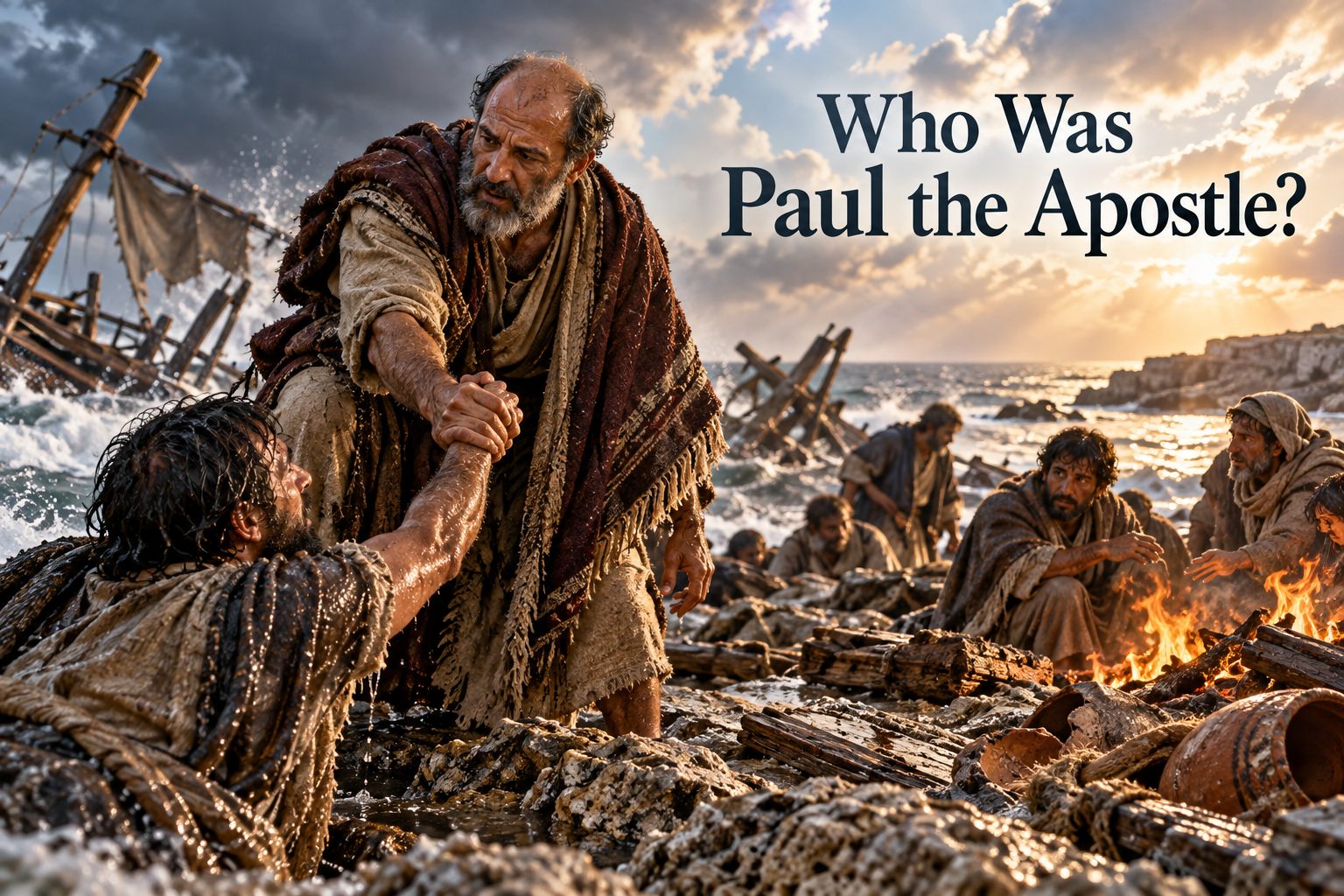
Acts says Paul returned to Jerusalem, was attacked after accusations concerning the temple and the law, and entered Roman custody. As a citizen he appealed to Caesar, survived a shipwreck, and reached Rome, where Acts ends with him preaching under house arrest (Acts 21:27-36; Acts 28:16-31). The book doesn’t narrate his trial or death. Its open ending keeps attention on the unhindered word reaching the imperial capital.
Paul’s letters show imprisonment but don’t provide an undisputed account of his execution. Early Christian tradition, reflected by the late first-century letter known as 1 Clement, remembers Paul suffering martyrdom after extensive witness. Later sources place his death under Nero in Rome, commonly by beheading. The broad tradition of Roman martyrdom is early and plausible, but the exact year, location, and manner aren’t established by the New Testament.
Some reconstructions propose that Paul was released after Acts and traveled to Spain before a second arrest. Romans says he hoped to visit Spain, while the Pastoral Letters appear to presuppose travel not narrated in Acts (Romans 15:22-24). Whether he fulfilled the plan depends partly on disputed authorship and later testimony. It should be presented as a possibility, not as a missing chapter everyone knows occurred.
Which Letters Did Paul Write?
Thirteen New Testament letters bear Paul’s name. Alongside the seven widely undisputed letters, scholars debate 2 Thessalonians, Colossians, and Ephesians; many regard 1 Timothy, 2 Timothy, and Titus as later works written in Paul’s name, while other scholars defend Pauline authorship, sometimes involving secretaries or coworkers. The arguments concern vocabulary, style, church organization, theology, and historical setting. Conclusions vary by letter, so “Paul wrote thirteen” and “Paul wrote only seven” both need explanation rather than assertion.
Ancient letter writing was collaborative, and Paul names co-senders and a scribe in some letters. That complicates simplistic style tests. At the same time, invoking a secretary can’t automatically solve every difference. Churches that receive all thirteen as canonical Scripture need not pretend the authorship debate doesn’t exist; canonicity and modern historical attribution are related questions but not identical ones.
Hebrews is anonymous and doesn’t claim Paul as its author. Some ancient churches associated it with him, but its style, argument, and self-presentation differ markedly from his undisputed letters. Most modern scholars don’t consider Paul the author. The safest language is that the New Testament contains thirteen letters attributed to Paul plus Hebrews, once traditionally linked to him in some settings.
Paul’s Lasting Importance
Paul’s letters became foundational for Christian teaching about grace, justification, union with Christ, the Spirit, the church, resurrection, and life together. Augustine, the Reformers, Wesley, modern liberationists, and countless others have read him in strikingly different ways. Recent scholarship has emphasized Paul’s Jewish identity and the corporate, political, and apocalyptic dimensions of his gospel. No single slogan exhausts him.
His legacy also includes difficult interpretive battles. Christians have appealed to Paul both to defend hierarchies and to dismantle them, to separate from Jews and to oppose antisemitism, to quiet women and to recognize their ministry. Some disputes arise from genuinely difficult texts; others come from reading later assumptions into ancient arguments. Respect for Scripture requires more than quoting Paul quickly. It requires hearing each letter in the conflict that called it forth and measuring interpretation by the crucified Messiah Paul proclaimed.
Paul never forgot that he had persecuted the church. That memory didn’t paralyze him, and it didn’t become a sentimental testimony in which victims disappeared. It made grace astonishing and apostleship undeserved. The man who once used zeal to destroy communities spent his remaining years building communities in which Jews and Gentiles could call one another family. His work was unfinished, his churches were messy, and his letters still provoke argument, but the direction of his life is unmistakable: the risen Jesus turned a persecutor into a witness.