
Who Was Job?
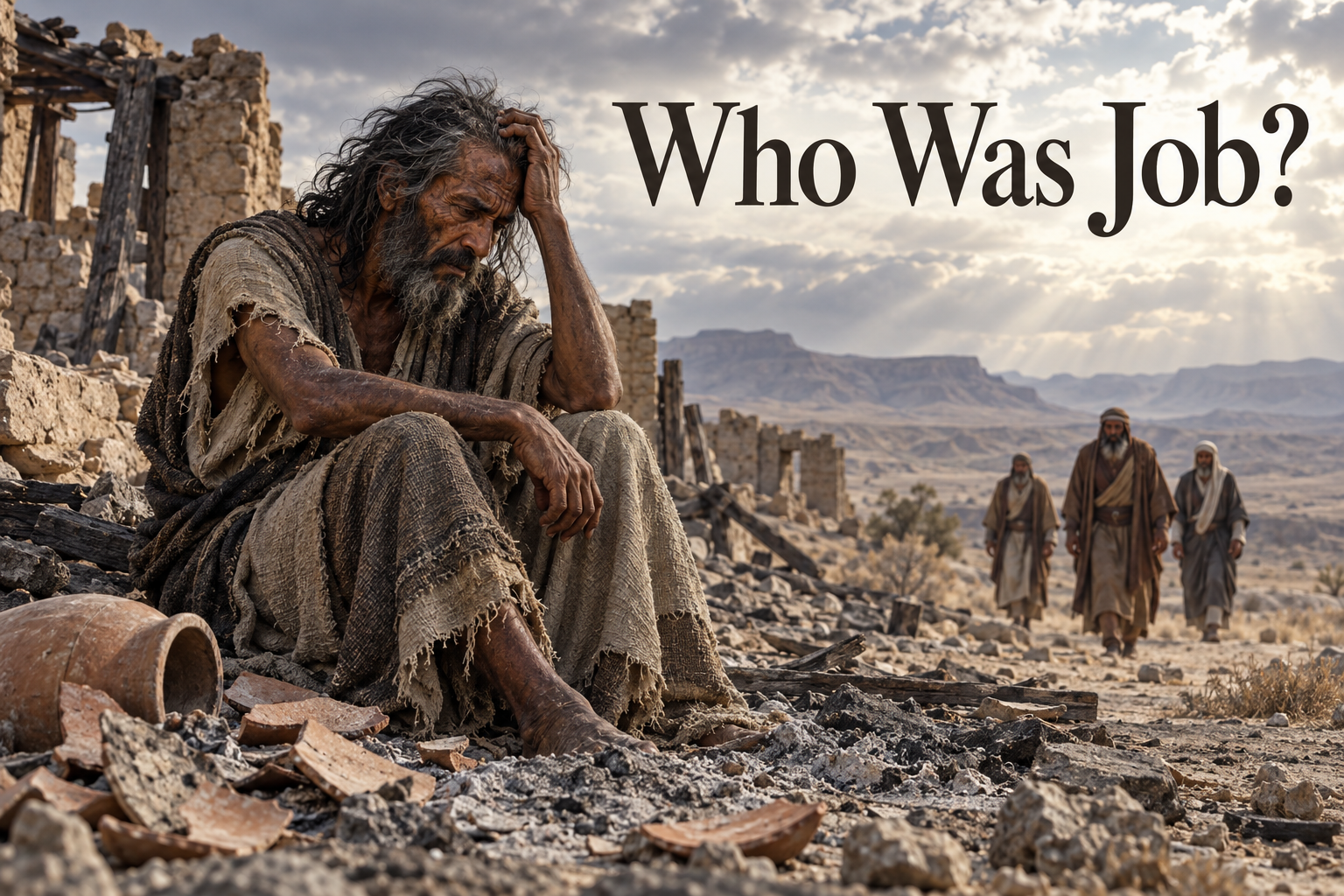
Job is remembered as the man who endured almost unimaginable loss and still refused to abandon God. That description is true, but it can also flatten the book that bears his name. Job doesn’t spend forty-two chapters smiling through pain or repeating religious slogans. He worships, protests, argues, grieves, demands answers, says things he later retracts, and forces his friends to confront the inadequacy of tidy explanations.
A man from the land of Uz
The book introduces Job as a blameless and upright man from the land of Uz who feared God and turned away from evil. He was wealthy, had seven sons and three daughters, and regularly offered sacrifices out of concern for his children’s spiritual welfare (Job 1:1-5). His blamelessness is essential to the story. Job isn’t suffering because the narrator has hidden a scandal that his friends eventually uncover. The reader is told from the beginning that their basic accusation is wrong.
Scripture doesn’t identify Job’s ancestry or date his life. Uz is associated elsewhere with regions east or southeast of Israel, but its precise location remains uncertain. Details such as Job’s wealth in livestock, his role as family priest, and his long life have led many readers to place him in a patriarchal period. That is a reasonable inference, not a date supplied by the text. The book’s setting feels ancient and non-Israelite, while its poetry reflects profound engagement with Israel’s wisdom tradition.
Christians also differ over the literary and historical character of the book. Ezekiel names Noah, Daniel, and Job together as models of righteousness (Ezekiel 14:14), and James points to Job’s endurance (James 5:11), so Scripture treats him as far more than an empty symbol. At the same time, Job is crafted as wisdom literature with extended poetic speeches, and recognizing literary artistry doesn’t require treating every speech as a courtroom transcript. The safest course is to take the biblical presentation of Job seriously without claiming a precision about composition, chronology, or genre that the book doesn’t provide.
The test the reader sees
The opening scene shifts to the heavenly court, where “the satan” appears as an accuser. In the Hebrew text, the expression functions as a title, though Christian readers commonly identify this figure with Satan. He challenges Job’s motives, arguing that Job fears God only because God has protected and enriched him. God permits a severe test while placing limits on what the accuser may do (Job 1:6-12). The narrative affirms God’s sovereignty, but it doesn’t turn the accuser’s cruelty into moral good or suggest that bereaved people should speculate that their suffering follows Job’s exact pattern.
Job then loses his livestock, servants, and children in a rapid series of disasters. He mourns openly, yet worships and refuses to charge God with wrongdoing (Job 1:13-22). A second test brings painful sores, and his wife tells him to curse God and die. Job rejects her counsel, though his reply about receiving good and adversity doesn’t mean that suffering is pleasant or that grief is unbelief (Job 2:1-10). When three friends arrive, they sit silently with him for seven days. Their silence is the most helpful thing they do, and the book may be gently suggesting that not every sorrow needs an immediate speech.
Job and his friends argue
Job eventually curses the day of his birth and asks why life is given to those in misery (Job 3:1-26). Eliphaz, Bildad, and Zophar respond from a familiar moral framework: God is just, the righteous prosper, the wicked suffer, and therefore Job’s suffering must expose hidden sin. Some of their individual statements sound pious and even resemble truths found elsewhere in Scripture. Their failure lies in applying general principles as an inflexible formula and accusing a suffering man without knowledge of his case.
Job insists that the scale of his suffering doesn’t match the friends’ explanation. He sometimes speaks rashly, but he also recognizes that their theology has left no room for innocent suffering. He longs for an arbiter who could stand between himself and God (Job 9:32-35), expresses hope that a witness or redeemer will vindicate him (Job 16:18-21; Job 19:23-27), and continues addressing God even while feeling abandoned. Christians have often read these longings in light of Christ. That canonical connection is meaningful, but Job himself isn’t delivering a complete New Testament doctrine of the incarnation or resurrection in advance.
A younger man named Elihu enters after the three friends fall silent. He criticizes both Job and the friends and argues that suffering can discipline or instruct rather than merely punish (Job 32:1-10). Readers disagree about how positively the book intends us to judge Elihu, partly because God later rebukes the three friends by name but doesn’t mention him. His speeches add important considerations, yet they still don’t disclose the heavenly scene or fully answer Job’s complaint.
God answers from the storm
When God finally speaks, he doesn’t give Job a line-by-line explanation of why his children died or why the accuser was permitted to test him. Instead, God questions Job about the earth, sea, stars, weather, animals, Behemoth, and Leviathan (Job 38:1-18; Job 40:15-24; Job 41:1-11). The point isn’t that power makes moral questions irrelevant. God reveals a creation whose scale, complexity, wildness, and governance exceed Job’s knowledge, including dimensions that don’t exist merely for human convenience.
Job responds by acknowledging that he spoke about things he didn’t understand and repents in dust and ashes (Job 42:1-6). The exact nuance of his final words is debated; they can be translated in ways that emphasize retraction, consolation, or a changed understanding. Whatever the translation, Job has encountered God rather than merely winning an argument about God. He doesn’t learn the heavenly backstory, but his confidence is relocated from his ability to explain events to God’s wisdom and presence.
Vindication and restoration
God then tells Eliphaz that he and his friends haven’t spoken rightly about him as Job has. They must offer sacrifices, and Job prays for them (Job 42:7-9). This is a striking verdict because Job’s speeches included anguish, accusation, and overstatement. The friends’ polished certainty proved more false than Job’s wounded honesty. Scripture doesn’t encourage careless speech about God, but neither does it require suffering people to pretend they aren’t devastated.
Job’s fortunes are restored, and he again has seven sons and three daughters. The daughters are named, praised for their beauty, and given an inheritance alongside their brothers, an unusual detail in the ancient setting (Job 42:10-17). The new children aren’t replacements for those who died, as though grief were an accounting problem that could be balanced with additional blessings. The ending affirms that loss doesn’t get the final word, while leaving the deaths in the opening chapters morally serious and emotionally real.
What Job does and doesn’t teach
Job rejects the claim that every case of suffering can be traced to a particular sin committed by the sufferer. Scripture does teach that actions have consequences and that God may discipline his people, but Job forbids us from turning those truths into a universal diagnosis. It also warns against presenting our limited interpretation as though we had attended God’s council. Religious certainty can become cruel when it cares more about protecting a system than listening to a wounded person.
The book doesn’t offer a complete philosophical solution to the problem of evil. It gives something less tidy and more demanding: a righteous sufferer, inadequate counselors, a God whose wisdom exceeds human reach, and a relationship strong enough to contain lament. Job remains faithful not because he understands everything but because, after every argument has run out, he still turns toward God. That isn’t shallow patience. It is faith tested in the dark.