
Who Was Ishmael?
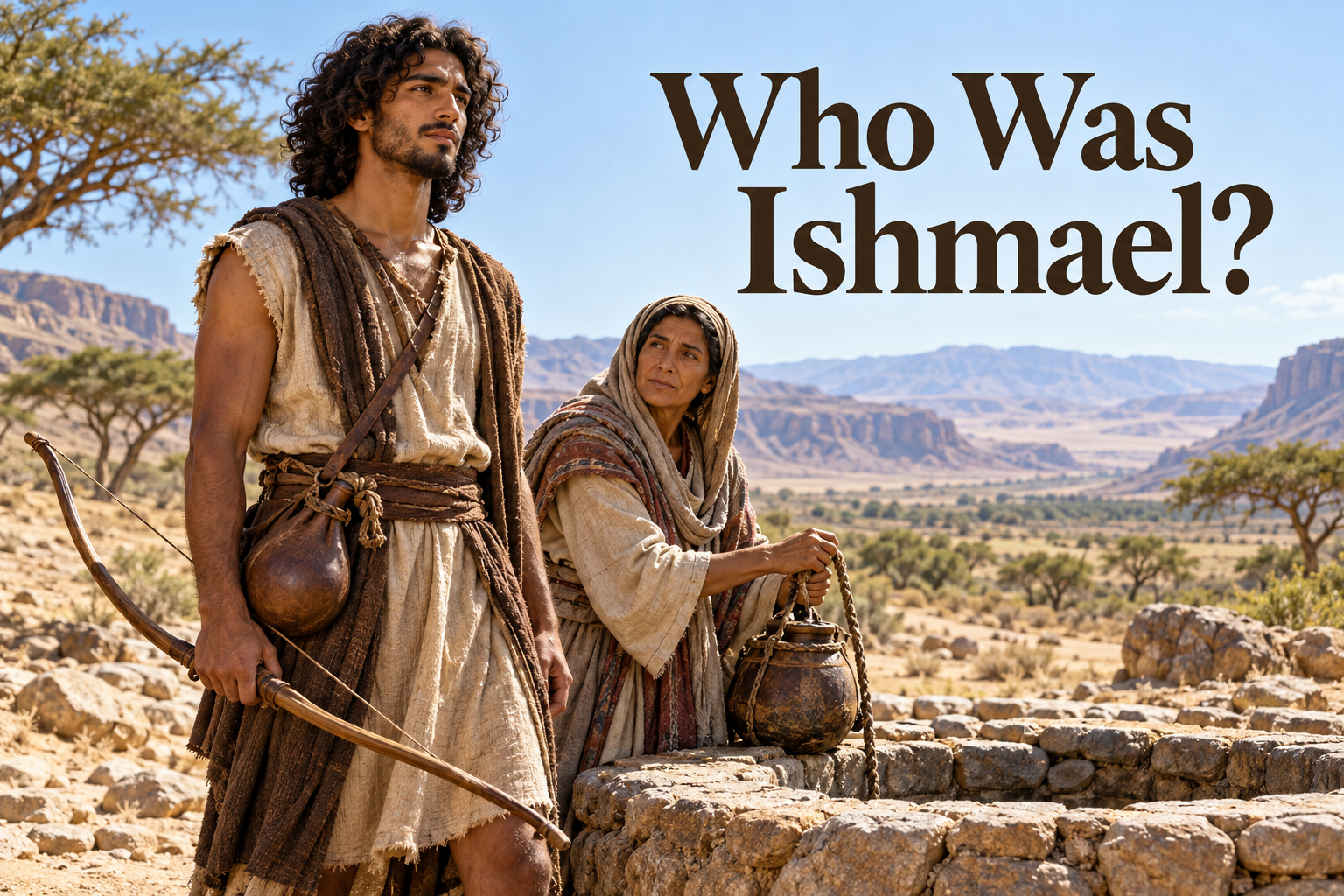
Ishmael is often remembered chiefly as the son who was not Isaac. Genesis does distinguish Isaac as the child through whom God’s covenant promise would continue, but it doesn’t treat Ishmael as disposable. He was Abraham’s first son, was named by God before birth, received covenantal circumcision, survived expulsion into the wilderness, and became the father of twelve tribal rulers. His story is one of rejection by a household and preservation by the God who heard him.
Abraham’s first son
Ishmael was born to Abraham and Hagar, an enslaved Egyptian woman belonging to Sarah. His conception resulted from Sarah’s plan to obtain a child through Hagar when the promised heir had not arrived. The arrangement fit practices known in the ancient world, but Genesis also shows the rivalry and suffering it produced (Genesis 16:1-6). Ishmael’s birth cannot be separated from Hagar’s lack of power, yet the son himself isn’t blamed for the choices that brought him into the family.
The angel of the Lord told Hagar to name the child Ishmael because the Lord had heard her affliction. The name means “God hears.” The angel promised Hagar innumerable descendants and described her son as a wild donkey of a man who would live in conflict and independence among his relatives (Genesis 16:7-12). That description has sometimes been treated as a racial insult or a timeless verdict on Arab peoples. In its ancient context, the wild donkey more naturally suggests a free-ranging life beyond servitude, though the verse also anticipates troubled relations.
Abraham was eighty-six when Hagar bore Ishmael (Genesis 16:15-16). For thirteen years, Ishmael was Abraham’s only son and the apparent heir of his household. When God announced that Sarah would bear a son, Abraham laughed and pleaded, “Oh that Ishmael might live before you!” God answered that Sarah’s son Isaac would carry the covenant line, but he also promised to bless Ishmael, multiply him greatly, and make him the father of twelve princes and a great nation (Genesis 17:15-21). Election for a particular covenant purpose did not mean that God hated or abandoned the son who wasn’t chosen for that role.
Circumcision and covenant distinction
Ishmael was thirteen when Abraham circumcised him on the same day as every male in the household (Genesis 17:23-27). Circumcision marked the covenant God made with Abraham, so Ishmael visibly shared in the life of the covenant household. Genesis nevertheless distinguishes participation in Abraham’s family from the specific promise that would be established through Isaac. Those two truths belong together: Ishmael was blessed and included, but he was not the ancestor of Israel’s covenant line.
This distinction is sometimes pressed into a complete theology of individual salvation, as though God’s choice of Isaac meant Ishmael was eternally condemned. Genesis doesn’t say that. The question in these chapters is which son will carry the line through which the promised people and, eventually, the blessing of the nations will come. A vocational choice within history shouldn’t automatically be converted into a verdict about every aspect of a person’s relationship with God.
Expelled into the wilderness
After Isaac was born and weaned, Sarah saw Ishmael laughing, playing, or mocking; the Hebrew verb allows more than one nuance. She demanded that Abraham drive out Hagar and her son so that Ishmael wouldn’t share Isaac’s inheritance (Genesis 21:8-10). Paul later describes the son born according to the flesh as persecuting the son born according to the Spirit (Galatians 4:28-31), which supports a hostile reading of the incident. Even so, Genesis doesn’t describe a physical attack, and interpreters should avoid inventing details.
Abraham was distressed, but God told him that the covenant family would be named through Isaac and again promised to make a nation from Ishmael because he was Abraham’s son. Abraham sent Hagar and Ishmael away with bread and water (Genesis 21:11-14). Ishmael was probably in his mid-teens by the narrative’s chronology, despite later paintings that make him a small child. Whatever his exact age at Isaac’s weaning and their expulsion, he and his mother were placed in a life-threatening position.
When the water ran out, Hagar placed Ishmael under a shrub and withdrew because she couldn’t bear to watch him die. God heard the boy’s voice, called to Hagar, renewed the national promise, and showed her a well (Genesis 21:15-19). The repetition is deliberate: the child named “God hears” was heard. Ishmael’s rescue didn’t reverse Sarah’s decision or restore his inheritance in Abraham’s camp, but it established that expulsion from the household wasn’t expulsion from God’s attention.
God remained with Ishmael as he grew in the wilderness of Paran. He became an archer, and Hagar found him a wife from Egypt (Genesis 21:20-21). Scripture doesn’t narrate his adult adventures or describe the formation of his people in detail. The brief notice presents a capable desert life and a continuing link to his mother’s Egyptian background.
Ishmael’s family and later life
Ishmael appears again with Isaac at Abraham’s burial in the cave of Machpelah (Genesis 25:7-10). Genesis doesn’t describe their conversation or tell us whether they had reconciled, but the estranged brothers stood together for their father’s burial. That restrained scene is worth leaving restrained. Later imagination may fill the silence, but Scripture doesn’t.
The account then names Ishmael’s twelve sons, calls them princes according to their settlements, and records that Ishmael died at the age of 137 (Genesis 25:12-18). This fulfills the promise of twelve rulers and a numerous people. Some descendants named in the list can be associated with groups known from other biblical texts and ancient records, though reconstructing every tribal location is uncertain. The Ishmaelites later appear as traders, desert peoples, and neighbors of Israel, but the biblical use of related ethnic labels is not always simple enough to support a perfectly tidy family map.
Ishmael, Arabs, and Islam
Jewish and Christian tradition commonly regarded Ishmael as an ancestor of various Arab peoples, and Islamic tradition places him in the ancestry of Muhammad and connects him with Abraham’s sanctuary at Mecca. The Quran refers to Ishmael as a prophet and a man faithful to his promise, and describes Abraham and Ishmael raising the foundations of the sacred House, understood in Islam as the Kaaba (Quran 2:127; 19:54). Later Islamic tradition supplies a fuller account of Hagar, Ishmael, and their life at Mecca. Those beliefs are important for understanding Islam, but the Meccan details aren’t part of the Genesis narrative and shouldn’t be presented as independently established history.
It is also too broad to say that every Arab is descended from Ishmael. “Arab” describes a large linguistic and cultural family with diverse ancestries, and even the Bible associates Arab groups with more than one ancestral line. Nor does Genesis turn Ishmael’s conflicts into a prophecy authorizing permanent hostility between Jews and Arabs. Modern political conflicts cannot simply be read backward into one ancient household as though Genesis had supplied a newspaper map.
How Scripture presents Ishmael
Ishmael wasn’t the covenant heir through whom Israel would come, but he was genuinely blessed. God named him, heard him, preserved him, remained with him, and fulfilled the promise of numerous descendants. His life therefore guards against two opposite mistakes: erasing the covenant distinction between Isaac and Ishmael, or treating that distinction as permission to despise Ishmael and those later associated with him.
The pain in Ishmael’s story grew from human attempts to manage God’s promise through power, slavery, and rivalry. He lived with consequences he didn’t create, yet his future wasn’t exhausted by the rejection he experienced. The God who chose Isaac for one purpose still listened when Ishmael cried in the wilderness. Genesis is capable of affirming both truths without embarrassment, and so should its readers.