

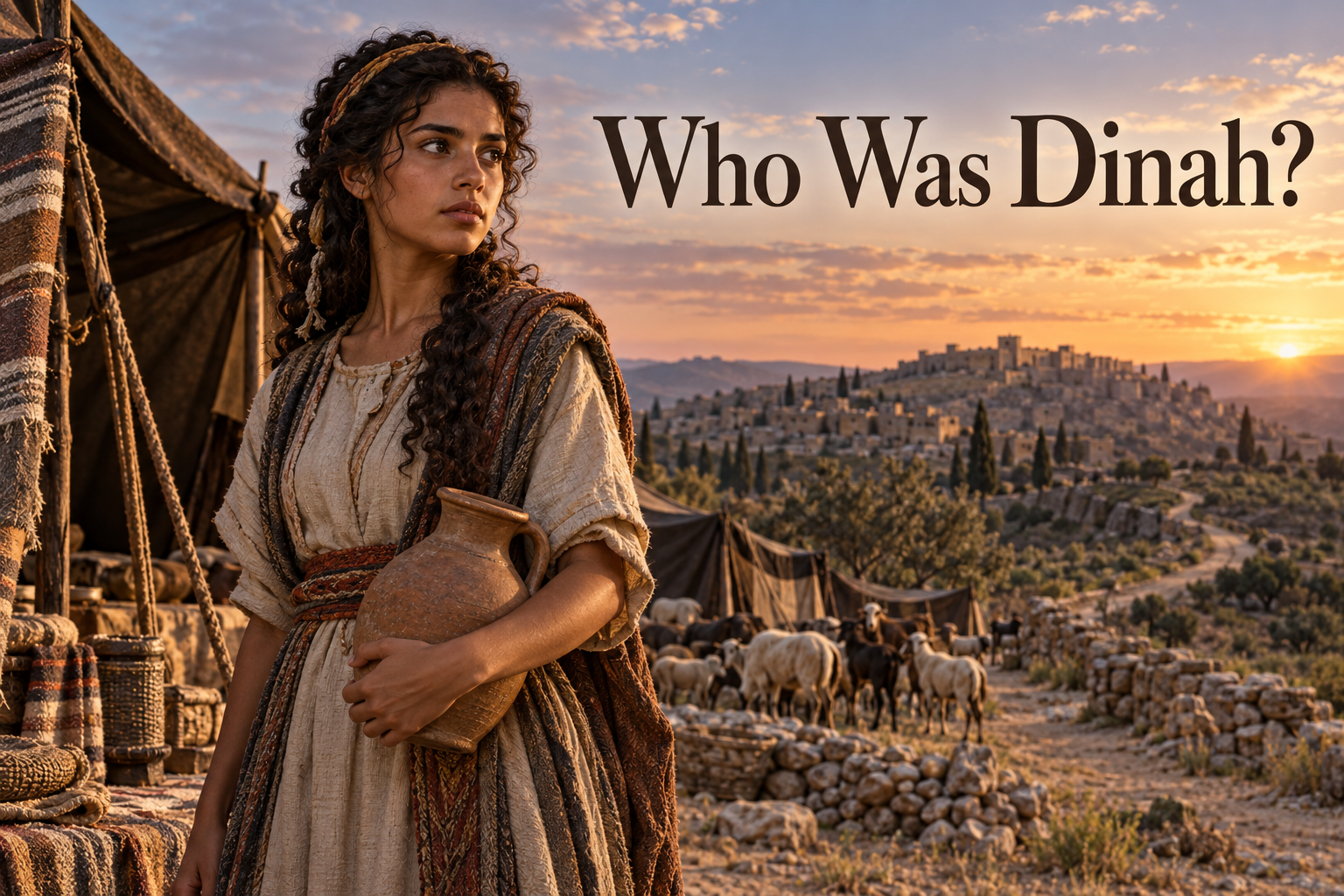
Dinah is one of the few daughters named in Jacob’s large family, yet nearly everything Genesis tells us about her is tied to violence done against her and violence committed in her name. She isn’t given a speech in the biblical account. The men around her speak, bargain, deceive, and kill, while her own wishes remain unrecorded. Reading her story responsibly means refusing to fill that silence with claims the text doesn’t make.
Jacob and Leah’s daughter
Dinah was the daughter of Jacob and Leah, born after Leah’s six sons (Genesis 30:21). That made Reuben, Simeon, Levi, Judah, Issachar, and Zebulun her full brothers, while Jacob’s children by Rachel, Bilhah, and Zilpah were also her siblings. Genesis lists far more sons than daughters because its genealogies usually follow the male lines through which clans and inheritances were traced. Dinah’s being named signals that her story matters, but it doesn’t mean she was Jacob’s only daughter.
After years with Laban, Jacob returned to Canaan and settled near the city of Shechem. He bought a parcel of land and erected an altar there (Genesis 33:18–20). The family had survived conflict with Laban and the anxious reunion with Esau, and the purchase suggests an attempt to establish a settled life. The next chapter shows how quickly that apparent stability collapsed.
What happened at Shechem
Genesis says Dinah went out to see the women of the land. Shechem, son of the local ruler Hamor, saw her, took her, slept with her, and humiliated or violated her (Genesis 34:1–2). English translations vary because the Hebrew wording carries both sexual and social dimensions, but the sequence is one of seizure and violation, not a clear account of mutual courtship. Nothing in the passage says Dinah invited the encounter or bears responsibility for it. Her ordinary act of visiting local women must not be turned into a warning that women cause violence by leaving home.
Shechem afterward became deeply attached to Dinah, spoke tenderly to her, and asked his father to arrange the marriage (Genesis 34:3–4). His later affection doesn’t retroactively make his earlier action consensual. Ancient marriage negotiations were conducted between households, and Hamor therefore approached Jacob about joining the two communities through intermarriage and trade. Shechem also offered to pay whatever bride-price and gift Dinah’s family demanded (Genesis 34:8–12). The proposal may have offered a socially recognizable future after the violation, but Dinah’s own answer is never reported.
Jacob heard what had happened while his sons were away with the livestock, and he remained silent until they returned. When the brothers learned of it, they were grieved and furious because Shechem had committed what the narrator calls a disgraceful act in Israel (Genesis 34:5–7). Their anger at Dinah’s mistreatment was justified. What they did with that anger was not.
A deceitful agreement and a massacre
Jacob’s sons answered Hamor and Shechem deceitfully. They said the families could intermarry only if every male in the city were circumcised, presenting the covenant sign as a condition of social and economic union (Genesis 34:13–17). Hamor and Shechem persuaded the city’s men by emphasizing the wealth and livestock that could become available through the arrangement. The men agreed and underwent circumcision (Genesis 34:18–24). A sign of belonging to God was thus used as an instrument in a trap.
On the third day, while the men were in pain, Simeon and Levi entered the city and killed every male, including Hamor and Shechem. They took Dinah from Shechem’s house and left, after which Jacob’s other sons looted the city and carried off its wealth, children, and women (Genesis 34:25–29). Rescuing their sister didn’t justify indiscriminate slaughter, plunder, and the captivity of people who hadn’t assaulted her. The narrative reports revenge escalating into collective violence; it doesn’t say God commanded the attack.
Jacob rebuked Simeon and Levi because their actions had made his household offensive to the surrounding peoples and placed the family in danger. They answered, “Should he treat our sister like a prostitute?” (Genesis 34:30–31). Their question exposes the real wrong done to Dinah, but it doesn’t settle the morality of their response. Jacob’s immediate objection sounds more concerned with consequences than with the victims, though his later words condemn the brothers’ anger and violence in unmistakable terms (Genesis 49:5–7).
When God directed Jacob to leave for Bethel, terror fell on the neighboring cities so they didn’t pursue the family (Genesis 35:1–5). That protection should not be read as divine approval of the massacre. Genesis often shows God preserving the covenant family despite its sins, not because every member has behaved well. The distinction matters here, since otherwise providence can be mistaken for endorsement.
Dinah’s silence and later tradition
Dinah appears once more in the list of Jacob’s household that went to Egypt (Genesis 46:8–15). Scripture doesn’t say whether she married, had children, or how she lived after Shechem. Nor does it tell us what she thought of Shechem’s proposal, her brothers’ scheme, or being taken from his house. Those questions are reasonable, but honest interpretation must leave them open.
Later Jewish writings expanded Dinah’s biography, sometimes supplying a marriage, descendants, or explanations for why she went out. Such traditions reveal the understandable desire to give a silenced woman a fuller life, but they aren’t additions to Genesis. Modern retellings have also imagined Dinah’s inner world, occasionally turning the encounter with Shechem into a romance. Fiction may explore possibilities, but it shouldn’t be confused with what the biblical narrator states.
Why Dinah’s story matters
Dinah’s story doesn’t offer an easy hero. Shechem violated her, Jacob initially remained silent, and her brothers answered one man’s crime by deceiving and destroying an entire community. Even their language of defending a sister existed alongside the capture of other women. The chapter exposes how concern for family honor can become another way for powerful men to act while the woman most affected is still denied a voice.
Scripture’s candor gives readers no permission to blame Dinah or romanticize what happened to her. It also gives no permission to treat vengeance as justice simply because the avengers can name a genuine wrong. Dinah should be remembered as a daughter of Israel whose dignity mattered before her brothers defended it and after their violence made everything worse. Her silence in the narrative is a reason for care, not an invitation to speak over her.