
Who Was Tamar, Judah’s Daughter-in-Law?
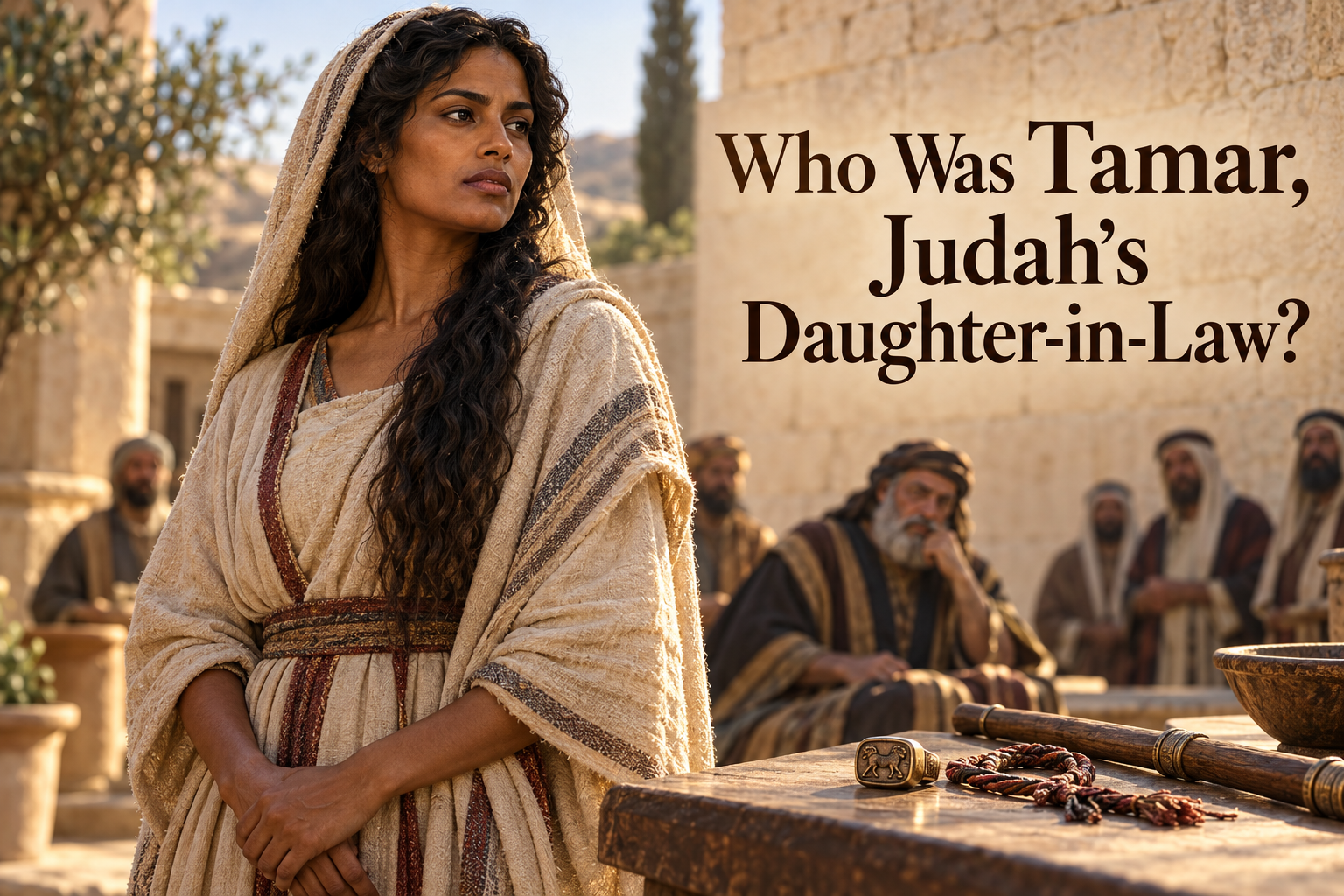
Tamar, Judah’s daughter-in-law, appears in a single chapter of Genesis, but that chapter changes the direction of Judah’s life and the history of Israel’s royal line. She was widowed twice, denied the future she had been promised, and left dependent on a father-in-law who failed to protect her. Tamar then used the limited options available to expose Judah’s wrongdoing and secure her place in the family. Genesis doesn’t present her strategy as simple or conventional, but it does let Judah render the decisive verdict: she was more righteous than he was.
A widow in Judah’s household
Tamar lived during the period after Judah separated from his brothers and settled among Canaanites. Judah arranged for his firstborn son, Er, to marry her. Genesis says Er was wicked in the Lord’s sight and that the Lord put him to death, but it doesn’t identify his offense (Genesis 38:1–7). Tamar was left a widow without a child, a precarious position in a society where household membership, land, and descendants were closely connected.
Judah then told his second son, Onan, to fulfill the duty of a husband’s brother and produce offspring for Er. Onan had sexual relations with Tamar but deliberately prevented conception because he knew the resulting child wouldn’t be counted as his own heir. The Lord judged his conduct, and Onan also died (Genesis 38:8–10). The passage isn’t primarily about masturbation, as it has often been used in later argument. It describes a man repeatedly taking what he wanted from Tamar while refusing the family obligation that gave the union its purpose.
Israel’s later law formally described a related practice in which a deceased man’s brother could preserve his name through a child with the widow (Deuteronomy 25:5–10). Genesis 38 takes place before that law was given, so it would be careless to press every later legal detail backward into Tamar’s circumstances. Still, Judah’s instruction shows that the underlying family duty was already recognized. Onan’s offense involved exploitation and a calculated refusal to provide the heir expected for his brother’s line.
Judah told Tamar to remain a widow in her father’s house until his youngest son, Shelah, grew up. Privately, however, Judah feared that Shelah might die like his brothers (Genesis 38:11). He treated Tamar as though she were the danger while withholding the son he had promised. Scripture never blames her for Er’s or Onan’s deaths, and neither should readers.
Tamar forces the issue
After Judah’s wife died and his mourning period ended, he traveled to Timnah for the sheep shearing. Tamar learned that Shelah had grown up but had not been given to her, so she removed her widow’s clothing, covered herself with a veil, and sat along Judah’s route (Genesis 38:12–14). Her disguise exploited Judah’s assumptions and the anonymity of the setting. The narrative doesn’t offer the episode as a general model for sexual ethics; it shows a vulnerable widow acting within a system that had denied her ordinary legal and family recourse.
Judah took Tamar for a sex worker and negotiated a young goat as payment. Because he didn’t have the goat with him, Tamar required his seal, its cord, and his staff as a pledge (Genesis 38:15–18). These were personal identifiers, rather like carrying a signature and official credentials in visible form. Tamar conceived, returned home, and resumed her widow’s clothing. When Judah later sent the promised payment, his friend couldn’t find the woman, and local people said no shrine prostitute had been there (Genesis 38:19–23). The shifting labels in the story don’t establish that Tamar held either occupation; she had presented herself in a way Judah interpreted for his own purposes.
About three months later, Judah was told that Tamar had become pregnant through sexual immorality. He ordered that she be brought out and burned, a startlingly severe sentence from the man responsible for the pregnancy. Tamar didn’t make a public accusation at first. She sent the identifying objects with the message that their owner was the father and asked Judah to recognize them (Genesis 38:24–25). Her wording echoes the earlier moment when Judah and his brothers asked Jacob to recognize Joseph’s bloodstained garment, although Genesis leaves readers to notice the connection rather than explaining it for them.
Judah recognized his belongings and admitted, “She is more righteous than I,” because he hadn’t given her to Shelah. Genesis adds that he didn’t have relations with her again (Genesis 38:26). Judah’s statement doesn’t mean every part of Tamar’s plan became an ideal to imitate. It acknowledges that she acted to obtain the justice and family standing he had wrongly withheld, while he had broken his promise and condemned her under a standard he didn’t apply to himself.
Perez, Zerah, and the royal line
Tamar gave birth to twins. During the delivery, Zerah extended a hand and received a scarlet thread, but Perez emerged first, giving him the position of firstborn (Genesis 38:27–30). The unexpected reversal fits a recurring pattern in Genesis, where status doesn’t always follow ordinary birth order. More importantly, Tamar’s endangered family line continued through Perez.
The book of Ruth remembers Tamar when the people of Bethlehem bless Boaz and Ruth, asking that their household be like the family Tamar bore to Judah (Ruth 4:11–12). The genealogy that follows traces Perez’s line to David (Ruth 4:18–22). Matthew then names Tamar in Jesus’ genealogy alongside Rahab, Ruth, “the wife of Uriah,” and Mary (Matthew 1:1–6). Her inclusion isn’t an embarrassment quietly edited out of the family story. She stands in the line through which Israel’s Messiah came.
This Tamar must be distinguished from Tamar, the daughter of King David, whose story appears centuries later in 2 Samuel. The women share a name and both experienced grave failures within powerful families, but they aren’t the same person. Judah’s daughter-in-law belongs to the patriarchal period; David’s daughter belonged to Israel’s monarchy. Blurring them together obscures both lives.
What Tamar’s story reveals
Later interpreters have sometimes made Tamar merely a clever trickster or a scandalous ancestor. Genesis gives a more demanding account. She was caught in a structure where Judah controlled whether she could marry Shelah, yet he left her waiting without intending to keep his word. Her disguise and demand for pledges turned his private misconduct into evidence he couldn’t dismiss.
Tamar’s story also marks an important point in Judah’s development. The brother who helped sell Joseph and then deceived his father was finally compelled to recognize his own identifying tokens and confess that someone else was more righteous. Later, Judah would offer himself for Benjamin rather than let Jacob lose another son (Genesis 44:18–34). Genesis doesn’t explicitly say Tamar caused that transformation, but her confrontation plainly forced Judah to tell the truth about himself.
The chapter never calls exploitation good, and it doesn’t pretend Tamar had a broad range of safe choices. It shows her surviving neglect, exposing hypocrisy, and obtaining the place in the family that Judah had denied her. Tamar enters the story as a widow other people manage. She leaves it as the mother of the line that leads to David and, in Matthew’s Gospel, to Jesus.