

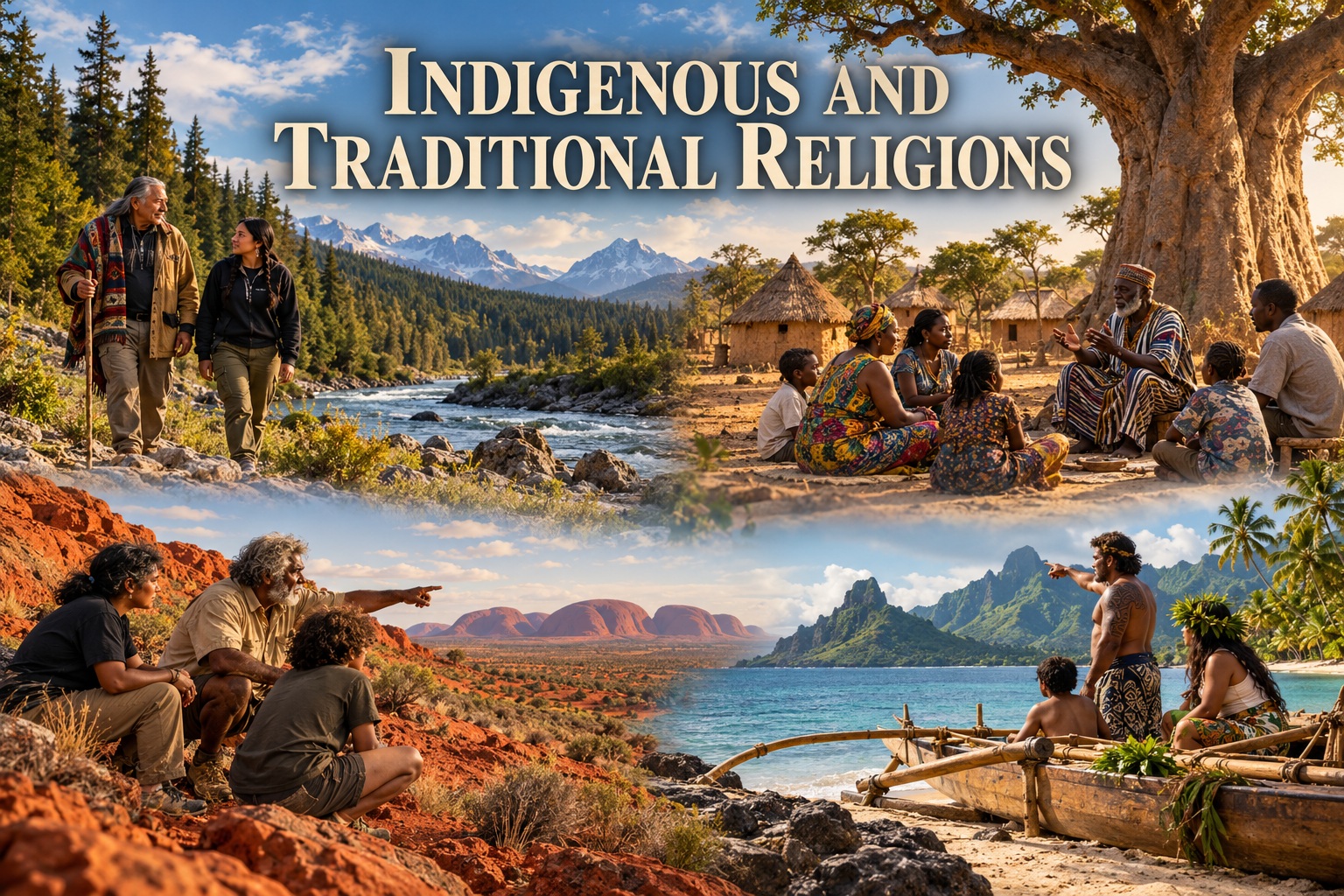
The expression indigenous religions sounds as though it names one family of beliefs. It doesn’t. It is a broad category applied to thousands of traditions that developed among particular peoples in particular places, often long before Christianity, Islam, Buddhism, or other missionary religions reached them. The religions of the Yoruba, the Lakota, the Maori, the Aboriginal peoples of Australia, and the Inuit don’t form one system any more than Greek philosophy and Chinese philosophy form one school simply because both are called philosophy.
Even the word religion can be awkward in this setting. Many Indigenous languages have no traditional term separating religion from family, law, land, healing, story, politics, and ordinary work. A ceremony may be an act of worship, a renewal of community identity, a remembrance of ancestors, and a lesson about the land at the same time. Western observers often divided these activities into separate categories because that was how Western institutions were organized. The people being observed didn’t always divide life in the same way.
A Category Created From the Outside
Terms such as primitive religion, tribal religion, native religion, and traditional religion have all been used by missionaries, colonial officials, anthropologists, and historians. Some of these labels carried the assumption that Indigenous peoples represented an early stage of human development that more advanced civilizations had supposedly outgrown. That approach didn’t merely misunderstand the traditions. It also provided a convenient excuse for treating their communities as backward people who needed to be controlled, relocated, educated out of their culture, or deprived of their land for their own good.
Indigenous is generally the more respectful term today, but it still doesn’t solve every problem. Communities differ over which names they prefer, and the same people may use tribal, Native, First Nations, Aboriginal, traditional, or the specific name of their nation. The best approach is to use the name a community uses for itself whenever possible. Broad categories remain useful when discussing recurring patterns, but they must never erase the differences among peoples.
Indigenous communities also belong to the present, not merely the past. They live in cities as well as rural homelands, use modern technology, participate in national politics, attend universities, operate businesses, and make their own decisions about belief and identity. Some continue traditional religious practices, some are Christians, Muslims, or members of other religions, and some combine inherited customs with newer faiths in ways outsiders may find difficult to classify. An Indigenous person doesn’t become less Indigenous by owning a smartphone, and a culture doesn’t cease to be real because it has changed.
Oral Tradition and Sacred Memory
Many Indigenous religions have transmitted their teachings primarily through speech, song, ceremony, art, dance, and the disciplined memory of elders rather than through a single written scripture. Calling a tradition oral doesn’t mean it is casual or unreliable by definition. Communities can develop demanding methods for preserving stories and rituals, including restrictions on who may tell them, when they may be told, and how they must be performed. A sacred story may belong to a particular family, society, clan, or ceremonial office rather than being available for anyone to repeat whenever the mood strikes.
Oral traditions often carry several kinds of knowledge at once. A creation account may explain the origin of a people, identify obligations toward animals or the land, establish relationships among clans, preserve the memory of migration, and teach children how they are expected to live. Songs can preserve geography, genealogy, law, and ritual instruction. When a language disappears, a community can lose far more than a set of words. It may lose categories of thought and layers of memory that can’t be transferred neatly into another language.
The absence of one authoritative book also means that beliefs may vary among neighboring communities and even among families within a people. There may be no central institution empowered to decide which version is official. Western researchers sometimes treated variation as evidence that oral traditions were confused, but written religions also contain schools, denominations, disputed interpretations, and local customs. Human beings rarely maintain perfect uniformity merely because someone has printed a book.
Land, Place, and Belonging
One of the most common themes in Indigenous religion is the connection between a people and a particular land. Mountains, rivers, springs, caves, forests, hunting grounds, and burial places may be sacred because of events believed to have occurred there, because spiritual beings are associated with them, or because generations of communal life have made them part of the people’s identity. Land is therefore more than property or scenery. It can carry memory, obligation, sustenance, and spiritual meaning.
This helps explain why forced removal has often been spiritually devastating as well as economically and politically destructive. A community moved hundreds of miles away may lose access to places required for ceremonies, plants used in healing, graves of ancestors, or the landscape through which its stories make sense. Telling people that they remain free to practice their religion after separating them from its sacred geography can be rather like locking a church and then insisting that nobody has interfered with Sunday worship.
Respect for land shouldn’t be romanticized into the claim that every Indigenous community has always lived in perfect ecological harmony. Indigenous peoples are human beings, not symbols of environmental innocence, and their practices have differed across time and place. Nevertheless, many traditions preserve serious ideas about restraint, gratitude, stewardship, and reciprocal responsibility. The natural world isn’t viewed merely as raw material waiting to be converted into wealth. Animals, plants, waters, and places may belong to a web of relationships in which human beings have obligations as well as needs.
Spirits, Ancestors, and the Unseen World
Many Indigenous traditions understand the visible world as inseparable from an unseen spiritual reality. Spirits may be associated with ancestors, animals, natural features, weather, fertility, illness, or the welfare of a community. Some traditions recognize a supreme Creator or high god, while others give greater practical attention to lesser spiritual beings. Still others use categories that don’t fit comfortably into the Western distinction between one God, many gods, and impersonal forces.
The term animism has often been used for beliefs that understand animals, plants, places, or objects as possessing spiritual life or agency. The word can be useful if it is carefully defined, but it has also been used dismissively, as though Indigenous people simply failed to distinguish a rock from a person. Their ideas are usually more developed than that caricature suggests. A sacred mountain isn’t necessarily believed to think and speak exactly as a human being does. The larger claim may be that reality contains forms of life, presence, relationship, or spiritual power that modern materialism refuses to consider.
Ancestors commonly occupy an important place because the dead are understood to remain connected with the living community. Families may offer food, drink, prayers, or ritual attention to deceased relatives, seeking their blessing or avoiding their displeasure. In some traditions, ancestors function as guardians and moral witnesses; in others, the dead are feared or require careful ritual management. Honoring the memory of one’s ancestors is not identical to worshiping them, so the meaning of a practice should be investigated before it is labeled. At the same time, attempts to communicate with the dead or seek their spiritual assistance raise clear questions from a biblical perspective.
Ritual Specialists, Healing, and Community
Indigenous societies often recognize people with specialized religious responsibilities, including priests, diviners, healers, spirit mediums, elders, or custodians of sacred knowledge. The word shaman properly comes from a particular Siberian setting, though it is now used much more broadly. Applying it to every Indigenous ritual specialist can conceal important differences. A healer who understands medicinal plants, a priest responsible for seasonal sacrifices, and a medium believed to communicate with spirits may hold very different offices even if an outsider places all three under the same label.
Healing frequently includes physical, social, moral, and spiritual dimensions. Illness may be connected with natural causes, broken relationships, spiritual attack, violation of a taboo, or disharmony within the community. A ceremony may therefore involve herbs, prayer, confession, reconciliation, music, movement, or the removal of an alleged spiritual cause. Some practices may possess genuine medicinal value, while others depend upon religious claims that must be evaluated separately. Respect for traditional knowledge doesn’t require believing every diagnosis or spiritual explanation.
Rituals also help communities move through the stages of life. Birth, naming, initiation, marriage, hunting, planting, harvest, illness, conflict, and death can all carry ceremonial obligations. Initiation rites may teach young people the history, responsibilities, and sacred knowledge of the group. Seasonal ceremonies reconnect present generations with ancestors and the rhythms of the land. Religion in such settings is not primarily a private opinion held inside an individual’s mind. It is a shared pattern of life through which a people understands who they are.
Enormous Diversity Across Regions
Traditional African religions include thousands of local systems rather than one African faith. Many recognize a supreme Creator while also giving attention to ancestors, divinities, spirits, and ritual powers closer to everyday concerns. Yoruba religion, for example, developed a rich tradition involving the supreme God and numerous orisha, while other African peoples organize the spiritual world differently. African traditional religions have also influenced religious life far beyond the continent through the forced migration of enslaved Africans and the development of traditions such as Santeria, Candomble, and Vodou. These religions emerged through particular histories of African continuity, colonial violence, Catholic influence, and cultural adaptation.
The Indigenous religions of the Americas are equally diverse. The ceremonial worlds of the Maya, Lakota, Hopi, Haudenosaunee, Inuit, Mapuche, and hundreds of other peoples cannot be reduced to a generic belief in a Great Spirit. Traditions may include creation narratives, sacred societies, vision experiences, dances, offerings, sweat ceremonies, healing practices, and relationships with animals or ancestral beings. Some ceremonies are open to visitors, while others are restricted and shouldn’t be treated as spiritual experiences available for purchase by curious outsiders.
Australia’s Aboriginal peoples maintain traditions connected with ancestral beings, law, kinship, and country. The English term Dreaming is often used for this complex reality, but it can sound as though the traditions concern imaginary events or ordinary dreams. For many communities, ancestral actions are understood as establishing enduring patterns in the land, social order, ceremony, and identity. The traditions of Aboriginal Australia also differ among language groups and regions, which is why a single summary can only go so far.
Across Oceania, Indigenous religions developed within island environments shaped by navigation, genealogy, chiefly authority, relationships with ancestors, and the powers associated with persons, places, and objects. Terms such as mana and tapu entered Western vocabulary from Polynesian cultures, usually after being simplified. In their original settings, they belong to wider systems of authority, sacredness, restriction, and communal order. Indigenous traditions also continue in parts of Asia, the Arctic, and northern Europe, including among peoples whose spiritual practices have survived long campaigns of suppression or assimilation.
Colonialism, Missions, and Suppression
European expansion brought Christianity into contact with Indigenous peoples through exploration, trade, settlement, conquest, and mission. These activities were sometimes so closely connected that Indigenous communities had little reason to distinguish the missionary from the colonial system that accompanied him. Missionaries learned local languages, translated Scripture, established schools, provided medical care, and sometimes defended Indigenous communities against exploitation. Others condemned local cultures wholesale, cooperated with forced assimilation, or treated European customs as though they were part of the gospel.
The consequences were often severe. Sacred objects and human remains were removed to private collections and museums. Ceremonies were outlawed, children were taken from their families into residential or boarding schools, and Native languages were punished. Communities in the Americas, Australia, and elsewhere experienced land seizure, violence, disease, and policies deliberately intended to replace their identities. Christian institutions participated in some of these systems, and acknowledging that history isn’t an attack on Christ. It is an act of truthfulness about what people acting in his name sometimes did.
That history doesn’t mean every Indigenous conversion to Christianity was coerced or insincere. Indigenous Christians translated the message into their own languages, formed churches, became pastors and theologians, challenged colonial injustice, and distinguished Christ from the conduct of colonial powers. Some rejected traditional religious practices, while others retained cultural forms they believed were compatible with Christian faith. Still others combined Christian and traditional beliefs in ways that churches have alternately encouraged, tolerated, or condemned.
The word syncretism is commonly used when elements from different religions are combined. Christians are right to ask whether a practice contradicts the worship of God revealed in Scripture, but the label should be used consistently. Singing a Christian hymn in an Indigenous musical style isn’t syncretism merely because the instruments are unfamiliar to Europeans. Every church expresses the faith through some culture, including churches that mistake nineteenth-century Western customs for the original atmosphere of the book of Acts.
Survival and Renewal
Indigenous religions didn’t simply vanish under colonial pressure. Communities preserved ceremonies in private, adapted them to new circumstances, or revived practices when legal restrictions were removed. Language programs, repatriation efforts, cultural schools, and renewed access to sacred sites have helped younger generations recover knowledge that governments once tried to eliminate. Museums and universities have also faced growing demands to return human remains, funerary objects, and sacred materials collected without meaningful consent.
Revival can generate internal disagreements. Elders may dispute whether a reconstructed ceremony is accurate, Christians within the community may object to restored religious practices, and younger activists may connect spiritual renewal with political sovereignty or environmental protection. Outsiders should resist the assumption that one spokesperson represents every member of a people. Indigenous communities contain the same kinds of generational, religious, and political disagreements found elsewhere.
Tourism and popular spirituality create another problem. Indigenous symbols, ceremonies, clothing, and medicines are sometimes marketed to people seeking an exotic spiritual experience. A ceremony detached from its community and sold at a weekend retreat may bear little resemblance to the tradition from which it was taken. Respect involves more than admiring Indigenous spirituality in the abstract. It includes listening when communities say that certain objects, stories, and rituals aren’t ours to borrow.
A Christian Evaluation
Christianity and Indigenous religions can share several points of contact. Both reject the idea that the material world is all that exists, recognize that human life carries moral and spiritual obligations, and understand people as members of communities rather than isolated consumers. Many Indigenous traditions preserve a strong awareness of gratitude, dependence, family responsibility, and the significance of creation. Christians can affirm those insights without claiming that every explanation attached to them is true.
The biblical account begins with one sovereign Creator who made the heavens and the earth. Creation is good and reveals God’s wisdom, but it isn’t itself divine. The sun, animals, rivers, mountains, ancestors, and spiritual beings all belong to the created order. They may inspire wonder or deserve responsible care, but they aren’t rivals to God or mediators through whom worship must pass. Scripture also forbids divination, attempts to consult the dead, and worship offered to other spiritual powers. Those disagreements should be stated clearly, though clarity doesn’t require mockery or fearmongering.
Christians should also be cautious about labeling every unfamiliar Indigenous ceremony demonic. Some practices are social, artistic, medicinal, historical, or political rather than acts of worship. Others contain religious claims that genuinely conflict with Christianity. Careful judgment asks what people believe they are doing, what powers they are invoking, and what meaning the community assigns to the act. Condemning everything is easier than understanding anything, but it isn’t more faithful.
The gospel doesn’t require people to become culturally European or American before they can follow Jesus. The New Testament envisions people from every nation, tribe, people, and language worshiping God, not one culture erasing all the others. Every culture contains beauty that can be received, human distortion that must be confronted, and assumptions that need to be brought under the lordship of Christ. That judgment applies to modern Western culture just as surely as it applies to Indigenous societies.
Indigenous religions preserve humanity’s long awareness that life is bound to the unseen, the past, the community, and the world around us. Christianity agrees that creation is charged with meaning, that the dead are not simply forgotten, and that human beings are accountable to more than themselves. It makes a more specific claim, however: the Creator has acted within history and made himself known decisively in Jesus Christ. Respectful study begins by listening carefully to Indigenous peoples, but Christian witness cannot end with appreciation alone. It points beyond every human tradition, including our own, to the God who is Lord of all peoples and who calls them into one redeemed family in Christ.